 Royaume-Uni : pour les restaurants et les plats à emporter
Prêt pour l’inspection sanitaire. Tous les jours.
In the UK each nation has its own hygiene rules. The app follows Schedule 4 temperature rules and the official packs: Safer Food Better Business, CookSafe and Safe Catering. Council food officers inspect.
14 jours gratuits · Un prix par site · Sans engagement
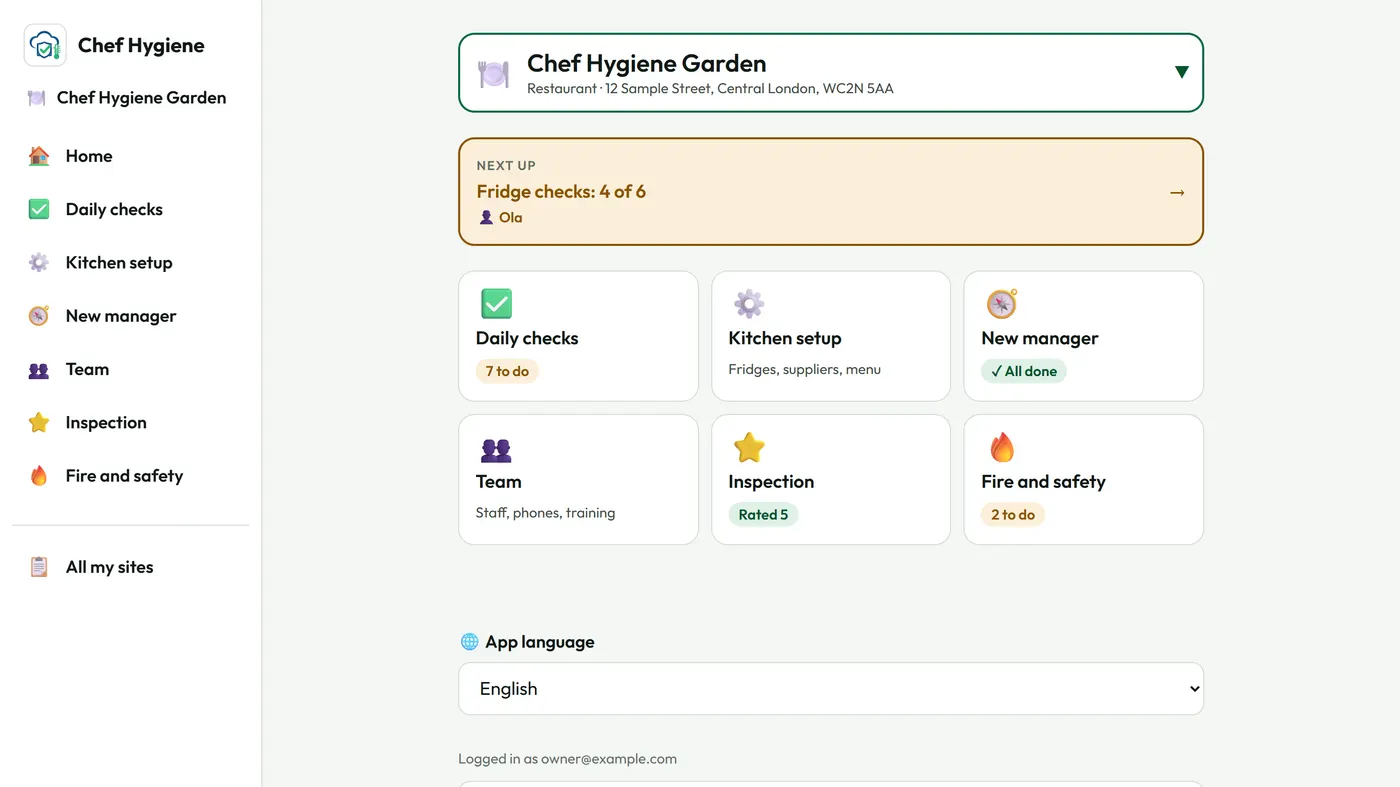
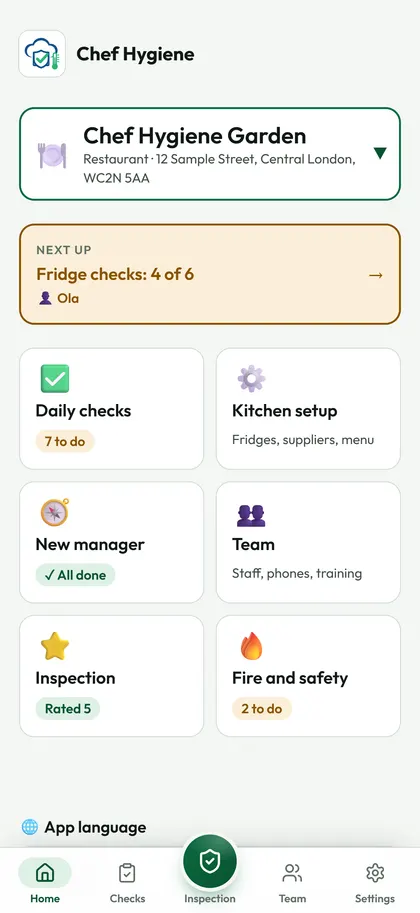
Royaume-Uni : règles d'hygiène alimentaire
Le règlement de cette page est pour l’instant en anglais. Il sera traduit dans votre langue.
- organisme d’inspection
- Food Standards Agency (FSA) in England, Wales and Northern Ireland; Food Standards Scotland (FSS) in Scotland; the local council inspects
- Évaluation publique
- Oui
- Langues disponibles dans l’application
- English
Votre inspection
The local council’s Environmental Health Officer (EHO) inspects food businesses. In England, Wales and Northern Ireland the Food Standards Agency runs the rating scheme. In Scotland, Food Standards Scotland runs it. Fire is checked by the fire and rescue service.
Officers may inspect your records in whatever form you keep them, use your computers and take copies away (Food Safety Act 1990, section 32; Northern Ireland: Food Safety (NI) Order 1991). In England, the Food Law Code of Practice says a high-risk business (category A) is visited every 6 months and a low-risk one (category E) every 36 months. You can appeal a rating within 21 days, free of charge. A re-rating visit is unannounced and the rating can go up or down.
Note d’hygiène
England, Wales and Northern Ireland: the Food Hygiene Rating Scheme (FHRS) gives a rating from 0 to 5. Display is required by law in Wales and Northern Ireland, and voluntary in England. Scotland: the Food Hygiene Information Scheme (FHIS) gives Pass or Improvement Required, and showing the certificate is not a legal requirement.
Pourquoi les archives sont importantes au Royaume-Uni
entreprises alimentaires du Royaume-Uni n’ont qu’une note de 4 à cause de leurs registres et de leur gestion. Tout le reste a obtenu les meilleures notes.
Notre décompte à partir des données ouvertes de la FSA, 28 sept. 2026
des établissements de vente à emporter en Angleterre, au Pays de Galles et en Irlande du Nord sont évalués en dessous de 5.
Données ouvertes de la FSA, 28 sept. 2026
C’est ce que les collectivités territoriales facturent pour une visite de réévaluation après une note faible.
Conseils de Preston, Hackney et Westminster
La « loi » désigne une règle contraignante. Les « recommandations officielles » ne constituent pas une loi, mais les inspecteurs s’y attendent. « Chef Hygiene valeur par défaut » est une valeur de référence utilisée par l’application lorsqu’aucune règle ne spécifie de valeur numérique.
Températures
- LoiEngland, Wales and Northern Ireland: keep chilled food at 8°C or below (Schedule 4 of the national hygiene regulations). Scotland has no legal chill temperature.
- Orientations officiellesGuidance for all nations: set fridges and chilled displays to 5°C or below. In Scotland, 8°C or below is recommended and 5°C is the aim (CookSafe).
- LoiEngland, Wales and Northern Ireland: hold hot food at 63°C or above. You may go below 63°C once, for under 2 hours, then reheat, cool to 8°C or below, or throw the food away. Scotland: above 63°C, with no 2-hour allowance.
- LoiEngland, Wales and Northern Ireland: chilled food may be on display out of the fridge once, for under 4 hours. Then put it back at 8°C or below, or throw it away. Scotland has no such allowance.
- Orientations officiellesCooking, core temperature (Safer Food Better Business): 70°C for 2 minutes. Equal options are 60°C for 45 minutes, 65°C for 10 minutes, 75°C for 30 seconds or 80°C for 6 seconds. CookSafe (Scotland) and Safe Catering (Northern Ireland) use 75°C.
- LoiScotland: reheat to at least 82°C, unless that would spoil the food. Then use a safe time and temperature, for example 70°C for 2 minutes (CookSafe).
- LoiCool food as quickly as possible. This applies in all UK nations.
- Orientations officiellesGuidance on reheating and cooling: England and Wales reheat until steaming hot all the way through. Northern Ireland reheats to 75°C and puts cooked food in the chill within 2 hours (Safe Catering). Scotland records cooling times or follows an established cooling method (CookSafe).
- Orientations officiellesKeep freezers at −18°C or below. Scotland’s CookSafe gives example delivery limits of 5°C or below for chilled food and −18°C or below for frozen food.
Personnel, formation et santé
- LoiNo law requires a food hygiene certificate. Food handlers must be supervised and instructed or trained for their work, and whoever runs the HACCP plan must be trained in it (Regulation 852/2004, Annex II).
- LoiStaff who are ill must not handle food and must report it at once. This applies in all four nations.
- Orientations officiellesFSA fitness-to-work guidance: staff with diarrhoea or vomiting stay off food work until 48 hours after the symptoms stop. Scotland also counts 48 hours after the last anti-diarrhoea medicine.
- Orientations officiellesScotland: guidance says high-risk food handlers should complete a formal food hygiene course within 3 months of starting.
- Orientations officiellesReturn-to-work forms: the FSA questionnaire (England, Wales, Northern Ireland), Safe Catering form SC7 (Northern Ireland) and the CookSafe Return to Work Questionnaire (Scotland).
Allergènes
- LoiYou must manage the 14 allergens: celery, cereals containing gluten, crustaceans, eggs, fish, lupin, milk, molluscs, mustard, peanuts, sesame, soya, sulphites and tree nuts.
- LoiLoose (non-prepacked) food: allergen information may be given by word of mouth, but only if a notice tells customers to ask staff. FSA best practice is to give it in writing as well, and to talk to the customer.
- LoiPrepacked for direct sale (PPDS) food, under Natasha’s Law since 1 October 2021: the label shows the food’s name and the full ingredients list, with allergens emphasised.
- LoiOrders by phone or online: give allergen information before the order is completed and again at delivery.
Contrôles de sécurité incendie
- LoiEngland and Wales: the responsible person must do a suitable fire risk assessment (Regulatory Reform (Fire Safety) Order 2005). Since 1 October 2023 it must be written down in full, with the assessor’s name, whatever the size of the business.
- LoiScotland and Northern Ireland: write the assessment down if you have 5 or more employees, need a licence or registration, or an alterations notice asks for it. Guidance says to write it down anyway.
- Orientations officiellesOfficial guidance: test the fire alarm every week. Test emergency lighting every month, with a full test every year. Service extinguishers every year and hold a fire drill at least once a year.
- LoiGas: keep appliances, pipes and flues safe, and use only Gas Safe engineers for gas work. HSE calls a yearly inspection a reasonable minimum.
- Orientations officiellesKitchen extract cleaning under the TR19 Grease standard: every 3 months for 12 to 16 hours of cooking a day, every 6 months for 6 to 12 hours, and every 12 months for 2 to 6 hours.
Archives
- LoiYou need permanent procedures based on HACCP principles, with records that fit the size of the business, kept for an appropriate period (Regulation 852/2004, Article 5). No law requires Safer Food Better Business, CookSafe or Safe Catering.
- LoiKeep purchase records: supplier name and address, product, quantity and date, one step back. This is not needed for sales to final consumers.
- Orientations officiellesElectronic records are accepted: the official Safer Food Better Business guidance allows an electronic diary. Safer Food Better Business also asks for a review every 4 weeks.
- Orientations officiellesHow long to keep records: Safer Food Better Business says until the council’s next visit; Northern Ireland guidance says at least 12 months.
Sources officielles
- Food Hygiene Rating Scheme: guidance for businesses (GOV.UK)
- Food safety management systems (GOV.UK)
- Safer Food, Better Business for caterers (GOV.UK)
- Food Standards Scotland: Food Hygiene Information Scheme
- Allergen guidance for food businesses (GOV.UK)
Checked
Cette page contient des informations générales et ne constitue pas un avis juridique. Veuillez consulter les autorités locales compétentes.
Royaume-Uni : guides d’hygiène alimentaire
Comment fonctionne la notation en matière d’hygiène alimentaire (0 à 5)
Comment les responsables de la sécurité alimentaire du Royaume-Uni notent un établissement de restauration, ce que signifie chaque notation de 0 à 5, et pourquoi les documents décident tant de notations. Avec les intervalles de notes officiels.
Qu’est-ce qu’un inspecteur de l’hygiène alimentaire contrôle ?
Ce que les responsables de la sécurité alimentaire du conseil examinent, les documents qu’ils demandent généralement, la fréquence des inspections et comment vous préparer pour votre visite.
Règles de température alimentaire au Royaume-Uni : Angleterre, Pays de Galles, Écosse et Irlande du Nord
Les températures légales et recommandées pour refroidir, maintenir à chaud, cuire, réchauffer et refroidir les aliments dans chaque nation du Royaume-Uni, dans un simple tableau.
Safer Food, Better Business : pouvez-vous le garder sur une application ?
Ce que SFBB est, ce que la loi exige vraiment, quels contrôles enregistrer chaque jour, et pourquoi les inspecteurs acceptent les documents de sécurité alimentaire numériques.
Allergènes et Natasha’s Law : ce que les restaurants et les petits commerces de restauration doivent faire
Les 14 allergènes, les règles pour les aliments vendus en vrac, livrés et préemballés, ce qu’une étiquette conforme à Natasha’s Law (PPDS) doit indiquer, et les meilleures pratiques actuelles de la FSA.
Sécurité incendie pour les restaurants et les petits commerces de restauration : les vérifications et la loi
Qui est responsable, l’évaluation des risques incendie, les vérifications quotidiennes à annuelles, et les risques d’incendie spéciaux dans les cuisines commerciales en Angleterre, au Pays de Galles, en Écosse et en Irlande du Nord.
Maladie du personnel dans les entreprises alimentaires : la règle des 48 heures
Quand un manipulateur d’aliments doit s’absenter du travail, pendant combien de temps, et ce qu’il faut enregistrer quand il revient, selon les directives officielles d’aptitude au travail.
Urgences en cuisine : fuites de gaz, coupures de courant et réfrigérateurs cassés
Les numéros d’urgence au Royaume-Uni et les premières choses à faire si vous sentez le gaz, perdez le courant, avez une fuite d’eau ou un réfrigérateur cassé dans une cuisine de restaurant ou un petit commerce de restauration.
Royaume-Uni : l'application Chef Hygiene
L’application charge ces règles pour votre cuisine, vérifie vos enregistrements par rapport à celles-ci et conserve les preuves pour l’inspecteur.
Autres pays
 Irlande
 Islande
 États-Unis
 Canada
 France
 Espagne
 Pays-Bas
 Belgique
 Portugal
 Allemagne
 Autriche
 Pologne
 Roumanie
 Italie
 Grèce
Grèce Danemark
 Suisse
 Luxembourg
 Chypre
 Malte
Malte Suède
Suède Norvège
 Finlande
 Tchéquie
 Hongrie
 Croatie
 Bulgarie
 Slovaquie
 Slovénie
 Estonie
 Lettonie
 Lituanie
 Liechtenstein
 Saint-Marin
 Gibraltar
 Monaco
 Moldavie
 Andorre
 Serbie
 Jersey
 Guernesey
 Île de Man
 Turquie
 Monténégro
 Bosnie-Herzégovine
 Kosovo
 Albanie
 Macédoine du Nord
 Ukraine