 Regno Unito: per ristoranti e takeaway
Pronti per l’ispezione alimentare. Ogni giorno.
In the UK each nation has its own hygiene rules. The app follows Schedule 4 temperature rules and the official packs: Safer Food Better Business, CookSafe and Safe Catering. Council food officers inspect.
14 giorni gratuiti · un prezzo unico per sito · nessun contratto
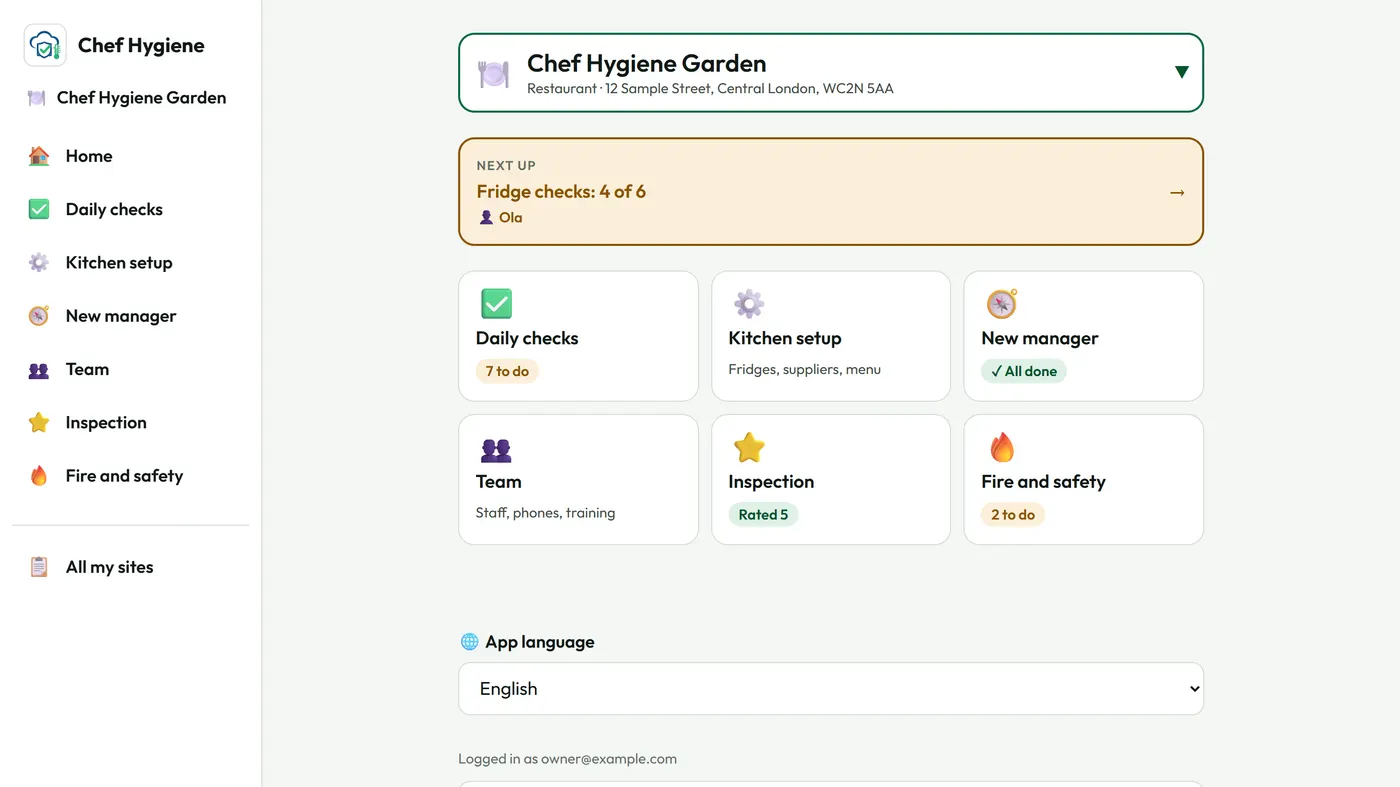
Regno Unito: norme di igiene alimentare
Le regole presenti in questa pagina sono al momento in inglese. Verranno tradotte nella tua lingua.
- organismo di ispezione
- Food Standards Agency (FSA) in England, Wales and Northern Ireland; Food Standards Scotland (FSS) in Scotland; the local council inspects
- Valutazione pubblica
- SÌ
- Lingue nell’app
- English
La tua ispezione
The local council’s Environmental Health Officer (EHO) inspects food businesses. In England, Wales and Northern Ireland the Food Standards Agency runs the rating scheme. In Scotland, Food Standards Scotland runs it. Fire is checked by the fire and rescue service.
Officers may inspect your records in whatever form you keep them, use your computers and take copies away (Food Safety Act 1990, section 32; Northern Ireland: Food Safety (NI) Order 1991). In England, the Food Law Code of Practice says a high-risk business (category A) is visited every 6 months and a low-risk one (category E) every 36 months. You can appeal a rating within 21 days, free of charge. A re-rating visit is unannounced and the rating can go up or down.
Valutazione igienica
England, Wales and Northern Ireland: the Food Hygiene Rating Scheme (FHRS) gives a rating from 0 to 5. Display is required by law in Wales and Northern Ireland, and voluntary in England. Scotland: the Food Hygiene Information Scheme (FHIS) gives Pass or Improvement Required, and showing the certificate is not a legal requirement.
Perché i documenti sono importanti nel Regno Unito
Le aziende alimentari britanniche hanno una valutazione di 4 solo per i loro registri e la gestione. Tutto il resto ha ottenuto i voti massimi.
Nostro conteggio dai dati aperti dell’FSA, 28 set 2026
degli asporto in Inghilterra, Galles e Irlanda del Nord hanno una valutazione inferiore a 5.
Dati aperti dell’FSA, 28 set 2026
è quello che i comuni addebitano per una visita di rivalutazione dopo un punteggio basso.
Comuni di Preston, Hackney e Westminster
“Legge” è una norma vincolante. “Linee guida ufficiali” non sono legge, ma gli ispettori se le aspettano. “Chef Hygiene predefinito” è un valore che l’app controlla quando nessuna norma fornisce un numero.
Temperature
- LeggeEngland, Wales and Northern Ireland: keep chilled food at 8°C or below (Schedule 4 of the national hygiene regulations). Scotland has no legal chill temperature.
- Linee guida ufficialiGuidance for all nations: set fridges and chilled displays to 5°C or below. In Scotland, 8°C or below is recommended and 5°C is the aim (CookSafe).
- LeggeEngland, Wales and Northern Ireland: hold hot food at 63°C or above. You may go below 63°C once, for under 2 hours, then reheat, cool to 8°C or below, or throw the food away. Scotland: above 63°C, with no 2-hour allowance.
- LeggeEngland, Wales and Northern Ireland: chilled food may be on display out of the fridge once, for under 4 hours. Then put it back at 8°C or below, or throw it away. Scotland has no such allowance.
- Linee guida ufficialiCooking, core temperature (Safer Food Better Business): 70°C for 2 minutes. Equal options are 60°C for 45 minutes, 65°C for 10 minutes, 75°C for 30 seconds or 80°C for 6 seconds. CookSafe (Scotland) and Safe Catering (Northern Ireland) use 75°C.
- LeggeScotland: reheat to at least 82°C, unless that would spoil the food. Then use a safe time and temperature, for example 70°C for 2 minutes (CookSafe).
- LeggeCool food as quickly as possible. This applies in all UK nations.
- Linee guida ufficialiGuidance on reheating and cooling: England and Wales reheat until steaming hot all the way through. Northern Ireland reheats to 75°C and puts cooked food in the chill within 2 hours (Safe Catering). Scotland records cooling times or follows an established cooling method (CookSafe).
- Linee guida ufficialiKeep freezers at −18°C or below. Scotland’s CookSafe gives example delivery limits of 5°C or below for chilled food and −18°C or below for frozen food.
Personale, formazione e salute
- LeggeNo law requires a food hygiene certificate. Food handlers must be supervised and instructed or trained for their work, and whoever runs the HACCP plan must be trained in it (Regulation 852/2004, Annex II).
- LeggeStaff who are ill must not handle food and must report it at once. This applies in all four nations.
- Linee guida ufficialiFSA fitness-to-work guidance: staff with diarrhoea or vomiting stay off food work until 48 hours after the symptoms stop. Scotland also counts 48 hours after the last anti-diarrhoea medicine.
- Linee guida ufficialiScotland: guidance says high-risk food handlers should complete a formal food hygiene course within 3 months of starting.
- Linee guida ufficialiReturn-to-work forms: the FSA questionnaire (England, Wales, Northern Ireland), Safe Catering form SC7 (Northern Ireland) and the CookSafe Return to Work Questionnaire (Scotland).
Allergeni
- LeggeYou must manage the 14 allergens: celery, cereals containing gluten, crustaceans, eggs, fish, lupin, milk, molluscs, mustard, peanuts, sesame, soya, sulphites and tree nuts.
- LeggeLoose (non-prepacked) food: allergen information may be given by word of mouth, but only if a notice tells customers to ask staff. FSA best practice is to give it in writing as well, and to talk to the customer.
- LeggePrepacked for direct sale (PPDS) food, under Natasha’s Law since 1 October 2021: the label shows the food’s name and the full ingredients list, with allergens emphasised.
- LeggeOrders by phone or online: give allergen information before the order is completed and again at delivery.
Controlli di sicurezza antincendio
- LeggeEngland and Wales: the responsible person must do a suitable fire risk assessment (Regulatory Reform (Fire Safety) Order 2005). Since 1 October 2023 it must be written down in full, with the assessor’s name, whatever the size of the business.
- LeggeScotland and Northern Ireland: write the assessment down if you have 5 or more employees, need a licence or registration, or an alterations notice asks for it. Guidance says to write it down anyway.
- Linee guida ufficialiOfficial guidance: test the fire alarm every week. Test emergency lighting every month, with a full test every year. Service extinguishers every year and hold a fire drill at least once a year.
- LeggeGas: keep appliances, pipes and flues safe, and use only Gas Safe engineers for gas work. HSE calls a yearly inspection a reasonable minimum.
- Linee guida ufficialiKitchen extract cleaning under the TR19 Grease standard: every 3 months for 12 to 16 hours of cooking a day, every 6 months for 6 to 12 hours, and every 12 months for 2 to 6 hours.
Registri
- LeggeYou need permanent procedures based on HACCP principles, with records that fit the size of the business, kept for an appropriate period (Regulation 852/2004, Article 5). No law requires Safer Food Better Business, CookSafe or Safe Catering.
- LeggeKeep purchase records: supplier name and address, product, quantity and date, one step back. This is not needed for sales to final consumers.
- Linee guida ufficialiElectronic records are accepted: the official Safer Food Better Business guidance allows an electronic diary. Safer Food Better Business also asks for a review every 4 weeks.
- Linee guida ufficialiHow long to keep records: Safer Food Better Business says until the council’s next visit; Northern Ireland guidance says at least 12 months.
Fonti ufficiali
- Food Hygiene Rating Scheme: guidance for businesses (GOV.UK)
- Food safety management systems (GOV.UK)
- Safer Food, Better Business for caterers (GOV.UK)
- Food Standards Scotland: Food Hygiene Information Scheme
- Allergen guidance for food businesses (GOV.UK)
Checked
Questa pagina fornisce informazioni di carattere generale e non costituisce consulenza legale. Si prega di contattare le autorità locali competenti.
Regno Unito: guide sull’igiene alimentare
Come funzionano le valutazioni igieniche alimentari (da 0 a 5)
Come i funzionari della sicurezza alimentare del Regno Unito valutano un’azienda alimentare, cosa significa ogni valutazione da 0 a 5, e perché i registri decidono così tante valutazioni. Con le fasce di punteggio ufficiali.
Cosa controlla un ispettore igienico alimentare?
Cosa guardano i funzionari della sicurezza alimentare del consiglio, i registri che solitamente chiedono, quante volte avvengono le ispezioni, e come prepararti per la tua visita.
Regole UK sulla temperatura del cibo: Inghilterra, Galles, Scozia e Irlanda del Nord
Le temperature legali e consigliate per il raffreddamento, il mantenimento in caldo, la cottura, il riscaldamento e il raffreddamento del cibo in ogni nazione UK, in una semplice tabella.
Safer Food, Better Business: puoi conservarlo su un’app?
Cos’è SFBB, cosa chiede veramente la legge, quali controlli registrare ogni giorno, e perché gli ispettori accettano i registri digitali di sicurezza alimentare.
Allergeni e Natasha’s Law: cosa devono fare ristoranti e takeaway
I 14 allergeni, le regole per il cibo sfuso, consegnato e confezionato, cosa deve mostrare un’etichetta Natasha’s Law (PPDS), e le ultime migliori pratiche della FSA.
Sicurezza antincendio per ristoranti e takeaway: i controlli e la legge
Chi è responsabile, la valutazione del rischio di incendio, i controlli da quotidiani a annuali, e i rischi di incendio speciali nelle cucine commerciali in Inghilterra, Galles, Scozia e Irlanda del Nord.
Malattia del personale nelle attività alimentari: la regola delle 48 ore
Quando un addetto alla manipolazione degli alimenti deve stare a casa dal lavoro, per quanto tempo, e cosa registrare quando torna, sulla base delle linee guida ufficiali di idoneità al lavoro.
Emergenze in cucina: perdite di gas, interruzioni di corrente e frigoriferi rotti
I numeri di emergenza UK e le prime cose da fare se senti odore di gas, perdi la corrente, hai una perdita d’acqua o un frigorifero si guasta in una cucina di ristorante o takeaway.
Regno Unito: l'app Chef Hygiene.
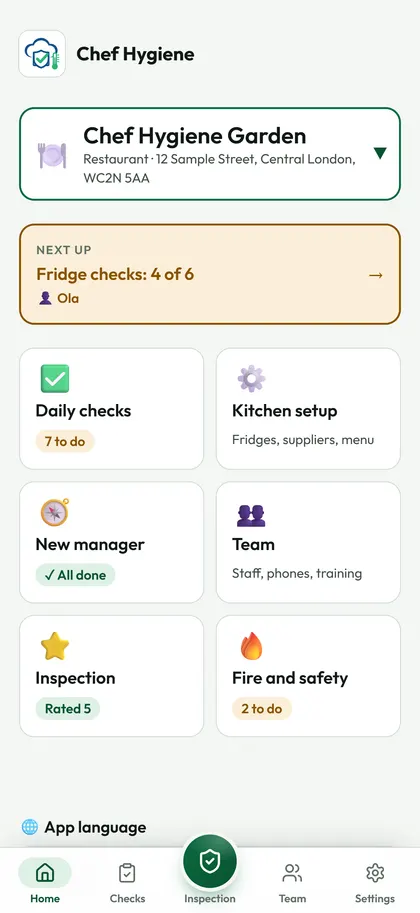
L’app carica queste regole per la tua cucina, verifica la conformità dei tuoi registri e conserva la documentazione per l’ispettore.
Altri paesi
 Irlanda
 Islanda
 Stati Uniti
 Canada
 Francia
 Spagna
 Paesi Bassi
 Belgio
 Portogallo
 Germania
 Austria
 Polonia
 Romania
 Italia
 Grecia
 Danimarca
 Svizzera
 Lussemburgo
 Cipro
Cipro Malta
Malta Svezia
 Norvegia
 Finlandia
 Cechia
 Ungheria
 Croazia
 Bulgaria
 Slovacchia
 Slovenia
 Estonia
 Lettonia
 Lituania
 Liechtenstein
 San Marino
 Gibilterra
 Monaco
 Moldavia
 Andorra
 Serbia
 Jersey
 Guernsey
 Isola di Man
 Turchia
 Montenegro
 Bosnia ed Erzegovina
 Kosovo
 Albania
 Macedonia del Nord
 Ucraina