 Estonie : pour les restaurants et les plats à emporter
Prêt pour l’inspection sanitaire. Tous les jours.
In Estonia the app follows the Food Act and the EU hygiene rules; the law sets no kitchen temperatures, so the numbers come from the PTA’s catering own-check guide, and the PTA inspects.
14 jours gratuits · Un prix par site · Sans engagement
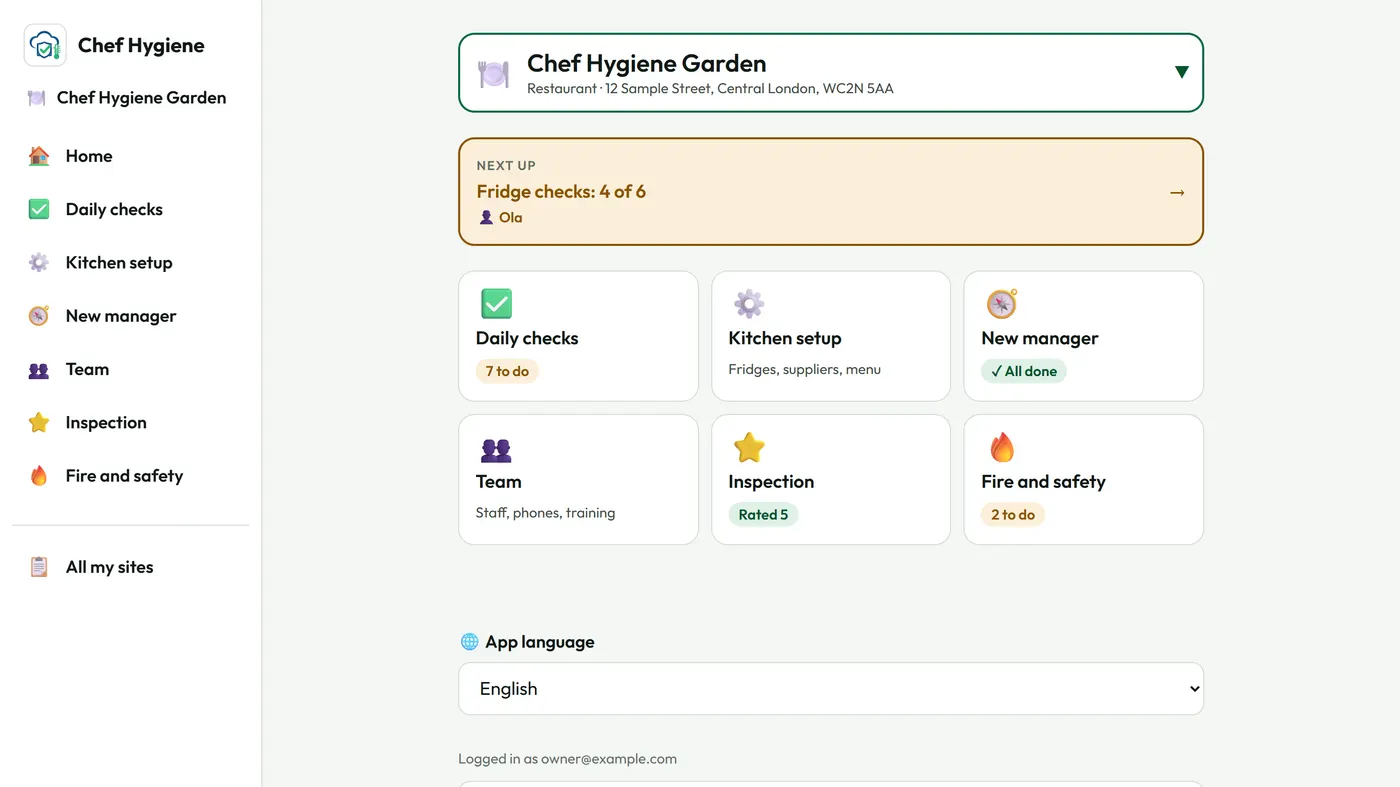
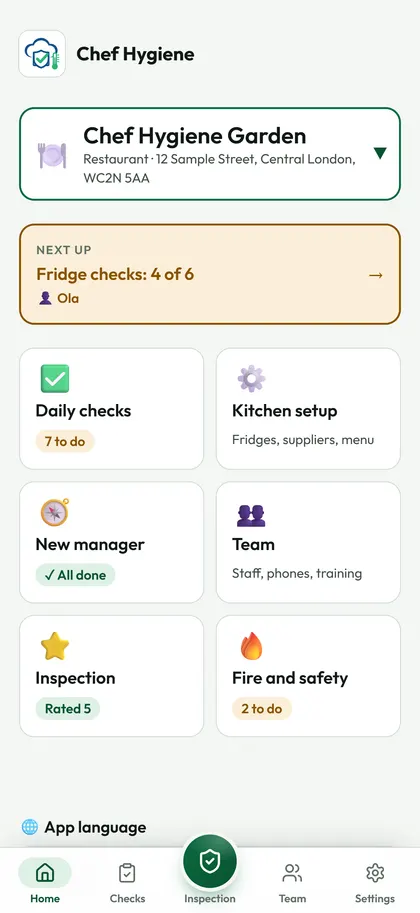
Estonie : règles d'hygiène alimentaire
Le règlement de cette page est pour l’instant en anglais. Il sera traduit dans votre langue.
- organisme d’inspection
- Agriculture and Food Board (Põllumajandus- ja Toiduamet, PTA)
- Évaluation publique
- Non
- Langues disponibles dans l’application
- English
Votre inspection
The Agriculture and Food Board (PTA) is the one national food authority, with regional offices (Food Act § 47). It inspects restaurants and cafés. Visits are risk-based and unannounced.
After a visit the PTA gives an explanation with time to fix small faults, an order (ettekirjutus) for serious faults, or starts misdemeanour proceedings. Dangerous food can be stopped by an order (Food Act § 49). Fines run from EUR 1,200 to EUR 3,200 for most breaches, for example EUR 1,600 (person) or EUR 2,600 (company) for breaking food rules; running without the required notice can cost up to EUR 2,400 or EUR 3,200 (Food Act §§ 53¹–53⁶). A normal restaurant needs no licence, only a business activity notice (majandustegevusteade) to the PTA.
Note d’hygiène
Estonia has no public hygiene rating, sticker or score, and nothing has to be displayed. The aim is a visit with no faults.
La « loi » désigne une règle contraignante. Les « recommandations officielles » ne constituent pas une loi, mais les inspecteurs s’y attendent. « Chef Hygiene valeur par défaut » est une valeur de référence utilisée par l’application lorsqu’aucune règle ne spécifie de valeur numérique.
Températures
- LoiEstonian law sets no restaurant fridge, hot-holding, cooling, cooking or reheating numbers. Food Act § 26 sends hygiene to EU Regulations 852/2004 and 853/2004. Your own-check plan is the legal duty.
- Orientations officiellesChilled storage at 2–6°C (PTA catering guide, model plan). The maker’s label range wins. Chef Hygiene aims for 5°C or colder.
- Orientations officiellesFrozen food at −18°C or colder (PTA guide). Quick-frozen food must be at −18°C (EU Regulation 37/2005).
- Orientations officiellesCooking: meat core at 75°C or more, measured for 2 minutes (PTA guide, example limit).
- Orientations officiellesHot holding: not below 63°C and not longer than 2 hours. Hot food sent out of the kitchen stays at 63°C or more (PTA guide).
- Orientations officiellesCooling: the food must be 5°C or colder after 2 hours (PTA guide, example limit).
- Orientations officiellesReheating: core at 75°C or more (PTA guide, example).
- Orientations officiellesDeep-fry oil below 175°C (PTA guide, example limit). Check the thermometer in iced water (−1 to +1°C) and boiling water (99–101°C).
Personnel, formation et santé
- LoiA written training plan is required, with aims, volume, frequency and procedure. Staff get regular training that fits the job, and their knowledge is assessed (Food Act § 29). There is no state certificate, hours or renewal period. Keep a training log.
- LoiStaff who handle food or drinking water, or clean food rooms, need a health certificate (tervisetõend) from a family doctor or occupational doctor before the first day. Keep it for the job plus 1 year (NETS § 13). There is no routine renewal.
- Orientations officiellesStop food work and tell the manager with diarrhoea, vomiting, fever, sore throat with fever, infected skin sores, or discharge from the ear, eye or nose (EU Regulation 852/2004 Annex II). The PTA guide says return after 48 hours without symptoms.
Allergènes
- LoiFor food that is not prepacked, give the dish name and the 14 EU allergens at the point of sale, in writing or orally. If not in writing, an easy-to-see notice must say where to get the information or to ask the staff (Regulation 24/2015 § 2). Give it in Estonian or a form the guest understands.
- LoiFor online and phone orders, give allergen information before the order and at delivery (Regulation 24/2015 § 2).
Contrôles de sécurité incendie
- LoiExtinguishers are checked and serviced by the maker’s interval. Without one, check yearly in a kitchen (damp, heat swings) and every 2 years in a dry, steady place. Keep the papers (Fire Safety Act §§ 31–32; extinguisher regulation § 10).
- LoiA fire alarm is serviced each quarter plus a yearly service, with a logbook and a daily look at the panel (fire-alarm regulation §§ 25–27).
- LoiStaff get fire training before they start or change job. A fire action plan and a yearly drill are required only where a fire report is required, for restaurants with over 150 usual users or over 1,000 m² (Fire Safety Act § 6).
- Orientations officiellesA periodic electrical audit is required for business premises. Chef Hygiene suggests every 10 years (5 years if built before 2000), based on TTJA guidance.
- Orientations officiellesGas: a check by a qualified gas worker every 4 years (TTJA guidance, Nov 2024). Chef Hygiene suggests this; the exact rule for restaurants is not confirmed.
Archives
- LoiA written own-check plan based on HACCP is required (Food Act § 34; EU Regulation 852/2004 art. 5).
- Orientations officiellesKeep monitoring sheets for 1 year, and test reports and audit sheets for at least 3 years (PTA guide). Chef Hygiene asks for temperature checks twice a day.
- LoiSend a business activity notice (majandustegevusteade) to the PTA before you start. You may start after the notice, and the PTA inspects after.
Sources officielles
- Agriculture and Food Board (PTA)
- PTA catering own-check guide (2021)
- Food Act (Riigi Teataja)
- Allergen information (Ministry of Agriculture)
- Fire Safety Act (Riigi Teataja)
Checked
Cette page contient des informations générales et ne constitue pas un avis juridique. Veuillez consulter les autorités locales compétentes.
Estonie : guides d’hygiène alimentaire
Configurer Chef Hygiene
Créez votre compte, configurez une tablette de cuisine partagée et installez l'application sur les téléphones de vos collaborateurs, étape par étape.
Estonie : inspections alimentaires
Qui inspecte votre cuisine, comment se déroule une inspection et s’il existe une évaluation de l’hygiène publique.
Estonie : règles de température des aliments
Les températures des aliments que votre cuisine doit maintenir et les règles qui les sous-tendent.
Estonie : allergènes
Ce que votre cuisine doit dire aux clients sur les allergènes.
Estonie : maladie et formation du personnel
Formation, règles de manipulation des aliments et lorsque le personnel malade doit rester à l’écart de la nourriture.
Estonie : sécurité incendie
Contrôles de sécurité incendie pour votre cuisine et fréquence à laquelle ils doivent être effectués.
Estonie : enregistrements à conserver
Les registres et enregistrements que votre cuisine doit conserver.
Estonie : l'application Chef Hygiene
L’application charge ces règles pour votre cuisine, vérifie vos enregistrements par rapport à celles-ci et conserve les preuves pour l’inspecteur.
Autres pays
 Royaume-Uni
 Irlande
 Islande
 États-Unis
 Canada
 France
 Espagne
 Pays-Bas
 Belgique
 Portugal
 Allemagne
 Autriche
 Pologne
 Roumanie
 Italie
 Grèce
Grèce Danemark
 Suisse
 Luxembourg
 Chypre
 Malte
Malte Suède
Suède Norvège
 Finlande
 Tchéquie
 Hongrie
 Croatie
 Bulgarie
 Slovaquie
 Slovénie
 Lettonie
 Lituanie
 Liechtenstein
 Saint-Marin
 Gibraltar
 Monaco
 Moldavie
 Andorre
 Serbie
 Jersey
 Guernesey
 Île de Man
 Turquie
 Monténégro
 Bosnie-Herzégovine
 Kosovo
 Albanie
 Macédoine du Nord
 Ukraine