 Danemark : pour les restaurants et les plats à emporter
Prêt pour l’inspection sanitaire. Tous les jours.
Chef Hygiene follows the Danish hygiene order (BEK 1331/2025) and the hygiene guide VEJ 9700/2025 of the Danish Veterinary and Food Authority (Fødevarestyrelsen), which inspects and publishes the Smiley result.
14 jours gratuits · Un prix par site · Sans engagement
Danemark : règles d'hygiène alimentaire
Le règlement de cette page est pour l’instant en anglais. Il sera traduit dans votre langue.
- organisme d’inspection
- Danish Veterinary and Food Authority (Fødevarestyrelsen)
- Évaluation publique
- Oui
- Langues disponibles dans l’application
- Dansk, English
Votre inspection
One national authority inspects: Fødevarestyrelsen (the Danish Veterinary and Food Authority), part of the Ministry of Business. It works through three food units: East, South and North. The inspector checks your self-check (egenkontrol), the premises and your papers.
Visits are unannounced. Most restaurants and cafés get sample-based control chosen by a risk model, with no fixed rhythm: firms with problems get more visits. The inspector can take samples and photos and hold back food. Sanctions are a warning, an order, a ban, an administrative fine, a police report or loss of approval. After a warning you pay for 1 follow-up visit, and after an order, ban or fine for 2.
Note d’hygiène
Yes: the public Smiley scheme (BEK 1225/2024). A glad smiley means no remarks. A smiley with a straight mouth means a warning, order or ban. A sad smiley means a fine, a police report or loss of approval. The smiley sign must hang at every public entrance, and the last 4 results are on findsmiley.dk.
La « loi » désigne une règle contraignante. Les « recommandations officielles » ne constituent pas une loi, mais les inspecteurs s’y attendent. « Chef Hygiene valeur par défaut » est une valeur de référence utilisée par l’application lorsqu’aucune règle ne spécifie de valeur numérique.
Températures
- LoiFridge: the air must be 5°C or colder for cooked and cooled dishes, minced meat, meat preparations, fresh poultry, food with cream and milk products (BEK 1331/2025, § 25 and annex 3).
- LoiOther chilled limits in the order: 10°C for mayonnaise salads with pH above 4,5 and for fish semi-preserves, and 12°C for eggs. If the label says colder, follow the label.
- LoiFresh fish and cooked shellfish: keep them on ice or at 2°C at most (EU Regulation 853/2004, which the authority applies to restaurants).
- LoiFreezer: −18°C or colder for deep-frozen food (BEK 1194/2005, § 5). A short rise of up to 3°C is allowed during local delivery.
- LoiCooking and reheating: 75°C in the whole food needs no extra documentation (BEK 1331/2025, § 26). A lower temperature needs your own proof that it is safe.
- Orientations officiellesFish: the hygiene guide accepts 60°C in the centre for at least 1 minute.
- LoiHot holding: at least 56°C everywhere in the food, with no time limit (BEK 1331/2025, § 29). This has been the rule since 1 January 2026. The old limit was 65°C.
- Orientations officiellesCooling: from 56°C to 10°C within 4 hours, then into the fridge at 5°C (hygiene guide VEJ 9700/2025). The law only says as fast as possible.
- Orientations officiellesChilled food taken out of the fridge for preparing, plating or a buffet: 3 hours at most in all. Leftovers are normally thrown away (hygiene guide).
Personnel, formation et santé
- Orientations officiellesThere is no food hygiene certificate, no set hours and no renewal. Staff must be instructed or trained in food handling and personal hygiene. Training by a colleague is often enough (hygiene guide VEJ 9700/2025, chapter 23).
- Orientations officiellesWhoever builds the self-check must be trained in HACCP (a food safety system), in proportion to the size of the business. The firm chooses who and which course.
- LoiStaff with an illness food can carry (vomiting, diarrhoea, skin or throat infection) may not handle food or enter food areas. They must tell the manager.
- Orientations officiellesA person should come back at least 48 hours after the symptoms stop. There is no health check or health certificate.
Allergènes
- LoiThe 14 EU allergens must be declared. For food that is not prepacked, the information can be written or given by staff in words (BEK 1355/2015, § 13).
- LoiIf the allergens are not written on the menu or by the food, a visible sign must say that allergen information is available from staff on request. For online orders, the notice also goes on the website.
- LoiYou need no sign if staff ask every customer about allergies first. You must be able to show what each dish contains, including sauces and spice mixes.
Contrôles de sécurité incendie
- Orientations officiellesFire extinguishers: a check every year by a competent person, with a label showing year, month and signature. A pressure test is needed every 5 years, and every 10 years for CO2 extinguishers (building regulation BR18 guide, chapter 7).
- Orientations officiellesKitchen: at least 1 suitable extinguisher, a fire blanket where you fry (checked every year), and a fat extinguisher of type 75 F or higher no more than 30 m away.
- LoiFire inspection (brandsyn) by the municipal rescue service is free. It is every year for rooms for more than 150 people, and every 2 years for 51 to 150 people only if the municipality decides (BEK 2341/2021).
- LoiElectrics: in a restaurant for more than 150 people, an authorised electrician checks the installation every 24 months. The certificate must be shown to guests (BEK 1119/2019).
- LoiGas: a kitchen is class 6 (large kitchen). You need a written operation and maintenance plan that sets how often it is checked (BEK 247/2018). Gas cooking appliances may only run while the extraction runs.
Archives
- LoiYour self-check (egenkontrol) is based on HACCP: a written risk analysis and a written programme for the critical points. Good working practices can be given in words. All must be at the premises, on paper or digital (EU Regulation 852/2004, article 5).
- Orientations officiellesTraceability records (supplier, goods, date, quantity, such as invoices or delivery notes) are always needed. Keep them 5 years as a starting point.
- Orientations officiellesKeep self-check records for a suitable period. The guidance gives no number of months. Review the self-check once a year as a rule.
Sources officielles
- Fødevarestyrelsen (Danish Veterinary and Food Authority)
- findsmiley.dk (Smiley results)
- Hygiene order BEK 1331/2025 (Retsinformation)
- Hygiene guide VEJ 9700/2025 (Retsinformation)
- Smiley order BEK 1225/2024 (Retsinformation)
Checked
Cette page contient des informations générales et ne constitue pas un avis juridique. Veuillez consulter les autorités locales compétentes.
Danemark : guides d’hygiène alimentaire
Configurer Chef Hygiene
Créez votre compte, configurez une tablette de cuisine partagée et installez l'application sur les téléphones de vos collaborateurs, étape par étape.
Danemark : inspections alimentaires
Qui inspecte votre cuisine, comment se déroule une inspection et s’il existe une évaluation de l’hygiène publique.
Danemark : règles de température des aliments
Les températures des aliments que votre cuisine doit maintenir et les règles qui les sous-tendent.
Danemark : allergènes
Ce que votre cuisine doit dire aux clients sur les allergènes.
Danemark : maladie et formation du personnel
Formation, règles de manipulation des aliments et lorsque le personnel malade doit rester à l’écart de la nourriture.
Danemark : sécurité incendie
Contrôles de sécurité incendie pour votre cuisine et fréquence à laquelle ils doivent être effectués.
Danemark : enregistrements à conserver
Les registres et enregistrements que votre cuisine doit conserver.
Danemark : l'application Chef Hygiene
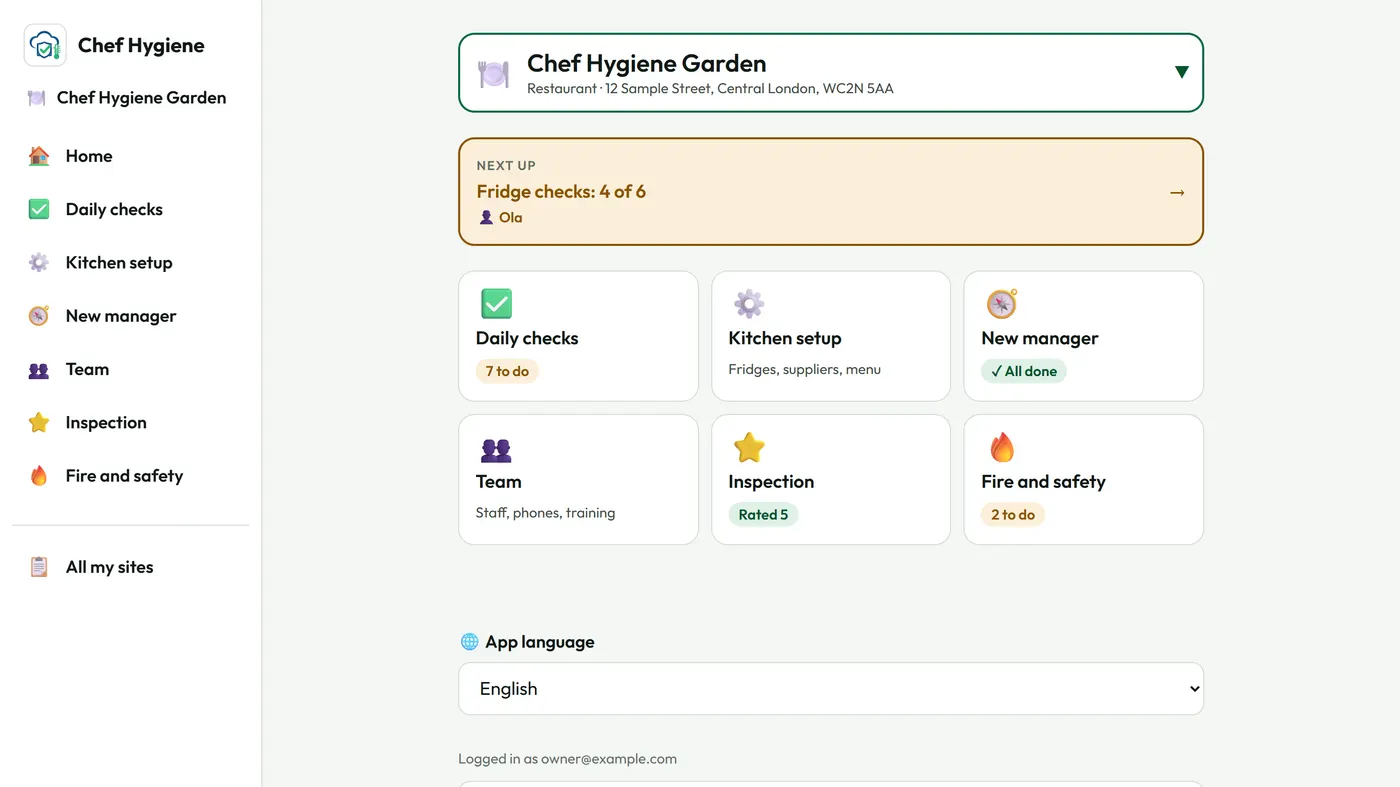
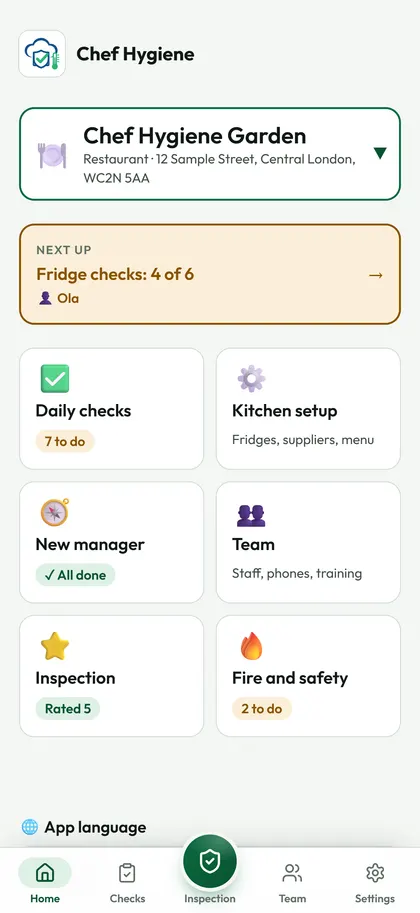
L’application charge ces règles pour votre cuisine, vérifie vos enregistrements par rapport à celles-ci et conserve les preuves pour l’inspecteur.
Autres pays
 Royaume-Uni
 Irlande
 Islande
 États-Unis
 Canada
 France
 Espagne
 Pays-Bas
 Belgique
 Portugal
 Allemagne
 Autriche
 Pologne
 Roumanie
 Italie
 Grèce
Grèce Suisse
 Luxembourg
 Chypre
 Malte
Malte Suède
Suède Norvège
 Finlande
 Tchéquie
 Hongrie
 Croatie
 Bulgarie
 Slovaquie
 Slovénie
 Estonie
 Lettonie
 Lituanie
 Liechtenstein
 Saint-Marin
 Gibraltar
 Monaco
 Moldavie
 Andorre
 Serbie
 Jersey
 Guernesey
 Île de Man
 Turquie
 Monténégro
 Bosnie-Herzégovine
 Kosovo
 Albanie
 Macédoine du Nord
 Ukraine