 Slovénie : pour les restaurants et les plats à emporter
Prêt pour l’inspection sanitaire. Tous les jours.
In Slovenia the app follows the EU hygiene rules and the Law on Safe Food and Feed (ZVHK); UVHVVR food inspectors inspect, and the kitchen temperatures come from the national catering guide, not from law.
14 jours gratuits · Un prix par site · Sans engagement
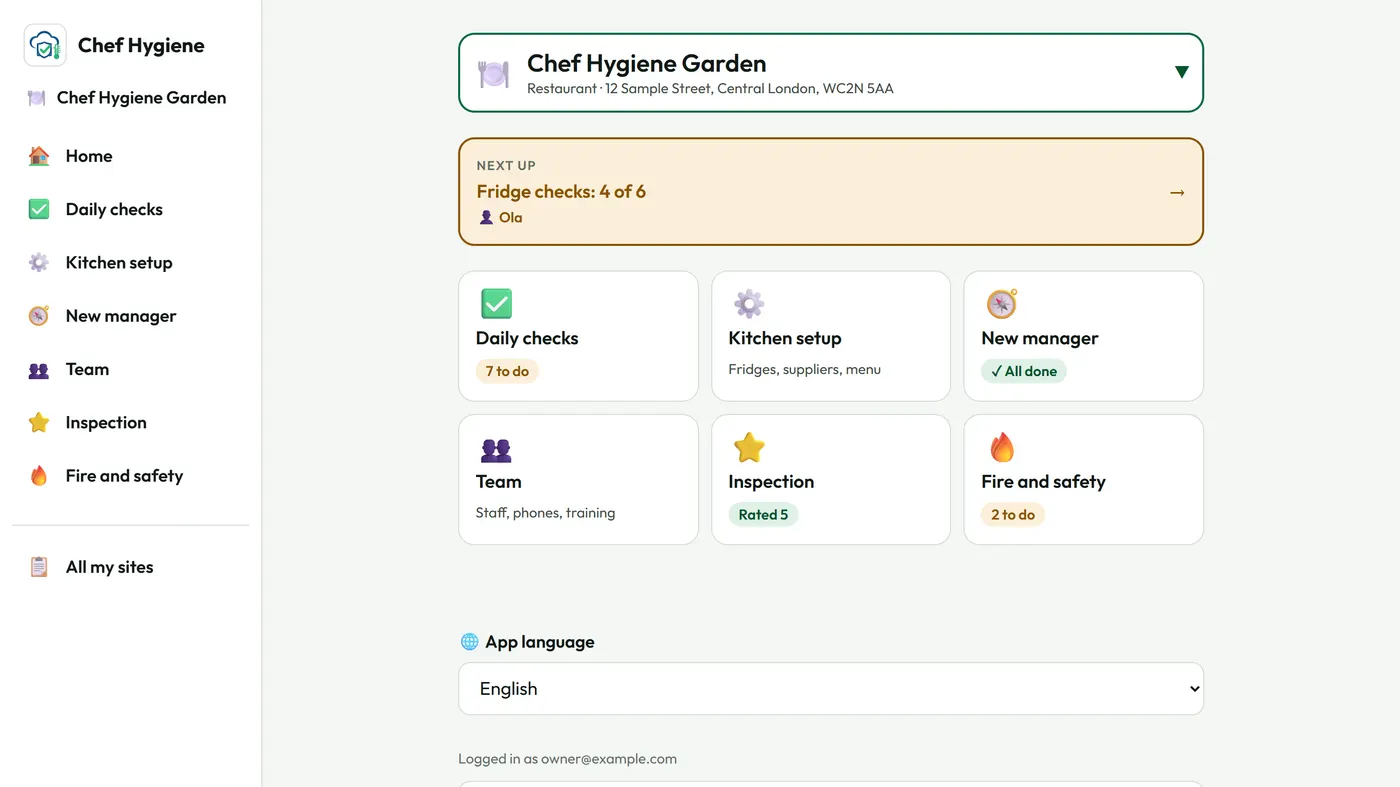
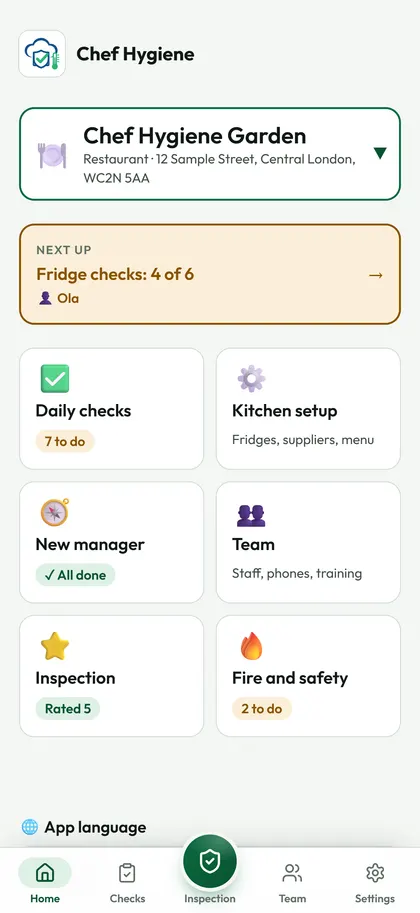
Slovénie : règles d'hygiène alimentaire
Le règlement de cette page est pour l’instant en anglais. Il sera traduit dans votre langue.
- organisme d’inspection
- Administration for Food Safety, Veterinary Sector and Plant Protection (Uprava za varno hrano, veterinarstvo in varstvo rastlin, UVHVVR)
- Évaluation publique
- Non
- Langues disponibles dans l’application
- Slovenščina, English, Italiano, Magyar
Votre inspection
UVHVVR food inspectors check food law in all phases, from 10 regional offices. The control plan 2025 to 2029 sets how often, by risk. A restaurant, inn or snack bar with more than 10 staff is checked about every 18 months. With fewer than 10 staff, or a café or pastry shop with its own production, about every 30 months.
For small faults the inspector gives a warning with a deadline, then a decision. If the fault is not fixed in time, or at once if there is direct danger to life or health, the inspector can ban the activity and seal the premises. Under the ZVHK (Art. 109) a company can be fined EUR 2,000 to 20,000 and a sole trader EUR 1,000 to 10,000 for breaches such as no traceability or unmet hygiene conditions.
Note d’hygiène
There is no national rating, sticker or duty to display a result. A ban for danger to life or health must be published online for at least 60 days.
La « loi » désigne une règle contraignante. Les « recommandations officielles » ne constituent pas une loi, mais les inspecteurs s’y attendent. « Chef Hygiene valeur par défaut » est une valeur de référence utilisée par l’application lorsqu’aucune règle ne spécifie de valeur numérique.
Températures
- Orientations officiellesNo Slovenian law sets restaurant fridge, hot-holding, cooling or reheating numbers. The values below come from the national catering guide (December 2010), as printed in NIJZ staff texts.
- Orientations officiellesChilled storage and goods-in: below 5°C, or as the label says. Some NIJZ lines say below 4°C for raw food and cooked cold dishes.
- Orientations officiellesFrozen food: −18°C or colder. For quick-frozen food this is law, with short rises of up to 3°C allowed (Rulebook 87/14, Art. 5).
- Orientations officiellesCooking, core temperature for 15 seconds: 74°C for poultry pieces, game, stuffings and dishes with minced-meat stuffing; 68°C for pork and minced or chopped meat; 63°C for beef, veal, lamb, fish, eggs, dairy, rice and pasta.
- Orientations officiellesHot holding: 63°C or hotter in the core. Below that, reheat or throw the food away. Serve within 2 hours of cooking, and never after 4 hours.
- Orientations officiellesCooling in two stages: from 63°C to 20°C within 2 hours, then to 5°C within 4 more hours. A blast chiller is better.
- Orientations officiellesReheating: 74°C for 15 seconds.
- Orientations officiellesCold display and salad bars: under 3 hours. Very sensitive dishes such as tartare and cream cakes stay at 5 to 8°C. Throw the food away once it is over the limit or not served within 3 hours, and write down when it was put out.
Personnel, formation et santé
- LoiSlovenia has no national food hygiene certificate, course length or renewal. EU law applies: the operator must instruct and train staff to suit their work (Regulation 852/2004).
- LoiBefore the first day each worker signs a consent to report illness and fills in a symptom declaration. The employer keeps them with a staff list for inspectors (Rulebook 82/03).
- LoiA worker with vomiting, diarrhoea, jaundice, pus-filled skin lesions or discharge from the eyes, ears or nose must stop food work and tell the manager at once (Rulebook 82/03).
- LoiThere is no routine yearly medical exam or health card. A public health institute checks a worker only after an infection, diarrhoea or vomiting at home, travel to an area with poor hygiene, or when an inspector asks. The employer pays.
- Orientations officiellesNIJZ outbreak guidance: stay away for 48 hours after symptoms stop for most infections. After typhoid or dysentery return only with a doctor’s certificate after negative stool tests.
Allergènes
- LoiIn catering, allergen information must be in writing, in at least one of the places where dishes are offered: menu, board, poster or screen. It must be easy to see, readable and not covered. There is no oral-only option (Decree 6/2014, Art. 3).
- Orientations officiellesUse the word “vsebuje” plus the allergen name, for the 14 EU allergens. This also applies to drinks (SPOT guidance).
- LoiThe information must be in Slovene (ZVHK, Art. 51). A breach is fined EUR 6,000 to 30,000 for a company and EUR 3,000 to 6,000 for a sole trader (Decree 6/2014, Art. 4).
Contrôles de sécurité incendie
- LoiEvery restaurant needs a fire order (požarni red) with annexes for records and check sheets. The owner sets how often the checks are done (Rulebook 52/07).
- LoiWhere an evacuation plan is required, hold a practical evacuation drill at least once a year and record it (Rulebook 52/07, Art. 11).
- LoiStaff get fire training at the start and again every 3 years for medium fire risk. Keep the records for at least 10 years (Rulebook 32/11).
- LoiExtinguishers are serviced by an authorised maintainer following the maker’s instructions. The label shows the next date. The rule sets no fixed interval (Rulebook 108/04).
- LoiBuilt-in fire systems, such as a fire alarm, gas detection and emergency lighting, need a certificate of proper functioning valid for 3 years (Rulebook 53/2019, Art. 21).
Archives
- LoiPermanent HACCP-based procedures are required, in proportion to the size of the business (ZVHK Art. 36; Regulation 852/2004).
- Orientations officiellesKeep traceability records of supplier, product and date in (ZVHK Art. 23). NIJZ advises keeping them usually 2 years, and 6 months after the use-by date for perishable or unpacked food.
- Orientations officiellesLog fridge and freezer temperatures at least once a day at the start of work, with corrective actions (NIJZ guidance).
- LoiRegister each premises with UVHVVR at least 15 days before opening and report changes within 15 days (ZVHK Art. 24).
Sources officielles
- UVHVVR, Administration for Food Safety, Veterinary Sector and Plant Protection
- Law on Safe Food and Feed (ZVHK), PISRS
- Decree 6/2014 on allergen information (PISRS)
- NIJZ, basic hygiene positions for food staff
- SPOT, restaurants and inns
Checked
Cette page contient des informations générales et ne constitue pas un avis juridique. Veuillez consulter les autorités locales compétentes.
Slovénie : guides d’hygiène alimentaire
Configurer Chef Hygiene
Créez votre compte, configurez une tablette de cuisine partagée et installez l'application sur les téléphones de vos collaborateurs, étape par étape.
Slovénie : inspections alimentaires
Qui inspecte votre cuisine, comment se déroule une inspection et s’il existe une évaluation de l’hygiène publique.
Slovénie : règles de température des aliments
Les températures des aliments que votre cuisine doit maintenir et les règles qui les sous-tendent.
Slovénie : allergènes
Ce que votre cuisine doit dire aux clients sur les allergènes.
Slovénie : maladie et formation du personnel
Formation, règles de manipulation des aliments et lorsque le personnel malade doit rester à l’écart de la nourriture.
Slovénie : sécurité incendie
Contrôles de sécurité incendie pour votre cuisine et fréquence à laquelle ils doivent être effectués.
Slovénie : enregistrements à conserver
Les registres et enregistrements que votre cuisine doit conserver.
Slovénie : l'application Chef Hygiene
L’application charge ces règles pour votre cuisine, vérifie vos enregistrements par rapport à celles-ci et conserve les preuves pour l’inspecteur.
Autres pays
 Royaume-Uni
 Irlande
 Islande
 États-Unis
 Canada
 France
 Espagne
 Pays-Bas
 Belgique
 Portugal
 Allemagne
 Autriche
 Pologne
 Roumanie
 Italie
 Grèce
Grèce Danemark
 Suisse
 Luxembourg
 Chypre
 Malte
Malte Suède
Suède Norvège
 Finlande
 Tchéquie
 Hongrie
 Croatie
 Bulgarie
 Slovaquie
 Estonie
 Lettonie
 Lituanie
 Liechtenstein
 Saint-Marin
 Gibraltar
 Monaco
 Moldavie
 Andorre
 Serbie
 Jersey
 Guernesey
 Île de Man
 Turquie
 Monténégro
 Bosnie-Herzégovine
 Kosovo
 Albanie
 Macédoine du Nord
 Ukraine