 Norvège : pour les restaurants et les plats à emporter
Prêt pour l’inspection sanitaire. Tous les jours.
Chef Hygiene follows the EU hygiene rules as Norway applies them (EEA), the Norwegian temperature rules in the hygiene regulation and Mattilsynet’s guidance, and Mattilsynet inspects and publishes the Smilefjes result.
14 jours gratuits · Un prix par site · Sans engagement
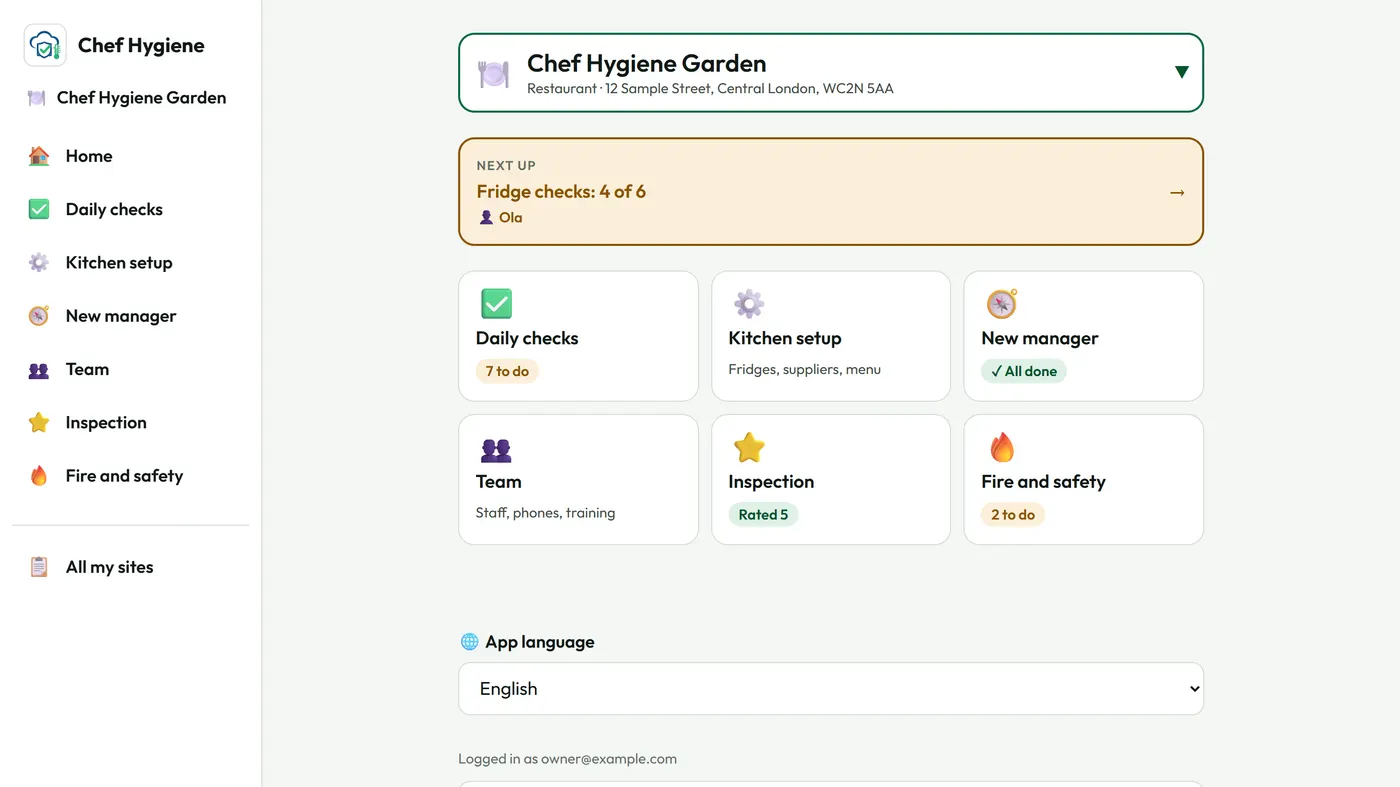
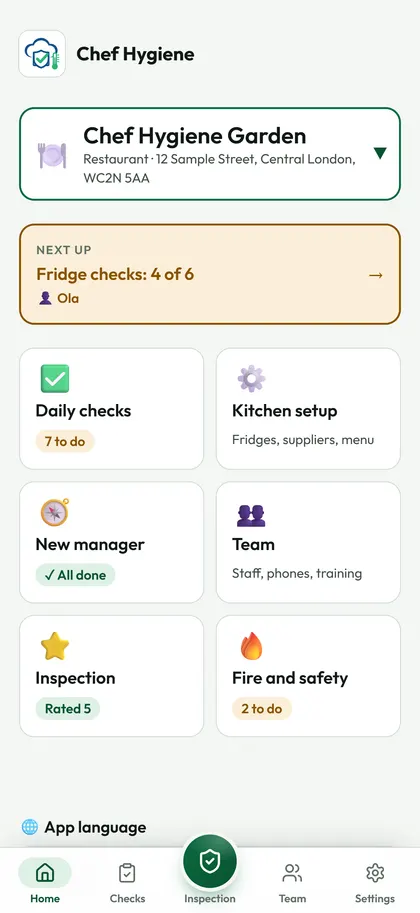
Norvège : règles d'hygiène alimentaire
Le règlement de cette page est pour l’instant en anglais. Il sera traduit dans votre langue.
- organisme d’inspection
- Norwegian Food Safety Authority (Mattilsynet)
- Évaluation publique
- Oui
- Langues disponibles dans l’application
- Norsk bokmål, English
Votre inspection
One national authority inspects: Mattilsynet (the Norwegian Food Safety Authority), under the Food Act (matloven, § 23). Municipalities only help on request. You must register your business before you start.
There is no fixed interval: Mattilsynet decides from risk and capacity. Visits are mostly unannounced, and some controls are digital. After a visit the steps are written guidance, then an order to correct with a deadline, then a coercive fine (tvangsmulkt). Mattilsynet can close an activity for up to 6 months for ignored orders or gross breaches. A follow-up control costs NOK 2,775 in person or NOK 1,388 otherwise.
Note d’hygiène
Yes: Smilefjes (smiley). The three symbols are Smilefjes (no breach, or only trivial ones), Strekmunn (straight mouth: breaches) and Sur munn (sour mouth: serious or repeated breaches). The report must hang next to the entrance, visible before guests go in. Results are published on smilefjes.mattilsynet.no.
La « loi » désigne une règle contraignante. Les « recommandations officielles » ne constituent pas une loi, mais les inspecteurs s’y attendent. « Chef Hygiene valeur par défaut » est une valeur de référence utilisée par l’application lorsqu’aucune règle ne spécifie de valeur numérique.
Températures
- LoiFridge: perishable food at 4°C or lower, unless the label says otherwise (hygiene regulation, § 12).
- Orientations officiellesFresh fish: keep it on ice, as near 0°C as possible, preferably 2°C or lower (Mattilsynet fish rules).
- Orientations officiellesFreezer: −18°C. Mattilsynet advises this for your own freezers. For food sold as deep-frozen it is law, with up to 3°C more allowed in local transport and final sale.
- Orientations officiellesCooking: 75°C in the centre can be enough (Smilefjes guide). Cook poultry and minced meat right through, and sear whole cuts well on the outside.
- LoiHot holding: 60°C or hotter (hygiene regulation, § 13). Lower is allowed only in transport and serving to the guest if there is no health risk.
- Orientations officiellesCooling: from 60°C to 10°C within 2 hours, then into the 4°C fridge (Smilefjes guide, a guide rule). The law says as quickly as possible.
- Orientations officiellesReheating: to over 70°C, then hold above 60°C (Mattilsynet). There is no legal figure.
- LoiDeliveries: chilled food at 4°C or the label’s temperature (law). Reject frozen food above −15°C. Hot food should arrive at 60°C or more (guidance).
- Orientations officiellesThawing: in the fridge, with no part of the food above 10°C (Smilefjes guide).
Personnel, formation et santé
- LoiThere is no food hygiene certificate, set hours or renewal. The rules ask for no formal qualification. The business must make sure everyone has the skills needed (Food Act, § 8).
- Orientations officiellesWhoever writes the routines needs enough HACCP (food safety system) training. Everyone should get an induction.
- LoiStaff with a food-borne illness, infected wounds or diarrhoea must not handle food, and must tell the manager at once (EU Regulation 852/2004, annex II chapter VIII).
- Orientations officiellesMattilsynet and the Institute of Public Health (FHI) advise coming back 48 hours after vomiting or diarrhoea stops. There is no health certificate and no stool test after travel.
Allergènes
- Orientations officiellesThe 14 EU allergens apply. For food that is not prepacked, Mattilsynet (June 2025) says the information must be in writing and in Norwegian, shown with the word “Inneholder” (contains) by each dish, on a poster or on a screen.
- Orientations officiellesSpeaking, a QR code or a screen may be added but cannot replace the written information. Guests must find it without asking.
- LoiFood information for guests must be in Norwegian or a language spelled like it. English may be added, not used instead (matinformasjonsforskriften, § 2).
Contrôles de sécurité incendie
- Orientations officiellesFire extinguishers: an owner look every 3 months, a certified control every year, and a service every 5 years (water, foam) or 10 years (powder, CO2), as in standard NS 3910 named by DSB. The law asks for checks by risk (FOR-2015-12-17-1710, § 5).
- Orientations officiellesGas: DSB’s table gives a check of large-kitchen gas equipment and pipe tightness every 2 years. From 1 January 2027 the law adds a condition check at least every 5 years and a gas detector.
- LoiElectrics: the law asks for necessary inspection and maintenance (FEL, § 9) and sets no fixed interval.
- Chef Hygiene par défautHood and duct: Chef Hygiene checks against the insurers’ rule (FG-1100:1): fat filters at least weekly, duct and fan every year, and an automatic fire suppression system serviced every 6 months. This is not law.
Archives
- LoiYou need written routines (internkontroll) for what to do when something goes wrong, how to stop it happening again, a regular review, and using only current routines (IK-mat regulation, §§ 4–5).
- LoiA binder, a notebook, a digital file or an app is accepted. HACCP principles apply (EU Regulation 852/2004, article 5).
- Chef Hygiene par défautNo fixed number of years is set for records. The business decides and writes down how long each record is kept. Chef Hygiene suggests 12 months.
Sources officielles
- Mattilsynet (Norwegian Food Safety Authority)
- Smilefjes results (Mattilsynet)
- Food Act, matloven (Lovdata)
- Smilefjes regulation (Lovdata)
- Hygiene regulation (Lovdata)
Checked
Cette page contient des informations générales et ne constitue pas un avis juridique. Veuillez consulter les autorités locales compétentes.
Norvège : guides d’hygiène alimentaire
Configurer Chef Hygiene
Créez votre compte, configurez une tablette de cuisine partagée et installez l'application sur les téléphones de vos collaborateurs, étape par étape.
Norvège : inspections alimentaires
Qui inspecte votre cuisine, comment se déroule une inspection et s’il existe une évaluation de l’hygiène publique.
Norvège : règles de température des aliments
Les températures des aliments que votre cuisine doit maintenir et les règles qui les sous-tendent.
Norvège : allergènes
Ce que votre cuisine doit dire aux clients sur les allergènes.
Norvège : maladie et formation du personnel
Formation, règles de manipulation des aliments et lorsque le personnel malade doit rester à l’écart de la nourriture.
Norvège : sécurité incendie
Contrôles de sécurité incendie pour votre cuisine et fréquence à laquelle ils doivent être effectués.
Norvège : enregistrements à conserver
Les registres et enregistrements que votre cuisine doit conserver.
Norvège : l'application Chef Hygiene
L’application charge ces règles pour votre cuisine, vérifie vos enregistrements par rapport à celles-ci et conserve les preuves pour l’inspecteur.
Autres pays
 Royaume-Uni
 Irlande
 Islande
 États-Unis
 Canada
 France
 Espagne
 Pays-Bas
 Belgique
 Portugal
 Allemagne
 Autriche
 Pologne
 Roumanie
 Italie
 Grèce
Grèce Danemark
 Suisse
 Luxembourg
 Chypre
 Malte
Malte Suède
Suède Finlande
 Tchéquie
 Hongrie
 Croatie
 Bulgarie
 Slovaquie
 Slovénie
 Estonie
 Lettonie
 Lituanie
 Liechtenstein
 Saint-Marin
 Gibraltar
 Monaco
 Moldavie
 Andorre
 Serbie
 Jersey
 Guernesey
 Île de Man
 Turquie
 Monténégro
 Bosnie-Herzégovine
 Kosovo
 Albanie
 Macédoine du Nord
 Ukraine