 Hongrie : pour les restaurants et les plats à emporter
Prêt pour l’inspection sanitaire. Tous les jours.
In Hungary the app follows the EU hygiene rules, Decree 62/2011 (VM) and Nébih’s catering hygiene guide; county and district government offices inspect, directed by NKFH.
14 jours gratuits · Un prix par site · Sans engagement
Hongrie : règles d'hygiène alimentaire
Le règlement de cette page est pour l’instant en anglais. Il sera traduit dans votre langue.
- organisme d’inspection
- National Trade and Consumer Protection Authority (Nemzeti Kereskedelmi és Fogyasztóvédelmi Hatóság, NKFH)
- Évaluation publique
- Non
- Langues disponibles dans l’application
- Magyar, English
Votre inspection
The county (vármegyei) government offices and their district offices (járási hivatal) inspect restaurants on site. NKFH directs this food-trade control and plans the yearly programme. Nébih keeps the food business register (FELIR), the hygiene guide and the list of risky firms.
Under the Food Chain Act (Éltv., Act 2008/XLVI) a fine starts at HUF 15,000. An on-the-spot fine is HUF 25,000 to 200,000. The authority can suspend a business for up to 1 year or ban it for up to 3 years, and a notice must hang on the premises meanwhile. The business pays for samples that fail. Fire, public-health, labour and tax offices also check premises.
Note d’hygiène
There is no rating or sticker for ordinary restaurants. Nébih has a voluntary quality rating from jeles (5, 90 to 100%) to elégtelen (1, under 60%), compulsory only for public canteens. Serious breaches are published by name on Nébih’s risky-firm list for 2 years.
La « loi » désigne une règle contraignante. Les « recommandations officielles » ne constituent pas une loi, mais les inspecteurs s’y attendent. « Chef Hygiene valeur par défaut » est une valeur de référence utilisée par l’application lorsqu’aucune règle ne spécifie de valeur numérique.
Températures
- Orientations officiellesChilled prepared food: 0 to +5°C, covered. Nébih’s catering guide gives this; there is no legal fridge limit for restaurants.
- Orientations officiellesRaw goods in the fridge, at most: red meat 7°C, poultry 4°C, offal 3°C, minced meat 2°C. Fresh fish is kept near melting ice (Nébih’s guide).
- LoiYour own freezing: −18°C or colder, and never warmer in storage (Decree 62/2011 (VM), annex 3).
- Orientations officiellesCooking: 72°C in the core for 2 minutes, or 75°C at every point. Decree 62/2011 (VM) defines this “safe heat treatment” and requires it for public catering and food sent to events; Nébih’s guide uses it for restaurants.
- Orientations officiellesHot holding: +63°C or hotter. Without hot holding, serve within 3 hours of making. Food kept 3 hours at an uncertain temperature is thrown away (Nébih’s guide).
- Orientations officiellesCooling: start within 30 minutes of cooking and reach below +10°C within the next 90 minutes (2 hours in all). Then keep it at 0 to +5°C (Nébih’s guide).
- Orientations officiellesReheating: 72°C in the core for 2 minutes, or 75°C at every point, and only once (Nébih’s guide).
- Orientations officiellesChilled food on an unchilled buffet: 2 hours at most. Leftovers from service are never offered again (Nébih’s guide; Decree 62/2011 (VM) § 16).
Personnel, formation et santé
- LoiThere is no hygiene certificate and no set training hours. Each new worker must be trained within 1 month of starting, and the business documents it (Decree 68/2007).
- LoiEveryone who makes or sells food needs a medical exam before starting, a signed health statement and a health booklet. The exam is repeated every year (Decree 33/1998 (NM)).
- LoiNobody with a food-borne illness, infected wound, skin infection or diarrhoea may work with food. They must report it at once (EU Regulation 852/2004).
- LoiA responsible food-safety person must be able to act at once during all opening hours. Micro firms need this person on site within 2 hours (Éltv. § 22).
- Orientations officiellesA worker comes back after illness with a doctor’s note (Nébih’s guide and NKFH’s guide).
Allergènes
- LoiGuests must be told about the 14 EU allergens in food that is not prepacked, before they order and free of charge. This includes online orders (Decree 36/2014 (FM)).
- LoiWritten information is a sheet, menu or screen where the food is offered, with a sign that points guests to it.
- LoiOral information is allowed only if a trained responsible person is always present, a visible notice says guests can ask, and a written internal procedure names that person and shows allergen training.
- LoiThe information must be in Hungarian. If fresh meat was frozen before, you must say so.
Contrôles de sécurité incendie
- LoiThe keeper checks each fire extinguisher at least every 3 months. A registered maintenance firm services it at the intervals in the OTSZ annex. Keep a fire-safety operating log (tűzvédelmi üzemeltetési napló) (OTSZ, Decree 54/2014 (BM) §§ 263–264).
- LoiA hot kitchen’s ventilation and odour extraction are cleaned at the maker’s interval, otherwise at least once a year, with written proof (OTSZ § 196).
- LoiThe electrical installation gets a fire-safety review at least every 6 years, or every 3 years if you store over 300 kg or 300 litres of highly flammable material (OTSZ § 277).
- LoiThe residual-current switch (RCD) is function-tested every 3 months. Hand tools and portable transformers are checked every year (Decree 10/2016 (NGM) § 19).
Archives
- LoiHACCP-based procedures are required (EU Regulation 852/2004). Paper and digital records are both accepted.
- LoiKeep the self-check records at the premises for at least 2 years. Micro and small firms may use paper or electronic records; larger firms must use electronic ones (Decree 28/2017 (FM) § 4).
- LoiPublic canteens and kitchens making over 29 portions a day keep a recipe record with allergens for 90 days after the dish ends (Decree 62/2011 (VM)).
- LoiPublic and event catering over 29 portions a day keeps a 100 g sample of each dish for 72 hours at 0 to +5°C (Decree 62/2011 (VM)).
Sources officielles
- NKFH, National Trade and Consumer Protection Authority
- Nébih, catering hygiene guide (GHP)
- Nébih, quality-driven public catering programme (rating)
- Decree 62/2011 (VM), official law database
- Fire protection code OTSZ, Decree 54/2014 (BM)
Checked
Cette page contient des informations générales et ne constitue pas un avis juridique. Veuillez consulter les autorités locales compétentes.
Hongrie : guides d’hygiène alimentaire
Configurer Chef Hygiene
Créez votre compte, configurez une tablette de cuisine partagée et installez l'application sur les téléphones de vos collaborateurs, étape par étape.
Hongrie : inspections alimentaires
Qui inspecte votre cuisine, comment se déroule une inspection et s’il existe une évaluation de l’hygiène publique.
Hongrie : règles de température des aliments
Les températures des aliments que votre cuisine doit maintenir et les règles qui les sous-tendent.
Hongrie : allergènes
Ce que votre cuisine doit dire aux clients sur les allergènes.
Hongrie : maladie et formation du personnel
Formation, règles de manipulation des aliments et lorsque le personnel malade doit rester à l’écart de la nourriture.
Hongrie : sécurité incendie
Contrôles de sécurité incendie pour votre cuisine et fréquence à laquelle ils doivent être effectués.
Hongrie : enregistrements à conserver
Les registres et enregistrements que votre cuisine doit conserver.
Hongrie : l'application Chef Hygiene
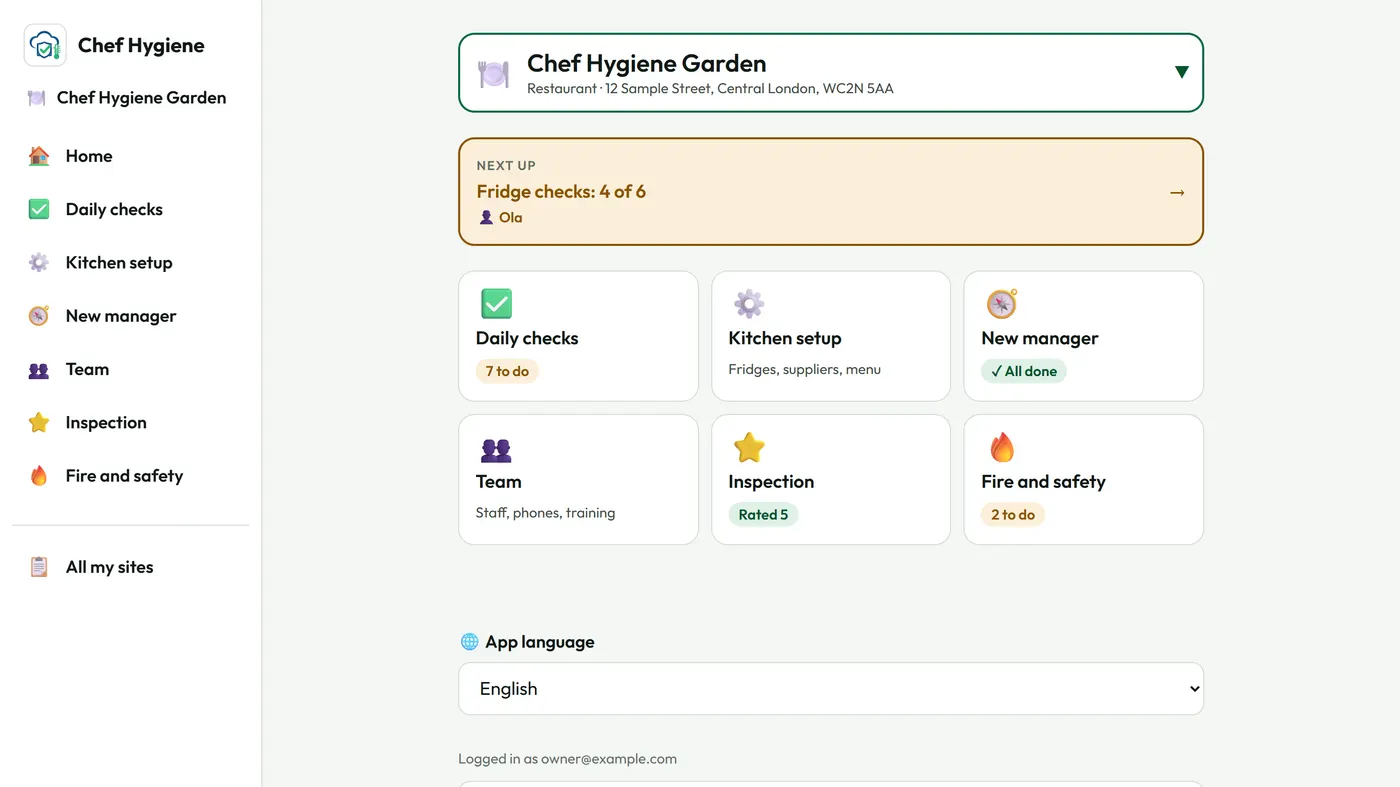
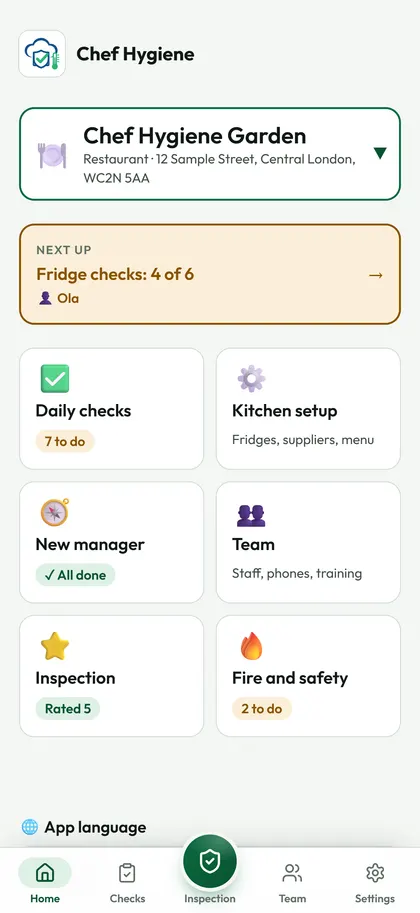
L’application charge ces règles pour votre cuisine, vérifie vos enregistrements par rapport à celles-ci et conserve les preuves pour l’inspecteur.
Autres pays
 Royaume-Uni
 Irlande
 Islande
 États-Unis
 Canada
 France
 Espagne
 Pays-Bas
 Belgique
 Portugal
 Allemagne
 Autriche
 Pologne
 Roumanie
 Italie
 Grèce
Grèce Danemark
 Suisse
 Luxembourg
 Chypre
 Malte
Malte Suède
Suède Norvège
 Finlande
 Tchéquie
 Croatie
 Bulgarie
 Slovaquie
 Slovénie
 Estonie
 Lettonie
 Lituanie
 Liechtenstein
 Saint-Marin
 Gibraltar
 Monaco
 Moldavie
 Andorre
 Serbie
 Jersey
 Guernesey
 Île de Man
 Turquie
 Monténégro
 Bosnie-Herzégovine
 Kosovo
 Albanie
 Macédoine du Nord
 Ukraine