 Pays-Bas : pour les restaurants et les plats à emporter
Prêt pour l’inspection sanitaire. Tous les jours.
In the European Netherlands, Chef Hygiene follows the Warenwetbesluit Bereiding en behandeling van levensmiddelen, EU Regulation 852/2004 and the KHN Hygiënecode voor de Horeca; the NVWA inspects.
14 jours gratuits · Un prix par site · Sans engagement
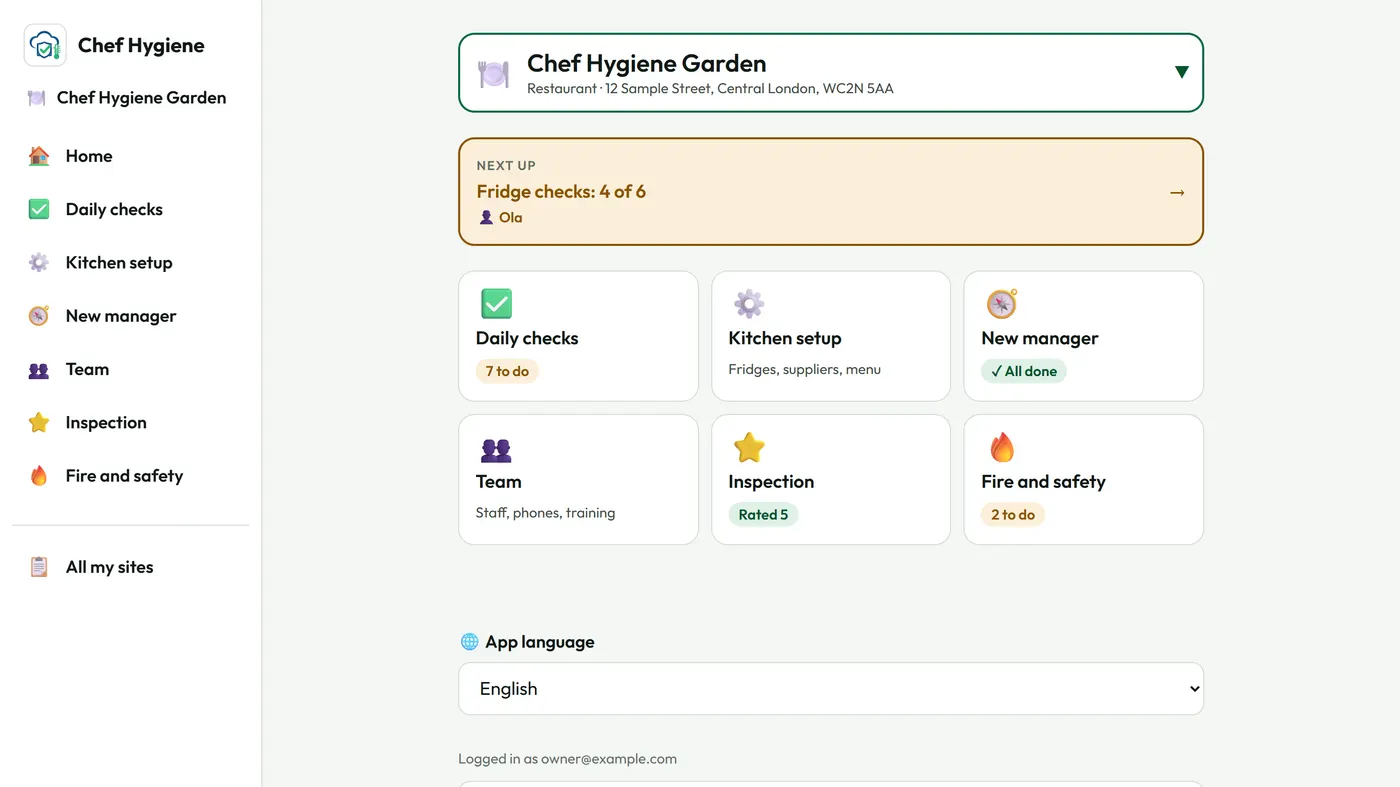
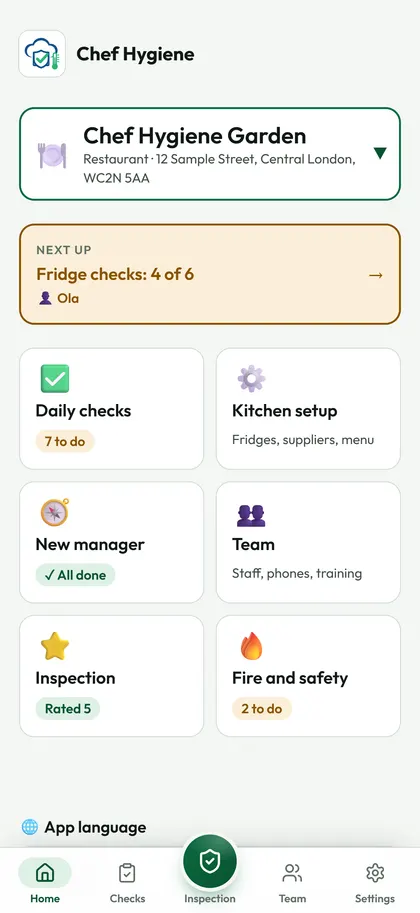
Pays-Bas : règles d'hygiène alimentaire
Le règlement de cette page est pour l’instant en anglais. Il sera traduit dans votre langue.
- organisme d’inspection
- Netherlands Food and Consumer Product Safety Authority (Nederlandse Voedsel- en Warenautoriteit, NVWA)
- Évaluation publique
- Oui
- Langues disponibles dans l’application
- Nederlands, English
Votre inspection
The NVWA inspects restaurants and takeaways for food safety. The municipality (gemeente) handles permits, the alcohol licence and local fire safety enforcement.
Visits are unannounced and based on risk. You must let the inspector in. A medium breach brings an official warning, and in hospitality a second one is followed by an administrative fine. A serious breach brings a fine at once and a re-inspection. Three or more serious breaches in 2 years mean verscherpt toezicht (stricter supervision), and the NVWA can then close the business.
Note d’hygiène
Yes, but there is no sticker. The NVWA publishes every result online under the Gezondheidswet, art. 44: Voldoet, Verbeterpunten vastgesteld, Verscherpt toezicht or Geen recente gegevens. A result stays online for at most 2 years.
La « loi » désigne une règle contraignante. Les « recommandations officielles » ne constituent pas une loi, mais les inspecteurs s’y attendent. « Chef Hygiene valeur par défaut » est une valeur de référence utilisée par l’application lorsqu’aucune règle ne spécifie de valeur numérique.
Températures
- LoiChilled food: 7°C or colder, measured in the food, in storage and in transport (Warenwetbesluit, art. 15(1)). A colder temperature on the label wins.
- Orientations officiellesChef Hygiene aims for a fridge setting of 4°C, as KHN and the Voedingscentrum advise. This is advice, not a legal limit.
- Orientations officiellesFrozen food: −18°C or colder (NVWA and the hygiene code).
- LoiHot food kept for direct sale: 60°C or hotter (art. 15(2)).
- Orientations officiellesCooking: 75°C or hotter in the centre (NVWA and the hygiene code).
- Orientations officiellesCooling: the law says only “as fast as possible” (Regulation 852/2004). The hygiene code starts at 75°C or hotter. It gives 20°C or colder after 2 hours as a guide value, and 7°C or colder within 5 hours as the norm.
- Orientations officiellesReheating: 60°C or hotter in the centre (NVWA), within 60 minutes (hygiene code).
- LoiIn restaurants, chilled food may stand out of the fridge once, for at most 2 hours, and is then thrown away. You need a written procedure and a log, kept for 1 year.
- Orientations officiellesThaw food in the fridge or under cold running water (NVWA).
Personnel, formation et santé
- LoiDutch law sets no food hygiene certificate, number of hours or renewal. Staff must be supervised and instructed to suit their work (Regulation 852/2004, Annex II, Chapter XII).
- Orientations officiellesStaff must know the hygiene code, and the owner may instruct them. The NVWA checks staff knowledge during inspections.
- LoiA person with a disease carried by food, infected wounds, skin infections, sores or diarrhoea must not handle food. They must report it at once (Regulation 852/2004, Annex II, Chapter VIII).
- Orientations officiellesFor norovirus, RIVM advises staff to return to their own work no earlier than 24 hours after vomiting or diarrhoea stops.
- LoiWith one or more employees you must appoint a BHV’er for first aid, fire fighting and evacuation (Arbowet, art. 15).
- LoiManagers on an alcohol licence must be 21 or older and hold the Verklaring Sociale Hygiëne (Alcoholwet, art. 8).
Allergènes
- LoiThe 14 EU allergens must be declared: gluten cereals, crustaceans, eggs, fish, peanuts, soya, milk, tree nuts, celery, mustard, sesame, sulphites, lupin and molluscs (Regulation 1169/2011).
- LoiWritten method: a clearly visible notice where the food is sold says where the allergen information is. The information is available in writing or electronically (Warenwetregeling allergeneninformatie, art. 2).
- LoiVerbal method (art. 3): staff can always give correct information before the sale. The written version is available to staff and the NVWA. A visible notice asks guests to ask staff.
Contrôles de sécurité incendie
- LoiRequired fire extinguishers and hose reels: maintenance with a function check at least every 2 years (Besluit bouwwerken leefomgeving, Bbl, art. 6.35). Insurers often ask for a yearly service.
- LoiTell the municipality at least 4 weeks before opening if more than 50 people will be inside (Bbl, art. 6.6 to 6.7).
- Orientations officiellesHood and duct cleaning has no legal interval. KHN advises at least once a year, and every 6 months with heavy grill, fryer or wok use. The municipality can ban cooking if a duct is dirty.
- Orientations officiellesGas appliances have no legal inspection interval for kitchens. The Arboportaal advises a check once a year as a safe minimum.
- Orientations officiellesThe electrical installation has no legal interval (Arbobesluit, art. 3.4). Insurers usually ask for a NEN 3140 inspection every 3 to 5 years.
Archives
- LoiYou need your own HACCP plan (Regulation 852/2004, art. 5) or an approved hygiene code. If you use the Hygiënecode voor de Horeca, you must follow it (Warenwetbesluit hygiëne van levensmiddelen, art. 5(2)).
- Orientations officiellesThe code’s model forms ask for fridge and freezer displays daily and a probe check weekly, deliveries weekly per supplier, and cooking, cooling, hot holding and reheating weekly.
- Orientations officiellesKHN advises keeping the code’s records for at least 6 months.
- LoiLogs of chilled food kept out of the fridge must be kept for at least 1 year (Warenwetregeling Vrijstelling gekoeld bewaren, art. 1).
Sources officielles
- NVWA: food safety in hospitality
- NVWA public inspection results
- Warenwetbesluit hygiëne van levensmiddelen
- KHN Hygiënecode voor de Horeca
- Warenwetregeling allergeneninformatie niet-voorverpakte levensmiddelen
Checked
Cette page contient des informations générales et ne constitue pas un avis juridique. Veuillez consulter les autorités locales compétentes.
Pays-Bas : guides d’hygiène alimentaire
Configurer Chef Hygiene
Créez votre compte, configurez une tablette de cuisine partagée et installez l'application sur les téléphones de vos collaborateurs, étape par étape.
Pays-Bas : inspections alimentaires
Qui inspecte votre cuisine, comment se déroule une inspection et s’il existe une évaluation de l’hygiène publique.
Pays-Bas : règles de température des aliments
Les températures des aliments que votre cuisine doit maintenir et les règles qui les sous-tendent.
Pays-Bas : allergènes
Ce que votre cuisine doit dire aux clients sur les allergènes.
Pays-Bas : maladie et formation du personnel
Formation, règles de manipulation des aliments et lorsque le personnel malade doit rester à l’écart de la nourriture.
Pays-Bas : sécurité incendie
Contrôles de sécurité incendie pour votre cuisine et fréquence à laquelle ils doivent être effectués.
Pays-Bas : enregistrements à conserver
Les registres et enregistrements que votre cuisine doit conserver.
Pays-Bas : l'application Chef Hygiene
L’application charge ces règles pour votre cuisine, vérifie vos enregistrements par rapport à celles-ci et conserve les preuves pour l’inspecteur.
Autres pays
 Royaume-Uni
 Irlande
 Islande
 États-Unis
 Canada
 France
 Espagne
 Belgique
 Portugal
 Allemagne
 Autriche
 Pologne
 Roumanie
 Italie
 Grèce
Grèce Danemark
 Suisse
 Luxembourg
 Chypre
 Malte
Malte Suède
Suède Norvège
 Finlande
 Tchéquie
 Hongrie
 Croatie
 Bulgarie
 Slovaquie
 Slovénie
 Estonie
 Lettonie
 Lituanie
 Liechtenstein
 Saint-Marin
 Gibraltar
 Monaco
 Moldavie
 Andorre
 Serbie
 Jersey
 Guernesey
 Île de Man
 Turquie
 Monténégro
 Bosnie-Herzégovine
 Kosovo
 Albanie
 Macédoine du Nord
 Ukraine