 Islande : pour les restaurants et les plats à emporter
Prêt pour l’inspection sanitaire. Tous les jours.
In Iceland the app follows the Act on Foodstuffs No. 93/1995 and EU Regulation 852/2004 (Regulation No. 103/2010), with MAST’s own-check guidance. Municipal health inspectorates inspect restaurants.
14 jours gratuits · Un prix par site · Sans engagement
Islande : règles d'hygiène alimentaire
Le règlement de cette page est pour l’instant en anglais. Il sera traduit dans votre langue.
- organisme d’inspection
- Icelandic Food and Veterinary Authority (Matvælastofnun, MAST); restaurants are inspected by the municipal health inspectorates (Heilbrigðiseftirlit)
- Évaluation publique
- Non
- Langues disponibles dans l’application
- Íslenska, English
Votre inspection
The municipal health inspectorates (Heilbrigðiseftirlit) inspect restaurants and issue operating permits (starfsleyfi). In Reykjavík this is Heilbrigðiseftirlit Reykjavíkur. MAST is the central competent authority for food safety and oversees large producers.
Your local health inspectorate usually inspects without warning. An inspector looks at your premises, equipment, food safety system and management knowledge. Keep your own-check system, its records and every instruction from the inspector in one place, available to the inspector. You must have an operating permit before you start, and it cannot be issued without an approved food safety plan.
Note d’hygiène
There is no 0–5 or sticker hygiene rating for restaurants in Iceland. Your local health inspectorate inspects and writes a report.
La « loi » désigne une règle contraignante. Les « recommandations officielles » ne constituent pas une loi, mais les inspecteurs s’y attendent. « Chef Hygiene valeur par défaut » est une valeur de référence utilisée par l’application lorsqu’aucune règle ne spécifie de valeur numérique.
Températures
- Orientations officiellesChilled food (kælihitastig): 0–4°C. Cold rooms should be no higher than 4°C.
- Orientations officiellesFrozen food (frystihitastig): −18°C or colder.
- Orientations officiellesHot holding: at least 60°C. In a hot counter, above 60°C and no longer than 2 hours.
- Orientations officiellesCooking: core temperature above 75°C for chicken, minced meat, stews and similar dishes. Burgers and other minced meat must reach 75°C at the core.
- Orientations officiellesReheating: above 75°C.
- Orientations officiellesCooling: cool cooked food in shallow containers to below 10°C within 3 hours, then put it in the fridge. Leftovers are cooled the same way, then dated and frozen.
- Orientations officiellesDefrosting: the food must never go above 4°C while thawing.
- Orientations officiellesDeliveries: chilled 0–4°C, frozen −18°C or colder, hot food at least 60°C. Measure and record on receipt. Reykjavík’s canteen handbook: 5–7°C means complain to the supplier, above 7°C means send it back.
- Orientations officiellesMeasure and record fridges and freezers at least once a day. Spot-check core temperatures, cooling and hot counters at least weekly. A surface thermometer cannot measure a core temperature.
Personnel, formation et santé
- LoiStaff must be supervised and instructed or trained for their work. Whoever runs the HACCP system must be trained in HACCP (Regulation 852/2004, Annex II).
- LoiAnyone with diarrhoea, vomiting, infected wounds or skin infections must not handle food if there is a risk of contamination, and must report it at once.
- Orientations officiellesMAST guidance: plan staff training and keep a record of it, covering food handling, microbes in food, the own-check system and each person’s duties.
Allergènes
- LoiEU Regulation 1169/2011 applies in Iceland. You must manage the 14 allergens: gluten, crustaceans, eggs, fish, peanuts, soybeans, milk, tree nuts, celery, mustard, sesame, sulphites, lupin and molluscs.
- LoiFor loose food served or sold in restaurants, written allergen information must be given where the food is presented, sold or supplied. It must be in Icelandic or English.
- Orientations officiellesA general notice such as this kitchen handles nuts is not enough. Give specific information for each dish.
Contrôles de sécurité incendie
- LoiSince the 2017 regulation on fire prevention and fire inspection (reglugerð um eldvarnir og eldvarnaeftirlit), businesses must check their own fire safety regularly (eigið eldvarnaeftirlit). They must also appoint a fire safety person (eldvarnafulltrúi).
- LoiThe Act on Working Environment, Health and Safety in Workplaces No. 46/1980 requires employers to prevent fires and take all reasonable measures for safety. The Housing and Construction Authority (HMS) coordinates fire prevention, and the fire brigades inspect.
- Chef Hygiene par défautChef Hygiene checks that gas appliances and pipes are inspected at least once a year.
Archives
- LoiA HACCP-based system with records is required (Regulation 852/2004, Article 5, through Regulation No. 103/2010). Records are kept for an appropriate period.
- Orientations officiellesKeep temperature, delivery, cleaning and training records. MAST’s own-check booklet gives example forms. Keep the system in one place and available to the inspector.
- Orientations officiellesUse a cleaning plan (þrifaáætlun) that says what, how, when and who, and record when and by whom cleaning is done. Sinks, worktops, floors and hand basins are cleaned daily; walls, doors and shelves weekly.
- Orientations officiellesIf you find pests, always call a pest controller (meindýraeyðir). A contract with marked bait points on a plan of the premises is best.
Sources officielles
- Reykjavík: food inspection (Heilbrigðiseftirlit Reykjavíkur)
- MAST: general own-check booklet (Almennt innra eftirlit)
- Act on Foodstuffs No. 93/1995 (Althingi)
- HMS: fire prevention (Brunavarnir)
Checked
Cette page contient des informations générales et ne constitue pas un avis juridique. Veuillez consulter les autorités locales compétentes.
Islande : guides d’hygiène alimentaire
Configurer Chef Hygiene
Créez votre compte, configurez une tablette de cuisine partagée et installez l'application sur les téléphones de vos collaborateurs, étape par étape.
Islande : inspections alimentaires
Qui inspecte votre cuisine, comment se déroule une inspection et s’il existe une évaluation de l’hygiène publique.
Islande : règles de température des aliments
Les températures des aliments que votre cuisine doit maintenir et les règles qui les sous-tendent.
Islande : allergènes
Ce que votre cuisine doit dire aux clients sur les allergènes.
Islande : maladie et formation du personnel
Formation, règles de manipulation des aliments et lorsque le personnel malade doit rester à l’écart de la nourriture.
Islande : sécurité incendie
Contrôles de sécurité incendie pour votre cuisine et fréquence à laquelle ils doivent être effectués.
Islande : enregistrements à conserver
Les registres et enregistrements que votre cuisine doit conserver.
Islande : l'application Chef Hygiene
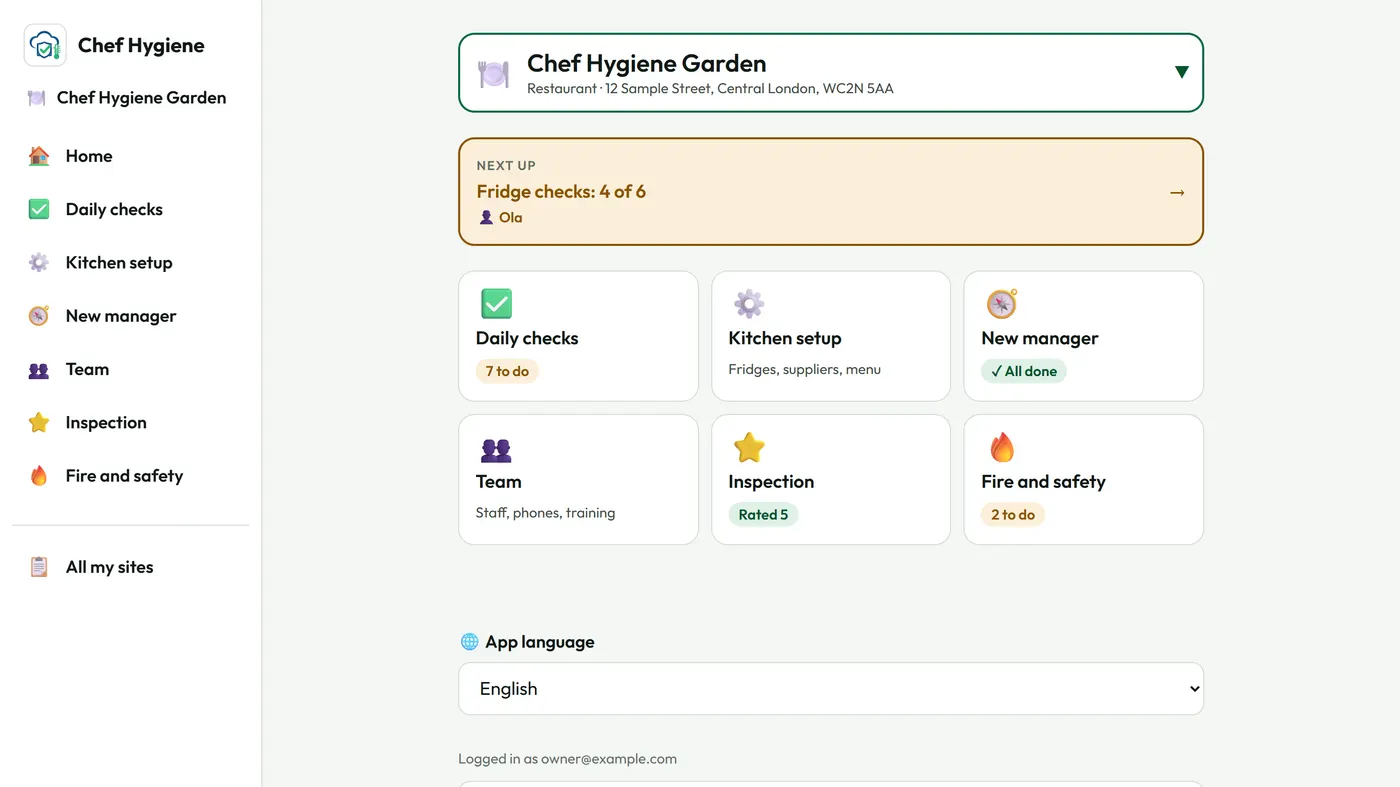
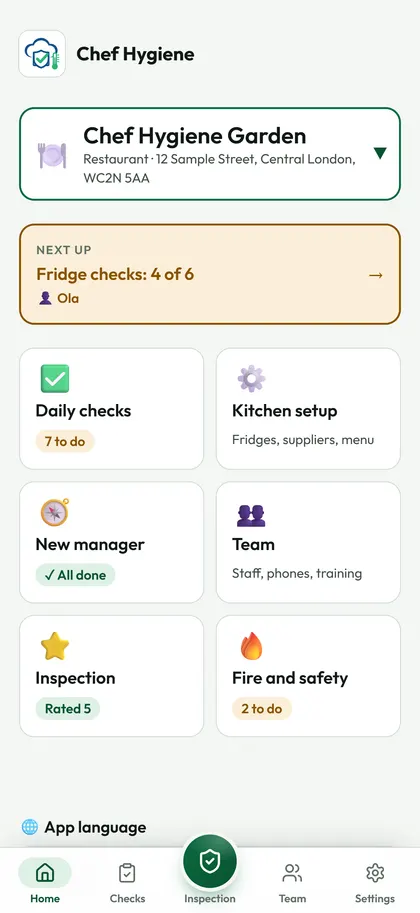
L’application charge ces règles pour votre cuisine, vérifie vos enregistrements par rapport à celles-ci et conserve les preuves pour l’inspecteur.
Autres pays
 Royaume-Uni
 Irlande
 États-Unis
 Canada
 France
 Espagne
 Pays-Bas
 Belgique
 Portugal
 Allemagne
 Autriche
 Pologne
 Roumanie
 Italie
 Grèce
Grèce Danemark
 Suisse
 Luxembourg
 Chypre
 Malte
Malte Suède
Suède Norvège
 Finlande
 Tchéquie
 Hongrie
 Croatie
 Bulgarie
 Slovaquie
 Slovénie
 Estonie
 Lettonie
 Lituanie
 Liechtenstein
 Saint-Marin
 Gibraltar
 Monaco
 Moldavie
 Andorre
 Serbie
 Jersey
 Guernesey
 Île de Man
 Turquie
 Monténégro
 Bosnie-Herzégovine
 Kosovo
 Albanie
 Macédoine du Nord
 Ukraine