 Malte : pour les restaurants et les plats à emporter
Prêt pour l’inspection sanitaire. Tous les jours.
In Malta the app follows the Food Safety Act (Cap. 449), the Temperature Control Regulations (S.L. 449.55) and the Malta Tourism Authority licence standards (S.L. 409.15); the FSSA inspects, and there is no public rating.
14 jours gratuits · Un prix par site · Sans engagement
Malte : règles d'hygiène alimentaire
Le règlement de cette page est pour l’instant en anglais. Il sera traduit dans votre langue.
- organisme d’inspection
- Food Safety and Security Authority (FSSA, Awtorità għas-Sigurtà tal-Ikel)
- Évaluation publique
- Non
- Langues disponibles dans l’application
- English
Votre inspection
The Food Safety and Security Authority (FSSA) has been the single food authority since 9 July 2025 (Act XV of 2025, Cap. 649). It registers, licenses and inspects food businesses. The Malta Tourism Authority (MTA) licenses catering places and checks the licence standards in S.L. 409.15.
Inspections are regular and happen when non-compliance is suspected, with frequency based on risk (Cap. 449, art. 26). Authorised officers can enter at reasonable times, inspect records on paper or computer, take samples and stop the use of food. They can issue an improvement notice with a deadline, or an emergency prohibition order, and the FSSA may close the premises if it is ignored. A first offence can bring a fine of €465.87 to €4,658.75 and/or up to 2 years in prison (Cap. 449, art. 43).
Note d’hygiène
Malta has no public hygiene rating, sticker or score, and nothing has to be displayed. The MTA First, Second and Third Class for restaurants is a tourism grade, not a hygiene rating.
La « loi » désigne une règle contraignante. Les « recommandations officielles » ne constituent pas une loi, mais les inspecteurs s’y attendent. « Chef Hygiene valeur par défaut » est une valeur de référence utilisée par l’application lorsqu’aucune règle ne spécifie de valeur numérique.
Températures
- LoiFood that can grow germs must not be kept above 8°C (S.L. 449.55, reg. 3).
- LoiMTA licence standards: fish and meat at 0–3°C in every licensed restaurant, snack bar and kiosk. Vegetables, eggs and cooked food at 2–10°C. Thawing never above 10°C (S.L. 409.15).
- LoiQuick-frozen food must be at −18°C or colder. It may rise briefly to −15°C in transport (S.L. 449.33, regs 5 and 6). The MTA standard for kitchens is also −18°C.
- LoiHot food must be kept at 63°C or more. Food on display for under 2 hours that was not displayed before is a defence (S.L. 449.55, reg. 6). Chef Hygiene checks hot holding against 65°C, the MTA figure.
- LoiMTA licence standards: buffet hot food and hot display counters at 65°C or more. Buffet cold food at 10°C or less (S.L. 409.15).
- LoiCool cooked food as quickly as possible. The regulations give no time (S.L. 449.55, reg. 8). The public health booklet (HPDP, 2025) advises small shallow containers and no more than 1 hour out of the fridge.
- LoiReheat food to a core temperature of at least 70°C, or higher if the food needs it (S.L. 449.55, reg. 10). The HPDP 2025 booklet advises 75°C.
- Orientations officiellesThe HPDP 2025 booklet advises cooking to 75°C, chilled food at 5°C or below and leftovers eaten within 2 days. This is public advice, not law.
Personnel, formation et santé
- LoiEvery food handler must be registered and hold a food handler card, shown on request. Employers may not use unregistered handlers (S.L. 449.27).
- LoiCategory B (preparing high-risk food, such as cooks) is valid for 5 years. Category A (wrapped or low-risk food, or staff who do not prepare food) is valid for 2 years. Renewal needs a new course certificate.
- LoiMTA licence standards for restaurants: staff have an MTA-recognised induction, regular training, and training on fire-fighting equipment (S.L. 409.15).
- LoiAnyone with typhoid, a salmonella or staphylococcal infection, or any infection likely to cause food poisoning, must not work with food (Cap. 449, art. 22). Infected wounds, skin infections, sores or diarrhoea: stay out of food areas and tell the employer.
- LoiThe authority can require a medical examination (S.L. 449.27, reg. 6). No fixed time off or medical certificate is set in law.
Allergènes
- LoiAllergen information on the 14 EU allergens is mandatory for food that is not prepacked (Regulation 1169/2011, art. 44).
- Chef Hygiene par défautChef Hygiene checks for a written list per dish and an “ask staff” sign. This is the app’s default.
Contrôles de sécurité incendie
- LoiFire drills must be held at least every 6 months and recorded. A fire safety expert recognised by the Civil Protection Department (CPD) may set a longer interval in writing, never over 12 months (S.L. 646.08, reg. 9).
- LoiFire equipment must be under a suitable system of maintenance to the CPD’s satisfaction, with records (S.L. 646.08). The law gives no interval. Chef Hygiene suggests a yearly service.
- LoiMTA standards for restaurants: service date shown on each extinguisher, a maintenance certificate from a professional, an automatic fire alarm, emergency lighting, and an evacuation exercise at least yearly. The extraction hood must be properly maintained, with no interval set.
- LoiThe electrical installation and its earthing must be inspected and tested periodically by a licensed electrician, at the interval the electrician recommends (S.L. 545.24, reg. 16).
- LoiMalta has no natural gas network, only LPG cylinders. An LPG store over 150 kg or with 6 or more linked cylinders needs authorisation from the regulator REWS, valid for 10 years (S.L. 545.20). Chef Hygiene suggests a yearly check by an approved LPG installer.
Archives
- LoiHACCP-based procedures are required, with records that fit the size of the business (Regulation 852/2004, art. 5).
- LoiMTA licence standards for restaurants: keep a temperature register and pest control inspection records (S.L. 409.15). Chef Hygiene asks for temperature checks twice a day.
- LoiRegister the premises with the FSSA if used 3 or more days in any 3 consecutive weeks. Report a new owner or change of business within 28 days (S.L. 449.28). The MTA catering licence runs to 31 December and is renewed each year (Cap. 409).
Sources officielles
- Food Safety and Security Authority (FSSA)
- Food Safety Act, Cap. 449
- Food Safety (Temperature Control) Regulations, S.L. 449.55
- Food handler registration, S.L. 449.27
- Malta Tourism Authority, catering licence standards S.L. 409.15
Checked
Cette page contient des informations générales et ne constitue pas un avis juridique. Veuillez consulter les autorités locales compétentes.
Malte : guides d’hygiène alimentaire
Configurer Chef Hygiene
Créez votre compte, configurez une tablette de cuisine partagée et installez l'application sur les téléphones de vos collaborateurs, étape par étape.
Malte : inspections alimentaires
Qui inspecte votre cuisine, comment se déroule une inspection et s’il existe une évaluation de l’hygiène publique.
Malte : règles de température des aliments
Les températures des aliments que votre cuisine doit maintenir et les règles qui les sous-tendent.
Malte : allergènes
Ce que votre cuisine doit dire aux clients sur les allergènes.
Malte : maladie et formation du personnel
Formation, règles de manipulation des aliments et lorsque le personnel malade doit rester à l’écart de la nourriture.
Malte : sécurité incendie
Contrôles de sécurité incendie pour votre cuisine et fréquence à laquelle ils doivent être effectués.
Malte : enregistrements à conserver
Les registres et enregistrements que votre cuisine doit conserver.
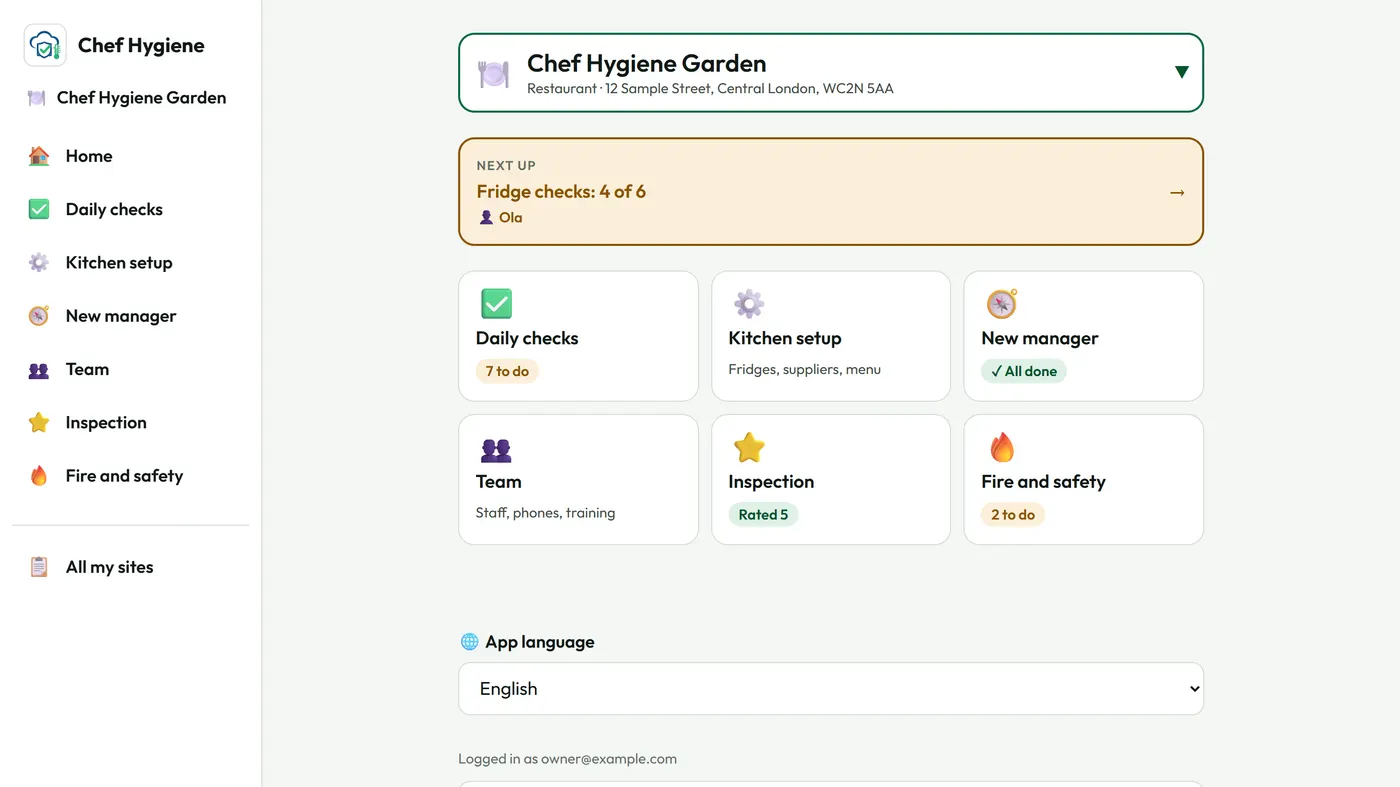
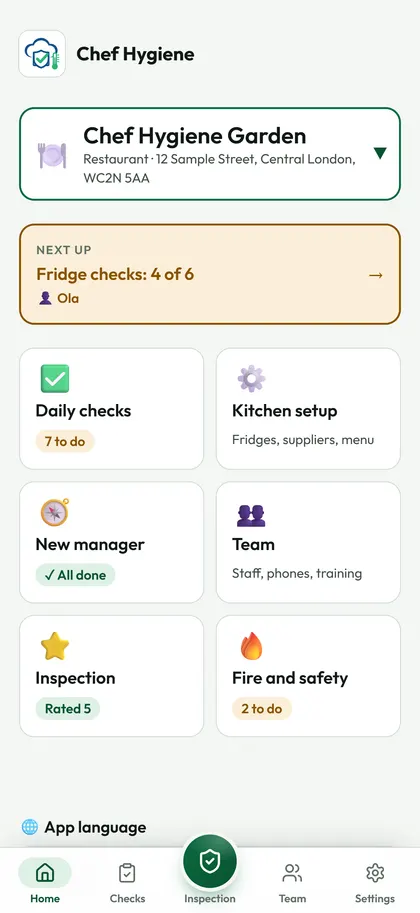
Malte : l'application Chef Hygiene
L’application charge ces règles pour votre cuisine, vérifie vos enregistrements par rapport à celles-ci et conserve les preuves pour l’inspecteur.
Autres pays
 Royaume-Uni
 Irlande
 Islande
 États-Unis
 Canada
 France
 Espagne
 Pays-Bas
 Belgique
 Portugal
 Allemagne
 Autriche
 Pologne
 Roumanie
 Italie
 Grèce
Grèce Danemark
 Suisse
 Luxembourg
 Chypre
 Suède
Suède Norvège
 Finlande
 Tchéquie
 Hongrie
 Croatie
 Bulgarie
 Slovaquie
 Slovénie
 Estonie
 Lettonie
 Lituanie
 Liechtenstein
 Saint-Marin
 Gibraltar
 Monaco
 Moldavie
 Andorre
 Serbie
 Jersey
 Guernesey
 Île de Man
 Turquie
 Monténégro
 Bosnie-Herzégovine
 Kosovo
 Albanie
 Macédoine du Nord
 Ukraine