 Suède : pour les restaurants et les plats à emporter
Prêt pour l’inspection sanitaire. Tous les jours.
Chef Hygiene follows EU Regulation 852/2004 and the Swedish Food Agency’s guidance (Kontrollwiki) and the Visita restaurant guide, because no Swedish law sets restaurant temperatures; the municipality inspects.
14 jours gratuits · Un prix par site · Sans engagement
Suède : règles d'hygiène alimentaire
Le règlement de cette page est pour l’instant en anglais. Il sera traduit dans votre langue.
- organisme d’inspection
- Municipal environment and health committee (kommunens miljö- och hälsoskyddsnämnd), led by the Swedish Food Agency (Livsmedelsverket)
- Évaluation publique
- Non
- Langues disponibles dans l’application
- Svenska, English
Votre inspection
Your municipality inspects restaurants and cafés through its environment and health committee (Livsmedelslag 2006:804). The Swedish Food Agency (Livsmedelsverket) leads and coordinates the control. The county boards support and audit the municipalities.
Controls are unannounced as a rule (EU Regulation 2017/625). How often depends on a risk class: a small restaurant gets about 1 control a year, as an official example (guidance). You pay by the hour afterwards, at your municipality’s rate. After a deviation you get a report and about 2 weeks to answer. Then the municipality can give an order, which can carry a fine (vite), a ban or a temporary closure.
Note d’hygiène
There is no national rating, sticker or smiley, and no duty to show a result. The national result words are Utan avvikelse (no deviation) and Avvikelse (deviation). Some municipalities publish results in their own way, and reports are public on request.
La « loi » désigne une règle contraignante. Les « recommandations officielles » ne constituent pas une loi, mais les inspecteurs s’y attendent. « Chef Hygiene valeur par défaut » est une valeur de référence utilisée par l’application lorsqu’aucune règle ne spécifie de valeur numérique.
Températures
- Orientations officiellesFridge: the Swedish Food Agency advises 4°C, and Visita (the industry guide) gives 0 to 8°C. Above 8°C the risk rises sharply. Mince 4°C, and fresh fish fillet on ice or 2°C. A colder label wins.
- Orientations officiellesFreezer: −18°C (guidance). Quick-frozen food may rise briefly to −15°C (LIVSFS 2006:12, § 5).
- Orientations officiellesCooking: 70°C in the centre is the usual value in the Food Agency’s guidance and the industry guides. Visita says: if unsure, use 70°C.
- LoiFish that may carry parasites: 60°C in the centre for 1 minute, or freeze it first at −20°C for 24 hours or −35°C for 15 hours (EU Regulation 853/2004).
- Orientations officiellesHot holding: 60°C or hotter is the guide value, or 2 hours at most. Hot food held over 2 hours and under 50°C is thrown away, otherwise it is reheated to above 70°C (Visita).
- Orientations officiellesCooling: from 60°C to 8°C within 6 hours. Visita says to measure it every time and throw the food away if it fails.
- Orientations officiellesReheating: 70°C or hotter, as fast as possible (guidance).
- Orientations officiellesCold buffet: under 8°C, or 2 hours at most, then throw the food away (Visita).
- Orientations officiellesDeliveries: accept chilled food at the product’s own temperature, so 8°C for ordinary chilled food. Reject frozen food above −15°C (Visita).
Personnel, formation et santé
- LoiThere is no hygiene certificate, set hours or renewal. The owner must make sure staff know enough, and instruction and supervision can be enough (EU Regulation 852/2004; Food Agency guidance).
- Orientations officiellesVisita advises you to review each person’s training need at least once a year.
- LoiStaff with a disease that can spread through food, infected wounds or diarrhoea must not handle food. They must tell the employer at once, and you need a routine for this (EU Regulation 852/2004).
- Orientations officiellesNo Swedish law sets a time to stay away. Visita advises 2 days after the symptoms stop for norovirus and rotavirus. With Salmonella, Shigella or EHEC, not until free of the infection.
Allergènes
- LoiThe 14 EU allergens must be covered. For food that is not prepacked, you must give the allergen information or a notice that it is available, even if nobody asks (LIVSFS 2014:4, § 10).
- LoiThe information can be given orally, on a sign by the food, on written material or on the menu. If it is given only on request, make clear how to get it, for example a sign such as “Fråga oss om allergena ingredienser”, or tell each guest.
- LoiAllergen information for guests must be in Swedish (LIVSFS 2014:4, § 5). Other languages may be added.
Contrôles de sécurité incendie
- Orientations officiellesFire extinguishers: a technician service every year, with an overhaul after 5 years (water, foam) or 10 years (powder, CO2). The owner also looks at them every 1 to 3 months (standard SS 3656, via MCF).
- LoiKitchen hood ducts (imkanaler): a fire-safety control every 2 years, done by the municipality’s chimney sweep (MSBFS 2014:6). Cleaning follows the municipality’s schedule (LSO 3 kap. 4 §).
- Orientations officiellesGas: a leak test before first use and again when needed (MSBFS 2020:1). Advice is a check every 2 years, and rubber or plastic hoses every year.
- LoiElectrics: the holder needs its own documented, risk-based routine. There is no fixed interval (Elsäkerhetslag; ELSÄK-FS 2022:3).
Archives
- LoiEvery food business needs a self-check system (egenkontroll): basic hygiene routines plus procedures based on HACCP (EU Regulation 852/2004, article 5). There is no required format.
- Orientations officiellesWritten records are required only for traceability and critical control points. The owner decides the rest (Visita).
- Chef Hygiene par défautNo Swedish text sets a number of years for records. The Food Agency says a reasonably long period. Chef Hygiene suggests 1 year.
Sources officielles
- Swedish Food Agency (Livsmedelsverket)
- Kontrollwiki (Livsmedelsverket)
- Food Act, Livsmedelslag 2006:804 (Riksdagen)
- Visita, hygiene guidelines for restaurants
Checked
Cette page contient des informations générales et ne constitue pas un avis juridique. Veuillez consulter les autorités locales compétentes.
Suède : guides d’hygiène alimentaire
Configurer Chef Hygiene
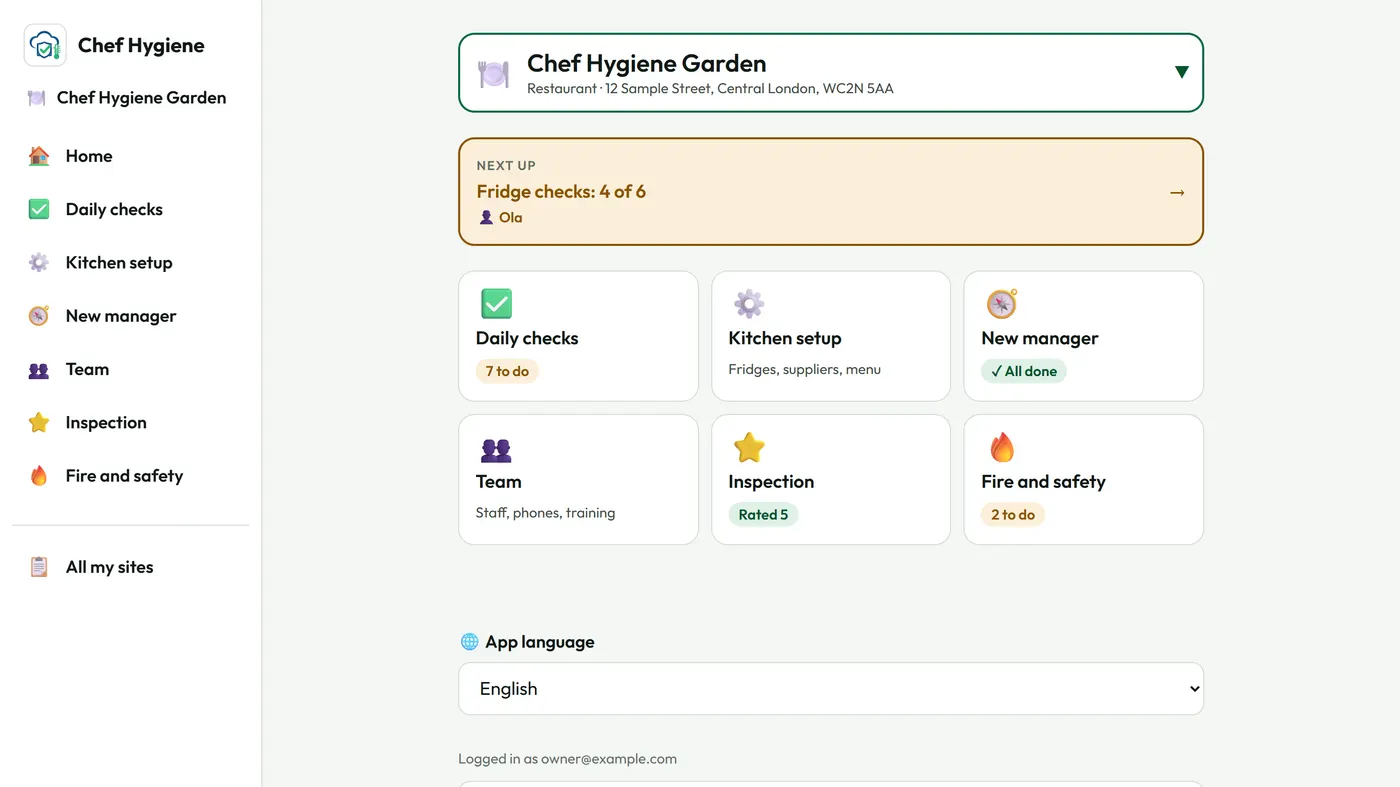
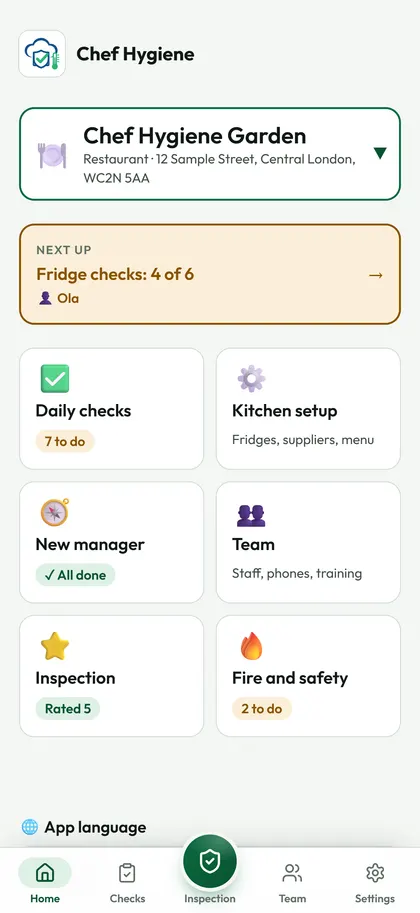
Créez votre compte, configurez une tablette de cuisine partagée et installez l'application sur les téléphones de vos collaborateurs, étape par étape.
Suède : inspections alimentaires
Qui inspecte votre cuisine, comment se déroule une inspection et s’il existe une évaluation de l’hygiène publique.
Suède : règles de température des aliments
Les températures des aliments que votre cuisine doit maintenir et les règles qui les sous-tendent.
Suède : allergènes
Ce que votre cuisine doit dire aux clients sur les allergènes.
Suède : maladie et formation du personnel
Formation, règles de manipulation des aliments et lorsque le personnel malade doit rester à l’écart de la nourriture.
Suède : sécurité incendie
Contrôles de sécurité incendie pour votre cuisine et fréquence à laquelle ils doivent être effectués.
Suède : enregistrements à conserver
Les registres et enregistrements que votre cuisine doit conserver.
Suède : l'application Chef Hygiene
L’application charge ces règles pour votre cuisine, vérifie vos enregistrements par rapport à celles-ci et conserve les preuves pour l’inspecteur.
Autres pays
 Royaume-Uni
 Irlande
 Islande
 États-Unis
 Canada
 France
 Espagne
 Pays-Bas
 Belgique
 Portugal
 Allemagne
 Autriche
 Pologne
 Roumanie
 Italie
 Grèce
Grèce Danemark
 Suisse
 Luxembourg
 Chypre
 Malte
Malte Norvège
 Finlande
 Tchéquie
 Hongrie
 Croatie
 Bulgarie
 Slovaquie
 Slovénie
 Estonie
 Lettonie
 Lituanie
 Liechtenstein
 Saint-Marin
 Gibraltar
 Monaco
 Moldavie
 Andorre
 Serbie
 Jersey
 Guernesey
 Île de Man
 Turquie
 Monténégro
 Bosnie-Herzégovine
 Kosovo
 Albanie
 Macédoine du Nord
 Ukraine