 Allemagne : pour les restaurants et les plats à emporter
Prêt pour l’inspection sanitaire. Tous les jours.
In Germany the app follows the food hygiene law (LFGB, LMHV, IfSG), EU Regulation 852/2004 and the BfR’s guidance; the food control office of your district or city inspects.
14 jours gratuits · Un prix par site · Sans engagement
Allemagne : règles d'hygiène alimentaire
Le règlement de cette page est pour l’instant en anglais. Il sera traduit dans votre langue.
- organisme d’inspection
- Food control office of the district or city (Lebensmittelüberwachung, also called Veterinär- und Lebensmittelüberwachungsamt)
- Évaluation publique
- Non
- Langues disponibles dans l’application
- Deutsch, English
Votre inspection
Food control is a task of each federal state (Land). In practice the food control office of the district or city (Lebensmittelüberwachung) inspects restaurants. The federal office BVL only coordinates and does not inspect restaurants.
Visits are based on risk. As a rule they are not announced. The authority can order tests and ban sales until the results come in. EU law also lets it stop all or part of a business’s activities. Fines run up to €100,000, €50,000 or €20,000 depending on the rule broken, and serious cases can be crimes.
Note d’hygiène
There is no hygiene rating, sticker or duty to display a result in any Land. When hygiene rules were broken badly or repeatedly and a fine of at least €350 is expected, the Land publishes the business name and the breach online for 6 months.
La « loi » désigne une règle contraignante. Les « recommandations officielles » ne constituent pas une loi, mais les inspecteurs s’y attendent. « Chef Hygiene valeur par défaut » est une valeur de référence utilisée par l’application lorsqu’aucune règle ne spécifie de valeur numérique.
Températures
- Orientations officiellesChef Hygiene checks fridges against 4°C as the aim and 7°C as the limit for chilled food and cold dishes. This follows BfR guidance and DIN 10508; German law sets no general fridge number for restaurants.
- Orientations officiellesRaw meat, poultry, mince and fresh fish: 2°C or colder when the label says nothing (BfR guidance). DIN 10508 says fresh fish at 2°C or on melting ice.
- LoiA storage temperature on a product’s label always applies.
- LoiMince made in your kitchen (Tier-LMHV Annex 5): use meat at 7°C or colder, poultry at 4°C, offal at 3°C. If it is not served where it was made, wrap it at once and chill it to 2°C in the core (mince) or 4°C (meat preparations), or freeze it to −18°C.
- LoiFrozen food: −18°C or colder. A short rise of at most 3°C is allowed in transport and shop freezers (TLMV § 2, the law for quick-frozen food).
- Chef Hygiene par défautChef Hygiene checks hot food against 65°C, the stricter value. The BfR advises 60°C or hotter at every point (2020) and no more than 3 hours; older DIN 10508 and many local sheets say 65°C.
- Orientations officiellesCooling: from 65°C to 10°C within 2 hours (DIN 10508 and local food control sheets). EU law only says to cool food as quickly as possible.
- Orientations officiellesCooking and reheating: 72°C in the centre for at least 2 minutes (BfR guidance, 2024). No German law sets this number.
- LoiDeliveries: suppliers must keep mince at 2°C or colder, poultry and meat preparations at 4°C, offal at 3°C, other meat at 7°C, and fresh fish near melting ice (Regulation 853/2004). Frozen food stays at −18°C; Chef Hygiene flags frozen deliveries above −15°C.
Personnel, formation et santé
- LoiIfSG certificate: before the first day of food work, every worker needs a certificate from the health office (Gesundheitsamt) or a doctor it commissions. It must be no older than 3 months at the start and has no expiry date (IfSG § 43).
- LoiInstruction by the employer: after the start and then every 2 years, you instruct staff on work bans and the duty to report illness, and you document it. Keep the certificate and the last record (IfSG § 43). Employing someone without the certificate can cost up to €25,000.
- LoiAnyone who makes, handles or sells perishable food needs food hygiene training (LMHV § 4). The law sets no hours, certificate or renewal, but you must be able to show proof on request.
- Orientations officiellesMunich’s food control office asks you to write down who was trained, when, on what topics and by whom, at hiring and at least once a year.
- LoiSick staff: nobody may work in a restaurant kitchen while ill with, or suspected of, typhoid, paratyphoid, cholera, shigellosis, salmonellosis, other infectious gastroenteritis or hepatitis A or E. The same applies with infected wounds or skin disease. Staff must tell the employer at once (IfSG §§ 42, 43).
Allergènes
- LoiThe 14 EU allergens: cereals with gluten, crustaceans, eggs, fish, peanuts, soybeans, milk, tree nuts, celery, mustard, sesame, sulphites, lupin and molluscs.
- LoiFor food that is not prepacked, tell guests before the sale, in German. Do it in writing (menu, sign, notice or screen) (LMIDV § 4).
- LoiTelling guests by word of mouth is allowed only if a written or electronic ingredient record exists, the authority and guests can see it on request, and a clear notice says so (LMIDV § 4).
- LoiSome additives must also be named on menus, for example “mit Farbstoff” (with colouring) and “mit Konservierungsstoff” (with preservative) (LMZDV § 5).
Contrôles de sécurité incendie
- Orientations officiellesFire extinguishers are serviced every 2 years by a competent person, and the result is documented (ASR A2.2). Fryers and woks need a class F extinguisher (BGN guidance).
- Orientations officiellesKitchen hood and grease filters are checked every working day. Ducts, fan and interlocks are checked every 6 months, and an exhaust test is done every year (BGN, VDI 2052, DGUV Regel 110-003).
- Orientations officiellesGas appliances and their flame-failure devices get a function check every year. The owner also looks over the whole gas installation every year (BGN, DGUV Regel 110-003).
- LoiLiquefied gas (LPG) must be tested by a competent person: fixed installations at least every 4 years, mobile ones every 2 years, and every year in a room below ground (BetrSichV, Annex 3).
- Orientations officiellesA qualified electrician tests the fixed electrical installation every 4 years. Portable appliances are tested about every 6 months, at most yearly if few faults are found (DGUV Regel 110-003).
Archives
- LoiYou need food safety procedures based on HACCP principles (EU Regulation 852/2004, art. 5). German food hygiene law (LMHV) has no separate HACCP rules.
- Orientations officiellesThe recognised national guide for restaurants is DEHOGA’s “Leitlinie für eine Gute Hygienepraxis in der Gastronomie” (3rd edition, 2022). It is sold and not free.
- LoiKeep your monitoring records, for example temperatures, cleaning and deliveries, for an appropriate period (Regulation 852/2004). Restaurants record who supplied what, but not their guests.
- Orientations officiellesKeep equipment test records at least until the next test, and for LPG installations for their whole life (BGN guidance).
Sources officielles
- Federal Office of Consumer Protection and Food Safety (BVL)
- Federal Institute for Risk Assessment (BfR)
- German federal laws (gesetze-im-internet.de)
- Robert Koch Institute: IfSG instruction leaflets
- BGN, accident insurer for hotels and restaurants
Checked
Cette page contient des informations générales et ne constitue pas un avis juridique. Veuillez consulter les autorités locales compétentes.
Allemagne : guides d’hygiène alimentaire
Configurer Chef Hygiene
Créez votre compte, configurez une tablette de cuisine partagée et installez l'application sur les téléphones de vos collaborateurs, étape par étape.
Allemagne : inspections alimentaires
Qui inspecte votre cuisine, comment se déroule une inspection et s’il existe une évaluation de l’hygiène publique.
Allemagne : règles de température des aliments
Les températures des aliments que votre cuisine doit maintenir et les règles qui les sous-tendent.
Allemagne : allergènes
Ce que votre cuisine doit dire aux clients sur les allergènes.
Allemagne : maladie et formation du personnel
Formation, règles de manipulation des aliments et lorsque le personnel malade doit rester à l’écart de la nourriture.
Allemagne : sécurité incendie
Contrôles de sécurité incendie pour votre cuisine et fréquence à laquelle ils doivent être effectués.
Allemagne : enregistrements à conserver
Les registres et enregistrements que votre cuisine doit conserver.
Allemagne : l'application Chef Hygiene
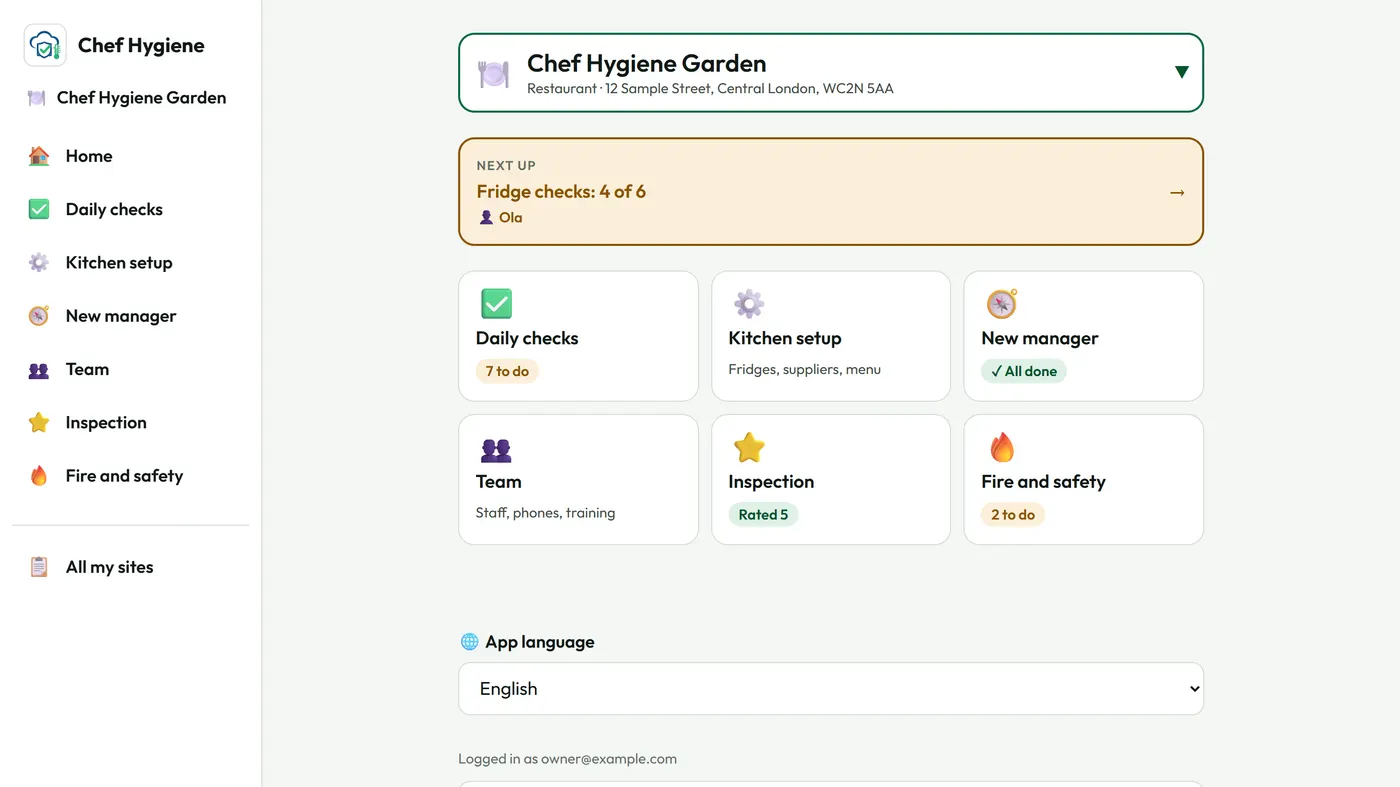
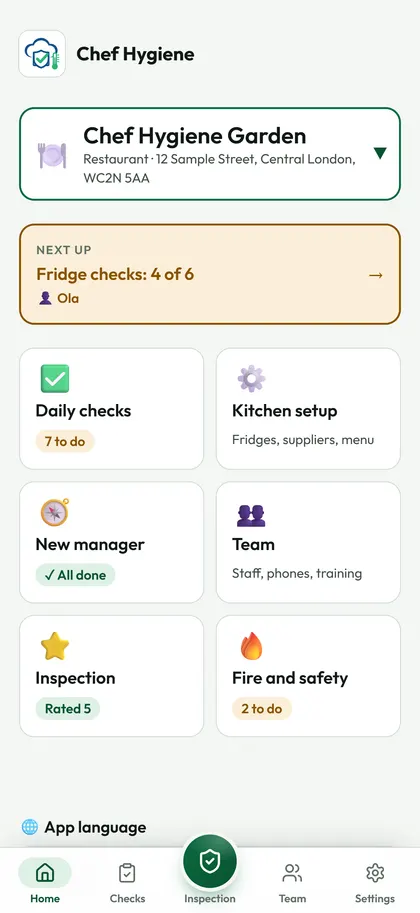
L’application charge ces règles pour votre cuisine, vérifie vos enregistrements par rapport à celles-ci et conserve les preuves pour l’inspecteur.
Autres pays
 Royaume-Uni
 Irlande
 Islande
 États-Unis
 Canada
 France
 Espagne
 Pays-Bas
 Belgique
 Portugal
 Autriche
 Pologne
 Roumanie
 Italie
 Grèce
Grèce Danemark
 Suisse
 Luxembourg
 Chypre
 Malte
Malte Suède
Suède Norvège
 Finlande
 Tchéquie
 Hongrie
 Croatie
 Bulgarie
 Slovaquie
 Slovénie
 Estonie
 Lettonie
 Lituanie
 Liechtenstein
 Saint-Marin
 Gibraltar
 Monaco
 Moldavie
 Andorre
 Serbie
 Jersey
 Guernesey
 Île de Man
 Turquie
 Monténégro
 Bosnie-Herzégovine
 Kosovo
 Albanie
 Macédoine du Nord
 Ukraine