 Canada : pour les restaurants et les plats à emporter
Prêt pour l’inspection sanitaire. Tous les jours.
In Canada the app follows the national Food Retail and Food Services Code (2016) and Health Canada’s safe temperatures, with each province’s own rules. Provincial and local health authorities inspect. Quebec comes later, in French.
14 jours gratuits · Un prix par site · Sans engagement
Canada : règles d'hygiène alimentaire
Le règlement de cette page est pour l’instant en anglais. Il sera traduit dans votre langue.
- organisme d’inspection
- Provincial and territorial governments and their health authorities (the Canadian Food Inspection Agency, CFIA, covers only food traded between provinces, imported or exported)
- Évaluation publique
- Non
- Langues disponibles dans l’application
- English
Votre inspection
Provincial and territorial governments regulate restaurants, takeaways and cafés within their borders, and many provinces let municipal authorities enforce the rules locally. The CFIA licenses only businesses that import, export or trade food between provinces.
Rules and inspections differ by province. The national Food Retail and Food Services Code (2016) is a model code, not federal law: each province chooses whether to adopt it. Check your province’s food safety rules and your local health authority.
Note d’hygiène
There is no national grade. Inspection results are public in most provinces, for example through Ontario’s boards of health, Toronto DineSafe, British Columbia’s health authorities, Alberta Health Services, Saskatchewan and Prince Edward Island.
La « loi » désigne une règle contraignante. Les « recommandations officielles » ne constituent pas une loi, mais les inspecteurs s’y attendent. « Chef Hygiene valeur par défaut » est une valeur de référence utilisée par l’application lorsqu’aucune règle ne spécifie de valeur numérique.
Températures
- Orientations officiellesKeep fridges at 4°C or lower and hot food at 60°C or higher (national code, with Ontario’s numbers).
- LoiManitoba: hazardous food must be kept at 5°C or lower (M.R. 339/88 R).
- Orientations officiellesKeep freezers at −18°C or lower.
- Orientations officiellesCooking, internal temperature (Health Canada): whole poultry 82°C; poultry pieces and ground poultry 74°C; egg dishes 74°C; shellfish 74°C.
- Orientations officiellesCooking, internal temperature (Health Canada): ground meat 71°C; pork 71°C; fish 70°C; beef, veal and lamb steaks from 63°C (medium-rare) to 77°C (well done).
- Orientations officiellesReheating: leftovers to 74°C (Health Canada). British Columbia: 74°C within 2 hours.
- Orientations officiellesCooling: cooked food goes from 60°C to 20°C within 2 hours, then to 4°C within another 4 hours, 6 hours in total. Quebec: 60°C to 21°C in 2 hours, then to 4°C.
- Orientations officiellesThe danger zone for bacteria is 4°C to 60°C, where they grow fastest.
- Chef Hygiene par défautChef Hygiene checks chilled deliveries at 4°C or lower and frozen food at −15°C or lower. Manitoba: chilled at 5°C or lower.
Personnel, formation et santé
- Orientations officiellesProvinces ask for trained food handlers. Ontario: a trained person every hour of operation. Alberta: a certified person, and with 6 or more food handlers a certified manager or supervisor on site.
- Orientations officiellesBritish Columbia: FOODSAFE for the operator, and a FOODSAFE holder present when the operator is away. Manitoba: a certified food handler, and one on duty at all times when more than 5 handlers work at once.
- Orientations officiellesNova Scotia: the operator, and a trained person present when the operator is away, renewed every 5 years. Quebec: training for 10% of staff (manager course 12 hours, handler course 6 hours).
Allergènes
- Orientations officiellesHealth Canada lists 11 priority allergens: peanuts, tree nuts, sesame seeds, fish, crustaceans and molluscs, eggs, milk, soy, wheat and triticale, mustard and sulphites.
- Chef Hygiene par défautThis list is for labels on prepackaged food. No federal law makes restaurants list these allergens on menus. Chef Hygiene uses the 11 for its allergen chart.
Contrôles de sécurité incendie
- Orientations officiellesThe National Fire Code of Canada 2020 is the model code for the provinces. Kitchen hoods follow NFPA 96, and fire suppression systems follow NFPA 17A or NFPA 10.
- Orientations officiellesFire protection equipment is inspected by a qualified person at least every 6 months. Portable extinguishers are looked over every month and fully serviced every year.
- Orientations officiellesAutomatic fire suppression systems need supervisory monitoring, so an alarm sounds on a fault or when the system operates.
- Orientations officiellesYour fire department and your province’s fire marshal or fire commissioner enforce the provincial fire code. Many restaurants also need a written fire safety plan approved by the fire department.
- Chef Hygiene par défautChef Hygiene checks that the hood’s fire suppression system is inspected every 6 months. It also checks for a Class K extinguisher within 9 metres (30 feet) of the fryers.
Archives
- LoiWHMIS 2015: employers must make sure hazardous products are labelled, keep the Safety Data Sheets (SDS) available to employees, and train workers. Suppliers provide the labels and SDS.
Sources officielles
- Health Canada: food safety and cooking temperatures
- Health Canada: safe food storage and cooling
- Health Canada: priority food allergens
- National Fire Code of Canada 2020
- WHMIS 2015 (Government of Canada)
Checked
Cette page contient des informations générales et ne constitue pas un avis juridique. Veuillez consulter les autorités locales compétentes.
Canada : guides d’hygiène alimentaire
Configurer Chef Hygiene
Créez votre compte, configurez une tablette de cuisine partagée et installez l'application sur les téléphones de vos collaborateurs, étape par étape.
Canada : inspections alimentaires
Qui inspecte votre cuisine, comment se déroule une inspection et s’il existe une évaluation de l’hygiène publique.
Canada : règles de température des aliments
Les températures des aliments que votre cuisine doit maintenir et les règles qui les sous-tendent.
Canada : allergènes
Ce que votre cuisine doit dire aux clients sur les allergènes.
Canada : maladie et formation du personnel
Formation, règles de manipulation des aliments et lorsque le personnel malade doit rester à l’écart de la nourriture.
Canada : sécurité incendie
Contrôles de sécurité incendie pour votre cuisine et fréquence à laquelle ils doivent être effectués.
Canada : enregistrements à conserver
Les registres et enregistrements que votre cuisine doit conserver.
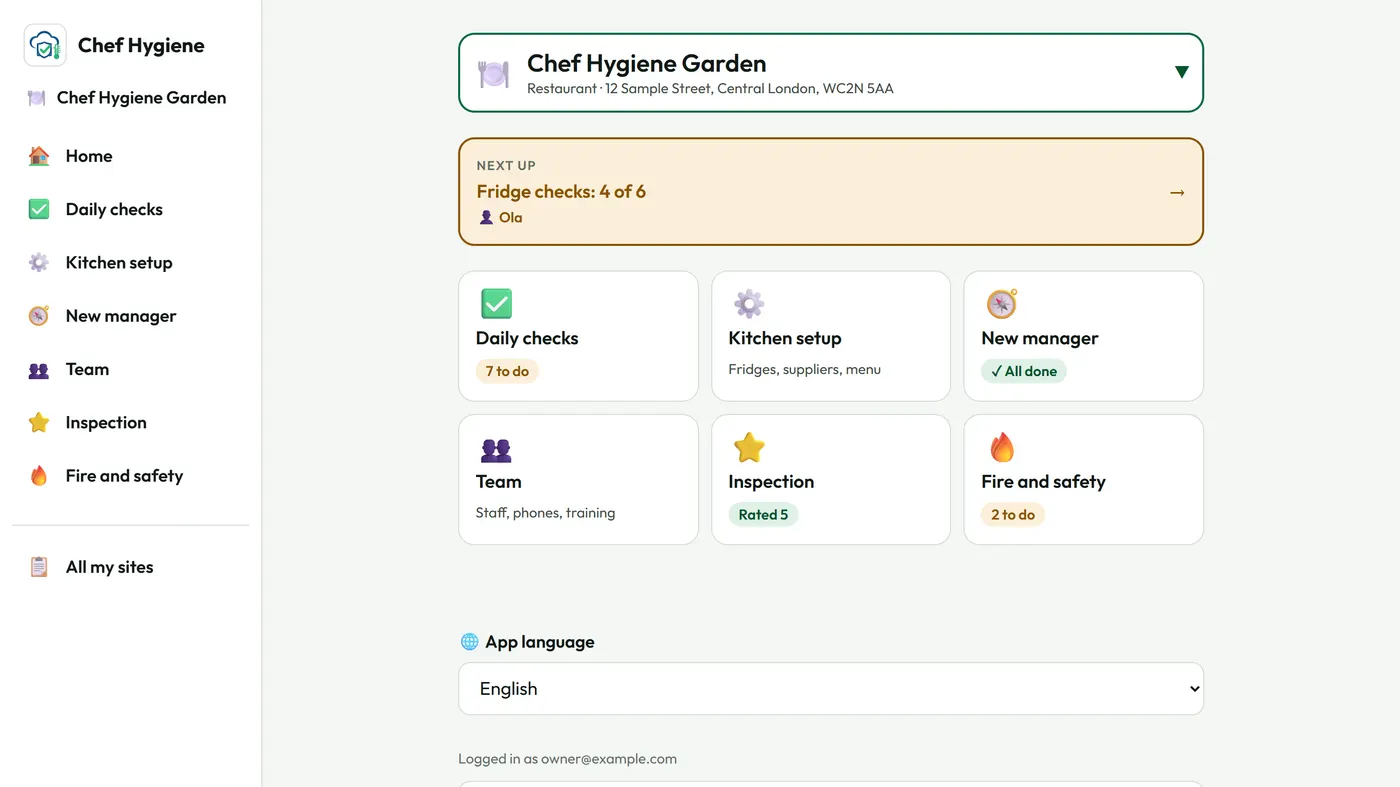
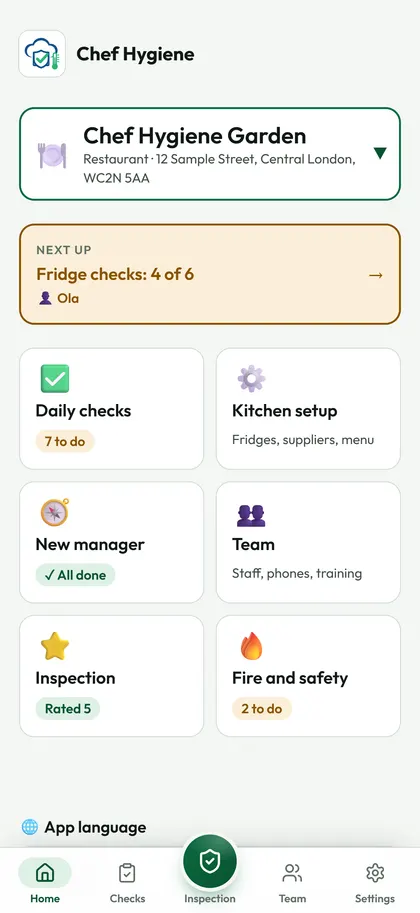
Canada : l'application Chef Hygiene
L’application charge ces règles pour votre cuisine, vérifie vos enregistrements par rapport à celles-ci et conserve les preuves pour l’inspecteur.
Autres pays
 Royaume-Uni
 Irlande
 Islande
 États-Unis
 France
 Espagne
 Pays-Bas
 Belgique
 Portugal
 Allemagne
 Autriche
 Pologne
 Roumanie
 Italie
 Grèce
Grèce Danemark
 Suisse
 Luxembourg
 Chypre
 Malte
Malte Suède
Suède Norvège
 Finlande
 Tchéquie
 Hongrie
 Croatie
 Bulgarie
 Slovaquie
 Slovénie
 Estonie
 Lettonie
 Lituanie
 Liechtenstein
 Saint-Marin
 Gibraltar
 Monaco
 Moldavie
 Andorre
 Serbie
 Jersey
 Guernesey
 Île de Man
 Turquie
 Monténégro
 Bosnie-Herzégovine
 Kosovo
 Albanie
 Macédoine du Nord
 Ukraine