 Vereinigtes Königreich: für Restaurants und Imbissbuden
Bereit für die Lebensmittelkontrolle. Jeden Tag.
In the UK each nation has its own hygiene rules. The app follows Schedule 4 temperature rules and the official packs: Safer Food Better Business, CookSafe and Safe Catering. Council food officers inspect.
14 Tage kostenlos · Ein Preis pro Standort · Keine Vertragsbindung
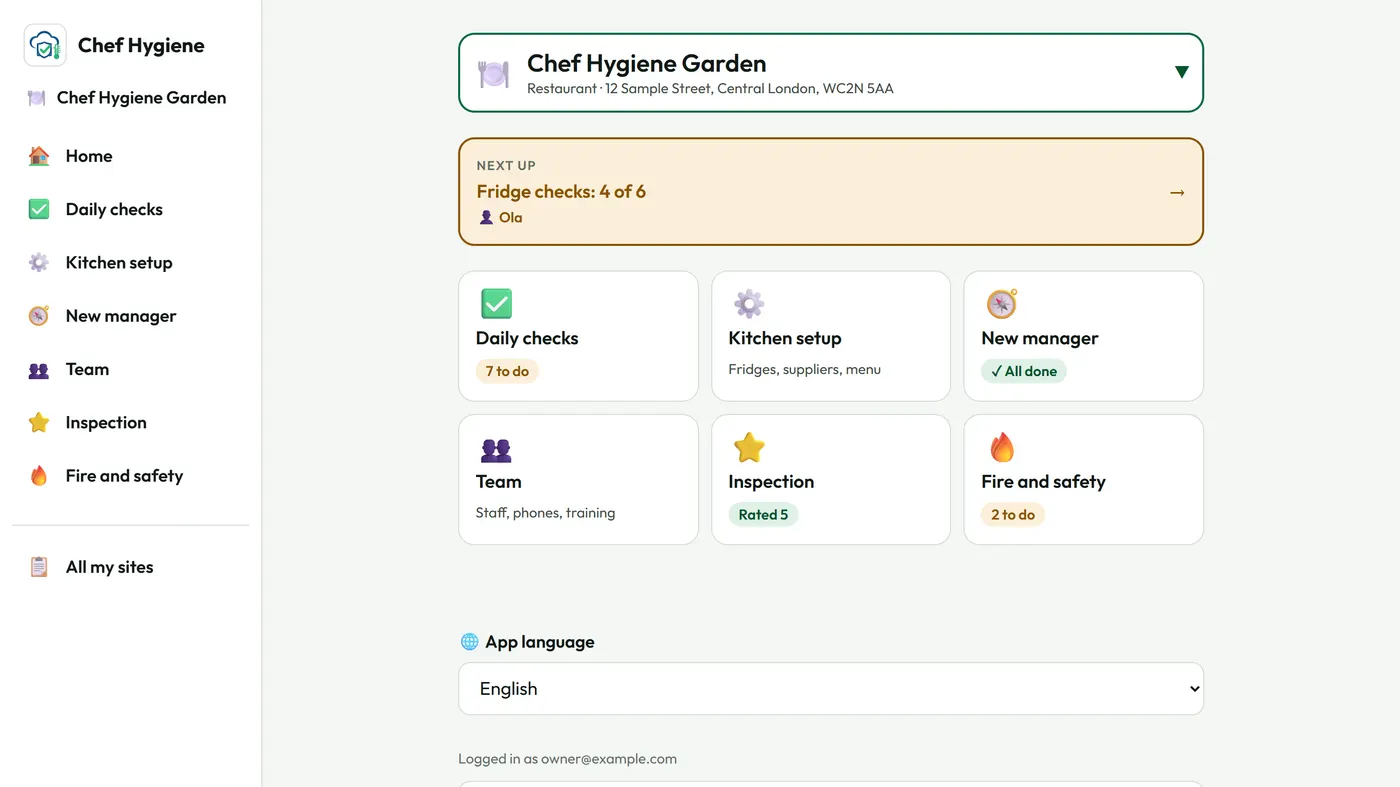
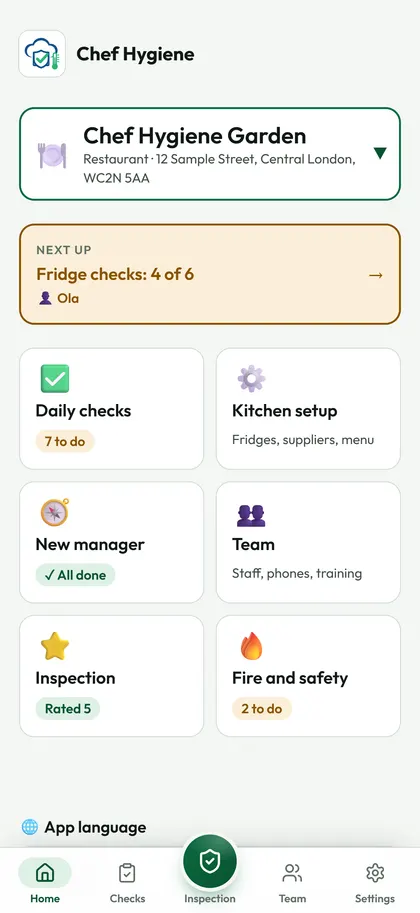
Vereinigtes Königreich: Lebensmittelhygieneregeln
Die Regeln auf dieser Seite sind vorerst auf Englisch. Sie werden in Ihre Sprache übersetzt.
- Inspektionsstelle
- Food Standards Agency (FSA) in England, Wales and Northern Ireland; Food Standards Scotland (FSS) in Scotland; the local council inspects
- Öffentliche Bewertung
- Ja
- Sprachen in der App
- English
Ihre Inspektion
The local council’s Environmental Health Officer (EHO) inspects food businesses. In England, Wales and Northern Ireland the Food Standards Agency runs the rating scheme. In Scotland, Food Standards Scotland runs it. Fire is checked by the fire and rescue service.
Officers may inspect your records in whatever form you keep them, use your computers and take copies away (Food Safety Act 1990, section 32; Northern Ireland: Food Safety (NI) Order 1991). In England, the Food Law Code of Practice says a high-risk business (category A) is visited every 6 months and a low-risk one (category E) every 36 months. You can appeal a rating within 21 days, free of charge. A re-rating visit is unannounced and the rating can go up or down.
Hygienebewertung
England, Wales and Northern Ireland: the Food Hygiene Rating Scheme (FHRS) gives a rating from 0 to 5. Display is required by law in Wales and Northern Ireland, and voluntary in England. Scotland: the Food Hygiene Information Scheme (FHIS) gives Pass or Improvement Required, and showing the certificate is not a legal requirement.
Warum Schallplatten in Großbritannien wichtig sind
UK-Lebensmittelbetriebe werden nur wegen ihrer Aufzeichnungen und des Managements mit 4 bewertet. Alles andere erhielt Bestnoten.
Unsere Berechnung aus FSA Open Data, 28. Sep 2026
der Lieferdienste in England, Wales und Nordirland sind unter 5 bewertet.
FSA Open Data, 28. Sep 2026
berechnen Bezirksräte für einen Nachkontrollbesuch nach einer niedrigen Bewertung.
Preston, Hackney und Westminster Councils
„Gesetz“ ist eine verbindliche Regel. „Offizielle Richtlinien“ sind kein Gesetz, werden aber von Prüfern erwartet. „Chef Hygiene Standardwert“ ist ein Wert, den die App überprüft, wenn keine Regel einen Wert vorgibt.
Temperaturen
- GesetzEngland, Wales and Northern Ireland: keep chilled food at 8°C or below (Schedule 4 of the national hygiene regulations). Scotland has no legal chill temperature.
- Offizielle LeitlinienGuidance for all nations: set fridges and chilled displays to 5°C or below. In Scotland, 8°C or below is recommended and 5°C is the aim (CookSafe).
- GesetzEngland, Wales and Northern Ireland: hold hot food at 63°C or above. You may go below 63°C once, for under 2 hours, then reheat, cool to 8°C or below, or throw the food away. Scotland: above 63°C, with no 2-hour allowance.
- GesetzEngland, Wales and Northern Ireland: chilled food may be on display out of the fridge once, for under 4 hours. Then put it back at 8°C or below, or throw it away. Scotland has no such allowance.
- Offizielle LeitlinienCooking, core temperature (Safer Food Better Business): 70°C for 2 minutes. Equal options are 60°C for 45 minutes, 65°C for 10 minutes, 75°C for 30 seconds or 80°C for 6 seconds. CookSafe (Scotland) and Safe Catering (Northern Ireland) use 75°C.
- GesetzScotland: reheat to at least 82°C, unless that would spoil the food. Then use a safe time and temperature, for example 70°C for 2 minutes (CookSafe).
- GesetzCool food as quickly as possible. This applies in all UK nations.
- Offizielle LeitlinienGuidance on reheating and cooling: England and Wales reheat until steaming hot all the way through. Northern Ireland reheats to 75°C and puts cooked food in the chill within 2 hours (Safe Catering). Scotland records cooling times or follows an established cooling method (CookSafe).
- Offizielle LeitlinienKeep freezers at −18°C or below. Scotland’s CookSafe gives example delivery limits of 5°C or below for chilled food and −18°C or below for frozen food.
Personal, Schulung und Gesundheit
- GesetzNo law requires a food hygiene certificate. Food handlers must be supervised and instructed or trained for their work, and whoever runs the HACCP plan must be trained in it (Regulation 852/2004, Annex II).
- GesetzStaff who are ill must not handle food and must report it at once. This applies in all four nations.
- Offizielle LeitlinienFSA fitness-to-work guidance: staff with diarrhoea or vomiting stay off food work until 48 hours after the symptoms stop. Scotland also counts 48 hours after the last anti-diarrhoea medicine.
- Offizielle LeitlinienScotland: guidance says high-risk food handlers should complete a formal food hygiene course within 3 months of starting.
- Offizielle LeitlinienReturn-to-work forms: the FSA questionnaire (England, Wales, Northern Ireland), Safe Catering form SC7 (Northern Ireland) and the CookSafe Return to Work Questionnaire (Scotland).
Allergene
- GesetzYou must manage the 14 allergens: celery, cereals containing gluten, crustaceans, eggs, fish, lupin, milk, molluscs, mustard, peanuts, sesame, soya, sulphites and tree nuts.
- GesetzLoose (non-prepacked) food: allergen information may be given by word of mouth, but only if a notice tells customers to ask staff. FSA best practice is to give it in writing as well, and to talk to the customer.
- GesetzPrepacked for direct sale (PPDS) food, under Natasha’s Law since 1 October 2021: the label shows the food’s name and the full ingredients list, with allergens emphasised.
- GesetzOrders by phone or online: give allergen information before the order is completed and again at delivery.
Brandschutzprüfungen
- GesetzEngland and Wales: the responsible person must do a suitable fire risk assessment (Regulatory Reform (Fire Safety) Order 2005). Since 1 October 2023 it must be written down in full, with the assessor’s name, whatever the size of the business.
- GesetzScotland and Northern Ireland: write the assessment down if you have 5 or more employees, need a licence or registration, or an alterations notice asks for it. Guidance says to write it down anyway.
- Offizielle LeitlinienOfficial guidance: test the fire alarm every week. Test emergency lighting every month, with a full test every year. Service extinguishers every year and hold a fire drill at least once a year.
- GesetzGas: keep appliances, pipes and flues safe, and use only Gas Safe engineers for gas work. HSE calls a yearly inspection a reasonable minimum.
- Offizielle LeitlinienKitchen extract cleaning under the TR19 Grease standard: every 3 months for 12 to 16 hours of cooking a day, every 6 months for 6 to 12 hours, and every 12 months for 2 to 6 hours.
Aufzeichnungen
- GesetzYou need permanent procedures based on HACCP principles, with records that fit the size of the business, kept for an appropriate period (Regulation 852/2004, Article 5). No law requires Safer Food Better Business, CookSafe or Safe Catering.
- GesetzKeep purchase records: supplier name and address, product, quantity and date, one step back. This is not needed for sales to final consumers.
- Offizielle LeitlinienElectronic records are accepted: the official Safer Food Better Business guidance allows an electronic diary. Safer Food Better Business also asks for a review every 4 weeks.
- Offizielle LeitlinienHow long to keep records: Safer Food Better Business says until the council’s next visit; Northern Ireland guidance says at least 12 months.
Offizielle Quellen
- Food Hygiene Rating Scheme: guidance for businesses (GOV.UK)
- Food safety management systems (GOV.UK)
- Safer Food, Better Business for caterers (GOV.UK)
- Food Standards Scotland: Food Hygiene Information Scheme
- Allergen guidance for food businesses (GOV.UK)
Checked
Diese Seite enthält allgemeine Informationen und stellt keine Rechtsberatung dar. Bitte wenden Sie sich an Ihre örtliche Behörde.
Vereinigtes Königreich: Leitfäden zur Lebensmittelhygiene
Wie Lebensmittelhygiene-Bewertungen funktionieren (0 bis 5)
Wie Lebensmittelsicherheitsbeamte einen Lebensmittelbetrieb bewerten, was jede Bewertung von 0 bis 5 bedeutet und warum Aufzeichnungen so viele Bewertungen entscheiden. Mit den offiziellen Bewertungsbändern.
Was überprüft ein Lebensmittelhygiene-Inspektor?
Worauf Lebensmittelsicherheitsbeamte aus dem Gemeinderat achten, die Aufzeichnungen, um die sie normalerweise bitten, wie oft Inspektionen durchgeführt werden und wie Sie sich auf Ihren Besuch vorbereiten.
UK-Lebensmitteltemperaturregeln: England, Wales, Schottland und Nordirland
Die gesetzlichen und empfohlenen Temperaturen zum Kühlen, Warmhalten, Kochen, Wiedererwärmen und Abkühlen von Lebensmitteln in jeder britischen Nation, in einer einfachen Tabelle.
Safer Food, Better Business: Können Sie es in einer App halten?
Was SFBB ist, was das Gesetz wirklich verlangt, welche Kontrollen täglich aufgezeichnet werden müssen und warum Kontrolleure digitale Lebensmittelsicherheitsaufzeichnungen akzeptieren.
Allergene und Natasha’s Law: was Restaurants und Takeaways tun müssen
Die 14 Allergene, die Regeln für lose, gelieferte und verpackte Lebensmittel, was ein Etikett nach Natasha’s Law (PPDS) zeigen muss, und die neuesten Best-Practices der FSA.
Brandschutz für Restaurants und Takeaways: die Kontrollen und das Recht
Wer verantwortlich ist, die Brandrisikobewertung, die täglich bis jährlich durchzuführenden Kontrollen, und die besonderen Brandrisiken in gewerblichen Küchen in England, Wales, Schottland und Nordirland.
Mitarbeiterkrankheit in Lebensmittelbetrieben: die 48-Stunden-Regel
Wann Mitarbeiter im Lebensmittelbereich nicht arbeiten dürfen, wie lange, und was bei der Rückkehr zu dokumentieren ist, basierend auf der offiziellen Arbeitsfähigkeits-Richtlinie.
Küchennotfälle: Gaslecks, Stromausfälle und kaputte Kühlschränke
Die britischen Notfallnummern und die ersten Dinge, die zu tun sind, wenn Sie Gasgeruch bemerken, Stromverlust haben, ein Wasserleck oder ein Kühlschrank in einer Restaurant- oder Takeaway-Küche ausfällt.
Vereinigtes Königreich: die Chef Hygiene-App
Die App lädt diese Regeln für Ihre Küche, gleicht Ihre Aufzeichnungen damit ab und speichert Nachweise für den Kontrolleur.
Andere Länder
 Irland
 Island
 Vereinigte Staaten
 Kanada
 Frankreich
 Spanien
 Niederlande
 Belgien
 Portugal
 Deutschland
 Österreich
 Polen
Polen Rumänien
 Italien
 Griechenland
 Dänemark
 Schweiz
 Luxemburg
 Zypern
 Malta
Malta Schweden
 Norwegen
 Finnland
 Tschechien
 Ungarn
 Kroatien
 Bulgarien
 Slowakei
 Slowenien
 Estland
 Lettland
 Litauen
 Liechtenstein
 San Marino
 Gibraltar
 Monaco
 Republik Moldau
 Andorra
 Serbien
 Jersey
 Guernsey
 Isle of Man
 Türkei
 Montenegro
 Bosnien und Herzegowina
 Kosovo
 Albanien
 Nordmazedonien
 Ukraine