 Pologne : pour les restaurants et les plats à emporter
Prêt pour l’inspection sanitaire. Tous les jours.
In Poland the app follows the food safety act, EU Regulation 852/2004 and the guidance of the Chief Sanitary Inspectorate (GIS); the district sanitary inspector (Sanepid) inspects.
14 jours gratuits · Un prix par site · Sans engagement
Pologne : règles d'hygiène alimentaire
Le règlement de cette page est pour l’instant en anglais. Il sera traduit dans votre langue.
- organisme d’inspection
- State Sanitary Inspection (Państwowa Inspekcja Sanitarna, “Sanepid”)
- Évaluation publique
- Non
- Langues disponibles dans l’application
- Polski, English
Votre inspection
The State Sanitary Inspection (Sanepid) inspects restaurants. The district inspector (PPIS, working through the PSSE) approves, registers and inspects them. The provincial inspector hears appeals and sets money fines, and GIS is the national body.
Visits are based on risk, and official food controls may be unannounced. Every business keeps an inspection book (książka kontroli) and shows it at the start of each inspection. A decision orders faults to be fixed by a set date. Where life or health is in direct danger, the inspector can close the premises at once, and fines can follow.
Note d’hygiène
Poland has no public hygiene rating or sticker, and results for single restaurants are not published. Nothing about the inspection has to be displayed at the premises.
La « loi » désigne une règle contraignante. Les « recommandations officielles » ne constituent pas une loi, mais les inspecteurs s’y attendent. « Chef Hygiene valeur par défaut » est une valeur de référence utilisée par l’application lorsqu’aucune règle ne spécifie de valeur numérique.
Températures
- Orientations officiellesNo Polish law sets fridge, hot-holding, cooling or reheating numbers for restaurants. GIS says each business sets them in its own HACCP procedure. The numbers below are official consumer guidance (GIS, Sanepid, and the WHO five keys that GIS recommends).
- Orientations officiellesChilled food: below 4°C (Sanepid guidance), preferably below 5°C (WHO). A temperature on the label or from the maker applies.
- LoiQuick-frozen food: −18°C or colder. A rise of up to 3°C is allowed only while loading and unloading and in shop cabinets (regulation of 19 September 2003, § 3).
- Orientations officiellesHot food: above 60°C just before serving (Sanepid, WHO). Cooked food stays out of the fridge no longer than 2 hours at room temperature (GIS).
- Orientations officiellesCooling: put cooked food in the fridge within 2 hours, preferably below 5°C (GIS, Sanepid). No temperature stages are given.
- Orientations officiellesReheating: heat food to 70°C (Sanepid guidance). Chef Hygiene warns on a lower reading.
- Orientations officiellesCooking: cook food to above 70°C (GIS guidance).
- Chef Hygiene par défautDeliveries: Chef Hygiene checks chilled food against 5°C when the label gives nothing. Frozen food must arrive at −18°C, with a 3°C rise allowed only while unloading.
Personnel, formation et santé
- LoiEveryone who works in contact with food needs a medical certificate for sanitary-epidemiological purposes (orzeczenie do celów sanitarno-epidemiologicznych). The employer sends the person for the tests. It has no expiry date in law (food safety act art. 59; infections act).
- Orientations officiellesGIS advises new tests after diarrhoea, a long cough, contact with infected people, or return after an infectious disease. Keep the certificate in the personnel file, with a copy at work.
- LoiFood hygiene training or instruction for all food staff and for the people running HACCP must be documented. The law sets no certificate, hours or renewal (food safety act art. 59).
- LoiSafety-at-work (BHP) training is a separate duty: before starting work, then every 3 years for manual jobs and every 5 years for managers.
- LoiSick staff: nobody with a disease that can pass through food, infected wounds, skin infections or diarrhoea may handle food. Staff must tell the manager at once, and the employer must take them off this work (EU Regulation 852/2004; infections act art. 10).
Allergènes
- LoiThe 14 EU allergens: cereals with gluten, crustaceans, eggs, fish, peanuts, soybeans, milk, tree nuts, celery, mustard, sesame, sulphites, lupin and molluscs.
- LoiFor restaurant dishes, give the dish name and the full list of ingredients with the allergens shown. Give it in writing, where guests see it before ordering: a menu, board, notice or screen (MRiRW regulation of 23 December 2014, § 19).
- LoiThe trade inspection authority (UOKiK) decided that staff answering questions does not replace the written information (decision DIH-1/57/2016).
- LoiMenus and allergen information must be in Polish. Other languages may be added. Drinks over 1.2% alcohol need no ingredient list, but their allergens must still be given.
Contrôles de sécurité incendie
- LoiPortable fire extinguishers are inspected and maintained at least once a year, as the maker and Polish Standards say. Where there is cooking oil, you need class F. The nearest extinguisher is at most 30 m away (MSWiA fire regulation).
- LoiFlue ducts from catering hearths are cleaned at least monthly, unless local rules differ. Ventilation ducts are cleaned at least every year, by people with chimney-sweep qualifications (MSWiA fire regulation § 34).
- LoiGas installations and chimney, flue and ventilation ducts are checked at least once a year, with a written protocol. This is a duty of the building owner or manager (building law art. 62).
- LoiElectrical and lightning installations are tested at least every 5 years, as part of the whole-building check (building law art. 62).
- LoiSince 30 June 2026 a room in commercial premises where fuel is burned needs a carbon monoxide detector. It is not needed for gas cooking appliances or closed-chamber appliances.
Archives
- LoiHACCP-based procedures are mandatory for all food businesses (EU Regulation 852/2004 art. 5; food safety act art. 59).
- Orientations officiellesGIS says food law sets no detailed rules for a kitchen’s own checks. The business sets them, and inspectors may ask for proof that they work but cannot impose specific solutions.
- LoiKeep training documents and medical certificates in the personnel files, with a copy at the place of work, and show them on request (food safety act art. 59).
- LoiKeep an inspection book (książka kontroli), on paper or electronic, and show it at the start of each inspection (Entrepreneurs’ Law art. 57).
Sources officielles
- Chief Sanitary Inspectorate (GIS)
- Sanepid approval and registration (biznes.gov.pl)
- Polish laws (Sejm, ISAP)
- State Fire Service (PSP)
- GIS answer on own checks, 15 March 2024
Checked
Cette page contient des informations générales et ne constitue pas un avis juridique. Veuillez consulter les autorités locales compétentes.
Pologne : guides d’hygiène alimentaire
Configurer Chef Hygiene
Créez votre compte, configurez une tablette de cuisine partagée et installez l'application sur les téléphones de vos collaborateurs, étape par étape.
Pologne : inspections alimentaires
Qui inspecte votre cuisine, comment se déroule une inspection et s’il existe une évaluation de l’hygiène publique.
Pologne : règles de température des aliments
Les températures des aliments que votre cuisine doit maintenir et les règles qui les sous-tendent.
Pologne : allergènes
Ce que votre cuisine doit dire aux clients sur les allergènes.
Pologne : maladie et formation du personnel
Formation, règles de manipulation des aliments et lorsque le personnel malade doit rester à l’écart de la nourriture.
Pologne : sécurité incendie
Contrôles de sécurité incendie pour votre cuisine et fréquence à laquelle ils doivent être effectués.
Pologne : enregistrements à conserver
Les registres et enregistrements que votre cuisine doit conserver.
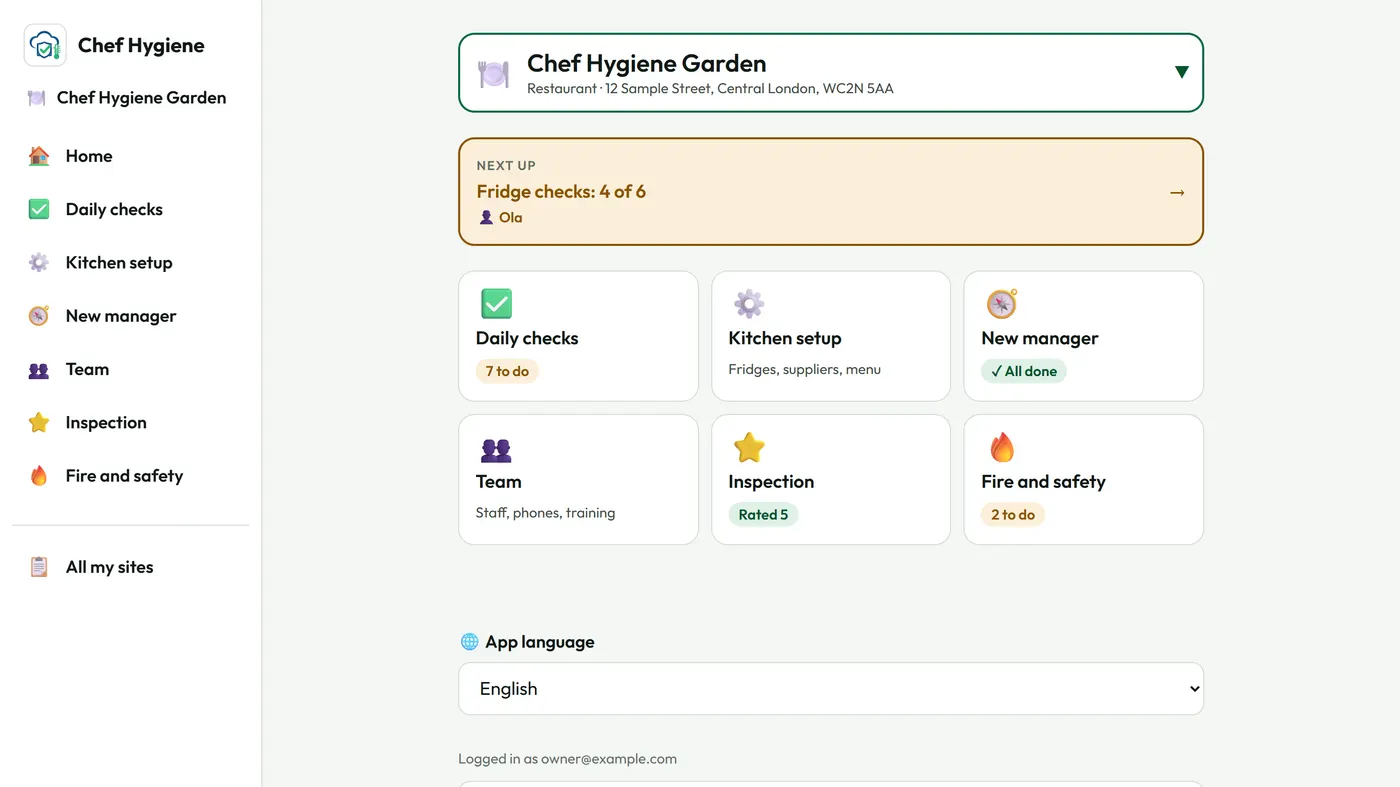
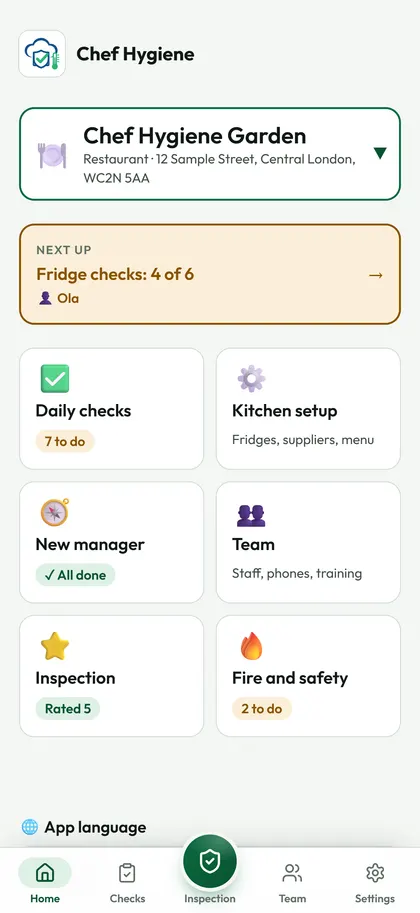
Pologne : l'application Chef Hygiene
L’application charge ces règles pour votre cuisine, vérifie vos enregistrements par rapport à celles-ci et conserve les preuves pour l’inspecteur.
Autres pays
 Royaume-Uni
 Irlande
 Islande
 États-Unis
 Canada
 France
 Espagne
 Pays-Bas
 Belgique
 Portugal
 Allemagne
 Autriche
 Roumanie
 Italie
 Grèce
Grèce Danemark
 Suisse
 Luxembourg
 Chypre
 Malte
Malte Suède
Suède Norvège
 Finlande
 Tchéquie
 Hongrie
 Croatie
 Bulgarie
 Slovaquie
 Slovénie
 Estonie
 Lettonie
 Lituanie
 Liechtenstein
 Saint-Marin
 Gibraltar
 Monaco
 Moldavie
 Andorre
 Serbie
 Jersey
 Guernesey
 Île de Man
 Turquie
 Monténégro
 Bosnie-Herzégovine
 Kosovo
 Albanie
 Macédoine du Nord
 Ukraine