 Roumanie : pour les restaurants et les plats à emporter
Prêt pour l’inspection sanitaire. Tous les jours.
In Romania the app follows the Ministry of Health’s hygiene rules (Order 976/1998), EU Regulation 852/2004 and the sector guides for restaurants; the county offices DSVSA and DSP and the consumer authority ANPC inspect.
14 jours gratuits · Un prix par site · Sans engagement
Roumanie : règles d'hygiène alimentaire
Le règlement de cette page est pour l’instant en anglais. Il sera traduit dans votre langue.
- organisme d’inspection
- National Sanitary Veterinary and Food Safety Authority (ANSVSA, Autoritatea Națională Sanitară Veterinară și pentru Siguranța Alimentelor)
- Évaluation publique
- Non
- Langues disponibles dans l’application
- Română, English
Votre inspection
Three bodies inspect restaurants. The county office DSVSA (of ANSVSA) checks food safety, and every restaurant must be registered with it. The county public health directorate DSP (Ministry of Health) checks hygiene, staff medical checks and hygiene course certificates. The consumer authority ANPC checks menus, allergen information and prices.
Visits are based on risk. Activity can be suspended or banned. Fines are set under Government Decisions 984/2005 (food safety) and 857/2011 (public health).
Note d’hygiène
Romania has no public hygiene rating, score or sticker. The only published results are the lists, on each DSVSA website, of units whose activity was banned.
La « loi » désigne une règle contraignante. Les « recommandations officielles » ne constituent pas une loi, mais les inspecteurs s’y attendent. « Chef Hygiene valeur par défaut » est une valeur de référence utilisée par l’application lorsqu’aucune règle ne spécifie de valeur numérique.
Températures
- LoiCold finished dishes are kept at 8°C or colder until served (Order 976/1998, art. 37 c). This 8°C is only for cold prepared dishes.
- LoiWhere one store room is used, the fridge has a separate raw meat compartment at 4°C or colder (Order 976/1998, art. 38 b). ANSVSA advises 0–4°C for food of animal origin, and Chef Hygiene aims for 4°C.
- LoiQuick-frozen food: −18°C or colder, with short rises of up to 3°C in transport and display (Order ANSVSA 134/2010).
- LoiHot dishes are kept at 60°C or hotter until served (Order 976/1998, art. 37 c).
- Chef Hygiene par défautChef Hygiene checks hot food against 63°C, the figure in the ANBCT chefs’ guide (2023) and the ANPC guide (2024). It is stricter than the law and meets both.
- Orientations officiellesCooling: the law only says to cool food as quickly as possible. The ANBCT guide says to 10–15°C within 90 minutes, then below 7°C within a further 150 minutes.
- Orientations officiellesReheating: the centre reaches 72°C with at least 2 minutes of even boiling, and food is reheated only once (ANBCT guide). Cooking: at least 75°C before hot holding.
- Chef Hygiene par défautDeliveries: Romanian law gives no number, so the temperature on the label applies. Chef Hygiene checks chilled deliveries against 4°C and flags frozen ones above −15°C.
- LoiMeals for organised groups, such as tourists or events: keep a sample of each dish for 48 hours at 4°C in a separate fridge (Order 976/1998, art. 37 e).
Personnel, formation et santé
- LoiFood hygiene course: the county public health directorate (DSP) issues a certificate after an exam of 30 questions with a 60% pass mark. It is valid 3 years, then a new course and exam are needed (Order 2209/4469/2022).
- LoiThe staff course (Level II) lasts at least 10 hours including a test. Managers take Level I, which lasts 12 hours (Order 2209/4469/2022).
- LoiMedical checks for everyone who touches unpackaged food: at hiring a doctor’s exam, a stool culture and a parasite test. After that a doctor’s exam every 6 months and the two tests every year. The fitness sheet says “apt lucru în sector alimentar” (Government Decision 355/2007).
- LoiSick staff: anyone with fever, diarrhoea, vomiting, jaundice, tonsillitis, boils, hand wounds, skin infections or pus goes to a doctor. They return only with the doctor’s written note (Government Decision 355/2007).
Allergènes
- LoiThe 14 EU allergens: cereals with gluten, crustaceans, eggs, fish, peanuts, soybeans, milk, nuts, celery, mustard, sesame, sulphites, lupin and molluscs.
- LoiInformation must be in writing, not spoken. For food sold unpacked it must be at the point of sale, visible, easy to read and indelible (ANPC Order 163/2021).
- LoiRestaurant menus list each dish’s ingredients with the allergens highlighted, name the additives and give the nutrition declaration (ANPC Order 201/2022, in force from 15 March 2023).
- LoiA QR code to the full menu is allowed if a printed copy is on site. For online orders, show the information before payment and on the delivery label. Public texts need a Romanian version (Law 500/2004).
Contrôles de sécurité incendie
- LoiFire extinguishers: your fire safety person checks them every month and writes it in a register. CO2 extinguishers are weighed every 6 months, and an authorised firm verifies them every 12 months once the warranty ends (OMAI 135/2023).
- LoiExtinguishers are recharged after use and at least every 3 years, and scrapped after 20 years (OMAI 135/2023).
- LoiGas installations: a technical verification at most every 2 years, and a technical revision at most every 10 years. The revision is also needed after more than 6 months unused or any incident. An ANRE-authorised firm does both (ANRE Order 179/2015).
- LoiElectrical installations are checked at start-up, periodically and after repairs, by ANRE-authorised electricians (Government Decision 1146/2006).
Archives
- LoiYou need food safety procedures based on HACCP principles (EU Regulation 852/2004, art. 5). Fridge temperatures must be recorded (Order 976/1998, art. 11).
- LoiPest control: insects at least every 3 months and rodents at least every 6 months, by a certified firm. Keep the signed report of each visit (Order 119/2014).
- LoiGas check records and the technical file are kept for the life of the installation (ANRE Order 179/2015).
- LoiKeep supplier records so food can be traced one step back and one step forward (EU Regulation 178/2002, art. 18).
Sources officielles
- ANSVSA, food safety authority
- ANPC, consumer protection: guides for public catering
- Ministry of Health
- ANRE, energy regulator: gas and electrical installations
- IGSU, emergency situations inspectorate: fire safety
Checked
Cette page contient des informations générales et ne constitue pas un avis juridique. Veuillez consulter les autorités locales compétentes.
Roumanie : guides d’hygiène alimentaire
Configurer Chef Hygiene
Créez votre compte, configurez une tablette de cuisine partagée et installez l'application sur les téléphones de vos collaborateurs, étape par étape.
Roumanie : inspections alimentaires
Qui inspecte votre cuisine, comment se déroule une inspection et s’il existe une évaluation de l’hygiène publique.
Roumanie : règles de température des aliments
Les températures des aliments que votre cuisine doit maintenir et les règles qui les sous-tendent.
Roumanie : allergènes
Ce que votre cuisine doit dire aux clients sur les allergènes.
Roumanie : maladie et formation du personnel
Formation, règles de manipulation des aliments et lorsque le personnel malade doit rester à l’écart de la nourriture.
Roumanie : sécurité incendie
Contrôles de sécurité incendie pour votre cuisine et fréquence à laquelle ils doivent être effectués.
Roumanie : enregistrements à conserver
Les registres et enregistrements que votre cuisine doit conserver.
Roumanie : l'application Chef Hygiene
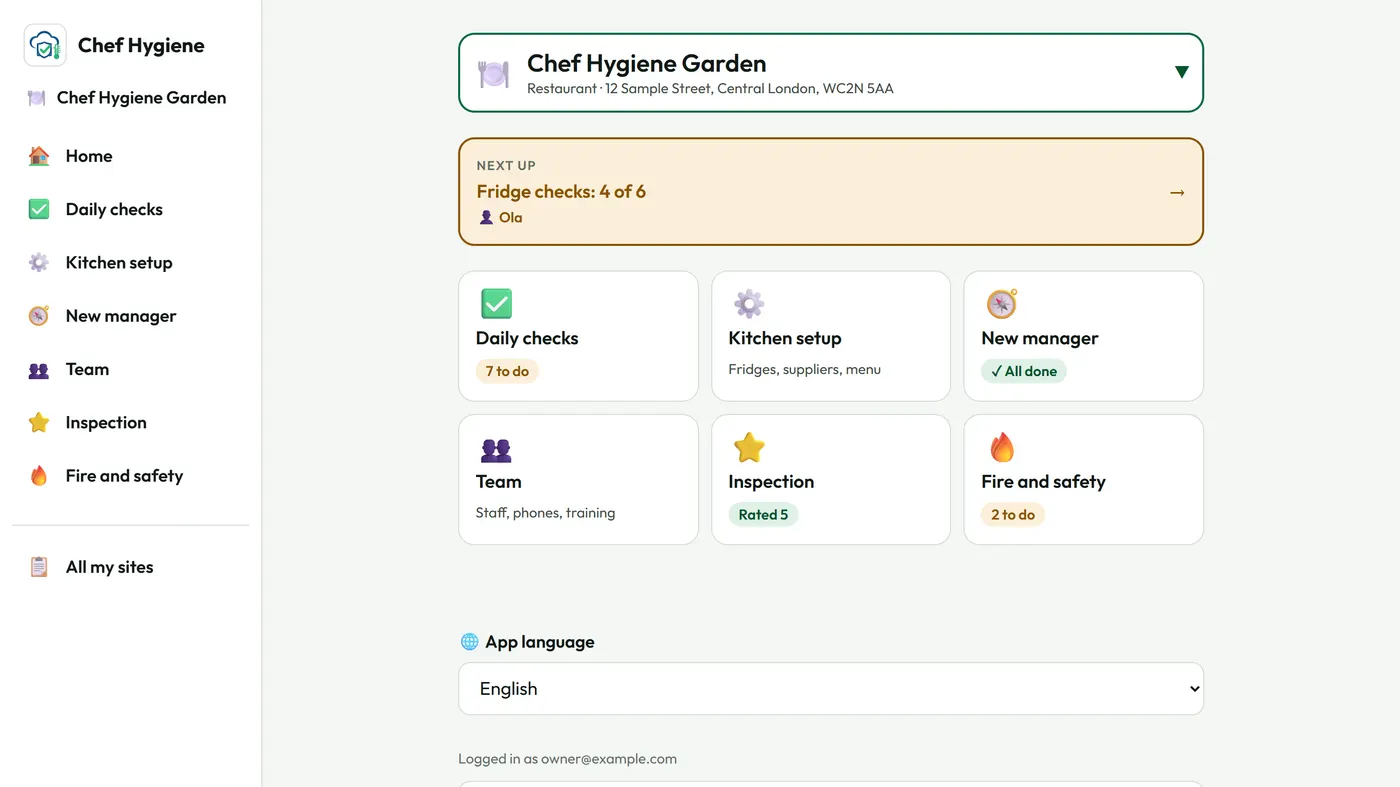
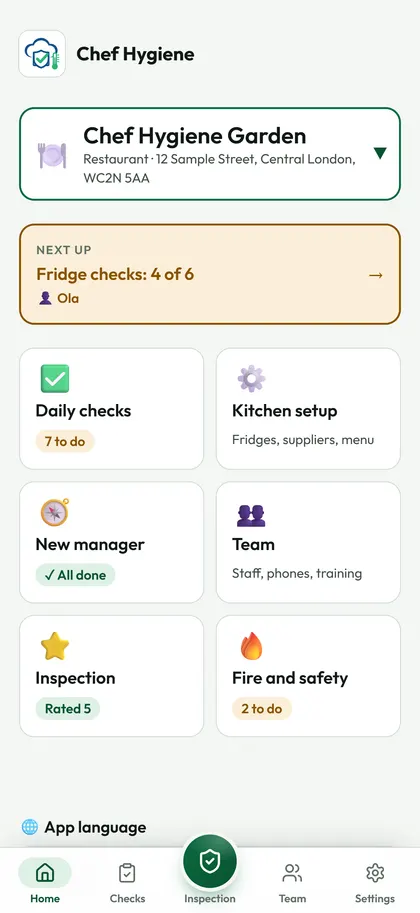
L’application charge ces règles pour votre cuisine, vérifie vos enregistrements par rapport à celles-ci et conserve les preuves pour l’inspecteur.
Autres pays
 Royaume-Uni
 Irlande
 Islande
 États-Unis
 Canada
 France
 Espagne
 Pays-Bas
 Belgique
 Portugal
 Allemagne
 Autriche
 Pologne
 Italie
 Grèce
Grèce Danemark
 Suisse
 Luxembourg
 Chypre
 Malte
Malte Suède
Suède Norvège
 Finlande
 Tchéquie
 Hongrie
 Croatie
 Bulgarie
 Slovaquie
 Slovénie
 Estonie
 Lettonie
 Lituanie
 Liechtenstein
 Saint-Marin
 Gibraltar
 Monaco
 Moldavie
 Andorre
 Serbie
 Jersey
 Guernesey
 Île de Man
 Turquie
 Monténégro
 Bosnie-Herzégovine
 Kosovo
 Albanie
 Macédoine du Nord
 Ukraine