 Niemcy: dla restauracji i dań na wynos
Gotowi na kontrolę żywności. Codziennie.
In Germany the app follows the food hygiene law (LFGB, LMHV, IfSG), EU Regulation 852/2004 and the BfR’s guidance; the food control office of your district or city inspects.
14 dni za darmo · jedna cena za witrynę · bez umowy
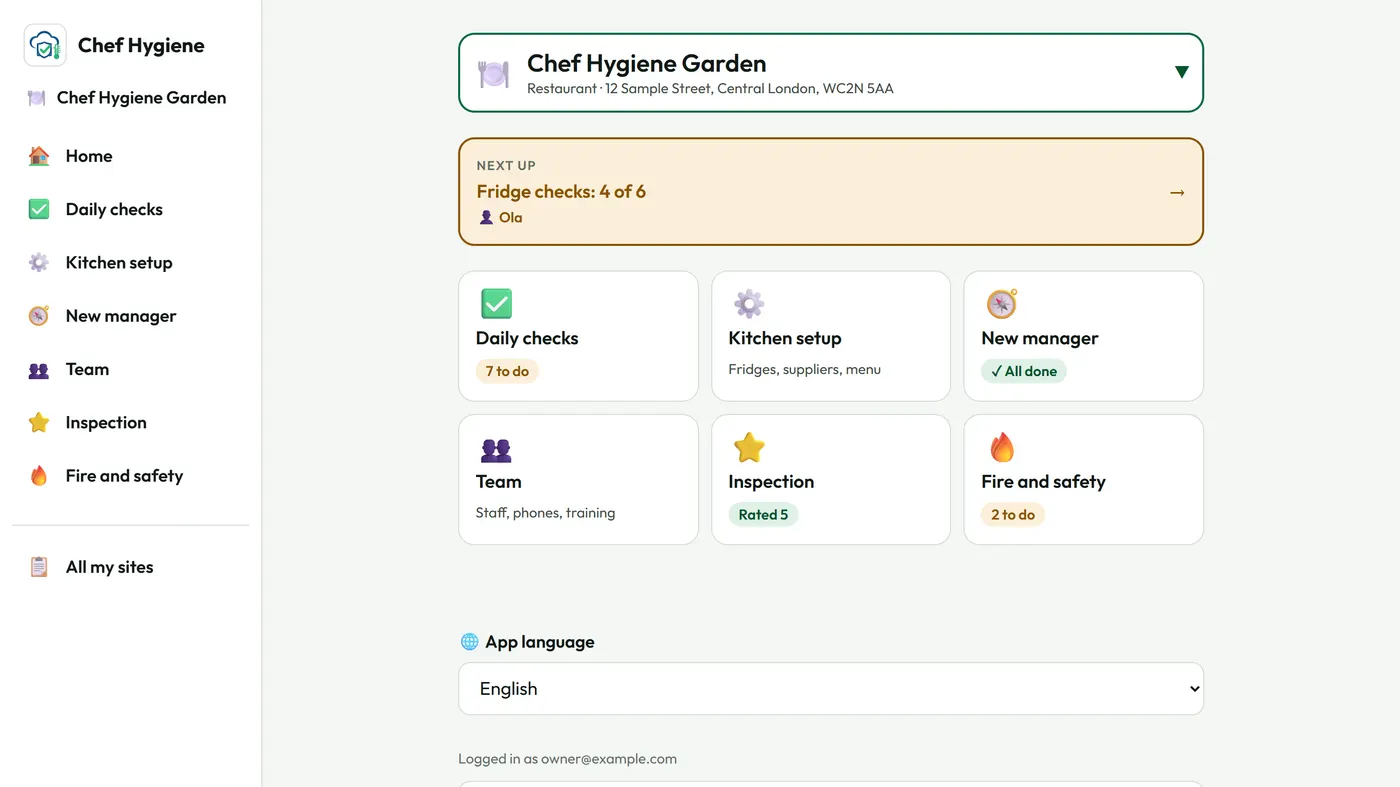
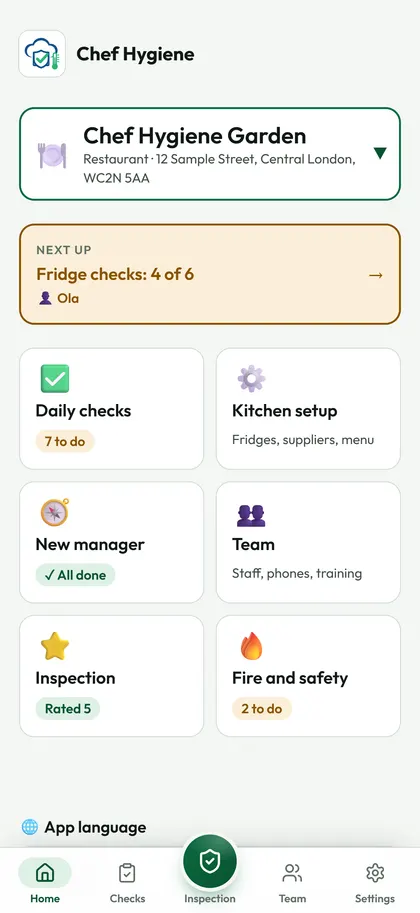
Niemcy: zasady higieny żywności
Zasady na tej stronie są na razie po angielsku. Zostaną przetłumaczone na Twój język.
- Organ inspekcyjny
- Food control office of the district or city (Lebensmittelüberwachung, also called Veterinär- und Lebensmittelüberwachungsamt)
- Ocena publiczna
- NIE
- Języki w aplikacji
- Deutsch, English
Twoja inspekcja
Food control is a task of each federal state (Land). In practice the food control office of the district or city (Lebensmittelüberwachung) inspects restaurants. The federal office BVL only coordinates and does not inspect restaurants.
Visits are based on risk. As a rule they are not announced. The authority can order tests and ban sales until the results come in. EU law also lets it stop all or part of a business’s activities. Fines run up to €100,000, €50,000 or €20,000 depending on the rule broken, and serious cases can be crimes.
Ocena higieny
There is no hygiene rating, sticker or duty to display a result in any Land. When hygiene rules were broken badly or repeatedly and a fine of at least €350 is expected, the Land publishes the business name and the breach online for 6 months.
„Prawo” to wiążąca reguła. „Oficjalne wytyczne” nie są prawem, ale inspektorzy ich oczekują. „Chef Hygiene domyślna” to wartość, którą aplikacja sprawdza, gdy żadna reguła nie podaje liczby.
Temperatury
- Oficjalne wytyczneChef Hygiene checks fridges against 4°C as the aim and 7°C as the limit for chilled food and cold dishes. This follows BfR guidance and DIN 10508; German law sets no general fridge number for restaurants.
- Oficjalne wytyczneRaw meat, poultry, mince and fresh fish: 2°C or colder when the label says nothing (BfR guidance). DIN 10508 says fresh fish at 2°C or on melting ice.
- PrawoA storage temperature on a product’s label always applies.
- PrawoMince made in your kitchen (Tier-LMHV Annex 5): use meat at 7°C or colder, poultry at 4°C, offal at 3°C. If it is not served where it was made, wrap it at once and chill it to 2°C in the core (mince) or 4°C (meat preparations), or freeze it to −18°C.
- PrawoFrozen food: −18°C or colder. A short rise of at most 3°C is allowed in transport and shop freezers (TLMV § 2, the law for quick-frozen food).
- Chef Hygiene domyślneChef Hygiene checks hot food against 65°C, the stricter value. The BfR advises 60°C or hotter at every point (2020) and no more than 3 hours; older DIN 10508 and many local sheets say 65°C.
- Oficjalne wytyczneCooling: from 65°C to 10°C within 2 hours (DIN 10508 and local food control sheets). EU law only says to cool food as quickly as possible.
- Oficjalne wytyczneCooking and reheating: 72°C in the centre for at least 2 minutes (BfR guidance, 2024). No German law sets this number.
- PrawoDeliveries: suppliers must keep mince at 2°C or colder, poultry and meat preparations at 4°C, offal at 3°C, other meat at 7°C, and fresh fish near melting ice (Regulation 853/2004). Frozen food stays at −18°C; Chef Hygiene flags frozen deliveries above −15°C.
Kadra, szkolenia i zdrowie
- PrawoIfSG certificate: before the first day of food work, every worker needs a certificate from the health office (Gesundheitsamt) or a doctor it commissions. It must be no older than 3 months at the start and has no expiry date (IfSG § 43).
- PrawoInstruction by the employer: after the start and then every 2 years, you instruct staff on work bans and the duty to report illness, and you document it. Keep the certificate and the last record (IfSG § 43). Employing someone without the certificate can cost up to €25,000.
- PrawoAnyone who makes, handles or sells perishable food needs food hygiene training (LMHV § 4). The law sets no hours, certificate or renewal, but you must be able to show proof on request.
- Oficjalne wytyczneMunich’s food control office asks you to write down who was trained, when, on what topics and by whom, at hiring and at least once a year.
- PrawoSick staff: nobody may work in a restaurant kitchen while ill with, or suspected of, typhoid, paratyphoid, cholera, shigellosis, salmonellosis, other infectious gastroenteritis or hepatitis A or E. The same applies with infected wounds or skin disease. Staff must tell the employer at once (IfSG §§ 42, 43).
Alergeny
- PrawoThe 14 EU allergens: cereals with gluten, crustaceans, eggs, fish, peanuts, soybeans, milk, tree nuts, celery, mustard, sesame, sulphites, lupin and molluscs.
- PrawoFor food that is not prepacked, tell guests before the sale, in German. Do it in writing (menu, sign, notice or screen) (LMIDV § 4).
- PrawoTelling guests by word of mouth is allowed only if a written or electronic ingredient record exists, the authority and guests can see it on request, and a clear notice says so (LMIDV § 4).
- PrawoSome additives must also be named on menus, for example “mit Farbstoff” (with colouring) and “mit Konservierungsstoff” (with preservative) (LMZDV § 5).
Kontrole bezpieczeństwa pożarowego
- Oficjalne wytyczneFire extinguishers are serviced every 2 years by a competent person, and the result is documented (ASR A2.2). Fryers and woks need a class F extinguisher (BGN guidance).
- Oficjalne wytyczneKitchen hood and grease filters are checked every working day. Ducts, fan and interlocks are checked every 6 months, and an exhaust test is done every year (BGN, VDI 2052, DGUV Regel 110-003).
- Oficjalne wytyczneGas appliances and their flame-failure devices get a function check every year. The owner also looks over the whole gas installation every year (BGN, DGUV Regel 110-003).
- PrawoLiquefied gas (LPG) must be tested by a competent person: fixed installations at least every 4 years, mobile ones every 2 years, and every year in a room below ground (BetrSichV, Annex 3).
- Oficjalne wytyczneA qualified electrician tests the fixed electrical installation every 4 years. Portable appliances are tested about every 6 months, at most yearly if few faults are found (DGUV Regel 110-003).
Dokumentacja
- PrawoYou need food safety procedures based on HACCP principles (EU Regulation 852/2004, art. 5). German food hygiene law (LMHV) has no separate HACCP rules.
- Oficjalne wytyczneThe recognised national guide for restaurants is DEHOGA’s “Leitlinie für eine Gute Hygienepraxis in der Gastronomie” (3rd edition, 2022). It is sold and not free.
- PrawoKeep your monitoring records, for example temperatures, cleaning and deliveries, for an appropriate period (Regulation 852/2004). Restaurants record who supplied what, but not their guests.
- Oficjalne wytyczneKeep equipment test records at least until the next test, and for LPG installations for their whole life (BGN guidance).
Oficjalne źródła
- Federal Office of Consumer Protection and Food Safety (BVL)
- Federal Institute for Risk Assessment (BfR)
- German federal laws (gesetze-im-internet.de)
- Robert Koch Institute: IfSG instruction leaflets
- BGN, accident insurer for hotels and restaurants
Checked
Ta strona zawiera ogólne informacje, a nie porady prawne. Sprawdź w lokalnym urzędzie.
Niemcy: Poradniki higieny żywności
Skonfiguruj Chef Hygiene
Utwórz konto, skonfiguruj wspólny tablet kuchenny i krok po kroku instaluj aplikację na telefonach swoich pracowników.
Niemcy: inspekcje żywności
Kto sprawdza Twoją kuchnię, jak przebiega kontrola i czy istnieje ocena higieny publicznej.
Niemcy: zasady dotyczące temperatury żywności
Temperatury żywności, które musi utrzymywać Twoja kuchnia, i zasady za nimi stojące.
Niemcy: alergeny
Co Twoja kuchnia musi mówić klientom o alergenach.
Niemcy: choroba personelu i szkolenie
Szkolenia, zasady postępowania z żywnością oraz sytuacje, w których chory personel musi trzymać się z daleka od żywności.
Niemcy: bezpieczeństwo przeciwpożarowe
Kontrole bezpieczeństwa przeciwpożarowego Twojej kuchni i częstotliwość ich przeprowadzania.
Niemcy: zapisy do przechowywania
Rejestry i rejestracje, które musi przechowywać Twoja kuchnia.
Niemcy: aplikacja Chef Hygiene.
Aplikacja ładuje te zasady do Twojej kuchni, sprawdza je pod kątem zgodności z zapisami i zachowuje dowód dla inspektora.
Inne kraje
 Wielka Brytania
 Irlandia
 Islandia
 Stany Zjednoczone
 Kanada
 Francja
 Hiszpania
 Holandia
 Belgia
 Portugalia
 Austria
 Polska
 Rumunia
 Włochy
 Grecja
 Dania
Dania Szwajcaria
 Luksemburg
 Cypr
Cypr Malta
Malta Szwecja
 Norwegia
 Finlandia
 Czechy
 Węgry
Węgry Chorwacja
 Bułgaria
 Słowacja
 Słowenia
 Estonia
 Łotwa
Łotwa Litwa
Litwa Liechtenstein
 San Marino
 Gibraltar
 Monako
 Mołdawia
 Andora
 Serbia
 Jersey
 Guernsey
 Wyspa Man
 Turcja
 Czarnogóra
 Bośnia i Hercegowina
 Kosowo
 Albania
 Macedonia Północna
 Ukraina