 Německo: pro restaurace a jídlo s sebou
Připraveni na kontrolu potravin. Každý den.
In Germany the app follows the food hygiene law (LFGB, LMHV, IfSG), EU Regulation 852/2004 and the BfR’s guidance; the food control office of your district or city inspects.
14 dní zdarma · jedna cena za web · bez smlouvy
Německo: pravidla hygieny potravin
Pravidla na této stránce jsou prozatím v angličtině. Budou přeložena do vašeho jazyka.
- Inspekční orgán
- Food control office of the district or city (Lebensmittelüberwachung, also called Veterinär- und Lebensmittelüberwachungsamt)
- Veřejné hodnocení
- Žádný
- Jazyky v aplikaci
- Deutsch, English
Vaše inspekce
Food control is a task of each federal state (Land). In practice the food control office of the district or city (Lebensmittelüberwachung) inspects restaurants. The federal office BVL only coordinates and does not inspect restaurants.
Visits are based on risk. As a rule they are not announced. The authority can order tests and ban sales until the results come in. EU law also lets it stop all or part of a business’s activities. Fines run up to €100,000, €50,000 or €20,000 depending on the rule broken, and serious cases can be crimes.
Hodnocení hygieny
There is no hygiene rating, sticker or duty to display a result in any Land. When hygiene rules were broken badly or repeatedly and a fine of at least €350 is expected, the Land publishes the business name and the breach online for 6 months.
„Zákon“ je závazné pravidlo. „Oficiální pokyny“ nejsou zákonem, ale inspektoři je očekávají. „Chef Hygiene výchozí“ je hodnota, kterou aplikace porovnává, pokud žádné pravidlo neuvádí číslo.
Teploty
- Oficiální pokynyChef Hygiene checks fridges against 4°C as the aim and 7°C as the limit for chilled food and cold dishes. This follows BfR guidance and DIN 10508; German law sets no general fridge number for restaurants.
- Oficiální pokynyRaw meat, poultry, mince and fresh fish: 2°C or colder when the label says nothing (BfR guidance). DIN 10508 says fresh fish at 2°C or on melting ice.
- ZákonA storage temperature on a product’s label always applies.
- ZákonMince made in your kitchen (Tier-LMHV Annex 5): use meat at 7°C or colder, poultry at 4°C, offal at 3°C. If it is not served where it was made, wrap it at once and chill it to 2°C in the core (mince) or 4°C (meat preparations), or freeze it to −18°C.
- ZákonFrozen food: −18°C or colder. A short rise of at most 3°C is allowed in transport and shop freezers (TLMV § 2, the law for quick-frozen food).
- Chef Hygiene výchozíChef Hygiene checks hot food against 65°C, the stricter value. The BfR advises 60°C or hotter at every point (2020) and no more than 3 hours; older DIN 10508 and many local sheets say 65°C.
- Oficiální pokynyCooling: from 65°C to 10°C within 2 hours (DIN 10508 and local food control sheets). EU law only says to cool food as quickly as possible.
- Oficiální pokynyCooking and reheating: 72°C in the centre for at least 2 minutes (BfR guidance, 2024). No German law sets this number.
- ZákonDeliveries: suppliers must keep mince at 2°C or colder, poultry and meat preparations at 4°C, offal at 3°C, other meat at 7°C, and fresh fish near melting ice (Regulation 853/2004). Frozen food stays at −18°C; Chef Hygiene flags frozen deliveries above −15°C.
Zaměstnanci, školení a zdraví
- ZákonIfSG certificate: before the first day of food work, every worker needs a certificate from the health office (Gesundheitsamt) or a doctor it commissions. It must be no older than 3 months at the start and has no expiry date (IfSG § 43).
- ZákonInstruction by the employer: after the start and then every 2 years, you instruct staff on work bans and the duty to report illness, and you document it. Keep the certificate and the last record (IfSG § 43). Employing someone without the certificate can cost up to €25,000.
- ZákonAnyone who makes, handles or sells perishable food needs food hygiene training (LMHV § 4). The law sets no hours, certificate or renewal, but you must be able to show proof on request.
- Oficiální pokynyMunich’s food control office asks you to write down who was trained, when, on what topics and by whom, at hiring and at least once a year.
- ZákonSick staff: nobody may work in a restaurant kitchen while ill with, or suspected of, typhoid, paratyphoid, cholera, shigellosis, salmonellosis, other infectious gastroenteritis or hepatitis A or E. The same applies with infected wounds or skin disease. Staff must tell the employer at once (IfSG §§ 42, 43).
Alergeny
- ZákonThe 14 EU allergens: cereals with gluten, crustaceans, eggs, fish, peanuts, soybeans, milk, tree nuts, celery, mustard, sesame, sulphites, lupin and molluscs.
- ZákonFor food that is not prepacked, tell guests before the sale, in German. Do it in writing (menu, sign, notice or screen) (LMIDV § 4).
- ZákonTelling guests by word of mouth is allowed only if a written or electronic ingredient record exists, the authority and guests can see it on request, and a clear notice says so (LMIDV § 4).
- ZákonSome additives must also be named on menus, for example “mit Farbstoff” (with colouring) and “mit Konservierungsstoff” (with preservative) (LMZDV § 5).
Kontroly požární bezpečnosti
- Oficiální pokynyFire extinguishers are serviced every 2 years by a competent person, and the result is documented (ASR A2.2). Fryers and woks need a class F extinguisher (BGN guidance).
- Oficiální pokynyKitchen hood and grease filters are checked every working day. Ducts, fan and interlocks are checked every 6 months, and an exhaust test is done every year (BGN, VDI 2052, DGUV Regel 110-003).
- Oficiální pokynyGas appliances and their flame-failure devices get a function check every year. The owner also looks over the whole gas installation every year (BGN, DGUV Regel 110-003).
- ZákonLiquefied gas (LPG) must be tested by a competent person: fixed installations at least every 4 years, mobile ones every 2 years, and every year in a room below ground (BetrSichV, Annex 3).
- Oficiální pokynyA qualified electrician tests the fixed electrical installation every 4 years. Portable appliances are tested about every 6 months, at most yearly if few faults are found (DGUV Regel 110-003).
Evidence
- ZákonYou need food safety procedures based on HACCP principles (EU Regulation 852/2004, art. 5). German food hygiene law (LMHV) has no separate HACCP rules.
- Oficiální pokynyThe recognised national guide for restaurants is DEHOGA’s “Leitlinie für eine Gute Hygienepraxis in der Gastronomie” (3rd edition, 2022). It is sold and not free.
- ZákonKeep your monitoring records, for example temperatures, cleaning and deliveries, for an appropriate period (Regulation 852/2004). Restaurants record who supplied what, but not their guests.
- Oficiální pokynyKeep equipment test records at least until the next test, and for LPG installations for their whole life (BGN guidance).
Oficiální zdroje
- Federal Office of Consumer Protection and Food Safety (BVL)
- Federal Institute for Risk Assessment (BfR)
- German federal laws (gesetze-im-internet.de)
- Robert Koch Institute: IfSG instruction leaflets
- BGN, accident insurer for hotels and restaurants
Checked
Tato stránka obsahuje obecné informace, nikoli právní poradenství. Obraťte se na místní úřad.
Německo: Příručky hygieny potravin
Nastavte Chef Hygiene
Vytvořte si účet, nastavte sdílený kuchyňský tablet a vložte aplikaci do telefonů svých zaměstnanců, krok za krokem.
Německo: kontroly potravin
Kdo kontroluje vaši kuchyni, jak probíhá kontrola a zda existuje veřejné hygienické hodnocení.
Německo: pravidla teploty potravin
Teploty potravin, které musí vaše kuchyně dodržovat, a pravidla, která se za nimi řídí.
Německo: alergeny
Co musí vaše kuchyně sdělit zákazníkům o alergenech.
Německo: nemoc a školení zaměstnanců
Školení, pravidla pro manipulaci s potravinami a nemocný personál se musí držet dál od jídla.
Německo: požární bezpečnost
Kontroly požární bezpečnosti vaší kuchyně a jak často se mají provádět.
Německo: záznamy k uchování
Záznamy a registrace, které musí vaše kuchyně vést.
Německo: aplikace Chef Hygiene
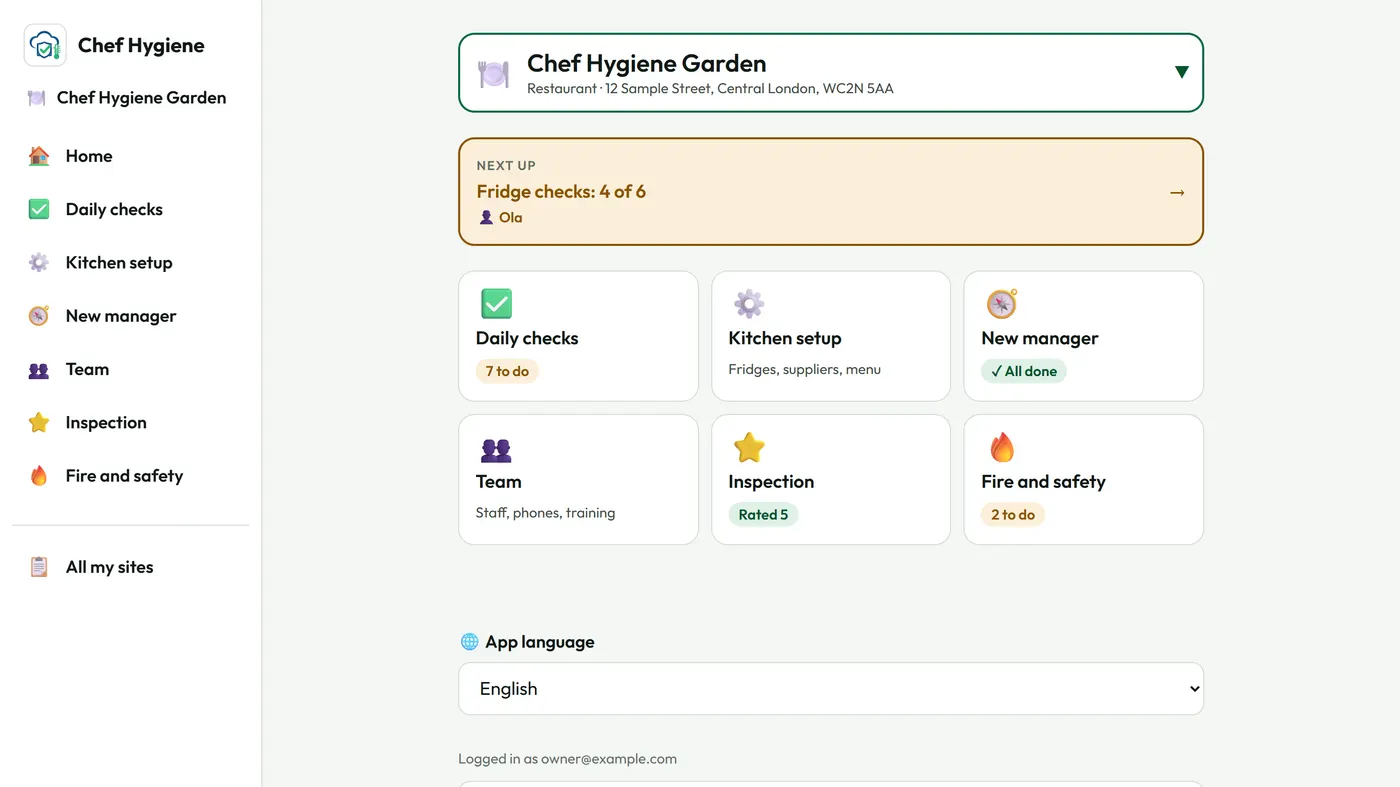
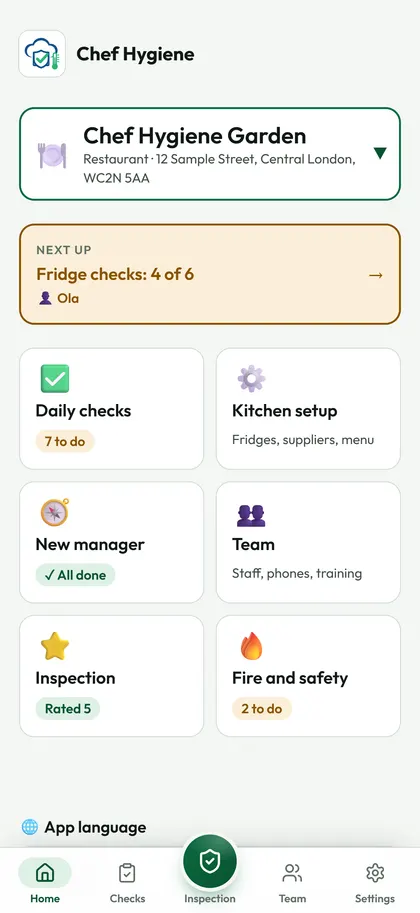
Aplikace načte tato pravidla pro vaši kuchyň, porovná s nimi vaše záznamy a uchovává důkazy pro inspektora.
Ostatní země
 Spojené království
 Irsko
Irsko Island
 Spojené státy
 Kanada
 Francie
 Španělsko
 Nizozemsko
 Belgie
 Portugalsko
 Rakousko
 Polsko
 Rumunsko
 Itálie
 Řecko
Řecko Dánsko
 Švýcarsko
 Lucembursko
 Kypr
Kypr Malta
Malta Švédsko
 Norsko
 Finsko
 Česko
Česko Maďarsko
 Chorvatsko
 Bulharsko
 Slovensko
 Slovinsko
 Estonsko
 Lotyšsko
 Litva
Litva Lichtenštejnsko
 San Marino
 Gibraltar
 Monako
 Moldavsko
 Andorra
 Srbsko
 Jersey
 Guernsey
 Ostrov Man
 Turecko
 Černá Hora
 Bosna a Hercegovina
 Kosovo
 Albánie
 Severní Makedonie
 Ukrajina