 Nemčija: za restavracije in hrano za s seboj
Pripravljeni na pregled hrane. Vsak dan.
In Germany the app follows the food hygiene law (LFGB, LMHV, IfSG), EU Regulation 852/2004 and the BfR’s guidance; the food control office of your district or city inspects.
14 dni brezplačno · ena cena na spletno mesto · brez pogodbe
Nemčija: higienska pravila živil
Pravila na tej strani so zaenkrat v angleščini. Prevedena bodo v vaš jezik.
- Inšpekcijski organ
- Food control office of the district or city (Lebensmittelüberwachung, also called Veterinär- und Lebensmittelüberwachungsamt)
- Javna ocena
- Ne
- Jeziki v aplikaciji
- Deutsch, English
Vaš pregled
Food control is a task of each federal state (Land). In practice the food control office of the district or city (Lebensmittelüberwachung) inspects restaurants. The federal office BVL only coordinates and does not inspect restaurants.
Visits are based on risk. As a rule they are not announced. The authority can order tests and ban sales until the results come in. EU law also lets it stop all or part of a business’s activities. Fines run up to €100,000, €50,000 or €20,000 depending on the rule broken, and serious cases can be crimes.
Ocena higiene
There is no hygiene rating, sticker or duty to display a result in any Land. When hygiene rules were broken badly or repeatedly and a fine of at least €350 is expected, the Land publishes the business name and the breach online for 6 months.
»Zakon« je zavezujoče pravilo. »Uradne smernice« niso zakon, vendar jih inšpektorji pričakujejo. »Chef Hygiene privzeto« je vrednost, s katero aplikacija preveri, kadar nobeno pravilo ne določa številke.
Temperature
- Uradna navodilaChef Hygiene checks fridges against 4°C as the aim and 7°C as the limit for chilled food and cold dishes. This follows BfR guidance and DIN 10508; German law sets no general fridge number for restaurants.
- Uradna navodilaRaw meat, poultry, mince and fresh fish: 2°C or colder when the label says nothing (BfR guidance). DIN 10508 says fresh fish at 2°C or on melting ice.
- PravoA storage temperature on a product’s label always applies.
- PravoMince made in your kitchen (Tier-LMHV Annex 5): use meat at 7°C or colder, poultry at 4°C, offal at 3°C. If it is not served where it was made, wrap it at once and chill it to 2°C in the core (mince) or 4°C (meat preparations), or freeze it to −18°C.
- PravoFrozen food: −18°C or colder. A short rise of at most 3°C is allowed in transport and shop freezers (TLMV § 2, the law for quick-frozen food).
- Chef Hygiene privzetoChef Hygiene checks hot food against 65°C, the stricter value. The BfR advises 60°C or hotter at every point (2020) and no more than 3 hours; older DIN 10508 and many local sheets say 65°C.
- Uradna navodilaCooling: from 65°C to 10°C within 2 hours (DIN 10508 and local food control sheets). EU law only says to cool food as quickly as possible.
- Uradna navodilaCooking and reheating: 72°C in the centre for at least 2 minutes (BfR guidance, 2024). No German law sets this number.
- PravoDeliveries: suppliers must keep mince at 2°C or colder, poultry and meat preparations at 4°C, offal at 3°C, other meat at 7°C, and fresh fish near melting ice (Regulation 853/2004). Frozen food stays at −18°C; Chef Hygiene flags frozen deliveries above −15°C.
Osebje, usposabljanje in zdravje
- PravoIfSG certificate: before the first day of food work, every worker needs a certificate from the health office (Gesundheitsamt) or a doctor it commissions. It must be no older than 3 months at the start and has no expiry date (IfSG § 43).
- PravoInstruction by the employer: after the start and then every 2 years, you instruct staff on work bans and the duty to report illness, and you document it. Keep the certificate and the last record (IfSG § 43). Employing someone without the certificate can cost up to €25,000.
- PravoAnyone who makes, handles or sells perishable food needs food hygiene training (LMHV § 4). The law sets no hours, certificate or renewal, but you must be able to show proof on request.
- Uradna navodilaMunich’s food control office asks you to write down who was trained, when, on what topics and by whom, at hiring and at least once a year.
- PravoSick staff: nobody may work in a restaurant kitchen while ill with, or suspected of, typhoid, paratyphoid, cholera, shigellosis, salmonellosis, other infectious gastroenteritis or hepatitis A or E. The same applies with infected wounds or skin disease. Staff must tell the employer at once (IfSG §§ 42, 43).
Alergeni
- PravoThe 14 EU allergens: cereals with gluten, crustaceans, eggs, fish, peanuts, soybeans, milk, tree nuts, celery, mustard, sesame, sulphites, lupin and molluscs.
- PravoFor food that is not prepacked, tell guests before the sale, in German. Do it in writing (menu, sign, notice or screen) (LMIDV § 4).
- PravoTelling guests by word of mouth is allowed only if a written or electronic ingredient record exists, the authority and guests can see it on request, and a clear notice says so (LMIDV § 4).
- PravoSome additives must also be named on menus, for example “mit Farbstoff” (with colouring) and “mit Konservierungsstoff” (with preservative) (LMZDV § 5).
Preverjanja požarne varnosti
- Uradna navodilaFire extinguishers are serviced every 2 years by a competent person, and the result is documented (ASR A2.2). Fryers and woks need a class F extinguisher (BGN guidance).
- Uradna navodilaKitchen hood and grease filters are checked every working day. Ducts, fan and interlocks are checked every 6 months, and an exhaust test is done every year (BGN, VDI 2052, DGUV Regel 110-003).
- Uradna navodilaGas appliances and their flame-failure devices get a function check every year. The owner also looks over the whole gas installation every year (BGN, DGUV Regel 110-003).
- PravoLiquefied gas (LPG) must be tested by a competent person: fixed installations at least every 4 years, mobile ones every 2 years, and every year in a room below ground (BetrSichV, Annex 3).
- Uradna navodilaA qualified electrician tests the fixed electrical installation every 4 years. Portable appliances are tested about every 6 months, at most yearly if few faults are found (DGUV Regel 110-003).
Zapisi
- PravoYou need food safety procedures based on HACCP principles (EU Regulation 852/2004, art. 5). German food hygiene law (LMHV) has no separate HACCP rules.
- Uradna navodilaThe recognised national guide for restaurants is DEHOGA’s “Leitlinie für eine Gute Hygienepraxis in der Gastronomie” (3rd edition, 2022). It is sold and not free.
- PravoKeep your monitoring records, for example temperatures, cleaning and deliveries, for an appropriate period (Regulation 852/2004). Restaurants record who supplied what, but not their guests.
- Uradna navodilaKeep equipment test records at least until the next test, and for LPG installations for their whole life (BGN guidance).
Uradni viri
- Federal Office of Consumer Protection and Food Safety (BVL)
- Federal Institute for Risk Assessment (BfR)
- German federal laws (gesetze-im-internet.de)
- Robert Koch Institute: IfSG instruction leaflets
- BGN, accident insurer for hotels and restaurants
Checked
Ta stran je splošna informacija in ne pravni nasvet. Za več informacij se obrnite na lokalne oblasti.
Nemčija: vodniki o higieni živil
Nastavitev storitve Chef Hygiene
Ustvarite račun, nastavite skupni tablični računalnik za kuhinjo in namestite aplikacijo na telefone zaposlenih – korak za korakom.
Nemčija: pregledi hrane
Kdo pregleduje vašo kuhinjo, kako poteka inšpekcija in ali obstaja ocena javne higiene.
Nemčija: pravila o temperaturi hrane
Temperature hrane, ki jih mora ohranjati vaša kuhinja, in pravila zanje.
Nemčija: alergeni
Kaj mora vaša kuhinja strankam povedati o alergenih.
Nemčija: bolezen osebja in usposabljanje
Usposabljanje, pravila za ravnanje s hrano in osebje, ko je bolno, se mora izogibati hrani.
Nemčija: požarna varnost
Preverjanja požarne varnosti vaše kuhinje in kako pogosto jih je treba izvesti.
Nemčija: zapisi, ki jih je treba hraniti
Evidence in registracije, ki jih mora voditi vaša kuhinja.
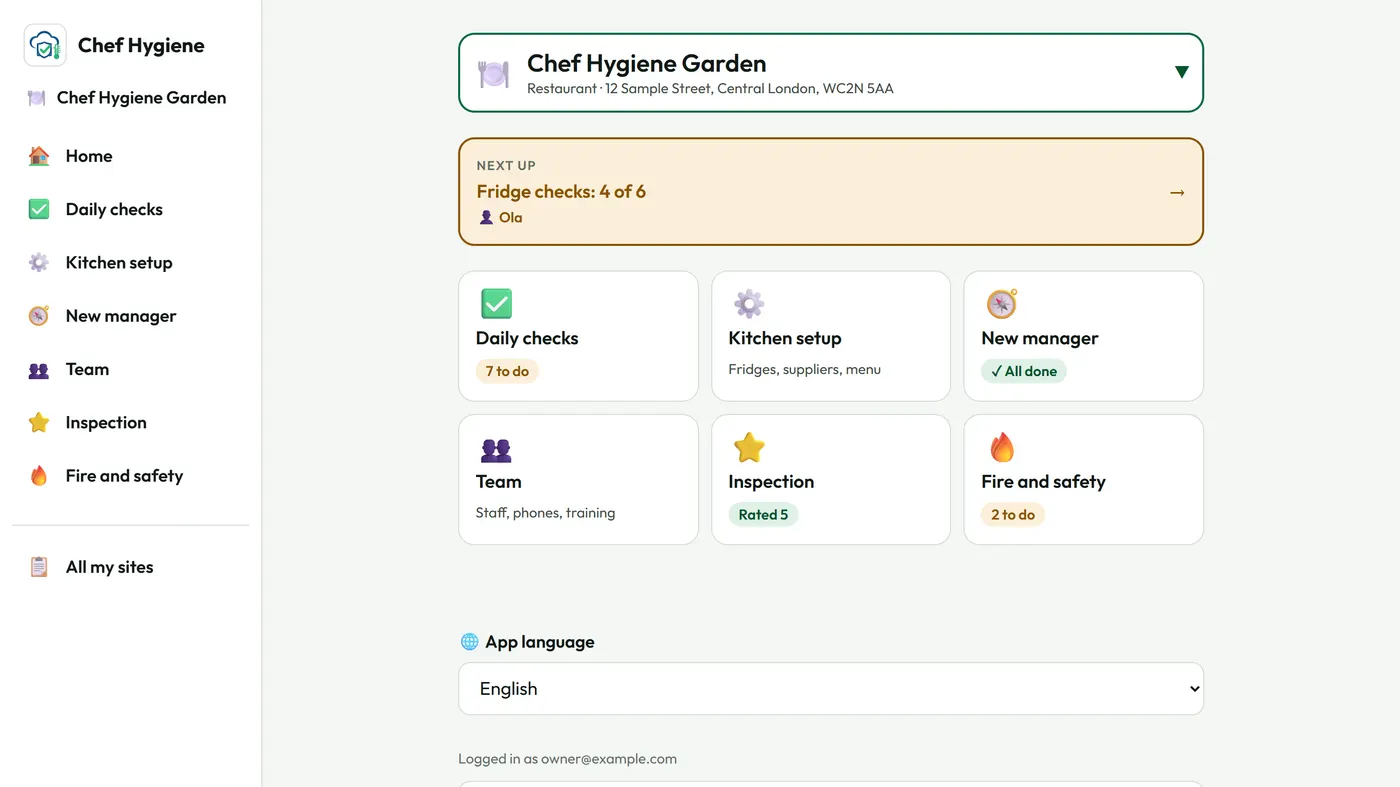
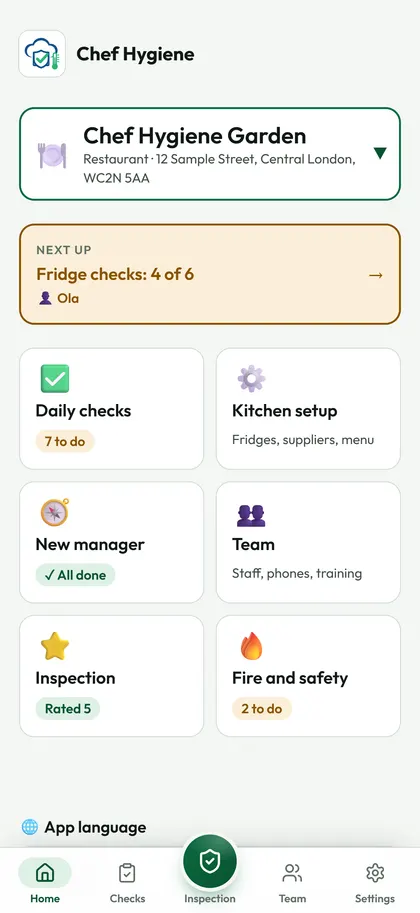
Nemčija: aplikacija Chef Hygiene.
Aplikacija naloži ta pravila za vašo kuhinjo, preveri vaše zapise glede nanje in shrani dokazilo za inšpektorja.
Druge države
 Združeno kraljestvo
 Irska
Irska Islandija
 Združene države Amerike
 Kanada
 Francija
 Španija
 Nizozemska
 Belgija
 Portugalska
 Avstrija
 Poljska
 Romunija
 Italija
 Grčija
 Danska
 Švica
Švica Luksemburg
 Ciper
Ciper Malta
Malta Švedska
 Norveška
 Finska
 Češka
Češka Madžarska
 Hrvaška
 Bolgarija
 Slovaška
 Slovenija
 Estonija
 Latvija
 Litva
Litva Lihtenštajn
 San Marino
 Gibraltar
 Monako
 Moldavija
 Andora
 Srbija
 Jersey
 Guernsey
 Otok Man
 Turčija
 Črna gora
 Bosna in Hercegovina
 Kosovo
 Albanija
 Severna Makedonija
 Ukrajina