 Tyskland: til restauranter og takeaways
Klar til fødevareinspektionen. Hver dag.
In Germany the app follows the food hygiene law (LFGB, LMHV, IfSG), EU Regulation 852/2004 and the BfR’s guidance; the food control office of your district or city inspects.
14 dage gratis · én pris pr. side · ingen kontrakt
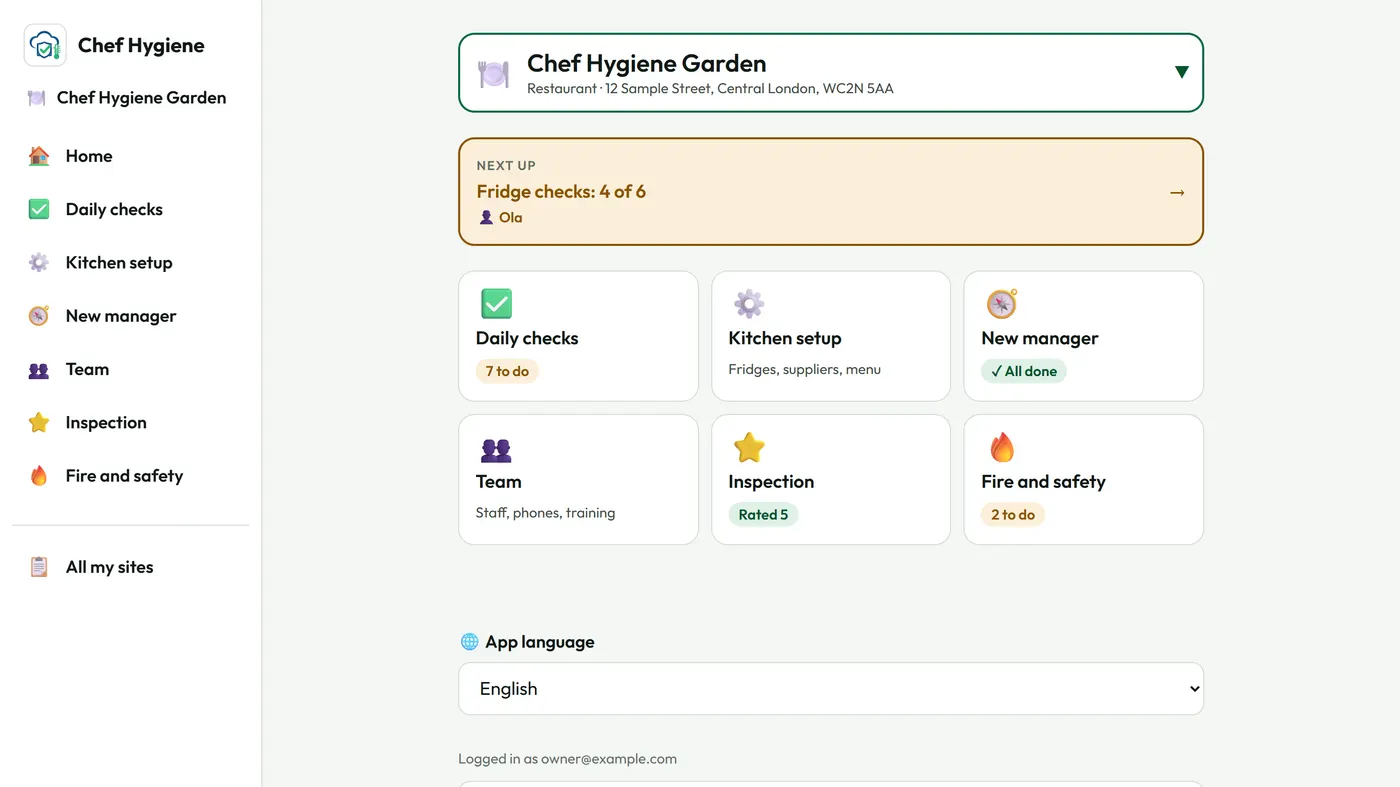
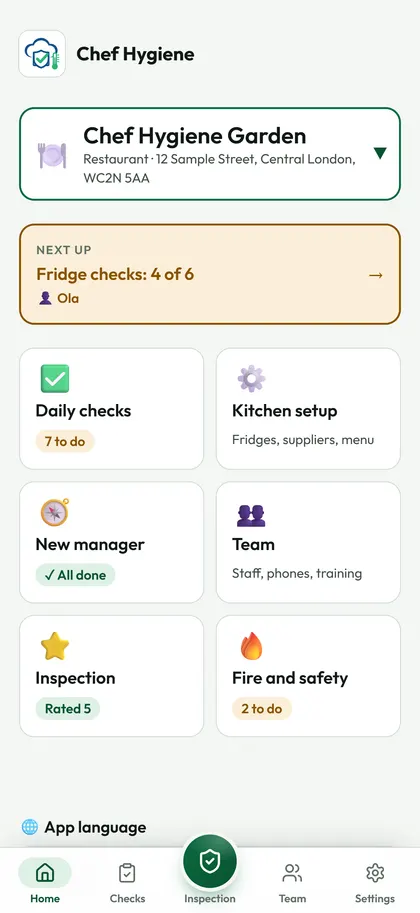
Tyskland: regler for fødevarehygiejne
Reglerne på denne side er for nuværende på engelsk. De vil blive oversat til dit sprog.
- Inspektionsorgan
- Food control office of the district or city (Lebensmittelüberwachung, also called Veterinär- und Lebensmittelüberwachungsamt)
- Offentlig vurdering
- Ingen
- Sprog i appen
- Deutsch, English
Din inspektion
Food control is a task of each federal state (Land). In practice the food control office of the district or city (Lebensmittelüberwachung) inspects restaurants. The federal office BVL only coordinates and does not inspect restaurants.
Visits are based on risk. As a rule they are not announced. The authority can order tests and ban sales until the results come in. EU law also lets it stop all or part of a business’s activities. Fines run up to €100,000, €50,000 or €20,000 depending on the rule broken, and serious cases can be crimes.
Hygiejnevurdering
There is no hygiene rating, sticker or duty to display a result in any Land. When hygiene rules were broken badly or repeatedly and a fine of at least €350 is expected, the Land publishes the business name and the breach online for 6 months.
“Lov” er en bindende regel. “Officiel vejledning” er ikke lov, men inspektører forventer det. “Chef Hygiene standard” er en værdi, som appen kontrollerer i forhold til, hvor ingen regel angiver et tal.
Temperaturer
- Officiel vejledningChef Hygiene checks fridges against 4°C as the aim and 7°C as the limit for chilled food and cold dishes. This follows BfR guidance and DIN 10508; German law sets no general fridge number for restaurants.
- Officiel vejledningRaw meat, poultry, mince and fresh fish: 2°C or colder when the label says nothing (BfR guidance). DIN 10508 says fresh fish at 2°C or on melting ice.
- LovA storage temperature on a product’s label always applies.
- LovMince made in your kitchen (Tier-LMHV Annex 5): use meat at 7°C or colder, poultry at 4°C, offal at 3°C. If it is not served where it was made, wrap it at once and chill it to 2°C in the core (mince) or 4°C (meat preparations), or freeze it to −18°C.
- LovFrozen food: −18°C or colder. A short rise of at most 3°C is allowed in transport and shop freezers (TLMV § 2, the law for quick-frozen food).
- Chef Hygiene standardChef Hygiene checks hot food against 65°C, the stricter value. The BfR advises 60°C or hotter at every point (2020) and no more than 3 hours; older DIN 10508 and many local sheets say 65°C.
- Officiel vejledningCooling: from 65°C to 10°C within 2 hours (DIN 10508 and local food control sheets). EU law only says to cool food as quickly as possible.
- Officiel vejledningCooking and reheating: 72°C in the centre for at least 2 minutes (BfR guidance, 2024). No German law sets this number.
- LovDeliveries: suppliers must keep mince at 2°C or colder, poultry and meat preparations at 4°C, offal at 3°C, other meat at 7°C, and fresh fish near melting ice (Regulation 853/2004). Frozen food stays at −18°C; Chef Hygiene flags frozen deliveries above −15°C.
Personale, uddannelse og sundhed
- LovIfSG certificate: before the first day of food work, every worker needs a certificate from the health office (Gesundheitsamt) or a doctor it commissions. It must be no older than 3 months at the start and has no expiry date (IfSG § 43).
- LovInstruction by the employer: after the start and then every 2 years, you instruct staff on work bans and the duty to report illness, and you document it. Keep the certificate and the last record (IfSG § 43). Employing someone without the certificate can cost up to €25,000.
- LovAnyone who makes, handles or sells perishable food needs food hygiene training (LMHV § 4). The law sets no hours, certificate or renewal, but you must be able to show proof on request.
- Officiel vejledningMunich’s food control office asks you to write down who was trained, when, on what topics and by whom, at hiring and at least once a year.
- LovSick staff: nobody may work in a restaurant kitchen while ill with, or suspected of, typhoid, paratyphoid, cholera, shigellosis, salmonellosis, other infectious gastroenteritis or hepatitis A or E. The same applies with infected wounds or skin disease. Staff must tell the employer at once (IfSG §§ 42, 43).
Allergener
- LovThe 14 EU allergens: cereals with gluten, crustaceans, eggs, fish, peanuts, soybeans, milk, tree nuts, celery, mustard, sesame, sulphites, lupin and molluscs.
- LovFor food that is not prepacked, tell guests before the sale, in German. Do it in writing (menu, sign, notice or screen) (LMIDV § 4).
- LovTelling guests by word of mouth is allowed only if a written or electronic ingredient record exists, the authority and guests can see it on request, and a clear notice says so (LMIDV § 4).
- LovSome additives must also be named on menus, for example “mit Farbstoff” (with colouring) and “mit Konservierungsstoff” (with preservative) (LMZDV § 5).
Brandsikkerhedstjek
- Officiel vejledningFire extinguishers are serviced every 2 years by a competent person, and the result is documented (ASR A2.2). Fryers and woks need a class F extinguisher (BGN guidance).
- Officiel vejledningKitchen hood and grease filters are checked every working day. Ducts, fan and interlocks are checked every 6 months, and an exhaust test is done every year (BGN, VDI 2052, DGUV Regel 110-003).
- Officiel vejledningGas appliances and their flame-failure devices get a function check every year. The owner also looks over the whole gas installation every year (BGN, DGUV Regel 110-003).
- LovLiquefied gas (LPG) must be tested by a competent person: fixed installations at least every 4 years, mobile ones every 2 years, and every year in a room below ground (BetrSichV, Annex 3).
- Officiel vejledningA qualified electrician tests the fixed electrical installation every 4 years. Portable appliances are tested about every 6 months, at most yearly if few faults are found (DGUV Regel 110-003).
Optegnelser
- LovYou need food safety procedures based on HACCP principles (EU Regulation 852/2004, art. 5). German food hygiene law (LMHV) has no separate HACCP rules.
- Officiel vejledningThe recognised national guide for restaurants is DEHOGA’s “Leitlinie für eine Gute Hygienepraxis in der Gastronomie” (3rd edition, 2022). It is sold and not free.
- LovKeep your monitoring records, for example temperatures, cleaning and deliveries, for an appropriate period (Regulation 852/2004). Restaurants record who supplied what, but not their guests.
- Officiel vejledningKeep equipment test records at least until the next test, and for LPG installations for their whole life (BGN guidance).
Officielle kilder
- Federal Office of Consumer Protection and Food Safety (BVL)
- Federal Institute for Risk Assessment (BfR)
- German federal laws (gesetze-im-internet.de)
- Robert Koch Institute: IfSG instruction leaflets
- BGN, accident insurer for hotels and restaurants
Checked
Denne side er til generel information, ikke juridisk rådgivning. Kontakt din kommune.
Tyskland: fødevarehygiejnevejledninger
Opsætning af Chef Hygiene
Opret din konto, opsæt en fælles tablet til køkkenet, og installer appen på personalets telefoner – trin for trin.
Tyskland: fødevareinspektioner
Hvem inspicerer dit køkken, hvordan et eftersyn fungerer, og om der er en offentlig hygiejnevurdering.
Tyskland: regler for madtemperatur
Madtemperaturerne dit køkken skal holde, og reglerne bag dem.
Tyskland: allergener
Hvad dit køkken skal fortælle kunderne om allergener.
Tyskland: personale sygdom og uddannelse
Træning, regler for fødevarehåndtering og hvornår syge personale skal holde sig fra mad.
Tyskland: brandsikkerhed
Brandsikkerhedstjek for dit køkken, og hvor ofte de skal betales.
Tyskland: optegnelser at opbevare
De optegnelser og registreringer dit køkken skal føre.
Tyskland: Chef Hygiene-appen
Appen indlæser disse regler for dit køkken, kontrollerer dine optegnelser i forhold til dem og gemmer beviser til inspektøren.
Andre lande
 Storbritannien
 Irland
 Island
 USA
USA Canada
 Frankrig
 Spanien
 Nederlandene
 Belgien
 Portugal
 Østrig
 Polen
Polen Rumænien
 Italien
 Grækenland
 Danmark
 Schweiz
 Luxembourg
 Cypern
 Malta
Malta Sverige
 Norge
Norge Finland
 Tjekkiet
 Ungarn
 Kroatien
 Bulgarien
 Slovakiet
 Slovenien
 Estland
 Letland
 Litauen
 Liechtenstein
 San Marino
 Gibraltar
 Monaco
 Moldova
 Andorra
 Serbien
 Jersey
 Guernsey
 Isle of Man
 Tyrkiet
 Montenegro
 Bosnien-Hercegovina
 Kosovo
 Albanien
 Nordmakedonien
 Ukraine