 Γερμανία: για εστιατόρια και φαγητό σε πακέτο
Έτοιμοι για τον έλεγχο τροφίμων. Κάθε μέρα.
In Germany the app follows the food hygiene law (LFGB, LMHV, IfSG), EU Regulation 852/2004 and the BfR’s guidance; the food control office of your district or city inspects.
14 ημέρες δωρεάν · μία τιμή ανά ιστότοπο · χωρίς συμβόλαιο
Γερμανία: κανόνες υγιεινής των τροφίμων
Οι κανόνες σε αυτήν τη σελίδα είναι προς το παρόν στα Αγγλικά. Θα μεταφραστούν στη γλώσσα σας.
- Φορέας επιθεώρησης
- Food control office of the district or city (Lebensmittelüberwachung, also called Veterinär- und Lebensmittelüberwachungsamt)
- Δημόσια αξιολόγηση
- Οχι
- Γλώσσες στην εφαρμογή
- Deutsch, English
Η επιθεώρησή σας
Food control is a task of each federal state (Land). In practice the food control office of the district or city (Lebensmittelüberwachung) inspects restaurants. The federal office BVL only coordinates and does not inspect restaurants.
Visits are based on risk. As a rule they are not announced. The authority can order tests and ban sales until the results come in. EU law also lets it stop all or part of a business’s activities. Fines run up to €100,000, €50,000 or €20,000 depending on the rule broken, and serious cases can be crimes.
Βαθμολογία υγιεινής
There is no hygiene rating, sticker or duty to display a result in any Land. When hygiene rules were broken badly or repeatedly and a fine of at least €350 is expected, the Land publishes the business name and the breach online for 6 months.
Ο όρος «Νόμος» είναι ένας δεσμευτικός κανόνας. Η «Επίσημη οδηγία» δεν είναι νόμος, αλλά οι επιθεωρητές την αναμένουν. Η τιμή «Chef Hygiene προεπιλογή» είναι μια τιμή που ελέγχει η εφαρμογή σε περίπτωση που κανένας κανόνας δεν δίνει αριθμό.
Θερμοκρασίες
- Επίσημες οδηγίεςChef Hygiene checks fridges against 4°C as the aim and 7°C as the limit for chilled food and cold dishes. This follows BfR guidance and DIN 10508; German law sets no general fridge number for restaurants.
- Επίσημες οδηγίεςRaw meat, poultry, mince and fresh fish: 2°C or colder when the label says nothing (BfR guidance). DIN 10508 says fresh fish at 2°C or on melting ice.
- ΝόμοςA storage temperature on a product’s label always applies.
- ΝόμοςMince made in your kitchen (Tier-LMHV Annex 5): use meat at 7°C or colder, poultry at 4°C, offal at 3°C. If it is not served where it was made, wrap it at once and chill it to 2°C in the core (mince) or 4°C (meat preparations), or freeze it to −18°C.
- ΝόμοςFrozen food: −18°C or colder. A short rise of at most 3°C is allowed in transport and shop freezers (TLMV § 2, the law for quick-frozen food).
- Chef Hygiene προεπιλογήChef Hygiene checks hot food against 65°C, the stricter value. The BfR advises 60°C or hotter at every point (2020) and no more than 3 hours; older DIN 10508 and many local sheets say 65°C.
- Επίσημες οδηγίεςCooling: from 65°C to 10°C within 2 hours (DIN 10508 and local food control sheets). EU law only says to cool food as quickly as possible.
- Επίσημες οδηγίεςCooking and reheating: 72°C in the centre for at least 2 minutes (BfR guidance, 2024). No German law sets this number.
- ΝόμοςDeliveries: suppliers must keep mince at 2°C or colder, poultry and meat preparations at 4°C, offal at 3°C, other meat at 7°C, and fresh fish near melting ice (Regulation 853/2004). Frozen food stays at −18°C; Chef Hygiene flags frozen deliveries above −15°C.
Προσωπικό, εκπαίδευση και υγεία
- ΝόμοςIfSG certificate: before the first day of food work, every worker needs a certificate from the health office (Gesundheitsamt) or a doctor it commissions. It must be no older than 3 months at the start and has no expiry date (IfSG § 43).
- ΝόμοςInstruction by the employer: after the start and then every 2 years, you instruct staff on work bans and the duty to report illness, and you document it. Keep the certificate and the last record (IfSG § 43). Employing someone without the certificate can cost up to €25,000.
- ΝόμοςAnyone who makes, handles or sells perishable food needs food hygiene training (LMHV § 4). The law sets no hours, certificate or renewal, but you must be able to show proof on request.
- Επίσημες οδηγίεςMunich’s food control office asks you to write down who was trained, when, on what topics and by whom, at hiring and at least once a year.
- ΝόμοςSick staff: nobody may work in a restaurant kitchen while ill with, or suspected of, typhoid, paratyphoid, cholera, shigellosis, salmonellosis, other infectious gastroenteritis or hepatitis A or E. The same applies with infected wounds or skin disease. Staff must tell the employer at once (IfSG §§ 42, 43).
Αλλεργιογόνα
- ΝόμοςThe 14 EU allergens: cereals with gluten, crustaceans, eggs, fish, peanuts, soybeans, milk, tree nuts, celery, mustard, sesame, sulphites, lupin and molluscs.
- ΝόμοςFor food that is not prepacked, tell guests before the sale, in German. Do it in writing (menu, sign, notice or screen) (LMIDV § 4).
- ΝόμοςTelling guests by word of mouth is allowed only if a written or electronic ingredient record exists, the authority and guests can see it on request, and a clear notice says so (LMIDV § 4).
- ΝόμοςSome additives must also be named on menus, for example “mit Farbstoff” (with colouring) and “mit Konservierungsstoff” (with preservative) (LMZDV § 5).
Έλεγχοι πυρασφάλειας
- Επίσημες οδηγίεςFire extinguishers are serviced every 2 years by a competent person, and the result is documented (ASR A2.2). Fryers and woks need a class F extinguisher (BGN guidance).
- Επίσημες οδηγίεςKitchen hood and grease filters are checked every working day. Ducts, fan and interlocks are checked every 6 months, and an exhaust test is done every year (BGN, VDI 2052, DGUV Regel 110-003).
- Επίσημες οδηγίεςGas appliances and their flame-failure devices get a function check every year. The owner also looks over the whole gas installation every year (BGN, DGUV Regel 110-003).
- ΝόμοςLiquefied gas (LPG) must be tested by a competent person: fixed installations at least every 4 years, mobile ones every 2 years, and every year in a room below ground (BetrSichV, Annex 3).
- Επίσημες οδηγίεςA qualified electrician tests the fixed electrical installation every 4 years. Portable appliances are tested about every 6 months, at most yearly if few faults are found (DGUV Regel 110-003).
Αρχεία
- ΝόμοςYou need food safety procedures based on HACCP principles (EU Regulation 852/2004, art. 5). German food hygiene law (LMHV) has no separate HACCP rules.
- Επίσημες οδηγίεςThe recognised national guide for restaurants is DEHOGA’s “Leitlinie für eine Gute Hygienepraxis in der Gastronomie” (3rd edition, 2022). It is sold and not free.
- ΝόμοςKeep your monitoring records, for example temperatures, cleaning and deliveries, for an appropriate period (Regulation 852/2004). Restaurants record who supplied what, but not their guests.
- Επίσημες οδηγίεςKeep equipment test records at least until the next test, and for LPG installations for their whole life (BGN guidance).
Επίσημες πηγές
- Federal Office of Consumer Protection and Food Safety (BVL)
- Federal Institute for Risk Assessment (BfR)
- German federal laws (gesetze-im-internet.de)
- Robert Koch Institute: IfSG instruction leaflets
- BGN, accident insurer for hotels and restaurants
Checked
Αυτή η σελίδα είναι γενικές πληροφορίες, όχι νομικές συμβουλές. Επικοινωνήστε με την τοπική σας αρχή.
Γερμανία: οδηγοί υγιεινής τροφίμων
Ρύθμιση του Chef Hygiene
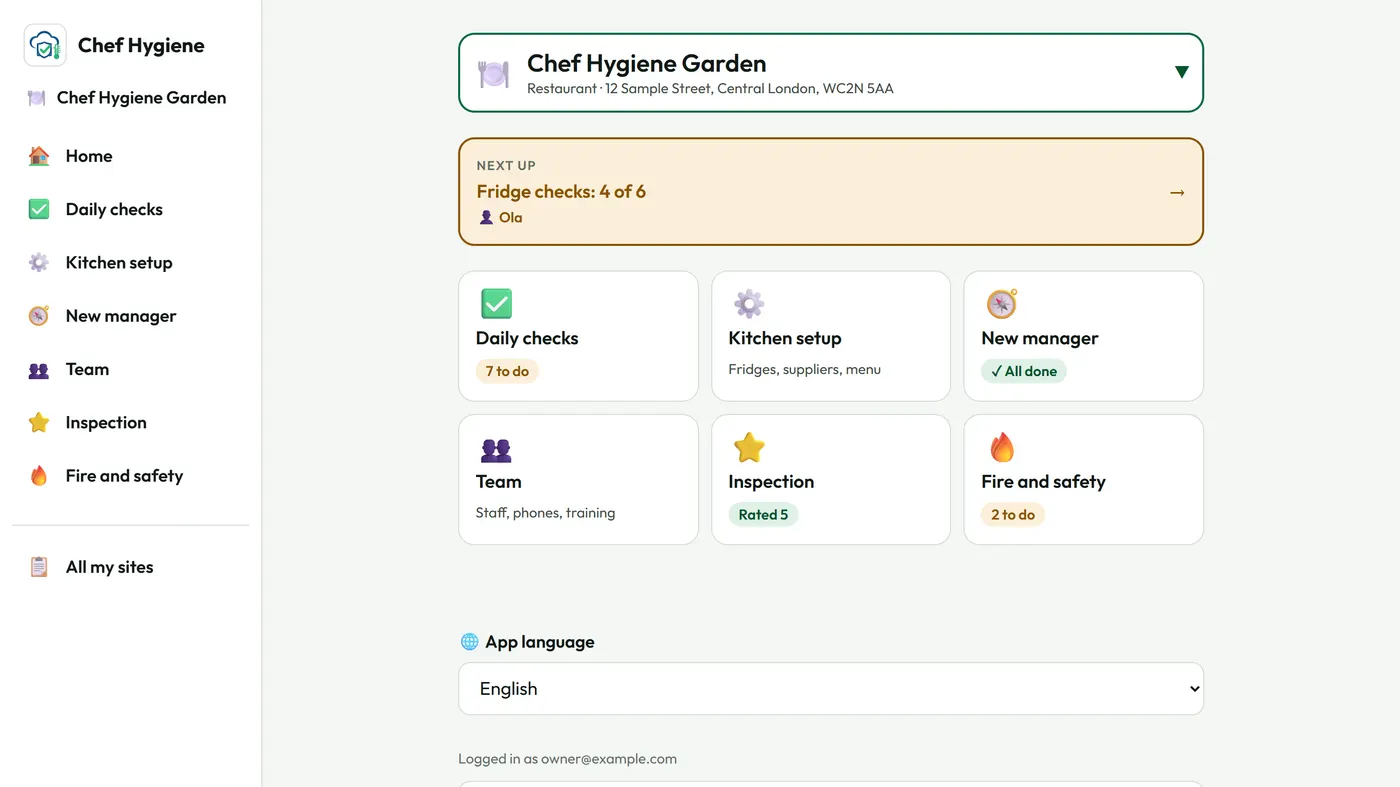
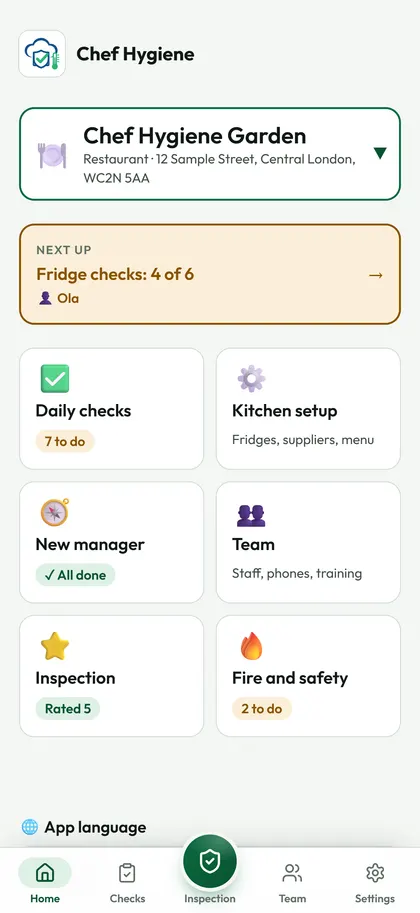
Δημιουργήστε τον λογαριασμό σας, ρυθμίστε ένα κοινόχρηστο tablet για την κουζίνα και εγκαταστήστε την εφαρμογή στα τηλέφωνα του προσωπικού σας, βήμα προς βήμα.
Γερμανία: επιθεωρήσεις τροφίμων
Ποιος επιθεωρεί την κουζίνα σας, πώς λειτουργεί μια επιθεώρηση και εάν υπάρχει βαθμολογία δημόσιας υγιεινής.
Γερμανία: κανόνες θερμοκρασίας φαγητού
Τις θερμοκρασίες των τροφίμων πρέπει να διατηρεί η κουζίνα σας και οι κανόνες πίσω από αυτές.
Γερμανία: αλλεργιογόνα
Τι πρέπει να λέει η κουζίνα σας στους πελάτες για τα αλλεργιογόνα.
Γερμανία: ασθένεια και εκπαίδευση του προσωπικού
Η εκπαίδευση, οι κανόνες του χειριστή τροφίμων και όταν το άρρωστο προσωπικό πρέπει να μείνει μακριά από τα τρόφιμα.
Γερμανία: πυρασφάλεια
Έλεγχοι πυρασφάλειας για την κουζίνα σας και πόσο συχνά οφείλονται.
Γερμανία: αρχεία προς διατήρηση
Τα αρχεία και οι εγγραφές που πρέπει να τηρεί η κουζίνα σας.
Γερμανία: η εφαρμογή Chef Hygiene
Η εφαρμογή φορτώνει αυτούς τους κανόνες για την κουζίνα σας, ελέγχει τα αρχεία σας σε σχέση με αυτούς και διατηρεί αποδεικτικά στοιχεία για τον επιθεωρητή.
Άλλες χώρες
 Ηνωμένο Βασίλειο
 Ιρλανδία
 Ισλανδία
 Ηνωμένες Πολιτείες
 Καναδάς
 Γαλλία
 Ισπανία
 Κάτω Χώρες
 Βέλγιο
 Πορτογαλία
 Αυστρία
 Πολωνία
 Ρουμανία
 Ιταλία
 Ελλάδα
 Δανία
Δανία Ελβετία
 Λουξεμβούργο
 Κύπρος
 Μάλτα
Μάλτα Σουηδία
 Νορβηγία
 Φινλανδία
 Τσεχία
 Ουγγαρία
 Κροατία
 Βουλγαρία
 Σλοβακία
 Σλοβενία
 Εσθονία
 Λετονία
 Λιθουανία
 Λιχτενστάιν
 Άγιος Μαρίνος
 Γιβραλτάρ
 Μονακό
 Μολδαβία
 Ανδόρα
 Σερβία
 Τζέρζι
 Γκέρνζι
 Νήσος του Μαν
 Τουρκία
 Μαυροβούνιο
 Βοσνία - Ερζεγοβίνη
 Κοσσυφοπέδιο
 Αλβανία
 Βόρεια Μακεδονία
 Ουκρανία