 英国
英国 爱尔兰
爱尔兰 冰岛
冰岛 美国
美国 加拿大
加拿大 法国
法国 西班牙
西班牙 荷兰
荷兰 比利时
比利时 葡萄牙
葡萄牙 奥地利
奥地利 波兰
波兰 罗马尼亚
罗马尼亚 意大利
意大利 希腊
希腊 丹麦
丹麦 瑞士
瑞士 卢森堡
卢森堡 塞浦路斯
塞浦路斯 马耳他
马耳他 瑞典
瑞典 挪威
挪威 芬兰
芬兰 捷克
捷克 匈牙利
匈牙利 克罗地亚
克罗地亚 保加利亚
保加利亚 斯洛伐克
斯洛伐克 斯洛文尼亚
斯洛文尼亚 爱沙尼亚
爱沙尼亚 拉脱维亚
拉脱维亚 立陶宛
立陶宛 列支敦士登
列支敦士登 圣马力诺
圣马力诺 直布罗陀
直布罗陀 摩纳哥
摩纳哥 摩尔多瓦
摩尔多瓦 安道尔
安道尔 塞尔维亚
塞尔维亚 泽西岛
泽西岛 根西岛
根西岛 马恩岛
马恩岛 土耳其
土耳其 黑山
黑山 波斯尼亚和黑塞哥维那
 科索沃
科索沃 阿尔巴尼亚
阿尔巴尼亚 北马其顿
北马其顿 乌克兰
乌克兰 德国:用于餐厅和外卖
每天都要做好接受食品检查的准备。
In Germany the app follows the food hygiene law (LFGB, LMHV, IfSG), EU Regulation 852/2004 and the BfR’s guidance; the food control office of your district or city inspects.
14 天免费试用 · 每个网站统一价格 · 无合同
德国:食品卫生规则
本页规则目前为英文版,稍后会翻译成您的语言。
- 检查机构
- Food control office of the district or city (Lebensmittelüberwachung, also called Veterinär- und Lebensmittelüberwachungsamt)
- 公众评价
- 不
- 应用内的语言
- Deutsch, English
您的检查
Food control is a task of each federal state (Land). In practice the food control office of the district or city (Lebensmittelüberwachung) inspects restaurants. The federal office BVL only coordinates and does not inspect restaurants.
Visits are based on risk. As a rule they are not announced. The authority can order tests and ban sales until the results come in. EU law also lets it stop all or part of a business’s activities. Fines run up to €100,000, €50,000 or €20,000 depending on the rule broken, and serious cases can be crimes.
卫生等级
There is no hygiene rating, sticker or duty to display a result in any Land. When hygiene rules were broken badly or repeatedly and a fine of at least €350 is expected, the Land publishes the business name and the breach online for 6 months.
“法律”是指具有约束力的规则。“官方指南”并非法律,但检查人员会参考它。“Chef Hygiene 默认值”是指在没有规则给出具体数值的情况下,应用程序会检查的值。
温度
- 官方指南Chef Hygiene checks fridges against 4°C as the aim and 7°C as the limit for chilled food and cold dishes. This follows BfR guidance and DIN 10508; German law sets no general fridge number for restaurants.
- 官方指南Raw meat, poultry, mince and fresh fish: 2°C or colder when the label says nothing (BfR guidance). DIN 10508 says fresh fish at 2°C or on melting ice.
- 法律A storage temperature on a product’s label always applies.
- 法律Mince made in your kitchen (Tier-LMHV Annex 5): use meat at 7°C or colder, poultry at 4°C, offal at 3°C. If it is not served where it was made, wrap it at once and chill it to 2°C in the core (mince) or 4°C (meat preparations), or freeze it to −18°C.
- 法律Frozen food: −18°C or colder. A short rise of at most 3°C is allowed in transport and shop freezers (TLMV § 2, the law for quick-frozen food).
- Chef Hygiene 默认值Chef Hygiene checks hot food against 65°C, the stricter value. The BfR advises 60°C or hotter at every point (2020) and no more than 3 hours; older DIN 10508 and many local sheets say 65°C.
- 官方指南Cooling: from 65°C to 10°C within 2 hours (DIN 10508 and local food control sheets). EU law only says to cool food as quickly as possible.
- 官方指南Cooking and reheating: 72°C in the centre for at least 2 minutes (BfR guidance, 2024). No German law sets this number.
- 法律Deliveries: suppliers must keep mince at 2°C or colder, poultry and meat preparations at 4°C, offal at 3°C, other meat at 7°C, and fresh fish near melting ice (Regulation 853/2004). Frozen food stays at −18°C; Chef Hygiene flags frozen deliveries above −15°C.
员工、培训和健康
- 法律IfSG certificate: before the first day of food work, every worker needs a certificate from the health office (Gesundheitsamt) or a doctor it commissions. It must be no older than 3 months at the start and has no expiry date (IfSG § 43).
- 法律Instruction by the employer: after the start and then every 2 years, you instruct staff on work bans and the duty to report illness, and you document it. Keep the certificate and the last record (IfSG § 43). Employing someone without the certificate can cost up to €25,000.
- 法律Anyone who makes, handles or sells perishable food needs food hygiene training (LMHV § 4). The law sets no hours, certificate or renewal, but you must be able to show proof on request.
- 官方指南Munich’s food control office asks you to write down who was trained, when, on what topics and by whom, at hiring and at least once a year.
- 法律Sick staff: nobody may work in a restaurant kitchen while ill with, or suspected of, typhoid, paratyphoid, cholera, shigellosis, salmonellosis, other infectious gastroenteritis or hepatitis A or E. The same applies with infected wounds or skin disease. Staff must tell the employer at once (IfSG §§ 42, 43).
过敏原
- 法律The 14 EU allergens: cereals with gluten, crustaceans, eggs, fish, peanuts, soybeans, milk, tree nuts, celery, mustard, sesame, sulphites, lupin and molluscs.
- 法律For food that is not prepacked, tell guests before the sale, in German. Do it in writing (menu, sign, notice or screen) (LMIDV § 4).
- 法律Telling guests by word of mouth is allowed only if a written or electronic ingredient record exists, the authority and guests can see it on request, and a clear notice says so (LMIDV § 4).
- 法律Some additives must also be named on menus, for example “mit Farbstoff” (with colouring) and “mit Konservierungsstoff” (with preservative) (LMZDV § 5).
消防安全检查
- 官方指南Fire extinguishers are serviced every 2 years by a competent person, and the result is documented (ASR A2.2). Fryers and woks need a class F extinguisher (BGN guidance).
- 官方指南Kitchen hood and grease filters are checked every working day. Ducts, fan and interlocks are checked every 6 months, and an exhaust test is done every year (BGN, VDI 2052, DGUV Regel 110-003).
- 官方指南Gas appliances and their flame-failure devices get a function check every year. The owner also looks over the whole gas installation every year (BGN, DGUV Regel 110-003).
- 法律Liquefied gas (LPG) must be tested by a competent person: fixed installations at least every 4 years, mobile ones every 2 years, and every year in a room below ground (BetrSichV, Annex 3).
- 官方指南A qualified electrician tests the fixed electrical installation every 4 years. Portable appliances are tested about every 6 months, at most yearly if few faults are found (DGUV Regel 110-003).
记录
- 法律You need food safety procedures based on HACCP principles (EU Regulation 852/2004, art. 5). German food hygiene law (LMHV) has no separate HACCP rules.
- 官方指南The recognised national guide for restaurants is DEHOGA’s “Leitlinie für eine Gute Hygienepraxis in der Gastronomie” (3rd edition, 2022). It is sold and not free.
- 法律Keep your monitoring records, for example temperatures, cleaning and deliveries, for an appropriate period (Regulation 852/2004). Restaurants record who supplied what, but not their guests.
- 官方指南Keep equipment test records at least until the next test, and for LPG installations for their whole life (BGN guidance).
官方消息
- Federal Office of Consumer Protection and Food Safety (BVL)
- Federal Institute for Risk Assessment (BfR)
- German federal laws (gesetze-im-internet.de)
- Robert Koch Institute: IfSG instruction leaflets
- BGN, accident insurer for hotels and restaurants
Checked
本页面仅提供一般信息,不构成法律建议。请咨询当地政府部门。
德国:食品卫生指南
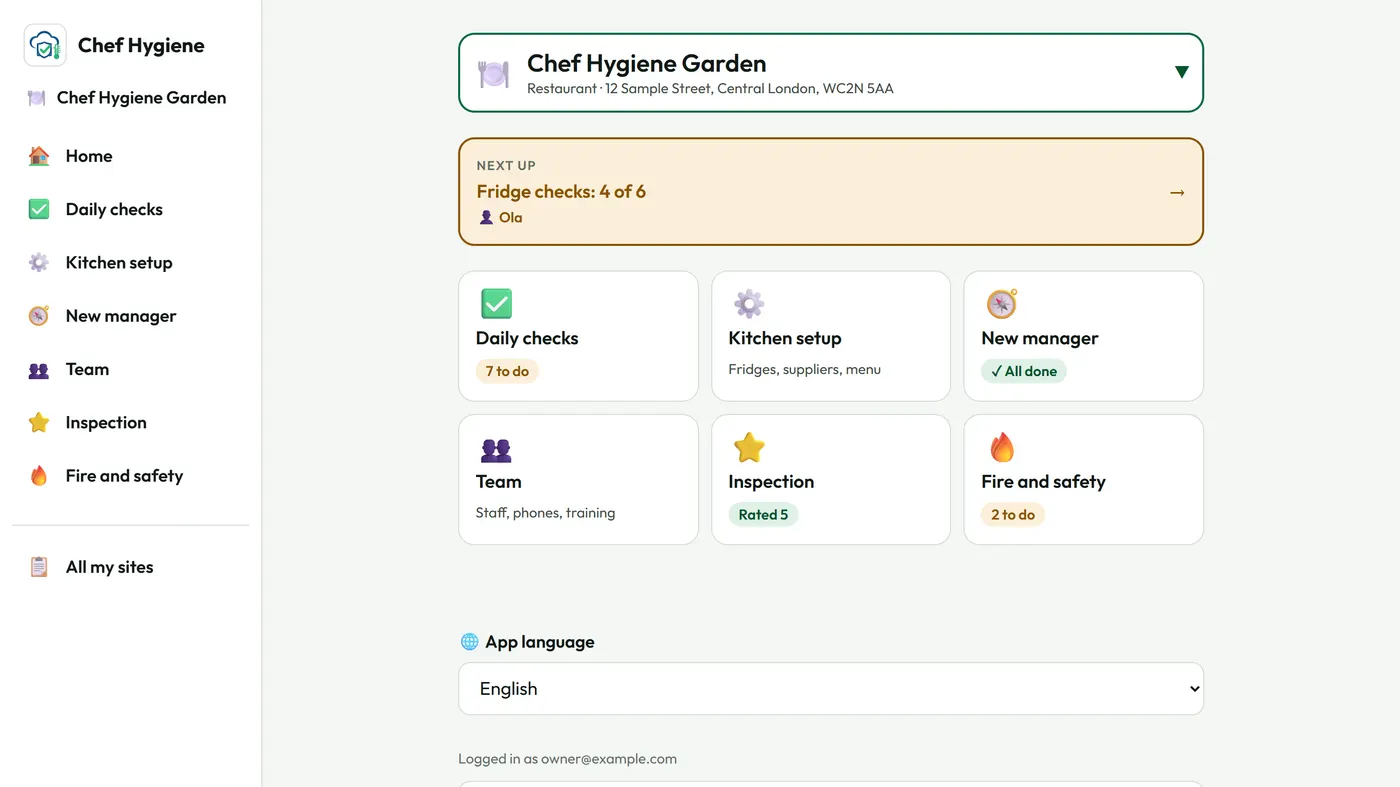
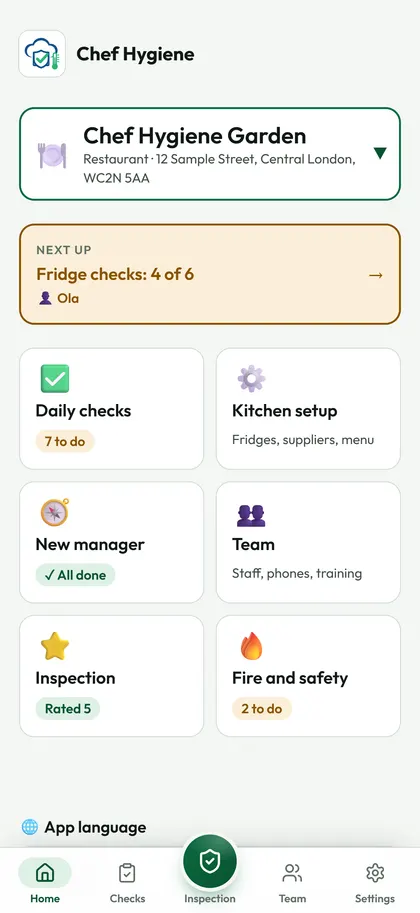
德国:Chef Hygiene 应用程序
该应用程序会加载您厨房的这些规则,对照这些规则检查您的记录,并保留证据以供检查员参考。