 Canadá: para restaurantes y comida para llevar
Listos para la inspección de alimentos. Todos los días.
In Canada the app follows the national Food Retail and Food Services Code (2016) and Health Canada’s safe temperatures, with each province’s own rules. Provincial and local health authorities inspect. Quebec comes later, in French.
14 días gratis · un precio por sitio · sin contrato
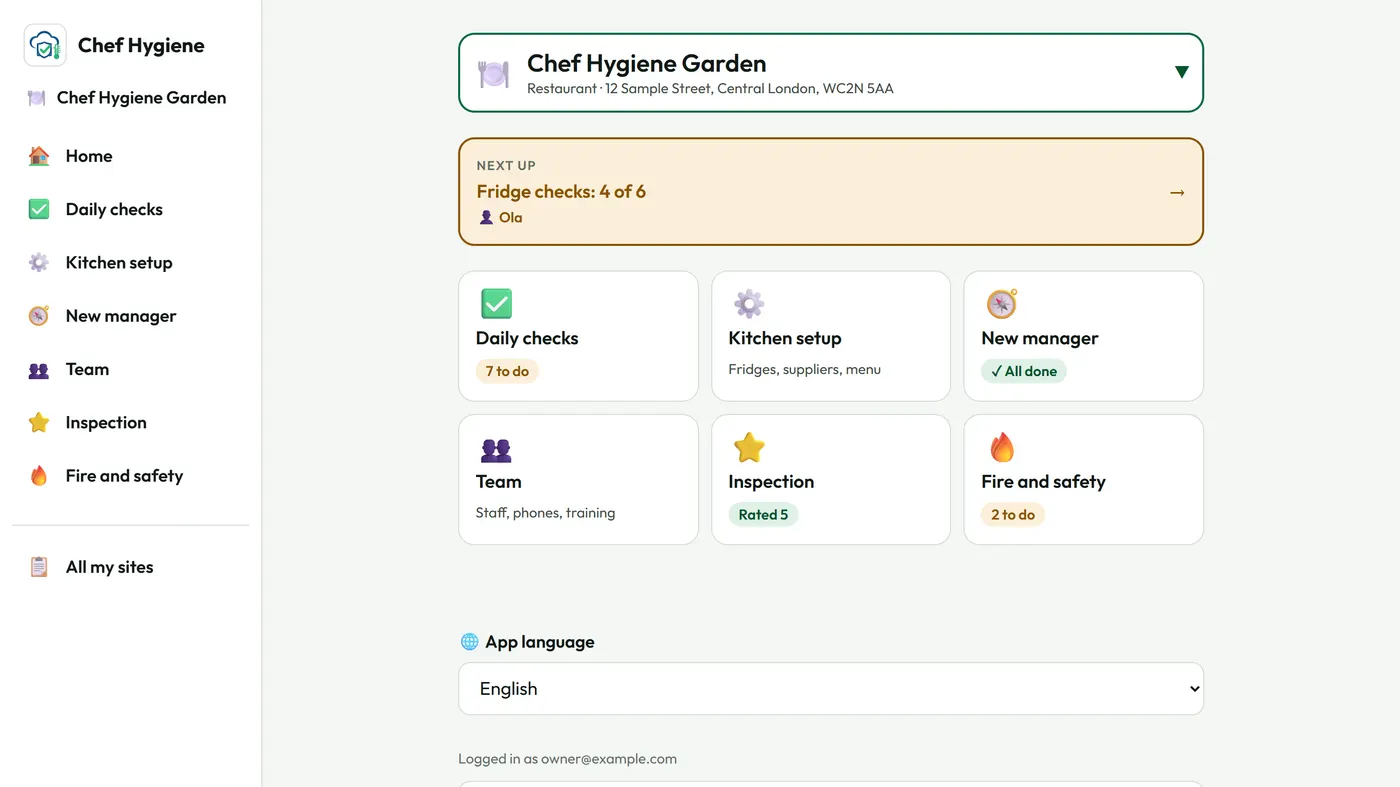
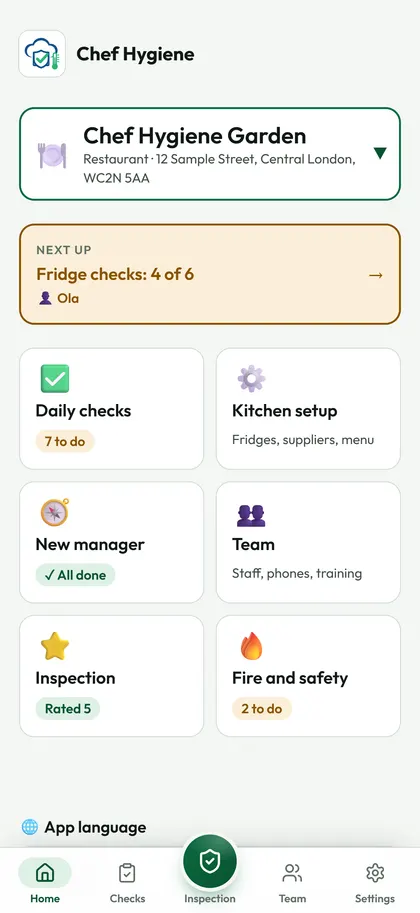
Canadá: reglas de higiene alimentaria
Las reglas de esta página están en inglés por el momento. Se traducirán a tu idioma.
- Órgano de inspección
- Provincial and territorial governments and their health authorities (the Canadian Food Inspection Agency, CFIA, covers only food traded between provinces, imported or exported)
- Calificación pública
- No
- Idiomas en la aplicación
- English
Su inspección
Provincial and territorial governments regulate restaurants, takeaways and cafés within their borders, and many provinces let municipal authorities enforce the rules locally. The CFIA licenses only businesses that import, export or trade food between provinces.
Rules and inspections differ by province. The national Food Retail and Food Services Code (2016) is a model code, not federal law: each province chooses whether to adopt it. Check your province’s food safety rules and your local health authority.
Calificación de higiene
There is no national grade. Inspection results are public in most provinces, for example through Ontario’s boards of health, Toronto DineSafe, British Columbia’s health authorities, Alberta Health Services, Saskatchewan and Prince Edward Island.
“Ley” es una norma vinculante. “Orientación oficial” no es ley, pero los inspectores la esperan. “Chef Hygiene predeterminado” es un valor que la aplicación comprueba cuando ninguna norma especifica un número.
Temperaturas
- Orientación oficialKeep fridges at 4°C or lower and hot food at 60°C or higher (national code, with Ontario’s numbers).
- LeyManitoba: hazardous food must be kept at 5°C or lower (M.R. 339/88 R).
- Orientación oficialKeep freezers at −18°C or lower.
- Orientación oficialCooking, internal temperature (Health Canada): whole poultry 82°C; poultry pieces and ground poultry 74°C; egg dishes 74°C; shellfish 74°C.
- Orientación oficialCooking, internal temperature (Health Canada): ground meat 71°C; pork 71°C; fish 70°C; beef, veal and lamb steaks from 63°C (medium-rare) to 77°C (well done).
- Orientación oficialReheating: leftovers to 74°C (Health Canada). British Columbia: 74°C within 2 hours.
- Orientación oficialCooling: cooked food goes from 60°C to 20°C within 2 hours, then to 4°C within another 4 hours, 6 hours in total. Quebec: 60°C to 21°C in 2 hours, then to 4°C.
- Orientación oficialThe danger zone for bacteria is 4°C to 60°C, where they grow fastest.
- Chef Hygiene predeterminadoChef Hygiene checks chilled deliveries at 4°C or lower and frozen food at −15°C or lower. Manitoba: chilled at 5°C or lower.
Personal, formación y salud
- Orientación oficialProvinces ask for trained food handlers. Ontario: a trained person every hour of operation. Alberta: a certified person, and with 6 or more food handlers a certified manager or supervisor on site.
- Orientación oficialBritish Columbia: FOODSAFE for the operator, and a FOODSAFE holder present when the operator is away. Manitoba: a certified food handler, and one on duty at all times when more than 5 handlers work at once.
- Orientación oficialNova Scotia: the operator, and a trained person present when the operator is away, renewed every 5 years. Quebec: training for 10% of staff (manager course 12 hours, handler course 6 hours).
Alérgenos
- Orientación oficialHealth Canada lists 11 priority allergens: peanuts, tree nuts, sesame seeds, fish, crustaceans and molluscs, eggs, milk, soy, wheat and triticale, mustard and sulphites.
- Chef Hygiene predeterminadoThis list is for labels on prepackaged food. No federal law makes restaurants list these allergens on menus. Chef Hygiene uses the 11 for its allergen chart.
Controles de seguridad contra incendios
- Orientación oficialThe National Fire Code of Canada 2020 is the model code for the provinces. Kitchen hoods follow NFPA 96, and fire suppression systems follow NFPA 17A or NFPA 10.
- Orientación oficialFire protection equipment is inspected by a qualified person at least every 6 months. Portable extinguishers are looked over every month and fully serviced every year.
- Orientación oficialAutomatic fire suppression systems need supervisory monitoring, so an alarm sounds on a fault or when the system operates.
- Orientación oficialYour fire department and your province’s fire marshal or fire commissioner enforce the provincial fire code. Many restaurants also need a written fire safety plan approved by the fire department.
- Chef Hygiene predeterminadoChef Hygiene checks that the hood’s fire suppression system is inspected every 6 months. It also checks for a Class K extinguisher within 9 metres (30 feet) of the fryers.
Archivos
- LeyWHMIS 2015: employers must make sure hazardous products are labelled, keep the Safety Data Sheets (SDS) available to employees, and train workers. Suppliers provide the labels and SDS.
Fuentes oficiales
- Health Canada: food safety and cooking temperatures
- Health Canada: safe food storage and cooling
- Health Canada: priority food allergens
- National Fire Code of Canada 2020
- WHMIS 2015 (Government of Canada)
Checked
Esta página contiene información general, no asesoramiento legal. Consulte con su autoridad local.
Canadá: guías de higiene alimentaria
Configurar Chef Hygiene
Cree su cuenta, configure una tableta de cocina compartida y coloque la aplicación en los teléfonos de su personal, paso a paso.
Canadá: inspecciones de alimentos
Quién inspecciona tu cocina, cómo funciona una inspección y si existe una calificación de higiene pública.
Canadá: reglas de temperatura de los alimentos
Las temperaturas de los alimentos que debe mantener su cocina y las reglas detrás de ellas.
Canadá: alérgenos
Lo que su cocina debe informar a los clientes sobre los alérgenos.
Canadá: enfermedad y formación del personal
Capacitación, reglas para manipuladores de alimentos y cuándo el personal enfermo debe mantenerse alejado de los alimentos.
Canadá: seguridad contra incendios
Controles de seguridad contra incendios en su cocina y con qué frecuencia deben realizarse.
Canadá: registros para mantener
Los registros y registros que debe llevar tu cocina.
Canadá: la aplicación Chef Hygiene
La aplicación carga estas normas para tu cocina, compara tus registros con ellas y guarda pruebas para el inspector.
Otros países
 Reino Unido
 Irlanda
 Islandia
 Estados Unidos
 Francia
 España
 Países Bajos
 Bélgica
 Portugal
 Alemania
 Austria
 Polonia
 Rumanía
 Italia
 Grecia
 Dinamarca
 Suiza
Suiza Luxemburgo
 Chipre
 Malta
Malta Suecia
 Noruega
 Finlandia
 Chequia
 Hungría
 Croacia
 Bulgaria
 Eslovaquia
 Eslovenia
 Estonia
 Letonia
 Lituania
 Liechtenstein
 San Marino
 Gibraltar
 Mónaco
 Moldavia
 Andorra
 Serbia
 Jersey
 Guernesey
 Isla de Man
 Turquía
 Montenegro
 Bosnia y Herzegovina
 Kosovo
 Albania
 Macedonia del Norte
 Ucrania