 Eslovênia: para restaurantes e delivery
Pronto para a inspeção sanitária. Todos os dias.
In Slovenia the app follows the EU hygiene rules and the Law on Safe Food and Feed (ZVHK); UVHVVR food inspectors inspect, and the kitchen temperatures come from the national catering guide, not from law.
14 dias grátis · preço único por site · sem contrato
Eslovênia: regras de higiene alimentar
As regras desta página estão em inglês por enquanto. Elas serão traduzidas para o seu idioma.
- Órgão de inspeção
- Administration for Food Safety, Veterinary Sector and Plant Protection (Uprava za varno hrano, veterinarstvo in varstvo rastlin, UVHVVR)
- Classificação pública
- Não
- Idiomas disponíveis no aplicativo
- Slovenščina, English, Italiano, Magyar
Sua inspeção
UVHVVR food inspectors check food law in all phases, from 10 regional offices. The control plan 2025 to 2029 sets how often, by risk. A restaurant, inn or snack bar with more than 10 staff is checked about every 18 months. With fewer than 10 staff, or a café or pastry shop with its own production, about every 30 months.
For small faults the inspector gives a warning with a deadline, then a decision. If the fault is not fixed in time, or at once if there is direct danger to life or health, the inspector can ban the activity and seal the premises. Under the ZVHK (Art. 109) a company can be fined EUR 2,000 to 20,000 and a sole trader EUR 1,000 to 10,000 for breaches such as no traceability or unmet hygiene conditions.
Classificação de higiene
There is no national rating, sticker or duty to display a result. A ban for danger to life or health must be published online for at least 60 days.
“Lei” é uma regra vinculativa. “Orientação oficial” não é lei, mas os inspetores esperam que seja. “Chef Hygiene padrão” é um valor que o aplicativo verifica quando nenhuma regra fornece um número.
Temperaturas
- Orientações oficiaisNo Slovenian law sets restaurant fridge, hot-holding, cooling or reheating numbers. The values below come from the national catering guide (December 2010), as printed in NIJZ staff texts.
- Orientações oficiaisChilled storage and goods-in: below 5°C, or as the label says. Some NIJZ lines say below 4°C for raw food and cooked cold dishes.
- Orientações oficiaisFrozen food: −18°C or colder. For quick-frozen food this is law, with short rises of up to 3°C allowed (Rulebook 87/14, Art. 5).
- Orientações oficiaisCooking, core temperature for 15 seconds: 74°C for poultry pieces, game, stuffings and dishes with minced-meat stuffing; 68°C for pork and minced or chopped meat; 63°C for beef, veal, lamb, fish, eggs, dairy, rice and pasta.
- Orientações oficiaisHot holding: 63°C or hotter in the core. Below that, reheat or throw the food away. Serve within 2 hours of cooking, and never after 4 hours.
- Orientações oficiaisCooling in two stages: from 63°C to 20°C within 2 hours, then to 5°C within 4 more hours. A blast chiller is better.
- Orientações oficiaisReheating: 74°C for 15 seconds.
- Orientações oficiaisCold display and salad bars: under 3 hours. Very sensitive dishes such as tartare and cream cakes stay at 5 to 8°C. Throw the food away once it is over the limit or not served within 3 hours, and write down when it was put out.
Equipe, treinamento e saúde
- LeiSlovenia has no national food hygiene certificate, course length or renewal. EU law applies: the operator must instruct and train staff to suit their work (Regulation 852/2004).
- LeiBefore the first day each worker signs a consent to report illness and fills in a symptom declaration. The employer keeps them with a staff list for inspectors (Rulebook 82/03).
- LeiA worker with vomiting, diarrhoea, jaundice, pus-filled skin lesions or discharge from the eyes, ears or nose must stop food work and tell the manager at once (Rulebook 82/03).
- LeiThere is no routine yearly medical exam or health card. A public health institute checks a worker only after an infection, diarrhoea or vomiting at home, travel to an area with poor hygiene, or when an inspector asks. The employer pays.
- Orientações oficiaisNIJZ outbreak guidance: stay away for 48 hours after symptoms stop for most infections. After typhoid or dysentery return only with a doctor’s certificate after negative stool tests.
Alérgenos
- LeiIn catering, allergen information must be in writing, in at least one of the places where dishes are offered: menu, board, poster or screen. It must be easy to see, readable and not covered. There is no oral-only option (Decree 6/2014, Art. 3).
- Orientações oficiaisUse the word “vsebuje” plus the allergen name, for the 14 EU allergens. This also applies to drinks (SPOT guidance).
- LeiThe information must be in Slovene (ZVHK, Art. 51). A breach is fined EUR 6,000 to 30,000 for a company and EUR 3,000 to 6,000 for a sole trader (Decree 6/2014, Art. 4).
Verificações de segurança contra incêndio
- LeiEvery restaurant needs a fire order (požarni red) with annexes for records and check sheets. The owner sets how often the checks are done (Rulebook 52/07).
- LeiWhere an evacuation plan is required, hold a practical evacuation drill at least once a year and record it (Rulebook 52/07, Art. 11).
- LeiStaff get fire training at the start and again every 3 years for medium fire risk. Keep the records for at least 10 years (Rulebook 32/11).
- LeiExtinguishers are serviced by an authorised maintainer following the maker’s instructions. The label shows the next date. The rule sets no fixed interval (Rulebook 108/04).
- LeiBuilt-in fire systems, such as a fire alarm, gas detection and emergency lighting, need a certificate of proper functioning valid for 3 years (Rulebook 53/2019, Art. 21).
Registros
- LeiPermanent HACCP-based procedures are required, in proportion to the size of the business (ZVHK Art. 36; Regulation 852/2004).
- Orientações oficiaisKeep traceability records of supplier, product and date in (ZVHK Art. 23). NIJZ advises keeping them usually 2 years, and 6 months after the use-by date for perishable or unpacked food.
- Orientações oficiaisLog fridge and freezer temperatures at least once a day at the start of work, with corrective actions (NIJZ guidance).
- LeiRegister each premises with UVHVVR at least 15 days before opening and report changes within 15 days (ZVHK Art. 24).
Fontes oficiais
- UVHVVR, Administration for Food Safety, Veterinary Sector and Plant Protection
- Law on Safe Food and Feed (ZVHK), PISRS
- Decree 6/2014 on allergen information (PISRS)
- NIJZ, basic hygiene positions for food staff
- SPOT, restaurants and inns
Checked
Esta página contém informações gerais e não constitui aconselhamento jurídico. Consulte a sua autoridade local.
Eslovênia: guias de higiene alimentar
Configurar Chef Hygiene
Crie sua conta, configure um tablet de cozinha compartilhada e coloque o aplicativo nos telefones de sua equipe, passo a passo.
Eslovênia: inspeções de alimentos
Quem fiscaliza sua cozinha, como funciona a fiscalização e se existe classificação de higiene pública.
Eslovênia: regras de temperatura dos alimentos
As temperaturas dos alimentos que sua cozinha deve manter e as regras por trás delas.
Eslovênia: alérgenos
O que sua cozinha deve informar aos clientes sobre alérgenos.
Eslovênia: doença e treinamento do pessoal
Treinamento, regras para manipuladores de alimentos e quando a equipe doente deve ficar longe dos alimentos.
Eslovênia: segurança contra incêndio
Verificações de segurança contra incêndio em sua cozinha e com que frequência.
Eslovênia: registros a serem mantidos
Os registros e registros que sua cozinha deve manter.
Eslovênia: o aplicativo Chef Hygiene
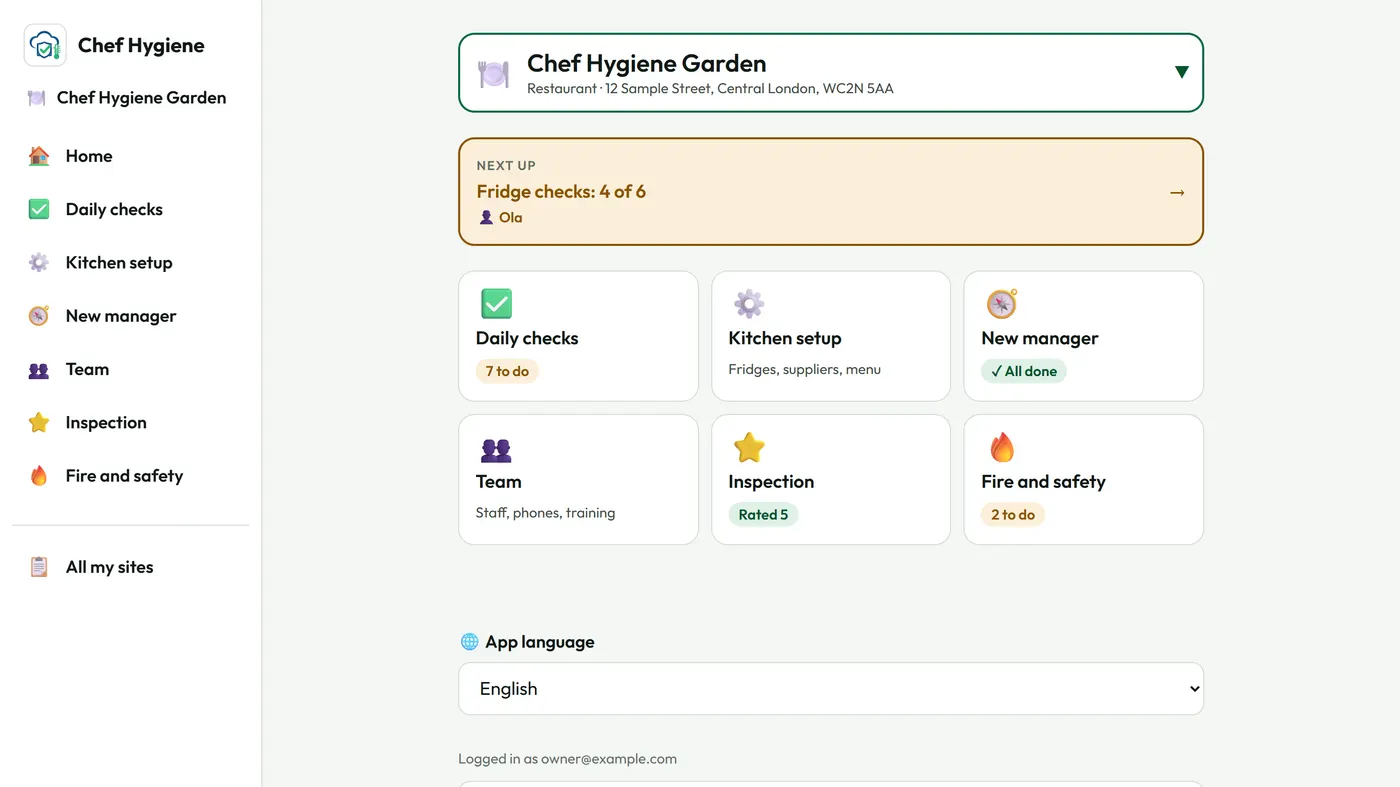
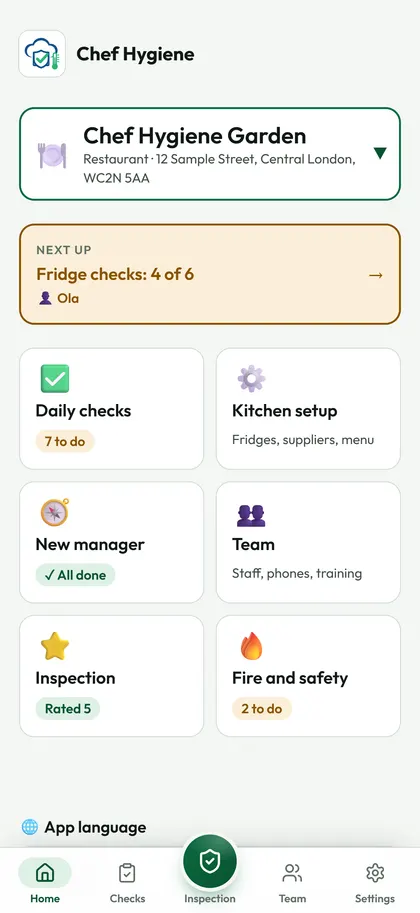
O aplicativo carrega essas regras para sua cozinha, compara seus registros com elas e guarda comprovantes para o inspetor.
Outros países
 Reino Unido
 Irlanda
 Islândia
 Estados Unidos
 Canadá
 França
 Espanha
 Países Baixos
 Bélgica
 Portugal
 Alemanha
 Áustria
 Polônia
 Romênia
 Itália
 Grécia
 Dinamarca
 Suíça
Suíça Luxemburgo
 Chipre
 Malta
Malta Suécia
 Noruega
 Finlândia
 Tchéquia
 Hungria
 Croácia
 Bulgária
 Eslováquia
 Estônia
 Letônia
 Lituânia
 Liechtenstein
 San Marino
 Gibraltar
 Mônaco
 Moldávia
 Andorra
 Sérvia
 Jersey
 Guernsey
 Ilha de Man
 Turquia
 Montenegro
 Bósnia e Herzegovina
 Kosovo
 Albânia
 Macedônia do Norte
 Ucrânia