 Slovenië: voor restaurants en afhaalrestaurants
Klaar voor de voedselinspectie. Elke dag.
In Slovenia the app follows the EU hygiene rules and the Law on Safe Food and Feed (ZVHK); UVHVVR food inspectors inspect, and the kitchen temperatures come from the national catering guide, not from law.
14 dagen gratis · één prijs per locatie · geen contract
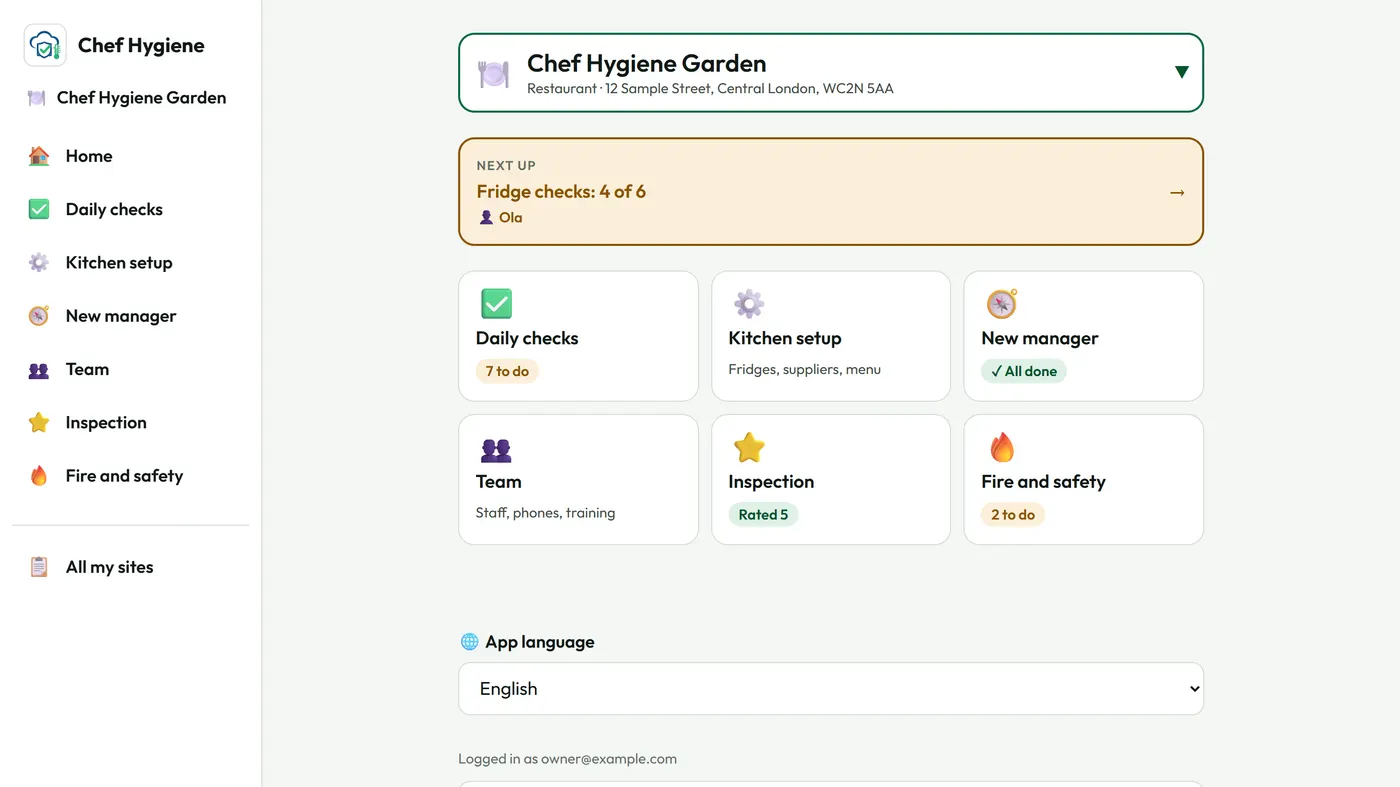
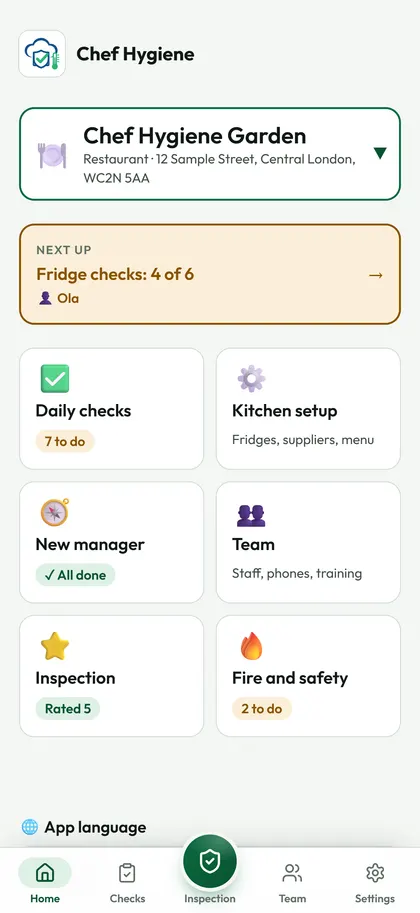
Slovenië: regels voor voedselhygiëne
De regels op deze pagina zijn voorlopig in het Engels. Ze zullen in uw taal worden vertaald.
- Inspectie-instantie
- Administration for Food Safety, Veterinary Sector and Plant Protection (Uprava za varno hrano, veterinarstvo in varstvo rastlin, UVHVVR)
- Publieke beoordeling
- Nee
- Talen in de app
- Slovenščina, English, Italiano, Magyar
Uw inspectie
UVHVVR food inspectors check food law in all phases, from 10 regional offices. The control plan 2025 to 2029 sets how often, by risk. A restaurant, inn or snack bar with more than 10 staff is checked about every 18 months. With fewer than 10 staff, or a café or pastry shop with its own production, about every 30 months.
For small faults the inspector gives a warning with a deadline, then a decision. If the fault is not fixed in time, or at once if there is direct danger to life or health, the inspector can ban the activity and seal the premises. Under the ZVHK (Art. 109) a company can be fined EUR 2,000 to 20,000 and a sole trader EUR 1,000 to 10,000 for breaches such as no traceability or unmet hygiene conditions.
Hygiënebeoordeling
There is no national rating, sticker or duty to display a result. A ban for danger to life or health must be published online for at least 60 days.
“Wet” is een bindende regel. “Officiële richtlijnen” zijn geen wet, maar inspecteurs verwachten ze wel. “Chef Hygiene standaardwaarde” is een waarde die de app controleert wanneer er geen regel is die een getal voorschrijft.
Temperaturen
- Officiële richtlijnenNo Slovenian law sets restaurant fridge, hot-holding, cooling or reheating numbers. The values below come from the national catering guide (December 2010), as printed in NIJZ staff texts.
- Officiële richtlijnenChilled storage and goods-in: below 5°C, or as the label says. Some NIJZ lines say below 4°C for raw food and cooked cold dishes.
- Officiële richtlijnenFrozen food: −18°C or colder. For quick-frozen food this is law, with short rises of up to 3°C allowed (Rulebook 87/14, Art. 5).
- Officiële richtlijnenCooking, core temperature for 15 seconds: 74°C for poultry pieces, game, stuffings and dishes with minced-meat stuffing; 68°C for pork and minced or chopped meat; 63°C for beef, veal, lamb, fish, eggs, dairy, rice and pasta.
- Officiële richtlijnenHot holding: 63°C or hotter in the core. Below that, reheat or throw the food away. Serve within 2 hours of cooking, and never after 4 hours.
- Officiële richtlijnenCooling in two stages: from 63°C to 20°C within 2 hours, then to 5°C within 4 more hours. A blast chiller is better.
- Officiële richtlijnenReheating: 74°C for 15 seconds.
- Officiële richtlijnenCold display and salad bars: under 3 hours. Very sensitive dishes such as tartare and cream cakes stay at 5 to 8°C. Throw the food away once it is over the limit or not served within 3 hours, and write down when it was put out.
Personeel, opleiding en gezondheid
- WetSlovenia has no national food hygiene certificate, course length or renewal. EU law applies: the operator must instruct and train staff to suit their work (Regulation 852/2004).
- WetBefore the first day each worker signs a consent to report illness and fills in a symptom declaration. The employer keeps them with a staff list for inspectors (Rulebook 82/03).
- WetA worker with vomiting, diarrhoea, jaundice, pus-filled skin lesions or discharge from the eyes, ears or nose must stop food work and tell the manager at once (Rulebook 82/03).
- WetThere is no routine yearly medical exam or health card. A public health institute checks a worker only after an infection, diarrhoea or vomiting at home, travel to an area with poor hygiene, or when an inspector asks. The employer pays.
- Officiële richtlijnenNIJZ outbreak guidance: stay away for 48 hours after symptoms stop for most infections. After typhoid or dysentery return only with a doctor’s certificate after negative stool tests.
Allergenen
- WetIn catering, allergen information must be in writing, in at least one of the places where dishes are offered: menu, board, poster or screen. It must be easy to see, readable and not covered. There is no oral-only option (Decree 6/2014, Art. 3).
- Officiële richtlijnenUse the word “vsebuje” plus the allergen name, for the 14 EU allergens. This also applies to drinks (SPOT guidance).
- WetThe information must be in Slovene (ZVHK, Art. 51). A breach is fined EUR 6,000 to 30,000 for a company and EUR 3,000 to 6,000 for a sole trader (Decree 6/2014, Art. 4).
Brandveiligheidscontroles
- WetEvery restaurant needs a fire order (požarni red) with annexes for records and check sheets. The owner sets how often the checks are done (Rulebook 52/07).
- WetWhere an evacuation plan is required, hold a practical evacuation drill at least once a year and record it (Rulebook 52/07, Art. 11).
- WetStaff get fire training at the start and again every 3 years for medium fire risk. Keep the records for at least 10 years (Rulebook 32/11).
- WetExtinguishers are serviced by an authorised maintainer following the maker’s instructions. The label shows the next date. The rule sets no fixed interval (Rulebook 108/04).
- WetBuilt-in fire systems, such as a fire alarm, gas detection and emergency lighting, need a certificate of proper functioning valid for 3 years (Rulebook 53/2019, Art. 21).
Records
- WetPermanent HACCP-based procedures are required, in proportion to the size of the business (ZVHK Art. 36; Regulation 852/2004).
- Officiële richtlijnenKeep traceability records of supplier, product and date in (ZVHK Art. 23). NIJZ advises keeping them usually 2 years, and 6 months after the use-by date for perishable or unpacked food.
- Officiële richtlijnenLog fridge and freezer temperatures at least once a day at the start of work, with corrective actions (NIJZ guidance).
- WetRegister each premises with UVHVVR at least 15 days before opening and report changes within 15 days (ZVHK Art. 24).
Officiële bronnen
- UVHVVR, Administration for Food Safety, Veterinary Sector and Plant Protection
- Law on Safe Food and Feed (ZVHK), PISRS
- Decree 6/2014 on allergen information (PISRS)
- NIJZ, basic hygiene positions for food staff
- SPOT, restaurants and inns
Checked
Deze pagina bevat algemene informatie en is geen juridisch advies. Neem contact op met uw lokale overheid.
Slovenië: gidsen voor voedselhygiëne
Stel Chef Hygiene in
Maak uw account aan, stel een gedeelde keukentablet in en zet de app stap voor stap op de telefoons van uw medewerkers.
Slovenië: voedselinspecties
Wie inspecteert uw keuken, hoe een inspectie werkt en of er een keuring voor de openbare hygiëne bestaat.
Slovenië: regels voor voedseltemperatuur
De voedseltemperaturen die uw keuken moet behouden, en de regels daarachter.
Slovenië: allergenen
Wat uw keuken klanten moet vertellen over allergenen.
Slovenië: ziekte en opleiding van het personeel
Training, regels voor voedselbehandelaars en wanneer ziek personeel van voedsel weg moet blijven.
Slovenië: brandveiligheid
Brandveiligheidscontroles voor uw keuken en hoe vaak deze moeten plaatsvinden.
Slovenië: gegevens die moeten worden bewaard
De administratie en registraties die uw keuken moet bijhouden.
Slovenië: de Chef Hygiene-app
De app laadt deze regels voor uw keuken in, controleert uw administratie aan de hand daarvan en bewaart het bewijs voor de inspecteur.
Andere landen
 Verenigd Koninkrijk
 Ierland
 IJsland
 Verenigde Staten
 Canada
 Frankrijk
 Spanje
 Nederland
 België
 Portugal
 Duitsland
 Oostenrijk
 Polen
Polen Roemenië
 Italië
 Griekenland
 Denemarken
 Zwitserland
 Luxemburg
 Cyprus
 Malta
Malta Zweden
 Noorwegen
 Finland
 Tsjechië
 Hongarije
 Kroatië
 Bulgarije
 Slowakije
 Estland
 Letland
 Litouwen
 Liechtenstein
 San Marino
 Gibraltar
 Monaco
 Moldavië
 Andorra
 Servië
 Jersey
 Guernsey
 Isle of Man
 Turkije
 Montenegro
 Bosnië en Herzegovina
 Kosovo
 Albanië
 Noord-Macedonië
 Oekraïne