 Polen: für Restaurants und Imbissbuden
Bereit für die Lebensmittelkontrolle. Jeden Tag.
In Poland the app follows the food safety act, EU Regulation 852/2004 and the guidance of the Chief Sanitary Inspectorate (GIS); the district sanitary inspector (Sanepid) inspects.
14 Tage kostenlos · Ein Preis pro Standort · Keine Vertragsbindung
Polen: Lebensmittelhygieneregeln
Die Regeln auf dieser Seite sind vorerst auf Englisch. Sie werden in Ihre Sprache übersetzt.
- Inspektionsstelle
- State Sanitary Inspection (Państwowa Inspekcja Sanitarna, “Sanepid”)
- Öffentliche Bewertung
- NEIN
- Sprachen in der App
- Polski, English
Ihre Inspektion
The State Sanitary Inspection (Sanepid) inspects restaurants. The district inspector (PPIS, working through the PSSE) approves, registers and inspects them. The provincial inspector hears appeals and sets money fines, and GIS is the national body.
Visits are based on risk, and official food controls may be unannounced. Every business keeps an inspection book (książka kontroli) and shows it at the start of each inspection. A decision orders faults to be fixed by a set date. Where life or health is in direct danger, the inspector can close the premises at once, and fines can follow.
Hygienebewertung
Poland has no public hygiene rating or sticker, and results for single restaurants are not published. Nothing about the inspection has to be displayed at the premises.
„Gesetz“ ist eine verbindliche Regel. „Offizielle Richtlinien“ sind kein Gesetz, werden aber von Prüfern erwartet. „Chef Hygiene Standardwert“ ist ein Wert, den die App überprüft, wenn keine Regel einen Wert vorgibt.
Temperaturen
- Offizielle LeitlinienNo Polish law sets fridge, hot-holding, cooling or reheating numbers for restaurants. GIS says each business sets them in its own HACCP procedure. The numbers below are official consumer guidance (GIS, Sanepid, and the WHO five keys that GIS recommends).
- Offizielle LeitlinienChilled food: below 4°C (Sanepid guidance), preferably below 5°C (WHO). A temperature on the label or from the maker applies.
- GesetzQuick-frozen food: −18°C or colder. A rise of up to 3°C is allowed only while loading and unloading and in shop cabinets (regulation of 19 September 2003, § 3).
- Offizielle LeitlinienHot food: above 60°C just before serving (Sanepid, WHO). Cooked food stays out of the fridge no longer than 2 hours at room temperature (GIS).
- Offizielle LeitlinienCooling: put cooked food in the fridge within 2 hours, preferably below 5°C (GIS, Sanepid). No temperature stages are given.
- Offizielle LeitlinienReheating: heat food to 70°C (Sanepid guidance). Chef Hygiene warns on a lower reading.
- Offizielle LeitlinienCooking: cook food to above 70°C (GIS guidance).
- Chef Hygiene StandardDeliveries: Chef Hygiene checks chilled food against 5°C when the label gives nothing. Frozen food must arrive at −18°C, with a 3°C rise allowed only while unloading.
Personal, Schulung und Gesundheit
- GesetzEveryone who works in contact with food needs a medical certificate for sanitary-epidemiological purposes (orzeczenie do celów sanitarno-epidemiologicznych). The employer sends the person for the tests. It has no expiry date in law (food safety act art. 59; infections act).
- Offizielle LeitlinienGIS advises new tests after diarrhoea, a long cough, contact with infected people, or return after an infectious disease. Keep the certificate in the personnel file, with a copy at work.
- GesetzFood hygiene training or instruction for all food staff and for the people running HACCP must be documented. The law sets no certificate, hours or renewal (food safety act art. 59).
- GesetzSafety-at-work (BHP) training is a separate duty: before starting work, then every 3 years for manual jobs and every 5 years for managers.
- GesetzSick staff: nobody with a disease that can pass through food, infected wounds, skin infections or diarrhoea may handle food. Staff must tell the manager at once, and the employer must take them off this work (EU Regulation 852/2004; infections act art. 10).
Allergene
- GesetzThe 14 EU allergens: cereals with gluten, crustaceans, eggs, fish, peanuts, soybeans, milk, tree nuts, celery, mustard, sesame, sulphites, lupin and molluscs.
- GesetzFor restaurant dishes, give the dish name and the full list of ingredients with the allergens shown. Give it in writing, where guests see it before ordering: a menu, board, notice or screen (MRiRW regulation of 23 December 2014, § 19).
- GesetzThe trade inspection authority (UOKiK) decided that staff answering questions does not replace the written information (decision DIH-1/57/2016).
- GesetzMenus and allergen information must be in Polish. Other languages may be added. Drinks over 1.2% alcohol need no ingredient list, but their allergens must still be given.
Brandschutzprüfungen
- GesetzPortable fire extinguishers are inspected and maintained at least once a year, as the maker and Polish Standards say. Where there is cooking oil, you need class F. The nearest extinguisher is at most 30 m away (MSWiA fire regulation).
- GesetzFlue ducts from catering hearths are cleaned at least monthly, unless local rules differ. Ventilation ducts are cleaned at least every year, by people with chimney-sweep qualifications (MSWiA fire regulation § 34).
- GesetzGas installations and chimney, flue and ventilation ducts are checked at least once a year, with a written protocol. This is a duty of the building owner or manager (building law art. 62).
- GesetzElectrical and lightning installations are tested at least every 5 years, as part of the whole-building check (building law art. 62).
- GesetzSince 30 June 2026 a room in commercial premises where fuel is burned needs a carbon monoxide detector. It is not needed for gas cooking appliances or closed-chamber appliances.
Aufzeichnungen
- GesetzHACCP-based procedures are mandatory for all food businesses (EU Regulation 852/2004 art. 5; food safety act art. 59).
- Offizielle LeitlinienGIS says food law sets no detailed rules for a kitchen’s own checks. The business sets them, and inspectors may ask for proof that they work but cannot impose specific solutions.
- GesetzKeep training documents and medical certificates in the personnel files, with a copy at the place of work, and show them on request (food safety act art. 59).
- GesetzKeep an inspection book (książka kontroli), on paper or electronic, and show it at the start of each inspection (Entrepreneurs’ Law art. 57).
Offizielle Quellen
- Chief Sanitary Inspectorate (GIS)
- Sanepid approval and registration (biznes.gov.pl)
- Polish laws (Sejm, ISAP)
- State Fire Service (PSP)
- GIS answer on own checks, 15 March 2024
Checked
Diese Seite enthält allgemeine Informationen und stellt keine Rechtsberatung dar. Bitte wenden Sie sich an Ihre örtliche Behörde.
Polen: Leitfäden zur Lebensmittelhygiene
Richten Sie Chef Hygiene ein
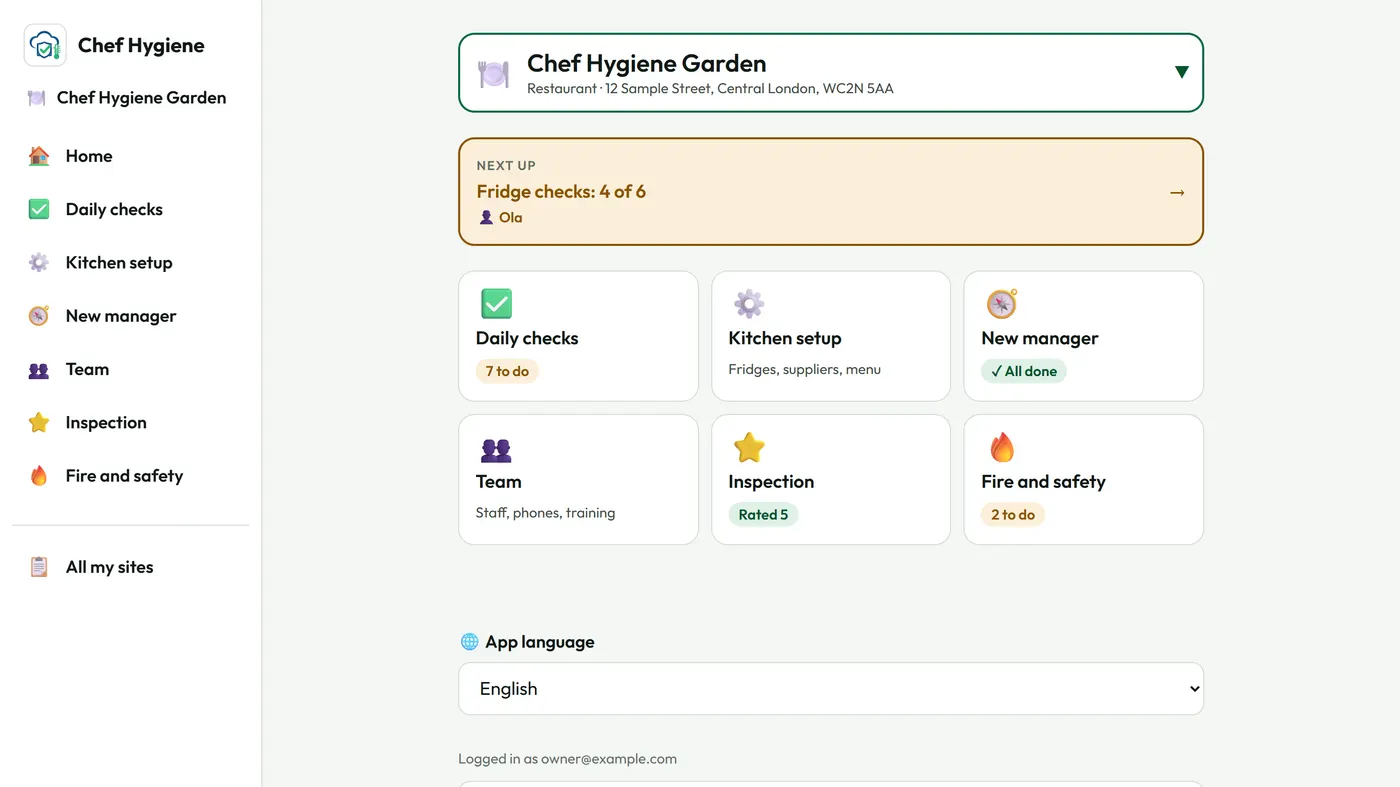
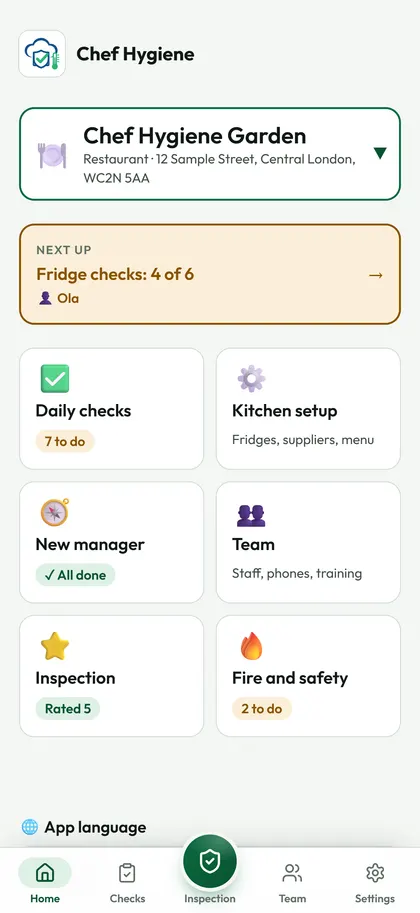
Erstellen Sie Ihr Konto, richten Sie ein Tablet für die gemeinsame Küche ein und installieren Sie die App Schritt für Schritt auf den Telefonen Ihrer Mitarbeiter.
Polen: Lebensmittelkontrollen
Wer inspiziert Ihre Küche, wie funktioniert eine Inspektion und ob es eine öffentliche Hygienebewertung gibt.
Polen: Regeln für die Lebensmitteltemperatur
Die Lebensmitteltemperaturen, die Ihre Küche einhalten muss, und die dahinter stehenden Regeln.
Polen: Allergene
Was Ihre Küche Ihren Kunden über Allergene sagen muss.
Polen: Krankheit und Schulung des Personals
Schulungen, Regeln für den Umgang mit Lebensmitteln und wenn krankes Personal sich von Lebensmitteln fernhalten muss.
Polen: Brandschutz
Brandschutzkontrollen für Ihre Küche und deren Häufigkeit.
Polen: aufzubewahrende Aufzeichnungen
Die Aufzeichnungen und Registrierungen, die Ihre Küche führen muss.
Polen: die Chef Hygiene-App
Die App lädt diese Regeln für Ihre Küche, gleicht Ihre Aufzeichnungen damit ab und speichert Nachweise für den Kontrolleur.
Andere Länder
 Vereinigtes Königreich
 Irland
 Island
 Vereinigte Staaten
 Kanada
 Frankreich
 Spanien
 Niederlande
 Belgien
 Portugal
 Deutschland
 Österreich
 Rumänien
 Italien
 Griechenland
 Dänemark
 Schweiz
 Luxemburg
 Zypern
 Malta
Malta Schweden
 Norwegen
 Finnland
 Tschechien
 Ungarn
 Kroatien
 Bulgarien
 Slowakei
 Slowenien
 Estland
 Lettland
 Litauen
 Liechtenstein
 San Marino
 Gibraltar
 Monaco
 Republik Moldau
 Andorra
 Serbien
 Jersey
 Guernsey
 Isle of Man
 Türkei
 Montenegro
 Bosnien und Herzegowina
 Kosovo
 Albanien
 Nordmazedonien
 Ukraine