 Polonya: restoranlar ve paket servisler için
Her gün gıda denetimine hazırız.
In Poland the app follows the food safety act, EU Regulation 852/2004 and the guidance of the Chief Sanitary Inspectorate (GIS); the district sanitary inspector (Sanepid) inspects.
14 gün ücretsiz · site başına tek fiyat · sözleşme yok
Polonya: gıda hijyen kuralları
Bu sayfadaki kurallar şimdilik İngilizce’dir. Daha sonra sizin dilinize çevrilecektir.
- Denetleme organı
- State Sanitary Inspection (Państwowa Inspekcja Sanitarna, “Sanepid”)
- Kamuoyu değerlendirmesi
- HAYIR
- Uygulamadaki diller
- Polski, English
Sizin incelemeniz
The State Sanitary Inspection (Sanepid) inspects restaurants. The district inspector (PPIS, working through the PSSE) approves, registers and inspects them. The provincial inspector hears appeals and sets money fines, and GIS is the national body.
Visits are based on risk, and official food controls may be unannounced. Every business keeps an inspection book (książka kontroli) and shows it at the start of each inspection. A decision orders faults to be fixed by a set date. Where life or health is in direct danger, the inspector can close the premises at once, and fines can follow.
Hijyen derecelendirmesi
Poland has no public hygiene rating or sticker, and results for single restaurants are not published. Nothing about the inspection has to be displayed at the premises.
“Kanun”, bağlayıcı bir kuraldır. “Resmi kılavuz” kanun değildir, ancak denetçiler bunu bekler. “Chef Hygiene varsayılan”, hiçbir kuralın sayı vermediği durumlarda uygulamanın kontrol ettiği bir değerdir.
Sıcaklıklar
- Resmi kılavuzNo Polish law sets fridge, hot-holding, cooling or reheating numbers for restaurants. GIS says each business sets them in its own HACCP procedure. The numbers below are official consumer guidance (GIS, Sanepid, and the WHO five keys that GIS recommends).
- Resmi kılavuzChilled food: below 4°C (Sanepid guidance), preferably below 5°C (WHO). A temperature on the label or from the maker applies.
- KanunQuick-frozen food: −18°C or colder. A rise of up to 3°C is allowed only while loading and unloading and in shop cabinets (regulation of 19 September 2003, § 3).
- Resmi kılavuzHot food: above 60°C just before serving (Sanepid, WHO). Cooked food stays out of the fridge no longer than 2 hours at room temperature (GIS).
- Resmi kılavuzCooling: put cooked food in the fridge within 2 hours, preferably below 5°C (GIS, Sanepid). No temperature stages are given.
- Resmi kılavuzReheating: heat food to 70°C (Sanepid guidance). Chef Hygiene warns on a lower reading.
- Resmi kılavuzCooking: cook food to above 70°C (GIS guidance).
- Chef Hygiene varsayılanDeliveries: Chef Hygiene checks chilled food against 5°C when the label gives nothing. Frozen food must arrive at −18°C, with a 3°C rise allowed only while unloading.
Personel, eğitim ve sağlık
- KanunEveryone who works in contact with food needs a medical certificate for sanitary-epidemiological purposes (orzeczenie do celów sanitarno-epidemiologicznych). The employer sends the person for the tests. It has no expiry date in law (food safety act art. 59; infections act).
- Resmi kılavuzGIS advises new tests after diarrhoea, a long cough, contact with infected people, or return after an infectious disease. Keep the certificate in the personnel file, with a copy at work.
- KanunFood hygiene training or instruction for all food staff and for the people running HACCP must be documented. The law sets no certificate, hours or renewal (food safety act art. 59).
- KanunSafety-at-work (BHP) training is a separate duty: before starting work, then every 3 years for manual jobs and every 5 years for managers.
- KanunSick staff: nobody with a disease that can pass through food, infected wounds, skin infections or diarrhoea may handle food. Staff must tell the manager at once, and the employer must take them off this work (EU Regulation 852/2004; infections act art. 10).
Alerjenler
- KanunThe 14 EU allergens: cereals with gluten, crustaceans, eggs, fish, peanuts, soybeans, milk, tree nuts, celery, mustard, sesame, sulphites, lupin and molluscs.
- KanunFor restaurant dishes, give the dish name and the full list of ingredients with the allergens shown. Give it in writing, where guests see it before ordering: a menu, board, notice or screen (MRiRW regulation of 23 December 2014, § 19).
- KanunThe trade inspection authority (UOKiK) decided that staff answering questions does not replace the written information (decision DIH-1/57/2016).
- KanunMenus and allergen information must be in Polish. Other languages may be added. Drinks over 1.2% alcohol need no ingredient list, but their allergens must still be given.
Yangın güvenliği kontrolleri
- KanunPortable fire extinguishers are inspected and maintained at least once a year, as the maker and Polish Standards say. Where there is cooking oil, you need class F. The nearest extinguisher is at most 30 m away (MSWiA fire regulation).
- KanunFlue ducts from catering hearths are cleaned at least monthly, unless local rules differ. Ventilation ducts are cleaned at least every year, by people with chimney-sweep qualifications (MSWiA fire regulation § 34).
- KanunGas installations and chimney, flue and ventilation ducts are checked at least once a year, with a written protocol. This is a duty of the building owner or manager (building law art. 62).
- KanunElectrical and lightning installations are tested at least every 5 years, as part of the whole-building check (building law art. 62).
- KanunSince 30 June 2026 a room in commercial premises where fuel is burned needs a carbon monoxide detector. It is not needed for gas cooking appliances or closed-chamber appliances.
Kayıtlar
- KanunHACCP-based procedures are mandatory for all food businesses (EU Regulation 852/2004 art. 5; food safety act art. 59).
- Resmi kılavuzGIS says food law sets no detailed rules for a kitchen’s own checks. The business sets them, and inspectors may ask for proof that they work but cannot impose specific solutions.
- KanunKeep training documents and medical certificates in the personnel files, with a copy at the place of work, and show them on request (food safety act art. 59).
- KanunKeep an inspection book (książka kontroli), on paper or electronic, and show it at the start of each inspection (Entrepreneurs’ Law art. 57).
Resmi kaynaklar
- Chief Sanitary Inspectorate (GIS)
- Sanepid approval and registration (biznes.gov.pl)
- Polish laws (Sejm, ISAP)
- State Fire Service (PSP)
- GIS answer on own checks, 15 March 2024
Checked
Bu sayfa genel bilgilendirme amaçlıdır, hukuki tavsiye niteliği taşımaz. Lütfen yerel yetkililerle iletişime geçin.
Polonya: gıda hijyeni kılavuzları
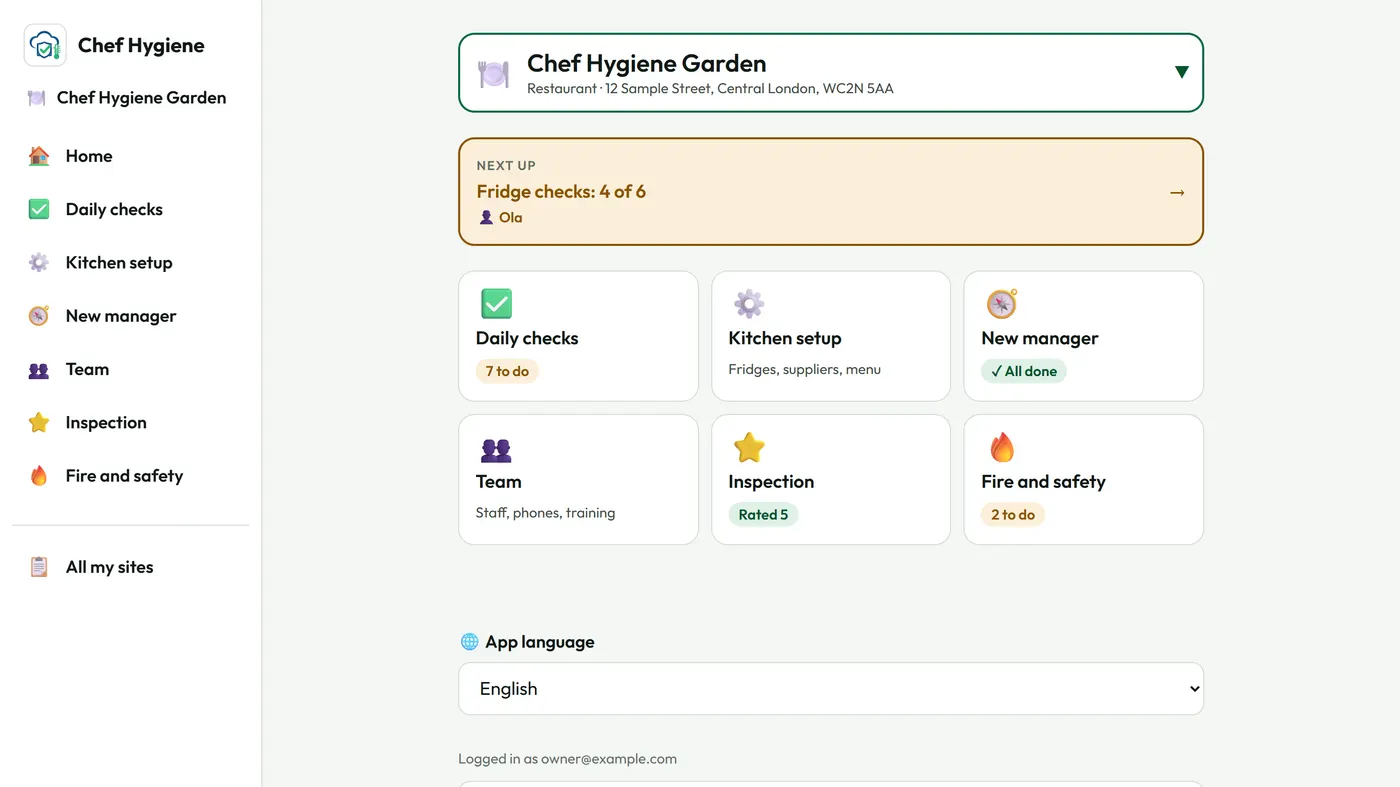
Chef Hygiene Kurulumu
Hesabınızı oluşturun, ortak bir mutfak tableti ayarlayın ve uygulamayı adım adım personelinizin telefonlarına yükleyin.
Polonya: gıda denetimleri
Mutfağınızı kim denetliyor, denetim nasıl yapılıyor ve genel hijyen derecelendirmesi olup olmadığı.
Polonya: yiyecek sıcaklığı kuralları
Mutfağınızın tutması gereken yiyecek sıcaklıkları ve bunların arkasındaki kurallar.
Polonya: alerjenler
Mutfağınızın müşterilere alerjenler hakkında söylemesi gerekenler.
Polonya: personel hastalığı ve eğitimi
Eğitim, yiyecek sorumlusu kuralları ve hasta personelin yiyeceklerden uzak durması gerektiği.
Polonya: yangın güvenliği
Mutfağınız için yangın güvenliği kontrolleri ve bunların ne sıklıkta yapılması gerektiği.
Polonya: tutulacak kayıtlar
Mutfağınızın tutması gereken kayıtlar ve kayıtlar.
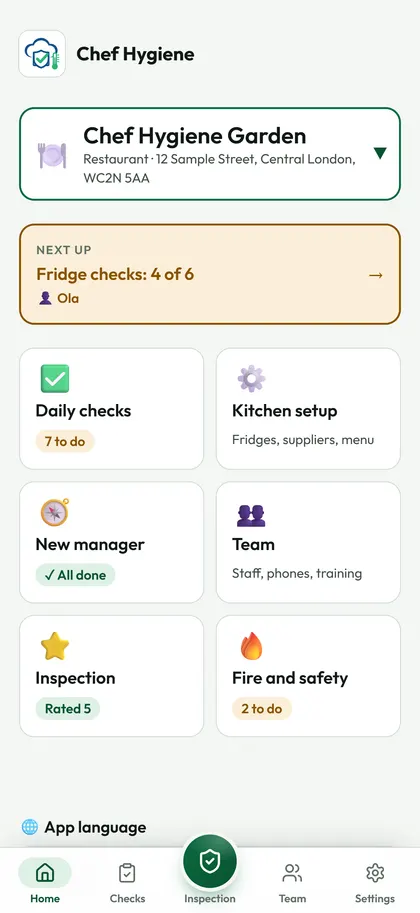
Polonya: Chef Hygiene uygulaması
Uygulama, mutfağınız için geçerli olan bu kuralları yükler, kayıtlarınızı bunlarla karşılaştırır ve denetçi için kanıt niteliğinde belgeler oluşturur.
Diğer ülkeler
 Birleşik Krallık
 İrlanda
 İzlanda
 Amerika Birleşik Devletleri
 Kanada
 Fransa
 İspanya
 Hollanda
 Belçika
 Portekiz
 Almanya
 Avusturya
 Romanya
 İtalya
 Yunanistan
 Danimarka
 İsviçre
 Lüksemburg
 Kıbrıs
 Malta
Malta İsveç
İsveç Norveç
 Finlandiya
 Çekya
Çekya Macaristan
 Hırvatistan
 Bulgaristan
 Slovakya
 Slovenya
 Estonya
 Letonya
 Litvanya
 Liechtenstein
 San Marino
 Cebelitarık
 Monako
 Moldova
 Andorra
 Sırbistan
 Jersey
 Guernsey
 Man Adası
 Türkiye
 Karadağ
 Bosna-Hersek
 Kosova
 Arnavutluk
 Kuzey Makedonya
 Ukrayna