 Polen: for restauranter og takeaway
Klar for matinspeksjon. Hver dag.
In Poland the app follows the food safety act, EU Regulation 852/2004 and the guidance of the Chief Sanitary Inspectorate (GIS); the district sanitary inspector (Sanepid) inspects.
14 dager gratis · én pris per nettsted · ingen kontrakt
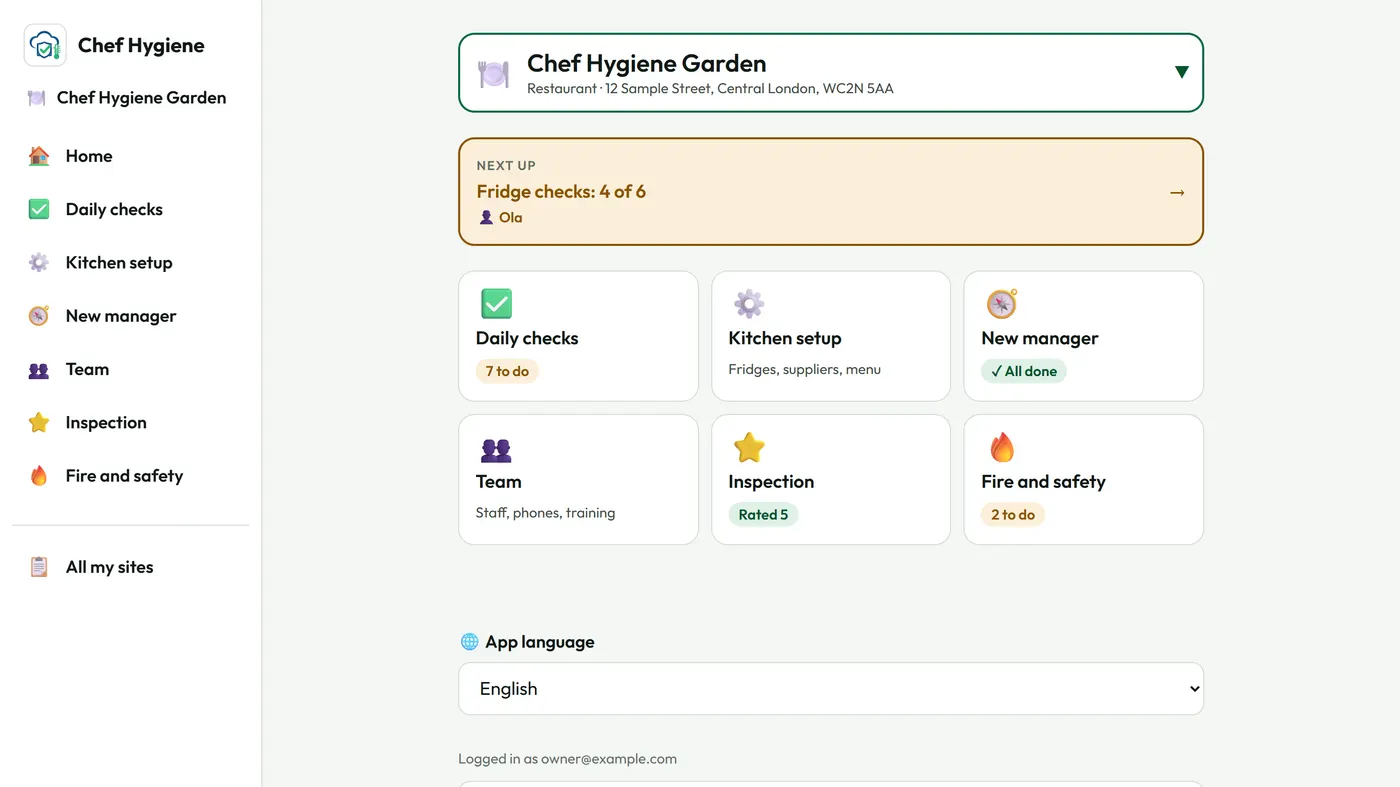
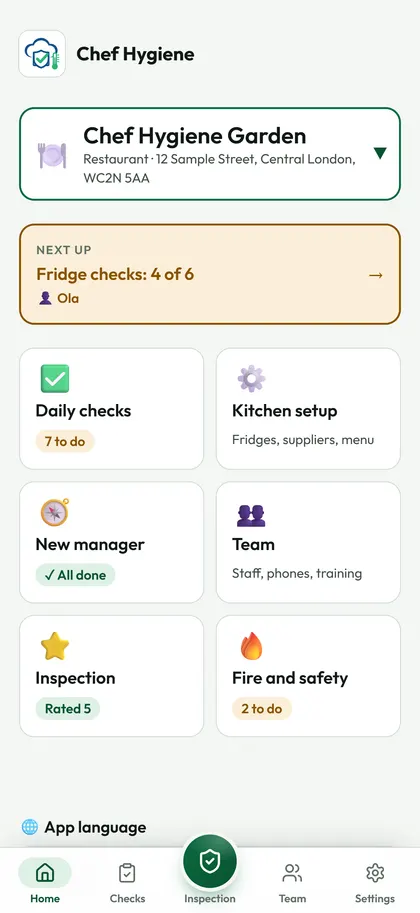
Polen: regler for mathygiene
Reglene på denne siden er foreløpig på engelsk. De vil bli oversatt til ditt språk.
- Inspeksjonsorgan
- State Sanitary Inspection (Państwowa Inspekcja Sanitarna, “Sanepid”)
- Offentlig vurdering
- Ingen
- Språk i appen
- Polski, English
Din inspeksjon
The State Sanitary Inspection (Sanepid) inspects restaurants. The district inspector (PPIS, working through the PSSE) approves, registers and inspects them. The provincial inspector hears appeals and sets money fines, and GIS is the national body.
Visits are based on risk, and official food controls may be unannounced. Every business keeps an inspection book (książka kontroli) and shows it at the start of each inspection. A decision orders faults to be fixed by a set date. Where life or health is in direct danger, the inspector can close the premises at once, and fines can follow.
Hygienevurdering
Poland has no public hygiene rating or sticker, and results for single restaurants are not published. Nothing about the inspection has to be displayed at the premises.
«Lov» er en bindende regel. «Offisiell veiledning» er ikke lov, men inspektører forventer det. «Chef Hygiene standard» er en verdi appen sjekker mot der ingen regel oppgir et tall.
Temperaturer
- Offisiell veiledningNo Polish law sets fridge, hot-holding, cooling or reheating numbers for restaurants. GIS says each business sets them in its own HACCP procedure. The numbers below are official consumer guidance (GIS, Sanepid, and the WHO five keys that GIS recommends).
- Offisiell veiledningChilled food: below 4°C (Sanepid guidance), preferably below 5°C (WHO). A temperature on the label or from the maker applies.
- LovQuick-frozen food: −18°C or colder. A rise of up to 3°C is allowed only while loading and unloading and in shop cabinets (regulation of 19 September 2003, § 3).
- Offisiell veiledningHot food: above 60°C just before serving (Sanepid, WHO). Cooked food stays out of the fridge no longer than 2 hours at room temperature (GIS).
- Offisiell veiledningCooling: put cooked food in the fridge within 2 hours, preferably below 5°C (GIS, Sanepid). No temperature stages are given.
- Offisiell veiledningReheating: heat food to 70°C (Sanepid guidance). Chef Hygiene warns on a lower reading.
- Offisiell veiledningCooking: cook food to above 70°C (GIS guidance).
- Chef Hygiene standardDeliveries: Chef Hygiene checks chilled food against 5°C when the label gives nothing. Frozen food must arrive at −18°C, with a 3°C rise allowed only while unloading.
Ansatte, opplæring og helse
- LovEveryone who works in contact with food needs a medical certificate for sanitary-epidemiological purposes (orzeczenie do celów sanitarno-epidemiologicznych). The employer sends the person for the tests. It has no expiry date in law (food safety act art. 59; infections act).
- Offisiell veiledningGIS advises new tests after diarrhoea, a long cough, contact with infected people, or return after an infectious disease. Keep the certificate in the personnel file, with a copy at work.
- LovFood hygiene training or instruction for all food staff and for the people running HACCP must be documented. The law sets no certificate, hours or renewal (food safety act art. 59).
- LovSafety-at-work (BHP) training is a separate duty: before starting work, then every 3 years for manual jobs and every 5 years for managers.
- LovSick staff: nobody with a disease that can pass through food, infected wounds, skin infections or diarrhoea may handle food. Staff must tell the manager at once, and the employer must take them off this work (EU Regulation 852/2004; infections act art. 10).
Allergener
- LovThe 14 EU allergens: cereals with gluten, crustaceans, eggs, fish, peanuts, soybeans, milk, tree nuts, celery, mustard, sesame, sulphites, lupin and molluscs.
- LovFor restaurant dishes, give the dish name and the full list of ingredients with the allergens shown. Give it in writing, where guests see it before ordering: a menu, board, notice or screen (MRiRW regulation of 23 December 2014, § 19).
- LovThe trade inspection authority (UOKiK) decided that staff answering questions does not replace the written information (decision DIH-1/57/2016).
- LovMenus and allergen information must be in Polish. Other languages may be added. Drinks over 1.2% alcohol need no ingredient list, but their allergens must still be given.
Brannsikkerhetskontroller
- LovPortable fire extinguishers are inspected and maintained at least once a year, as the maker and Polish Standards say. Where there is cooking oil, you need class F. The nearest extinguisher is at most 30 m away (MSWiA fire regulation).
- LovFlue ducts from catering hearths are cleaned at least monthly, unless local rules differ. Ventilation ducts are cleaned at least every year, by people with chimney-sweep qualifications (MSWiA fire regulation § 34).
- LovGas installations and chimney, flue and ventilation ducts are checked at least once a year, with a written protocol. This is a duty of the building owner or manager (building law art. 62).
- LovElectrical and lightning installations are tested at least every 5 years, as part of the whole-building check (building law art. 62).
- LovSince 30 June 2026 a room in commercial premises where fuel is burned needs a carbon monoxide detector. It is not needed for gas cooking appliances or closed-chamber appliances.
Records
- LovHACCP-based procedures are mandatory for all food businesses (EU Regulation 852/2004 art. 5; food safety act art. 59).
- Offisiell veiledningGIS says food law sets no detailed rules for a kitchen’s own checks. The business sets them, and inspectors may ask for proof that they work but cannot impose specific solutions.
- LovKeep training documents and medical certificates in the personnel files, with a copy at the place of work, and show them on request (food safety act art. 59).
- LovKeep an inspection book (książka kontroli), on paper or electronic, and show it at the start of each inspection (Entrepreneurs’ Law art. 57).
Offisielle kilder
- Chief Sanitary Inspectorate (GIS)
- Sanepid approval and registration (biznes.gov.pl)
- Polish laws (Sejm, ISAP)
- State Fire Service (PSP)
- GIS answer on own checks, 15 March 2024
Checked
Denne siden er generell informasjon, ikke juridisk rådgivning. Ta kontakt med din lokale kommune.
Polen: veiledninger for mathygiene
Kom i gang med Chef Hygiene
Opprett konto, sett opp et felles nettbrett til kjøkkenet, og installer appen på de ansattes telefoner – steg for steg.
Polen: matinspeksjoner
Hvem inspiserer kjøkkenet ditt, hvordan en inspeksjon fungerer og om det er en offentlig hygienevurdering.
Polen: regler for mattemperatur
Mattemperaturene kjøkkenet ditt må holde, og reglene bak dem.
Polen: allergener
Hva kjøkkenet ditt må fortelle kundene om allergener.
Polen: ansattes sykdom og opplæring
Opplæring, regler for matbehandler og når syke ansatte må holde seg unna mat.
Polen: brannsikkerhet
Brannsikkerhetssjekker for kjøkkenet ditt, og hvor ofte de skal leveres.
Polen: poster å holde
Opptegnelsene og registreringene kjøkkenet ditt må føre.
Polen: Chef Hygiene-appen
Appen laster inn disse reglene for kjøkkenet ditt, sjekker registreringene dine mot dem og oppbevarer bevis for inspektøren.
Andre land
 Storbritannia
 Irland
 Island
 USA
USA Canada
 Frankrike
 Spania
 Nederland
 Belgia
 Portugal
 Tyskland
 Østerrike
 Romania
 Italia
 Hellas
 Danmark
 Sveits
 Luxemburg
 Kypros
 Malta
Malta Sverige
 Norge
Norge Finland
 Tsjekkia
 Ungarn
 Kroatia
 Bulgaria
 Slovakia
 Slovenia
 Estland
 Latvia
 Litauen
 Liechtenstein
 San Marino
 Gibraltar
 Monaco
 Moldova
 Andorra
 Serbia
 Jersey
 Guernsey
 Man
Man Tyrkia
 Montenegro
 Bosnia-Hercegovina
 Kosovo
 Albania
 Nord-Makedonia
 Ukraina