 Pólland: fyrir veitingastaði og meðlæti
Tilbúinn fyrir matvælaskoðun. Á hverjum degi.
In Poland the app follows the food safety act, EU Regulation 852/2004 and the guidance of the Chief Sanitary Inspectorate (GIS); the district sanitary inspector (Sanepid) inspects.
14 dagar ókeypis · eitt verð á síðu · enginn samningur
Pólland: reglur um hollustuhætti matvæla
Reglurnar á þessari síðu eru á ensku í bili. Þær verða þýddar á þitt tungumál.
- Skoðunaraðili
- State Sanitary Inspection (Państwowa Inspekcja Sanitarna, “Sanepid”)
- Opinber einkunn
- Nei
- Tungumál í appinu
- Polski, English
Skoðun þín
The State Sanitary Inspection (Sanepid) inspects restaurants. The district inspector (PPIS, working through the PSSE) approves, registers and inspects them. The provincial inspector hears appeals and sets money fines, and GIS is the national body.
Visits are based on risk, and official food controls may be unannounced. Every business keeps an inspection book (książka kontroli) and shows it at the start of each inspection. A decision orders faults to be fixed by a set date. Where life or health is in direct danger, the inspector can close the premises at once, and fines can follow.
Hreinlætismat
Poland has no public hygiene rating or sticker, and results for single restaurants are not published. Nothing about the inspection has to be displayed at the premises.
„Lög“ eru bindandi regla. „Opinberar leiðbeiningar“ eru ekki lög, en eftirlitsmenn búast við þeim. „Chef Hygiene sjálfgefið gildi“ er gildi sem appið ber saman við þar sem engin regla gefur upp tölu.
Hitastig
- Opinberar leiðbeiningarNo Polish law sets fridge, hot-holding, cooling or reheating numbers for restaurants. GIS says each business sets them in its own HACCP procedure. The numbers below are official consumer guidance (GIS, Sanepid, and the WHO five keys that GIS recommends).
- Opinberar leiðbeiningarChilled food: below 4°C (Sanepid guidance), preferably below 5°C (WHO). A temperature on the label or from the maker applies.
- LögfræðiQuick-frozen food: −18°C or colder. A rise of up to 3°C is allowed only while loading and unloading and in shop cabinets (regulation of 19 September 2003, § 3).
- Opinberar leiðbeiningarHot food: above 60°C just before serving (Sanepid, WHO). Cooked food stays out of the fridge no longer than 2 hours at room temperature (GIS).
- Opinberar leiðbeiningarCooling: put cooked food in the fridge within 2 hours, preferably below 5°C (GIS, Sanepid). No temperature stages are given.
- Opinberar leiðbeiningarReheating: heat food to 70°C (Sanepid guidance). Chef Hygiene warns on a lower reading.
- Opinberar leiðbeiningarCooking: cook food to above 70°C (GIS guidance).
- Chef Hygiene sjálfgefiðDeliveries: Chef Hygiene checks chilled food against 5°C when the label gives nothing. Frozen food must arrive at −18°C, with a 3°C rise allowed only while unloading.
Starfsfólk, þjálfun og heilsa
- LögfræðiEveryone who works in contact with food needs a medical certificate for sanitary-epidemiological purposes (orzeczenie do celów sanitarno-epidemiologicznych). The employer sends the person for the tests. It has no expiry date in law (food safety act art. 59; infections act).
- Opinberar leiðbeiningarGIS advises new tests after diarrhoea, a long cough, contact with infected people, or return after an infectious disease. Keep the certificate in the personnel file, with a copy at work.
- LögfræðiFood hygiene training or instruction for all food staff and for the people running HACCP must be documented. The law sets no certificate, hours or renewal (food safety act art. 59).
- LögfræðiSafety-at-work (BHP) training is a separate duty: before starting work, then every 3 years for manual jobs and every 5 years for managers.
- LögfræðiSick staff: nobody with a disease that can pass through food, infected wounds, skin infections or diarrhoea may handle food. Staff must tell the manager at once, and the employer must take them off this work (EU Regulation 852/2004; infections act art. 10).
Ofnæmisvaldar
- LögfræðiThe 14 EU allergens: cereals with gluten, crustaceans, eggs, fish, peanuts, soybeans, milk, tree nuts, celery, mustard, sesame, sulphites, lupin and molluscs.
- LögfræðiFor restaurant dishes, give the dish name and the full list of ingredients with the allergens shown. Give it in writing, where guests see it before ordering: a menu, board, notice or screen (MRiRW regulation of 23 December 2014, § 19).
- LögfræðiThe trade inspection authority (UOKiK) decided that staff answering questions does not replace the written information (decision DIH-1/57/2016).
- LögfræðiMenus and allergen information must be in Polish. Other languages may be added. Drinks over 1.2% alcohol need no ingredient list, but their allergens must still be given.
Brunavarnaeftirlit
- LögfræðiPortable fire extinguishers are inspected and maintained at least once a year, as the maker and Polish Standards say. Where there is cooking oil, you need class F. The nearest extinguisher is at most 30 m away (MSWiA fire regulation).
- LögfræðiFlue ducts from catering hearths are cleaned at least monthly, unless local rules differ. Ventilation ducts are cleaned at least every year, by people with chimney-sweep qualifications (MSWiA fire regulation § 34).
- LögfræðiGas installations and chimney, flue and ventilation ducts are checked at least once a year, with a written protocol. This is a duty of the building owner or manager (building law art. 62).
- LögfræðiElectrical and lightning installations are tested at least every 5 years, as part of the whole-building check (building law art. 62).
- LögfræðiSince 30 June 2026 a room in commercial premises where fuel is burned needs a carbon monoxide detector. It is not needed for gas cooking appliances or closed-chamber appliances.
Skrár
- LögfræðiHACCP-based procedures are mandatory for all food businesses (EU Regulation 852/2004 art. 5; food safety act art. 59).
- Opinberar leiðbeiningarGIS says food law sets no detailed rules for a kitchen’s own checks. The business sets them, and inspectors may ask for proof that they work but cannot impose specific solutions.
- LögfræðiKeep training documents and medical certificates in the personnel files, with a copy at the place of work, and show them on request (food safety act art. 59).
- LögfræðiKeep an inspection book (książka kontroli), on paper or electronic, and show it at the start of each inspection (Entrepreneurs’ Law art. 57).
Opinberar heimildir
- Chief Sanitary Inspectorate (GIS)
- Sanepid approval and registration (biznes.gov.pl)
- Polish laws (Sejm, ISAP)
- State Fire Service (PSP)
- GIS answer on own checks, 15 March 2024
Checked
Þessi síða er almennar upplýsingar, ekki lögfræðiráðgjöf. Hafðu samband við sveitarfélagið þitt.
Pólland: leiðbeiningar um hollustuhætti matvæla
Uppsetning á Chef Hygiene
Stofnaðu aðgang, settu upp sameiginlega spjaldtölvu í eldhúsinu og settu smáforritið í síma starfsfólksins, skref fyrir skref.
Pólland: matvælaeftirlit
Hver skoðar eldhúsið þitt, hvernig skoðun virkar og hvort það sé almennt hreinlætismat.
Pólland: reglur um hitastig matvæla
Matarhitastigið sem eldhúsið þitt verður að halda og reglurnar að baki þeim.
Pólland: ofnæmisvaldar
Það sem eldhúsið þitt verður að segja viðskiptavinum um ofnæmisvaka.
Pólland: veikindi starfsfólks og þjálfun
Þjálfun, reglur um umgengni um matvæli og þegar veikt starfsfólk verður að halda sig frá mat.
Pólland: brunavarnir
Eldvarnaeftirlit fyrir eldhúsið þitt og hversu oft þau eiga að skila sér.
Pólland: skrár til að halda
Skráningar og skráningar sem eldhúsið þitt verður að halda.
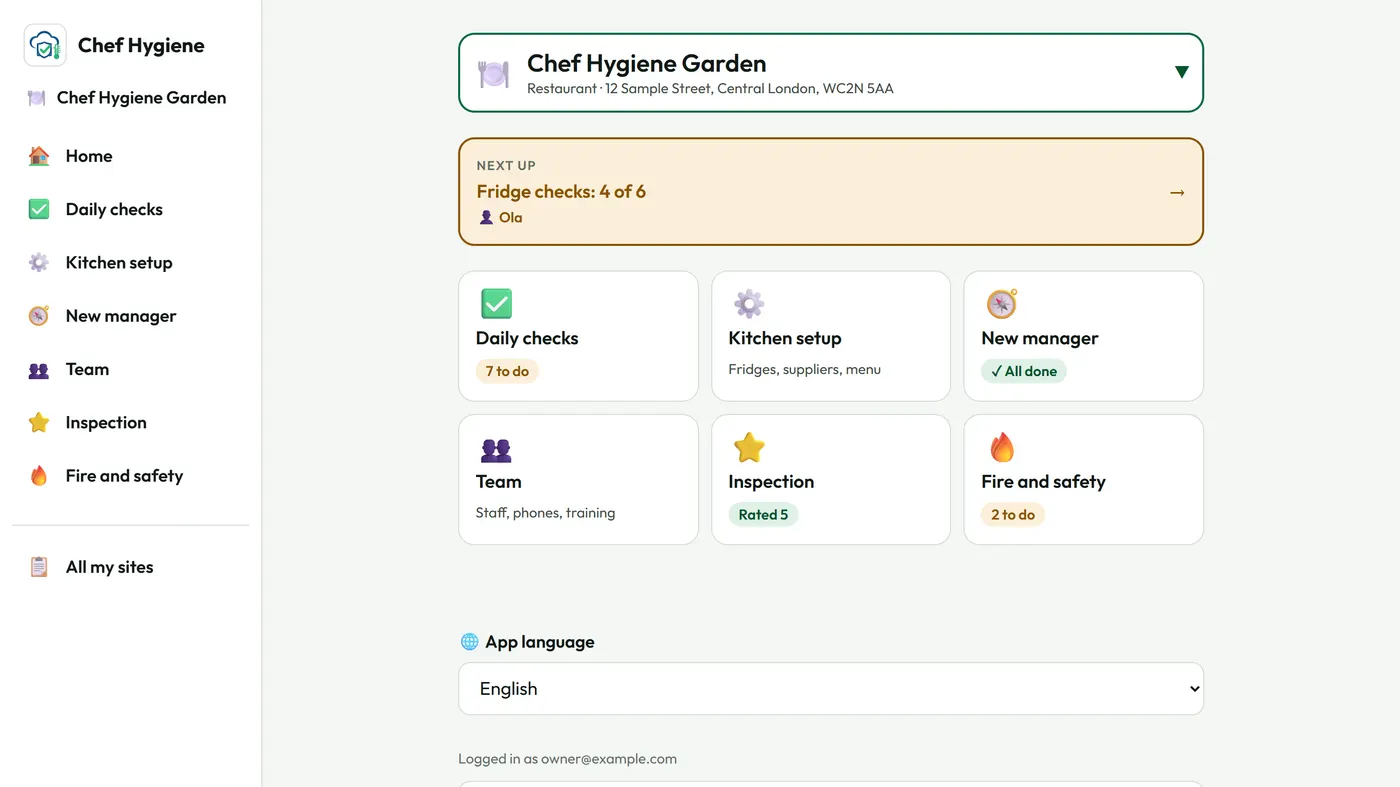
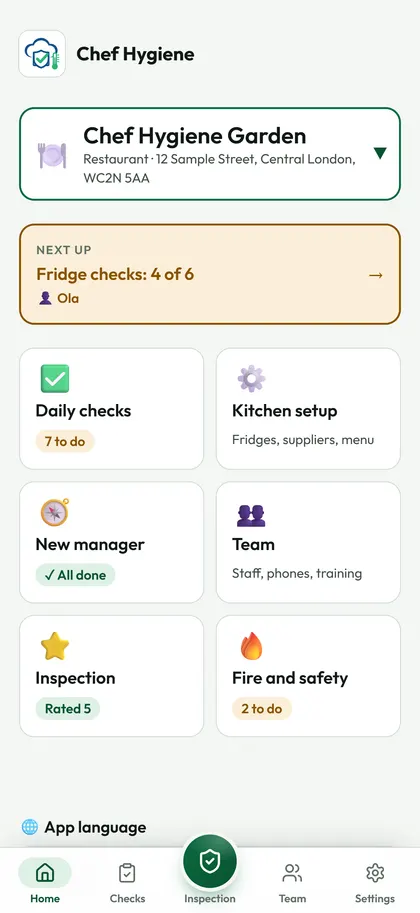
Pólland: Chef Hygiene appið
Appið hleður þessum reglum inn fyrir eldhúsið þitt, ber saman skrár þínar við þær og geymir sönnunargögn fyrir skoðunarmanninn.
Önnur lönd
 Bretland
 Írland
 Ísland
 Bandaríkin
 Kanada
 Frakkland
 Spánn
Spánn Holland
 Belgía
 Portúgal
 Þýskaland
 Austurríki
 Rúmenía
 Ítalía
 Grikkland
 Danmörk
 Sviss
Sviss Lúxemborg
 Kýpur
Kýpur Malta
Malta Svíþjóð
 Noregur
 Finnland
 Tékkland
 Ungverjaland
 Króatía
 Búlgaría
 Slóvakía
 Slóvenía
 Eistland
 Lettland
 Litháen
 Liechtenstein
 San Marínó
 Gíbraltar
 Mónakó
 Moldóva
 Andorra
 Serbía
 Jersey
 Guernsey
 Mön
Mön Tyrkland
 Svartfjallaland
 Bosnía og Hersegóvína
 Kósóvó
 Albanía
 Norður-Makedónía
 Úkraína