 Suécia: para restaurantes e delivery
Pronto para a inspeção sanitária. Todos os dias.
Chef Hygiene follows EU Regulation 852/2004 and the Swedish Food Agency’s guidance (Kontrollwiki) and the Visita restaurant guide, because no Swedish law sets restaurant temperatures; the municipality inspects.
14 dias grátis · preço único por site · sem contrato
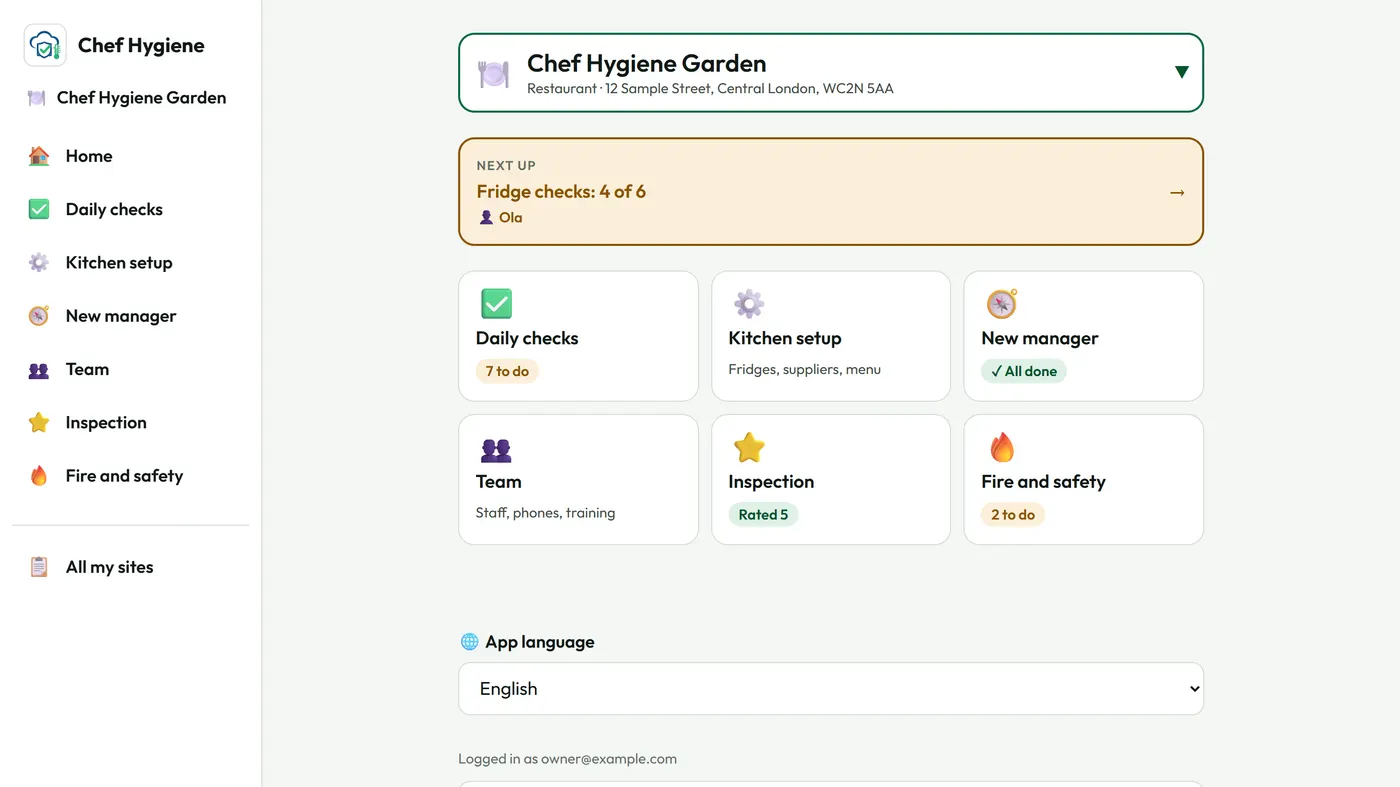
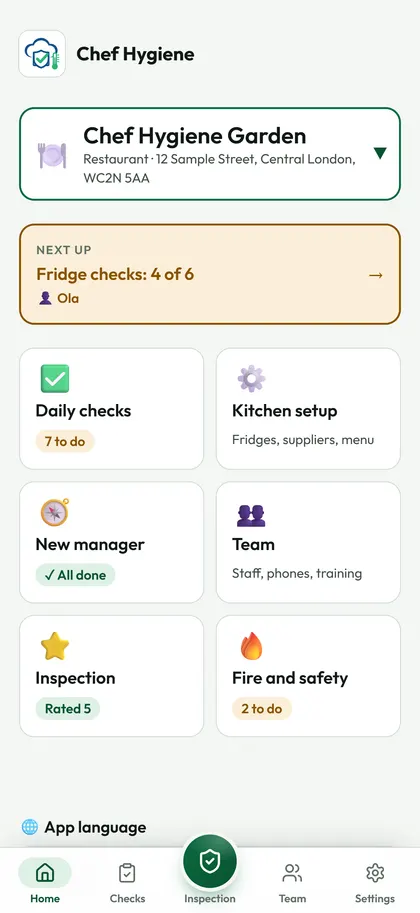
Suécia: regras de higiene alimentar
As regras desta página estão em inglês por enquanto. Elas serão traduzidas para o seu idioma.
- Órgão de inspeção
- Municipal environment and health committee (kommunens miljö- och hälsoskyddsnämnd), led by the Swedish Food Agency (Livsmedelsverket)
- Classificação pública
- Não
- Idiomas disponíveis no aplicativo
- Svenska, English
Sua inspeção
Your municipality inspects restaurants and cafés through its environment and health committee (Livsmedelslag 2006:804). The Swedish Food Agency (Livsmedelsverket) leads and coordinates the control. The county boards support and audit the municipalities.
Controls are unannounced as a rule (EU Regulation 2017/625). How often depends on a risk class: a small restaurant gets about 1 control a year, as an official example (guidance). You pay by the hour afterwards, at your municipality’s rate. After a deviation you get a report and about 2 weeks to answer. Then the municipality can give an order, which can carry a fine (vite), a ban or a temporary closure.
Classificação de higiene
There is no national rating, sticker or smiley, and no duty to show a result. The national result words are Utan avvikelse (no deviation) and Avvikelse (deviation). Some municipalities publish results in their own way, and reports are public on request.
“Lei” é uma regra vinculativa. “Orientação oficial” não é lei, mas os inspetores esperam que seja. “Chef Hygiene padrão” é um valor que o aplicativo verifica quando nenhuma regra fornece um número.
Temperaturas
- Orientações oficiaisFridge: the Swedish Food Agency advises 4°C, and Visita (the industry guide) gives 0 to 8°C. Above 8°C the risk rises sharply. Mince 4°C, and fresh fish fillet on ice or 2°C. A colder label wins.
- Orientações oficiaisFreezer: −18°C (guidance). Quick-frozen food may rise briefly to −15°C (LIVSFS 2006:12, § 5).
- Orientações oficiaisCooking: 70°C in the centre is the usual value in the Food Agency’s guidance and the industry guides. Visita says: if unsure, use 70°C.
- LeiFish that may carry parasites: 60°C in the centre for 1 minute, or freeze it first at −20°C for 24 hours or −35°C for 15 hours (EU Regulation 853/2004).
- Orientações oficiaisHot holding: 60°C or hotter is the guide value, or 2 hours at most. Hot food held over 2 hours and under 50°C is thrown away, otherwise it is reheated to above 70°C (Visita).
- Orientações oficiaisCooling: from 60°C to 8°C within 6 hours. Visita says to measure it every time and throw the food away if it fails.
- Orientações oficiaisReheating: 70°C or hotter, as fast as possible (guidance).
- Orientações oficiaisCold buffet: under 8°C, or 2 hours at most, then throw the food away (Visita).
- Orientações oficiaisDeliveries: accept chilled food at the product’s own temperature, so 8°C for ordinary chilled food. Reject frozen food above −15°C (Visita).
Equipe, treinamento e saúde
- LeiThere is no hygiene certificate, set hours or renewal. The owner must make sure staff know enough, and instruction and supervision can be enough (EU Regulation 852/2004; Food Agency guidance).
- Orientações oficiaisVisita advises you to review each person’s training need at least once a year.
- LeiStaff with a disease that can spread through food, infected wounds or diarrhoea must not handle food. They must tell the employer at once, and you need a routine for this (EU Regulation 852/2004).
- Orientações oficiaisNo Swedish law sets a time to stay away. Visita advises 2 days after the symptoms stop for norovirus and rotavirus. With Salmonella, Shigella or EHEC, not until free of the infection.
Alérgenos
- LeiThe 14 EU allergens must be covered. For food that is not prepacked, you must give the allergen information or a notice that it is available, even if nobody asks (LIVSFS 2014:4, § 10).
- LeiThe information can be given orally, on a sign by the food, on written material or on the menu. If it is given only on request, make clear how to get it, for example a sign such as “Fråga oss om allergena ingredienser”, or tell each guest.
- LeiAllergen information for guests must be in Swedish (LIVSFS 2014:4, § 5). Other languages may be added.
Verificações de segurança contra incêndio
- Orientações oficiaisFire extinguishers: a technician service every year, with an overhaul after 5 years (water, foam) or 10 years (powder, CO2). The owner also looks at them every 1 to 3 months (standard SS 3656, via MCF).
- LeiKitchen hood ducts (imkanaler): a fire-safety control every 2 years, done by the municipality’s chimney sweep (MSBFS 2014:6). Cleaning follows the municipality’s schedule (LSO 3 kap. 4 §).
- Orientações oficiaisGas: a leak test before first use and again when needed (MSBFS 2020:1). Advice is a check every 2 years, and rubber or plastic hoses every year.
- LeiElectrics: the holder needs its own documented, risk-based routine. There is no fixed interval (Elsäkerhetslag; ELSÄK-FS 2022:3).
Registros
- LeiEvery food business needs a self-check system (egenkontroll): basic hygiene routines plus procedures based on HACCP (EU Regulation 852/2004, article 5). There is no required format.
- Orientações oficiaisWritten records are required only for traceability and critical control points. The owner decides the rest (Visita).
- Chef Hygiene padrãoNo Swedish text sets a number of years for records. The Food Agency says a reasonably long period. Chef Hygiene suggests 1 year.
Fontes oficiais
- Swedish Food Agency (Livsmedelsverket)
- Kontrollwiki (Livsmedelsverket)
- Food Act, Livsmedelslag 2006:804 (Riksdagen)
- Visita, hygiene guidelines for restaurants
Checked
Esta página contém informações gerais e não constitui aconselhamento jurídico. Consulte a sua autoridade local.
Suécia: guias de higiene alimentar
Configurar Chef Hygiene
Crie sua conta, configure um tablet de cozinha compartilhada e coloque o aplicativo nos telefones de sua equipe, passo a passo.
Suécia: inspeções de alimentos
Quem fiscaliza sua cozinha, como funciona a fiscalização e se existe classificação de higiene pública.
Suécia: regras de temperatura dos alimentos
As temperaturas dos alimentos que sua cozinha deve manter e as regras por trás delas.
Suécia: alérgenos
O que sua cozinha deve informar aos clientes sobre alérgenos.
Suécia: doença e treinamento do pessoal
Treinamento, regras para manipuladores de alimentos e quando a equipe doente deve ficar longe dos alimentos.
Suécia: segurança contra incêndio
Verificações de segurança contra incêndio em sua cozinha e com que frequência.
Suécia: registros a serem mantidos
Os registros e registros que sua cozinha deve manter.
Suécia: o aplicativo Chef Hygiene
O aplicativo carrega essas regras para sua cozinha, compara seus registros com elas e guarda comprovantes para o inspetor.
Outros países
 Reino Unido
 Irlanda
 Islândia
 Estados Unidos
 Canadá
 França
 Espanha
 Países Baixos
 Bélgica
 Portugal
 Alemanha
 Áustria
 Polônia
 Romênia
 Itália
 Grécia
 Dinamarca
 Suíça
Suíça Luxemburgo
 Chipre
 Malta
Malta Noruega
 Finlândia
 Tchéquia
 Hungria
 Croácia
 Bulgária
 Eslováquia
 Eslovênia
 Estônia
 Letônia
 Lituânia
 Liechtenstein
 San Marino
 Gibraltar
 Mônaco
 Moldávia
 Andorra
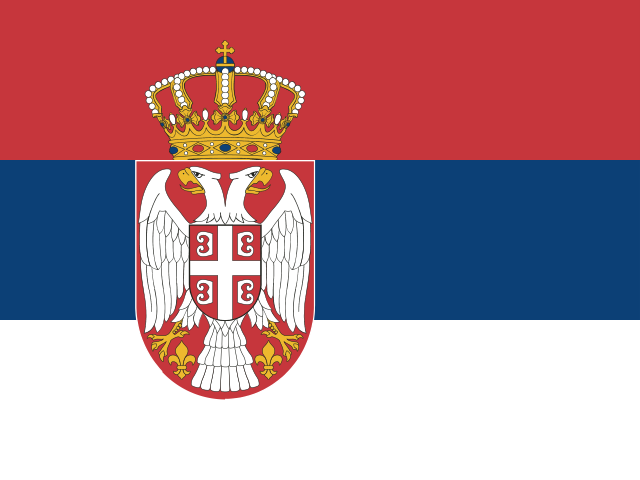 Sérvia
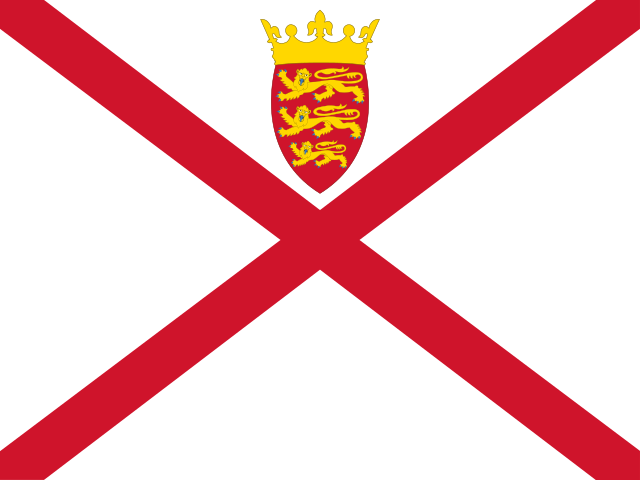 Jersey
 Guernsey
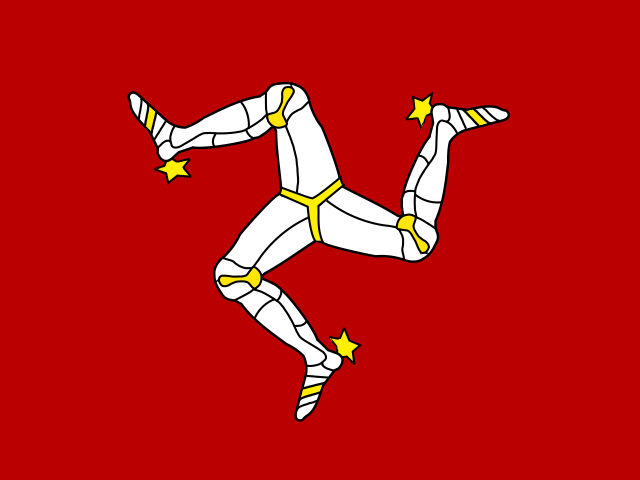 Ilha de Man
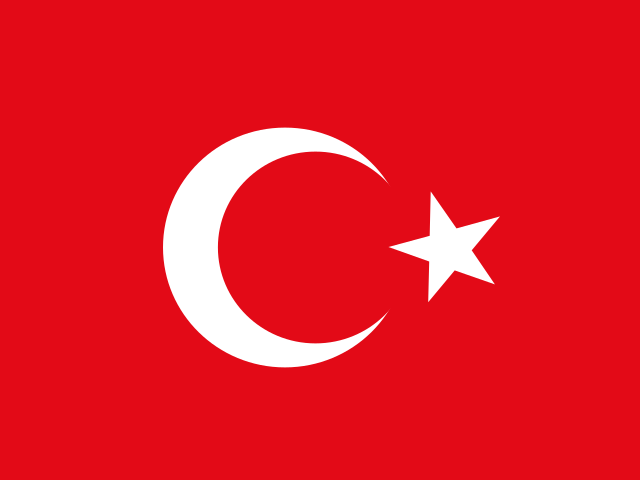 Turquia
 Montenegro
 Bósnia e Herzegovina
 Kosovo
 Albânia
 Macedônia do Norte
 Ucrânia