 Sweden: for restaurants and takeaways
Ready for the food inspection. Every day.
Chef Hygiene follows EU Regulation 852/2004 and the Swedish Food Agency’s guidance (Kontrollwiki) and the Visita restaurant guide, because no Swedish law sets restaurant temperatures; the municipality inspects.
14 days free · one price per site · no contract
Sweden: food hygiene rules
- Inspection body
- Municipal environment and health committee (kommunens miljö- och hälsoskyddsnämnd), led by the Swedish Food Agency (Livsmedelsverket)
- Public rating
- No
- Languages in the app
- Svenska, English
Your inspection
Your municipality inspects restaurants and cafés through its environment and health committee (Livsmedelslag 2006:804). The Swedish Food Agency (Livsmedelsverket) leads and coordinates the control. The county boards support and audit the municipalities.
Controls are unannounced as a rule (EU Regulation 2017/625). How often depends on a risk class: a small restaurant gets about 1 control a year, as an official example (guidance). You pay by the hour afterwards, at your municipality’s rate. After a deviation you get a report and about 2 weeks to answer. Then the municipality can give an order, which can carry a fine (vite), a ban or a temporary closure.
Hygiene rating
There is no national rating, sticker or smiley, and no duty to show a result. The national result words are Utan avvikelse (no deviation) and Avvikelse (deviation). Some municipalities publish results in their own way, and reports are public on request.
“Law” is a binding rule. “Official guidance” is not law, but inspectors expect it. “Chef Hygiene default” is a value the app checks against where no rule gives a number.
Temperatures
- Official guidanceFridge: the Swedish Food Agency advises 4°C, and Visita (the industry guide) gives 0 to 8°C. Above 8°C the risk rises sharply. Mince 4°C, and fresh fish fillet on ice or 2°C. A colder label wins.
- Official guidanceFreezer: −18°C (guidance). Quick-frozen food may rise briefly to −15°C (LIVSFS 2006:12, § 5).
- Official guidanceCooking: 70°C in the centre is the usual value in the Food Agency’s guidance and the industry guides. Visita says: if unsure, use 70°C.
- LawFish that may carry parasites: 60°C in the centre for 1 minute, or freeze it first at −20°C for 24 hours or −35°C for 15 hours (EU Regulation 853/2004).
- Official guidanceHot holding: 60°C or hotter is the guide value, or 2 hours at most. Hot food held over 2 hours and under 50°C is thrown away, otherwise it is reheated to above 70°C (Visita).
- Official guidanceCooling: from 60°C to 8°C within 6 hours. Visita says to measure it every time and throw the food away if it fails.
- Official guidanceReheating: 70°C or hotter, as fast as possible (guidance).
- Official guidanceCold buffet: under 8°C, or 2 hours at most, then throw the food away (Visita).
- Official guidanceDeliveries: accept chilled food at the product’s own temperature, so 8°C for ordinary chilled food. Reject frozen food above −15°C (Visita).
Staff, training and health
- LawThere is no hygiene certificate, set hours or renewal. The owner must make sure staff know enough, and instruction and supervision can be enough (EU Regulation 852/2004; Food Agency guidance).
- Official guidanceVisita advises you to review each person’s training need at least once a year.
- LawStaff with a disease that can spread through food, infected wounds or diarrhoea must not handle food. They must tell the employer at once, and you need a routine for this (EU Regulation 852/2004).
- Official guidanceNo Swedish law sets a time to stay away. Visita advises 2 days after the symptoms stop for norovirus and rotavirus. With Salmonella, Shigella or EHEC, not until free of the infection.
Allergens
- LawThe 14 EU allergens must be covered. For food that is not prepacked, you must give the allergen information or a notice that it is available, even if nobody asks (LIVSFS 2014:4, § 10).
- LawThe information can be given orally, on a sign by the food, on written material or on the menu. If it is given only on request, make clear how to get it, for example a sign such as “Fråga oss om allergena ingredienser”, or tell each guest.
- LawAllergen information for guests must be in Swedish (LIVSFS 2014:4, § 5). Other languages may be added.
Fire safety checks
- Official guidanceFire extinguishers: a technician service every year, with an overhaul after 5 years (water, foam) or 10 years (powder, CO2). The owner also looks at them every 1 to 3 months (standard SS 3656, via MCF).
- LawKitchen hood ducts (imkanaler): a fire-safety control every 2 years, done by the municipality’s chimney sweep (MSBFS 2014:6). Cleaning follows the municipality’s schedule (LSO 3 kap. 4 §).
- Official guidanceGas: a leak test before first use and again when needed (MSBFS 2020:1). Advice is a check every 2 years, and rubber or plastic hoses every year.
- LawElectrics: the holder needs its own documented, risk-based routine. There is no fixed interval (Elsäkerhetslag; ELSÄK-FS 2022:3).
Records
- LawEvery food business needs a self-check system (egenkontroll): basic hygiene routines plus procedures based on HACCP (EU Regulation 852/2004, article 5). There is no required format.
- Official guidanceWritten records are required only for traceability and critical control points. The owner decides the rest (Visita).
- Chef Hygiene defaultNo Swedish text sets a number of years for records. The Food Agency says a reasonably long period. Chef Hygiene suggests 1 year.
Official sources
- Swedish Food Agency (Livsmedelsverket)
- Kontrollwiki (Livsmedelsverket)
- Food Act, Livsmedelslag 2006:804 (Riksdagen)
- Visita, hygiene guidelines for restaurants
Checked
This page is general information, not legal advice. Check with your local authority.
Sweden: food hygiene guides
Set up Chef Hygiene
Create your account, set up a shared kitchen tablet, and put the app on your staff's phones, step by step.
Sweden: food inspections
Who inspects your kitchen, how an inspection works and whether there is a public hygiene rating.
Sweden: food temperature rules
The food temperatures your kitchen must keep, and the rules behind them.
Sweden: allergens
What your kitchen must tell customers about allergens.
Sweden: staff sickness and training
Training, food handler rules and when sick staff must stay away from food.
Sweden: fire safety
Fire safety checks for your kitchen, and how often they are due.
Sweden: records to keep
The records and registrations your kitchen must keep.
Sweden: the Chef Hygiene app
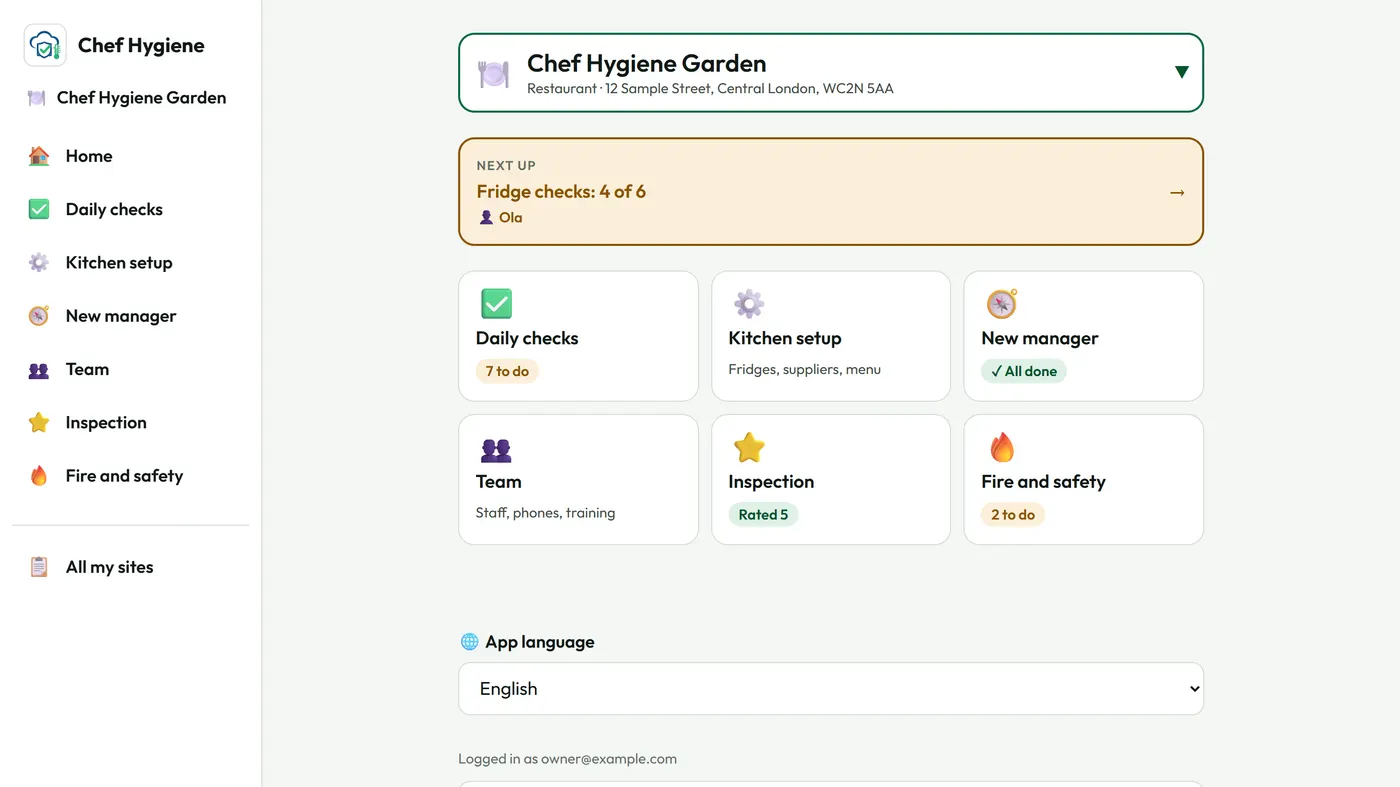
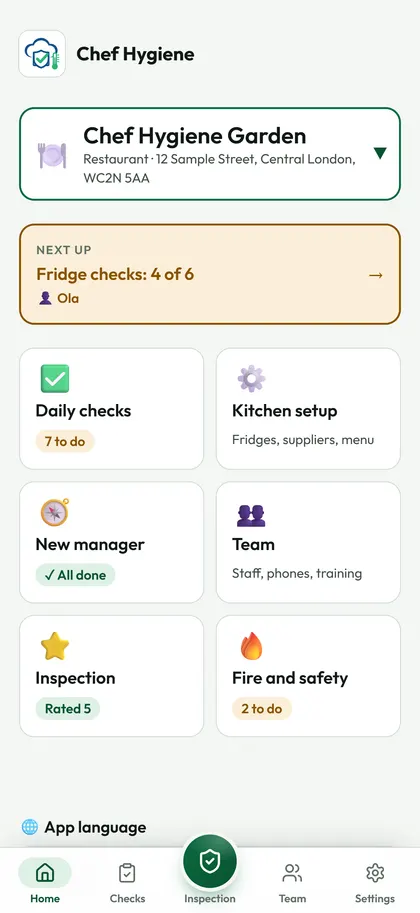
The app loads these rules for your kitchen, checks your records against them and keeps proof for the inspector.
Other countries
 United Kingdom
 Ireland
 Iceland
 United States
 Canada
 France
 Spain
Spain Netherlands
 Belgium
 Portugal
 Germany
 Austria
 Poland
 Romania
 Italy
Italy Greece
 Denmark
 Switzerland
 Luxembourg
 Cyprus
 Malta
Malta Norway
 Finland
 Czechia
 Hungary
 Croatia
 Bulgaria
 Slovakia
 Slovenia
 Estonia
 Latvia
 Lithuania
 Liechtenstein
 San Marino
 Gibraltar
 Monaco
 Moldova
 Andorra
 Serbia
 Jersey
 Guernsey
 Isle of Man
 Türkiye
 Montenegro
 Bosnia & Herzegovina
 Kosovo
 Albania
 North Macedonia
 Ukraine