 Norwegia: dla restauracji i dań na wynos
Gotowi na kontrolę żywności. Codziennie.
Chef Hygiene follows the EU hygiene rules as Norway applies them (EEA), the Norwegian temperature rules in the hygiene regulation and Mattilsynet’s guidance, and Mattilsynet inspects and publishes the Smilefjes result.
14 dni za darmo · jedna cena za witrynę · bez umowy
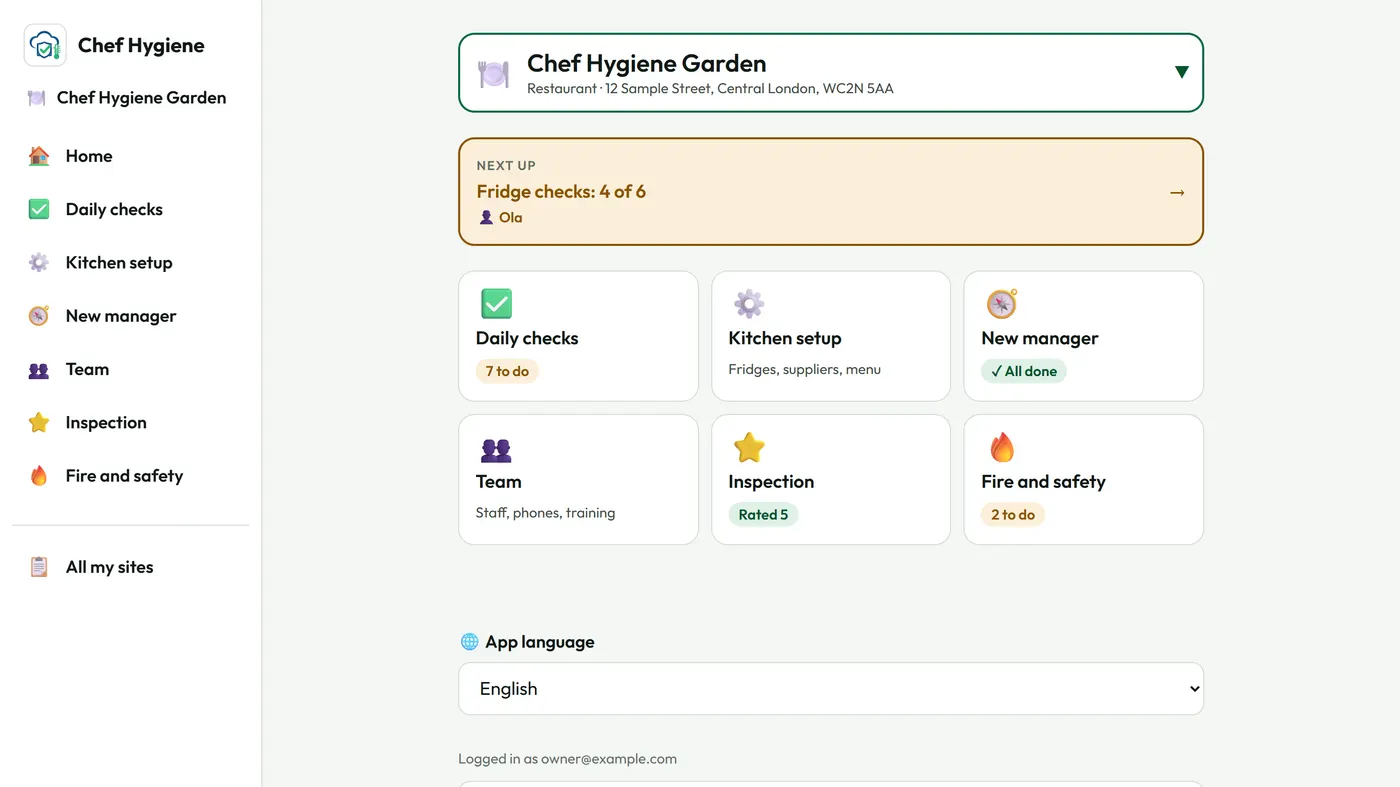
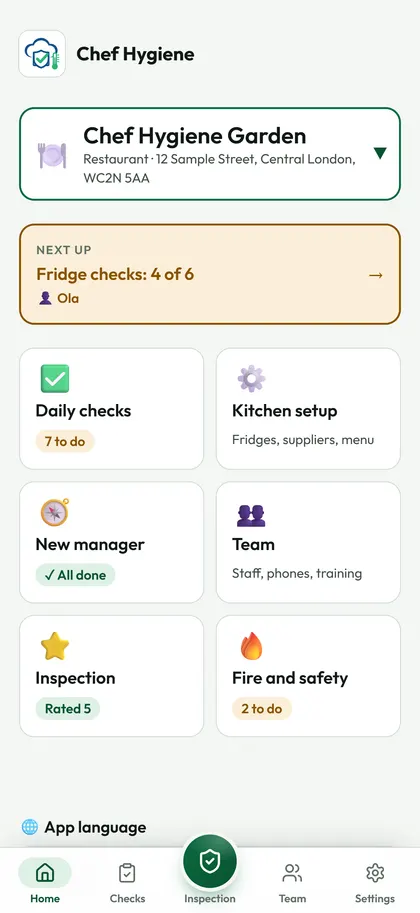
Norwegia: zasady higieny żywności
Zasady na tej stronie są na razie po angielsku. Zostaną przetłumaczone na Twój język.
- Organ inspekcyjny
- Norwegian Food Safety Authority (Mattilsynet)
- Ocena publiczna
- Tak
- Języki w aplikacji
- Norsk bokmål, English
Twoja inspekcja
One national authority inspects: Mattilsynet (the Norwegian Food Safety Authority), under the Food Act (matloven, § 23). Municipalities only help on request. You must register your business before you start.
There is no fixed interval: Mattilsynet decides from risk and capacity. Visits are mostly unannounced, and some controls are digital. After a visit the steps are written guidance, then an order to correct with a deadline, then a coercive fine (tvangsmulkt). Mattilsynet can close an activity for up to 6 months for ignored orders or gross breaches. A follow-up control costs NOK 2,775 in person or NOK 1,388 otherwise.
Ocena higieny
Yes: Smilefjes (smiley). The three symbols are Smilefjes (no breach, or only trivial ones), Strekmunn (straight mouth: breaches) and Sur munn (sour mouth: serious or repeated breaches). The report must hang next to the entrance, visible before guests go in. Results are published on smilefjes.mattilsynet.no.
„Prawo” to wiążąca reguła. „Oficjalne wytyczne” nie są prawem, ale inspektorzy ich oczekują. „Chef Hygiene domyślna” to wartość, którą aplikacja sprawdza, gdy żadna reguła nie podaje liczby.
Temperatury
- PrawoFridge: perishable food at 4°C or lower, unless the label says otherwise (hygiene regulation, § 12).
- Oficjalne wytyczneFresh fish: keep it on ice, as near 0°C as possible, preferably 2°C or lower (Mattilsynet fish rules).
- Oficjalne wytyczneFreezer: −18°C. Mattilsynet advises this for your own freezers. For food sold as deep-frozen it is law, with up to 3°C more allowed in local transport and final sale.
- Oficjalne wytyczneCooking: 75°C in the centre can be enough (Smilefjes guide). Cook poultry and minced meat right through, and sear whole cuts well on the outside.
- PrawoHot holding: 60°C or hotter (hygiene regulation, § 13). Lower is allowed only in transport and serving to the guest if there is no health risk.
- Oficjalne wytyczneCooling: from 60°C to 10°C within 2 hours, then into the 4°C fridge (Smilefjes guide, a guide rule). The law says as quickly as possible.
- Oficjalne wytyczneReheating: to over 70°C, then hold above 60°C (Mattilsynet). There is no legal figure.
- PrawoDeliveries: chilled food at 4°C or the label’s temperature (law). Reject frozen food above −15°C. Hot food should arrive at 60°C or more (guidance).
- Oficjalne wytyczneThawing: in the fridge, with no part of the food above 10°C (Smilefjes guide).
Kadra, szkolenia i zdrowie
- PrawoThere is no food hygiene certificate, set hours or renewal. The rules ask for no formal qualification. The business must make sure everyone has the skills needed (Food Act, § 8).
- Oficjalne wytyczneWhoever writes the routines needs enough HACCP (food safety system) training. Everyone should get an induction.
- PrawoStaff with a food-borne illness, infected wounds or diarrhoea must not handle food, and must tell the manager at once (EU Regulation 852/2004, annex II chapter VIII).
- Oficjalne wytyczneMattilsynet and the Institute of Public Health (FHI) advise coming back 48 hours after vomiting or diarrhoea stops. There is no health certificate and no stool test after travel.
Alergeny
- Oficjalne wytyczneThe 14 EU allergens apply. For food that is not prepacked, Mattilsynet (June 2025) says the information must be in writing and in Norwegian, shown with the word “Inneholder” (contains) by each dish, on a poster or on a screen.
- Oficjalne wytyczneSpeaking, a QR code or a screen may be added but cannot replace the written information. Guests must find it without asking.
- PrawoFood information for guests must be in Norwegian or a language spelled like it. English may be added, not used instead (matinformasjonsforskriften, § 2).
Kontrole bezpieczeństwa pożarowego
- Oficjalne wytyczneFire extinguishers: an owner look every 3 months, a certified control every year, and a service every 5 years (water, foam) or 10 years (powder, CO2), as in standard NS 3910 named by DSB. The law asks for checks by risk (FOR-2015-12-17-1710, § 5).
- Oficjalne wytyczneGas: DSB’s table gives a check of large-kitchen gas equipment and pipe tightness every 2 years. From 1 January 2027 the law adds a condition check at least every 5 years and a gas detector.
- PrawoElectrics: the law asks for necessary inspection and maintenance (FEL, § 9) and sets no fixed interval.
- Chef Hygiene domyślneHood and duct: Chef Hygiene checks against the insurers’ rule (FG-1100:1): fat filters at least weekly, duct and fan every year, and an automatic fire suppression system serviced every 6 months. This is not law.
Dokumentacja
- PrawoYou need written routines (internkontroll) for what to do when something goes wrong, how to stop it happening again, a regular review, and using only current routines (IK-mat regulation, §§ 4–5).
- PrawoA binder, a notebook, a digital file or an app is accepted. HACCP principles apply (EU Regulation 852/2004, article 5).
- Chef Hygiene domyślneNo fixed number of years is set for records. The business decides and writes down how long each record is kept. Chef Hygiene suggests 12 months.
Oficjalne źródła
- Mattilsynet (Norwegian Food Safety Authority)
- Smilefjes results (Mattilsynet)
- Food Act, matloven (Lovdata)
- Smilefjes regulation (Lovdata)
- Hygiene regulation (Lovdata)
Checked
Ta strona zawiera ogólne informacje, a nie porady prawne. Sprawdź w lokalnym urzędzie.
Norwegia: Poradniki higieny żywności
Skonfiguruj Chef Hygiene
Utwórz konto, skonfiguruj wspólny tablet kuchenny i krok po kroku instaluj aplikację na telefonach swoich pracowników.
Norwegia: inspekcje żywności
Kto sprawdza Twoją kuchnię, jak przebiega kontrola i czy istnieje ocena higieny publicznej.
Norwegia: zasady dotyczące temperatury żywności
Temperatury żywności, które musi utrzymywać Twoja kuchnia, i zasady za nimi stojące.
Norwegia: alergeny
Co Twoja kuchnia musi mówić klientom o alergenach.
Norwegia: choroba personelu i szkolenie
Szkolenia, zasady postępowania z żywnością oraz sytuacje, w których chory personel musi trzymać się z daleka od żywności.
Norwegia: bezpieczeństwo przeciwpożarowe
Kontrole bezpieczeństwa przeciwpożarowego Twojej kuchni i częstotliwość ich przeprowadzania.
Norwegia: zapisy do przechowywania
Rejestry i rejestracje, które musi przechowywać Twoja kuchnia.
Norwegia: aplikacja Chef Hygiene.
Aplikacja ładuje te zasady do Twojej kuchni, sprawdza je pod kątem zgodności z zapisami i zachowuje dowód dla inspektora.
Inne kraje
 Wielka Brytania
 Irlandia
 Islandia
 Stany Zjednoczone
 Kanada
 Francja
 Hiszpania
 Holandia
 Belgia
 Portugalia
 Niemcy
 Austria
 Polska
 Rumunia
 Włochy
 Grecja
 Dania
Dania Szwajcaria
 Luksemburg
 Cypr
Cypr Malta
Malta Szwecja
 Finlandia
 Czechy
 Węgry
Węgry Chorwacja
 Bułgaria
 Słowacja
 Słowenia
 Estonia
 Łotwa
Łotwa Litwa
Litwa Liechtenstein
 San Marino
 Gibraltar
 Monako
 Mołdawia
 Andora
 Serbia
 Jersey
 Guernsey
 Wyspa Man
 Turcja
 Czarnogóra
 Bośnia i Hercegowina
 Kosowo
 Albania
 Macedonia Północna
 Ukraina