 Países Bajos: para restaurantes y comida para llevar
Listos para la inspección de alimentos. Todos los días.
In the European Netherlands, Chef Hygiene follows the Warenwetbesluit Bereiding en behandeling van levensmiddelen, EU Regulation 852/2004 and the KHN Hygiënecode voor de Horeca; the NVWA inspects.
14 días gratis · un precio por sitio · sin contrato
Países Bajos: reglas de higiene alimentaria
Las reglas de esta página están en inglés por el momento. Se traducirán a tu idioma.
- Órgano de inspección
- Netherlands Food and Consumer Product Safety Authority (Nederlandse Voedsel- en Warenautoriteit, NVWA)
- Calificación pública
- Sí
- Idiomas en la aplicación
- Nederlands, English
Su inspección
The NVWA inspects restaurants and takeaways for food safety. The municipality (gemeente) handles permits, the alcohol licence and local fire safety enforcement.
Visits are unannounced and based on risk. You must let the inspector in. A medium breach brings an official warning, and in hospitality a second one is followed by an administrative fine. A serious breach brings a fine at once and a re-inspection. Three or more serious breaches in 2 years mean verscherpt toezicht (stricter supervision), and the NVWA can then close the business.
Calificación de higiene
Yes, but there is no sticker. The NVWA publishes every result online under the Gezondheidswet, art. 44: Voldoet, Verbeterpunten vastgesteld, Verscherpt toezicht or Geen recente gegevens. A result stays online for at most 2 years.
“Ley” es una norma vinculante. “Orientación oficial” no es ley, pero los inspectores la esperan. “Chef Hygiene predeterminado” es un valor que la aplicación comprueba cuando ninguna norma especifica un número.
Temperaturas
- LeyChilled food: 7°C or colder, measured in the food, in storage and in transport (Warenwetbesluit, art. 15(1)). A colder temperature on the label wins.
- Orientación oficialChef Hygiene aims for a fridge setting of 4°C, as KHN and the Voedingscentrum advise. This is advice, not a legal limit.
- Orientación oficialFrozen food: −18°C or colder (NVWA and the hygiene code).
- LeyHot food kept for direct sale: 60°C or hotter (art. 15(2)).
- Orientación oficialCooking: 75°C or hotter in the centre (NVWA and the hygiene code).
- Orientación oficialCooling: the law says only “as fast as possible” (Regulation 852/2004). The hygiene code starts at 75°C or hotter. It gives 20°C or colder after 2 hours as a guide value, and 7°C or colder within 5 hours as the norm.
- Orientación oficialReheating: 60°C or hotter in the centre (NVWA), within 60 minutes (hygiene code).
- LeyIn restaurants, chilled food may stand out of the fridge once, for at most 2 hours, and is then thrown away. You need a written procedure and a log, kept for 1 year.
- Orientación oficialThaw food in the fridge or under cold running water (NVWA).
Personal, formación y salud
- LeyDutch law sets no food hygiene certificate, number of hours or renewal. Staff must be supervised and instructed to suit their work (Regulation 852/2004, Annex II, Chapter XII).
- Orientación oficialStaff must know the hygiene code, and the owner may instruct them. The NVWA checks staff knowledge during inspections.
- LeyA person with a disease carried by food, infected wounds, skin infections, sores or diarrhoea must not handle food. They must report it at once (Regulation 852/2004, Annex II, Chapter VIII).
- Orientación oficialFor norovirus, RIVM advises staff to return to their own work no earlier than 24 hours after vomiting or diarrhoea stops.
- LeyWith one or more employees you must appoint a BHV’er for first aid, fire fighting and evacuation (Arbowet, art. 15).
- LeyManagers on an alcohol licence must be 21 or older and hold the Verklaring Sociale Hygiëne (Alcoholwet, art. 8).
Alérgenos
- LeyThe 14 EU allergens must be declared: gluten cereals, crustaceans, eggs, fish, peanuts, soya, milk, tree nuts, celery, mustard, sesame, sulphites, lupin and molluscs (Regulation 1169/2011).
- LeyWritten method: a clearly visible notice where the food is sold says where the allergen information is. The information is available in writing or electronically (Warenwetregeling allergeneninformatie, art. 2).
- LeyVerbal method (art. 3): staff can always give correct information before the sale. The written version is available to staff and the NVWA. A visible notice asks guests to ask staff.
Controles de seguridad contra incendios
- LeyRequired fire extinguishers and hose reels: maintenance with a function check at least every 2 years (Besluit bouwwerken leefomgeving, Bbl, art. 6.35). Insurers often ask for a yearly service.
- LeyTell the municipality at least 4 weeks before opening if more than 50 people will be inside (Bbl, art. 6.6 to 6.7).
- Orientación oficialHood and duct cleaning has no legal interval. KHN advises at least once a year, and every 6 months with heavy grill, fryer or wok use. The municipality can ban cooking if a duct is dirty.
- Orientación oficialGas appliances have no legal inspection interval for kitchens. The Arboportaal advises a check once a year as a safe minimum.
- Orientación oficialThe electrical installation has no legal interval (Arbobesluit, art. 3.4). Insurers usually ask for a NEN 3140 inspection every 3 to 5 years.
Archivos
- LeyYou need your own HACCP plan (Regulation 852/2004, art. 5) or an approved hygiene code. If you use the Hygiënecode voor de Horeca, you must follow it (Warenwetbesluit hygiëne van levensmiddelen, art. 5(2)).
- Orientación oficialThe code’s model forms ask for fridge and freezer displays daily and a probe check weekly, deliveries weekly per supplier, and cooking, cooling, hot holding and reheating weekly.
- Orientación oficialKHN advises keeping the code’s records for at least 6 months.
- LeyLogs of chilled food kept out of the fridge must be kept for at least 1 year (Warenwetregeling Vrijstelling gekoeld bewaren, art. 1).
Fuentes oficiales
- NVWA: food safety in hospitality
- NVWA public inspection results
- Warenwetbesluit hygiëne van levensmiddelen
- KHN Hygiënecode voor de Horeca
- Warenwetregeling allergeneninformatie niet-voorverpakte levensmiddelen
Checked
Esta página contiene información general, no asesoramiento legal. Consulte con su autoridad local.
Países Bajos: guías de higiene alimentaria
Configurar Chef Hygiene
Cree su cuenta, configure una tableta de cocina compartida y coloque la aplicación en los teléfonos de su personal, paso a paso.
Países Bajos: inspecciones de alimentos
Quién inspecciona tu cocina, cómo funciona una inspección y si existe una calificación de higiene pública.
Países Bajos: reglas de temperatura de los alimentos
Las temperaturas de los alimentos que debe mantener su cocina y las reglas detrás de ellas.
Países Bajos: alérgenos
Lo que su cocina debe informar a los clientes sobre los alérgenos.
Países Bajos: enfermedad y formación del personal
Capacitación, reglas para manipuladores de alimentos y cuándo el personal enfermo debe mantenerse alejado de los alimentos.
Países Bajos: seguridad contra incendios
Controles de seguridad contra incendios en su cocina y con qué frecuencia deben realizarse.
Países Bajos: registros para mantener
Los registros y registros que debe llevar tu cocina.
Países Bajos: la aplicación Chef Hygiene
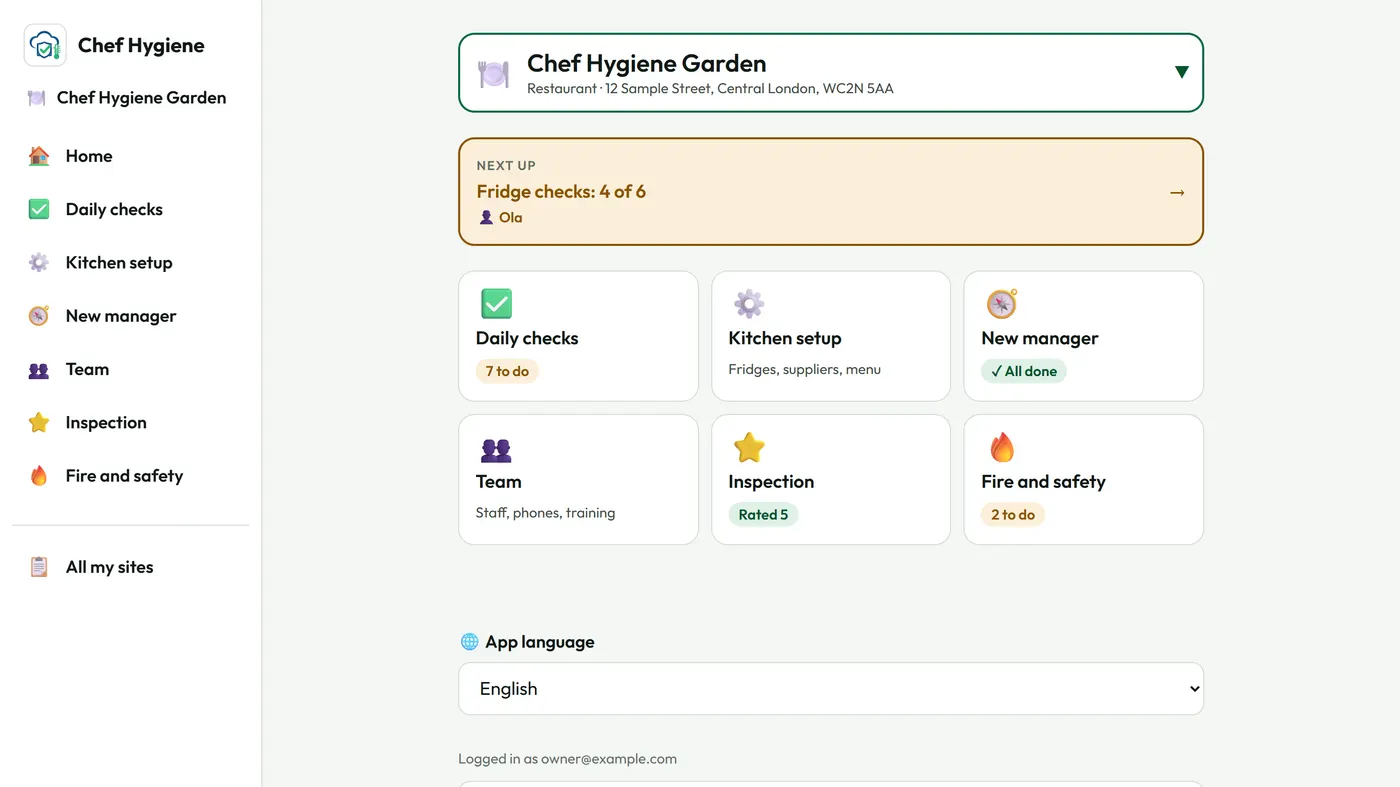
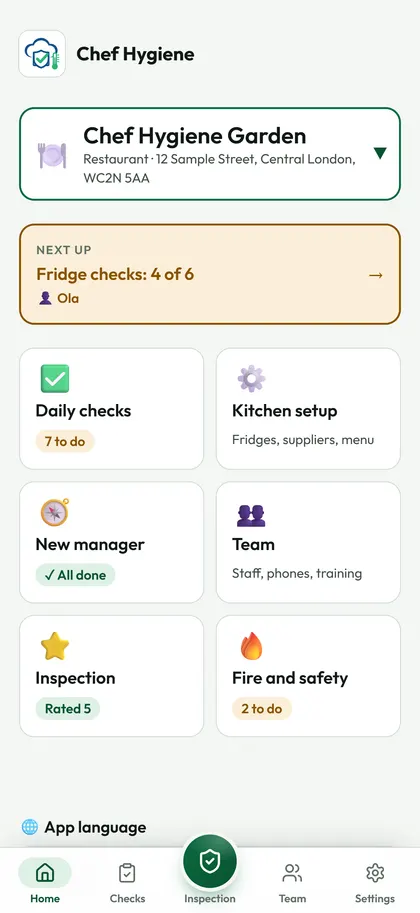
La aplicación carga estas normas para tu cocina, compara tus registros con ellas y guarda pruebas para el inspector.
Otros países
 Reino Unido
 Irlanda
 Islandia
 Estados Unidos
 Canadá
 Francia
 España
 Bélgica
 Portugal
 Alemania
 Austria
 Polonia
 Rumanía
 Italia
 Grecia
 Dinamarca
 Suiza
Suiza Luxemburgo
 Chipre
 Malta
Malta Suecia
 Noruega
 Finlandia
 Chequia
 Hungría
 Croacia
 Bulgaria
 Eslovaquia
 Eslovenia
 Estonia
 Letonia
 Lituania
 Liechtenstein
 San Marino
 Gibraltar
 Mónaco
 Moldavia
 Andorra
 Serbia
 Jersey
 Guernesey
 Isla de Man
 Turquía
 Montenegro
 Bosnia y Herzegovina
 Kosovo
 Albania
 Macedonia del Norte
 Ucrania