 Iceland: for restaurants and takeaways
Ready for the food inspection. Every day.
In Iceland the app follows the Act on Foodstuffs No. 93/1995 and EU Regulation 852/2004 (Regulation No. 103/2010), with MAST’s own-check guidance. Municipal health inspectorates inspect restaurants.
14 days free · one price per site · no contract
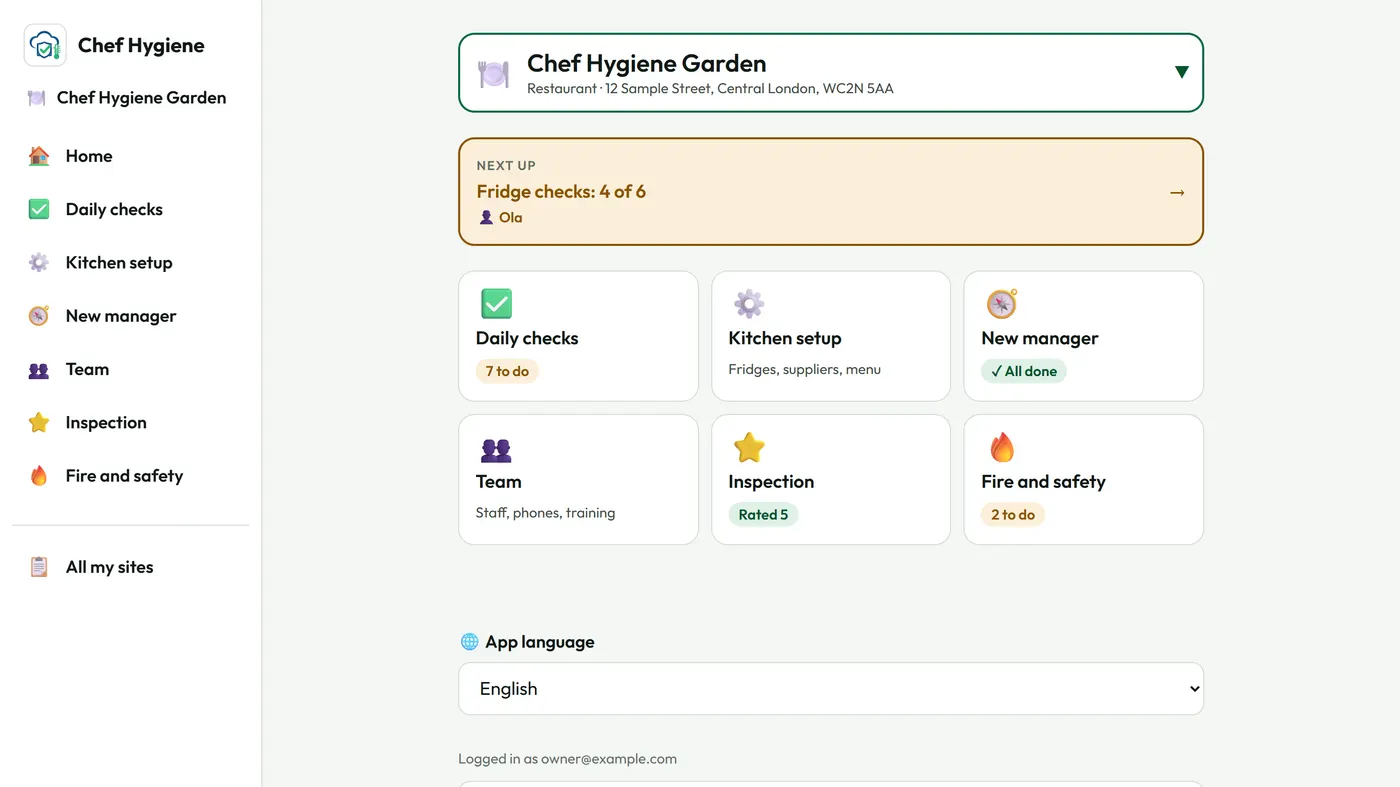
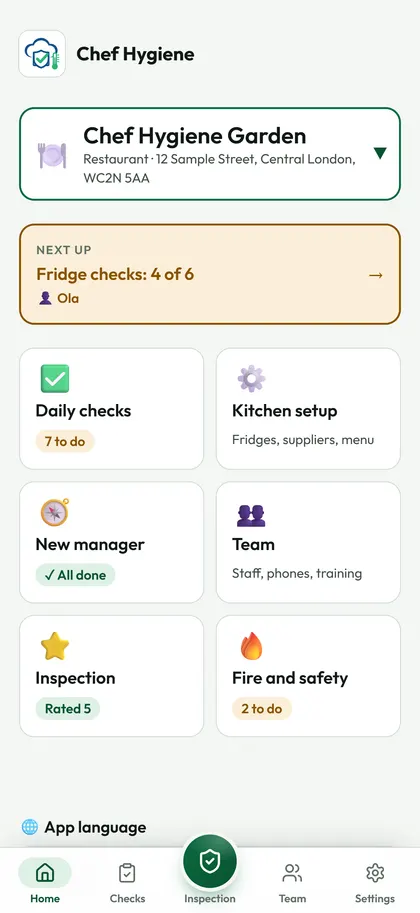
Iceland: food hygiene rules
- Inspection body
- Icelandic Food and Veterinary Authority (Matvælastofnun, MAST); restaurants are inspected by the municipal health inspectorates (Heilbrigðiseftirlit)
- Public rating
- No
- Languages in the app
- Íslenska, English
Your inspection
The municipal health inspectorates (Heilbrigðiseftirlit) inspect restaurants and issue operating permits (starfsleyfi). In Reykjavík this is Heilbrigðiseftirlit Reykjavíkur. MAST is the central competent authority for food safety and oversees large producers.
Your local health inspectorate usually inspects without warning. An inspector looks at your premises, equipment, food safety system and management knowledge. Keep your own-check system, its records and every instruction from the inspector in one place, available to the inspector. You must have an operating permit before you start, and it cannot be issued without an approved food safety plan.
Hygiene rating
There is no 0–5 or sticker hygiene rating for restaurants in Iceland. Your local health inspectorate inspects and writes a report.
“Law” is a binding rule. “Official guidance” is not law, but inspectors expect it. “Chef Hygiene default” is a value the app checks against where no rule gives a number.
Temperatures
- Official guidanceChilled food (kælihitastig): 0–4°C. Cold rooms should be no higher than 4°C.
- Official guidanceFrozen food (frystihitastig): −18°C or colder.
- Official guidanceHot holding: at least 60°C. In a hot counter, above 60°C and no longer than 2 hours.
- Official guidanceCooking: core temperature above 75°C for chicken, minced meat, stews and similar dishes. Burgers and other minced meat must reach 75°C at the core.
- Official guidanceReheating: above 75°C.
- Official guidanceCooling: cool cooked food in shallow containers to below 10°C within 3 hours, then put it in the fridge. Leftovers are cooled the same way, then dated and frozen.
- Official guidanceDefrosting: the food must never go above 4°C while thawing.
- Official guidanceDeliveries: chilled 0–4°C, frozen −18°C or colder, hot food at least 60°C. Measure and record on receipt. Reykjavík’s canteen handbook: 5–7°C means complain to the supplier, above 7°C means send it back.
- Official guidanceMeasure and record fridges and freezers at least once a day. Spot-check core temperatures, cooling and hot counters at least weekly. A surface thermometer cannot measure a core temperature.
Staff, training and health
- LawStaff must be supervised and instructed or trained for their work. Whoever runs the HACCP system must be trained in HACCP (Regulation 852/2004, Annex II).
- LawAnyone with diarrhoea, vomiting, infected wounds or skin infections must not handle food if there is a risk of contamination, and must report it at once.
- Official guidanceMAST guidance: plan staff training and keep a record of it, covering food handling, microbes in food, the own-check system and each person’s duties.
Allergens
- LawEU Regulation 1169/2011 applies in Iceland. You must manage the 14 allergens: gluten, crustaceans, eggs, fish, peanuts, soybeans, milk, tree nuts, celery, mustard, sesame, sulphites, lupin and molluscs.
- LawFor loose food served or sold in restaurants, written allergen information must be given where the food is presented, sold or supplied. It must be in Icelandic or English.
- Official guidanceA general notice such as this kitchen handles nuts is not enough. Give specific information for each dish.
Fire safety checks
- LawSince the 2017 regulation on fire prevention and fire inspection (reglugerð um eldvarnir og eldvarnaeftirlit), businesses must check their own fire safety regularly (eigið eldvarnaeftirlit). They must also appoint a fire safety person (eldvarnafulltrúi).
- LawThe Act on Working Environment, Health and Safety in Workplaces No. 46/1980 requires employers to prevent fires and take all reasonable measures for safety. The Housing and Construction Authority (HMS) coordinates fire prevention, and the fire brigades inspect.
- Chef Hygiene defaultChef Hygiene checks that gas appliances and pipes are inspected at least once a year.
Records
- LawA HACCP-based system with records is required (Regulation 852/2004, Article 5, through Regulation No. 103/2010). Records are kept for an appropriate period.
- Official guidanceKeep temperature, delivery, cleaning and training records. MAST’s own-check booklet gives example forms. Keep the system in one place and available to the inspector.
- Official guidanceUse a cleaning plan (þrifaáætlun) that says what, how, when and who, and record when and by whom cleaning is done. Sinks, worktops, floors and hand basins are cleaned daily; walls, doors and shelves weekly.
- Official guidanceIf you find pests, always call a pest controller (meindýraeyðir). A contract with marked bait points on a plan of the premises is best.
Official sources
- Reykjavík: food inspection (Heilbrigðiseftirlit Reykjavíkur)
- MAST: general own-check booklet (Almennt innra eftirlit)
- Act on Foodstuffs No. 93/1995 (Althingi)
- HMS: fire prevention (Brunavarnir)
Checked
This page is general information, not legal advice. Check with your local authority.
Iceland: food hygiene guides
Set up Chef Hygiene
Create your account, set up a shared kitchen tablet, and put the app on your staff's phones, step by step.
Iceland: food inspections
Who inspects your kitchen, how an inspection works and whether there is a public hygiene rating.
Iceland: food temperature rules
The food temperatures your kitchen must keep, and the rules behind them.
Iceland: allergens
What your kitchen must tell customers about allergens.
Iceland: staff sickness and training
Training, food handler rules and when sick staff must stay away from food.
Iceland: fire safety
Fire safety checks for your kitchen, and how often they are due.
Iceland: records to keep
The records and registrations your kitchen must keep.
Iceland: the Chef Hygiene app
The app loads these rules for your kitchen, checks your records against them and keeps proof for the inspector.
Other countries
 United Kingdom
 Ireland
 United States
 Canada
 France
 Spain
Spain Netherlands
 Belgium
 Portugal
 Germany
 Austria
 Poland
 Romania
 Italy
Italy Greece
 Denmark
 Switzerland
 Luxembourg
 Cyprus
 Malta
Malta Sweden
 Norway
 Finland
 Czechia
 Hungary
 Croatia
 Bulgaria
 Slovakia
 Slovenia
 Estonia
 Latvia
 Lithuania
 Liechtenstein
 San Marino
 Gibraltar
 Monaco
 Moldova
 Andorra
 Serbia
 Jersey
 Guernsey
 Isle of Man
 Türkiye
 Montenegro
 Bosnia & Herzegovina
 Kosovo
 Albania
 North Macedonia
 Ukraine