 Islandia: para restaurantes y comida para llevar
Listos para la inspección de alimentos. Todos los días.
In Iceland the app follows the Act on Foodstuffs No. 93/1995 and EU Regulation 852/2004 (Regulation No. 103/2010), with MAST’s own-check guidance. Municipal health inspectorates inspect restaurants.
14 días gratis · un precio por sitio · sin contrato
Islandia: reglas de higiene alimentaria
Las reglas de esta página están en inglés por el momento. Se traducirán a tu idioma.
- Órgano de inspección
- Icelandic Food and Veterinary Authority (Matvælastofnun, MAST); restaurants are inspected by the municipal health inspectorates (Heilbrigðiseftirlit)
- Calificación pública
- No
- Idiomas en la aplicación
- Íslenska, English
Su inspección
The municipal health inspectorates (Heilbrigðiseftirlit) inspect restaurants and issue operating permits (starfsleyfi). In Reykjavík this is Heilbrigðiseftirlit Reykjavíkur. MAST is the central competent authority for food safety and oversees large producers.
Your local health inspectorate usually inspects without warning. An inspector looks at your premises, equipment, food safety system and management knowledge. Keep your own-check system, its records and every instruction from the inspector in one place, available to the inspector. You must have an operating permit before you start, and it cannot be issued without an approved food safety plan.
Calificación de higiene
There is no 0–5 or sticker hygiene rating for restaurants in Iceland. Your local health inspectorate inspects and writes a report.
“Ley” es una norma vinculante. “Orientación oficial” no es ley, pero los inspectores la esperan. “Chef Hygiene predeterminado” es un valor que la aplicación comprueba cuando ninguna norma especifica un número.
Temperaturas
- Orientación oficialChilled food (kælihitastig): 0–4°C. Cold rooms should be no higher than 4°C.
- Orientación oficialFrozen food (frystihitastig): −18°C or colder.
- Orientación oficialHot holding: at least 60°C. In a hot counter, above 60°C and no longer than 2 hours.
- Orientación oficialCooking: core temperature above 75°C for chicken, minced meat, stews and similar dishes. Burgers and other minced meat must reach 75°C at the core.
- Orientación oficialReheating: above 75°C.
- Orientación oficialCooling: cool cooked food in shallow containers to below 10°C within 3 hours, then put it in the fridge. Leftovers are cooled the same way, then dated and frozen.
- Orientación oficialDefrosting: the food must never go above 4°C while thawing.
- Orientación oficialDeliveries: chilled 0–4°C, frozen −18°C or colder, hot food at least 60°C. Measure and record on receipt. Reykjavík’s canteen handbook: 5–7°C means complain to the supplier, above 7°C means send it back.
- Orientación oficialMeasure and record fridges and freezers at least once a day. Spot-check core temperatures, cooling and hot counters at least weekly. A surface thermometer cannot measure a core temperature.
Personal, formación y salud
- LeyStaff must be supervised and instructed or trained for their work. Whoever runs the HACCP system must be trained in HACCP (Regulation 852/2004, Annex II).
- LeyAnyone with diarrhoea, vomiting, infected wounds or skin infections must not handle food if there is a risk of contamination, and must report it at once.
- Orientación oficialMAST guidance: plan staff training and keep a record of it, covering food handling, microbes in food, the own-check system and each person’s duties.
Alérgenos
- LeyEU Regulation 1169/2011 applies in Iceland. You must manage the 14 allergens: gluten, crustaceans, eggs, fish, peanuts, soybeans, milk, tree nuts, celery, mustard, sesame, sulphites, lupin and molluscs.
- LeyFor loose food served or sold in restaurants, written allergen information must be given where the food is presented, sold or supplied. It must be in Icelandic or English.
- Orientación oficialA general notice such as this kitchen handles nuts is not enough. Give specific information for each dish.
Controles de seguridad contra incendios
- LeySince the 2017 regulation on fire prevention and fire inspection (reglugerð um eldvarnir og eldvarnaeftirlit), businesses must check their own fire safety regularly (eigið eldvarnaeftirlit). They must also appoint a fire safety person (eldvarnafulltrúi).
- LeyThe Act on Working Environment, Health and Safety in Workplaces No. 46/1980 requires employers to prevent fires and take all reasonable measures for safety. The Housing and Construction Authority (HMS) coordinates fire prevention, and the fire brigades inspect.
- Chef Hygiene predeterminadoChef Hygiene checks that gas appliances and pipes are inspected at least once a year.
Archivos
- LeyA HACCP-based system with records is required (Regulation 852/2004, Article 5, through Regulation No. 103/2010). Records are kept for an appropriate period.
- Orientación oficialKeep temperature, delivery, cleaning and training records. MAST’s own-check booklet gives example forms. Keep the system in one place and available to the inspector.
- Orientación oficialUse a cleaning plan (þrifaáætlun) that says what, how, when and who, and record when and by whom cleaning is done. Sinks, worktops, floors and hand basins are cleaned daily; walls, doors and shelves weekly.
- Orientación oficialIf you find pests, always call a pest controller (meindýraeyðir). A contract with marked bait points on a plan of the premises is best.
Fuentes oficiales
- Reykjavík: food inspection (Heilbrigðiseftirlit Reykjavíkur)
- MAST: general own-check booklet (Almennt innra eftirlit)
- Act on Foodstuffs No. 93/1995 (Althingi)
- HMS: fire prevention (Brunavarnir)
Checked
Esta página contiene información general, no asesoramiento legal. Consulte con su autoridad local.
Islandia: guías de higiene alimentaria
Configurar Chef Hygiene
Cree su cuenta, configure una tableta de cocina compartida y coloque la aplicación en los teléfonos de su personal, paso a paso.
Islandia: inspecciones de alimentos
Quién inspecciona tu cocina, cómo funciona una inspección y si existe una calificación de higiene pública.
Islandia: reglas de temperatura de los alimentos
Las temperaturas de los alimentos que debe mantener su cocina y las reglas detrás de ellas.
Islandia: alérgenos
Lo que su cocina debe informar a los clientes sobre los alérgenos.
Islandia: enfermedad y formación del personal
Capacitación, reglas para manipuladores de alimentos y cuándo el personal enfermo debe mantenerse alejado de los alimentos.
Islandia: seguridad contra incendios
Controles de seguridad contra incendios en su cocina y con qué frecuencia deben realizarse.
Islandia: registros para mantener
Los registros y registros que debe llevar tu cocina.
Islandia: la aplicación Chef Hygiene
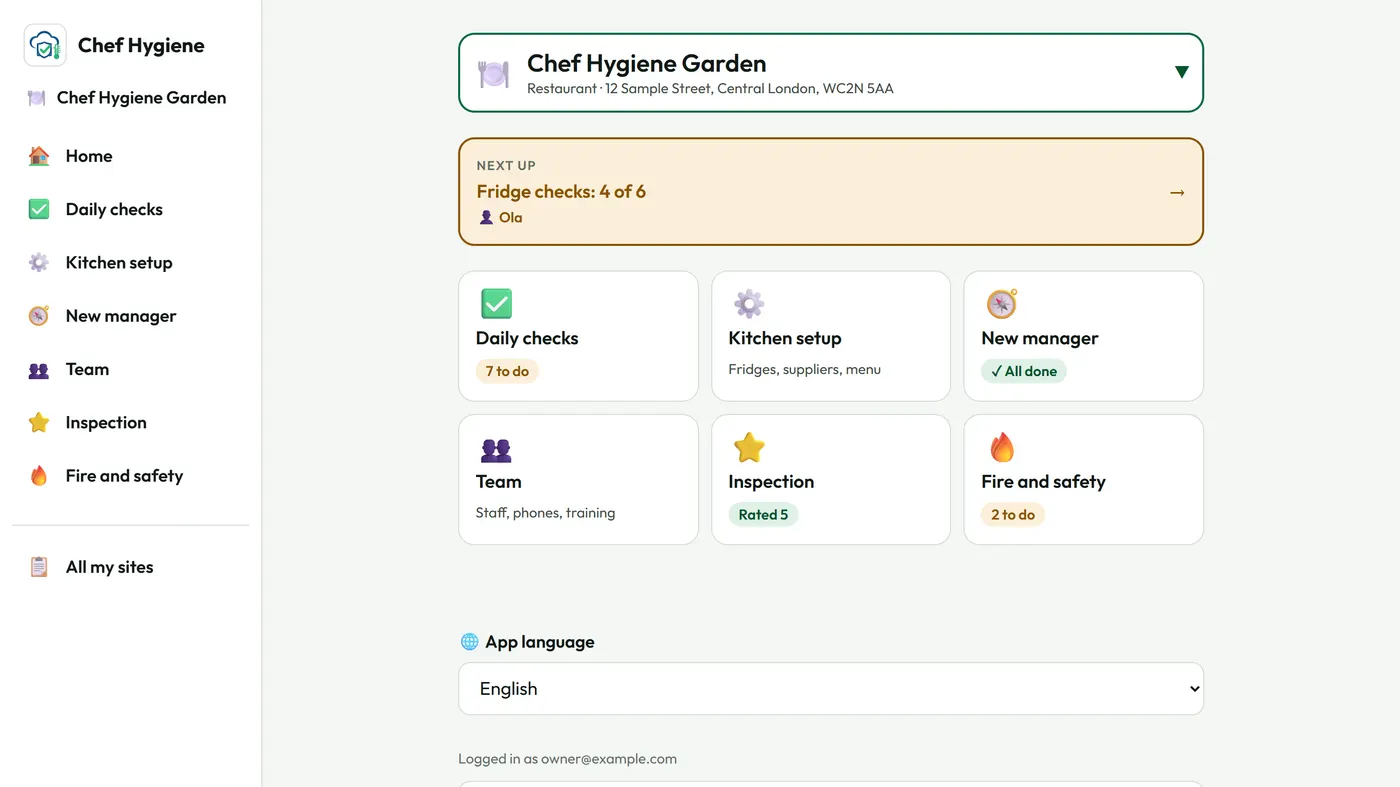
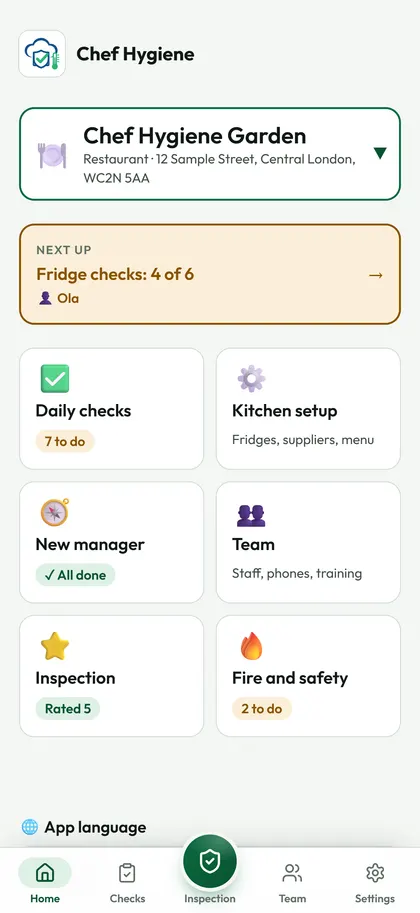
La aplicación carga estas normas para tu cocina, compara tus registros con ellas y guarda pruebas para el inspector.
Otros países
 Reino Unido
 Irlanda
 Estados Unidos
 Canadá
 Francia
 España
 Países Bajos
 Bélgica
 Portugal
 Alemania
 Austria
 Polonia
 Rumanía
 Italia
 Grecia
 Dinamarca
 Suiza
Suiza Luxemburgo
 Chipre
 Malta
Malta Suecia
 Noruega
 Finlandia
 Chequia
 Hungría
 Croacia
 Bulgaria
 Eslovaquia
 Eslovenia
 Estonia
 Letonia
 Lituania
 Liechtenstein
 San Marino
 Gibraltar
 Mónaco
 Moldavia
 Andorra
 Serbia
 Jersey
 Guernesey
 Isla de Man
 Turquía
 Montenegro
 Bosnia y Herzegovina
 Kosovo
 Albania
 Macedonia del Norte
 Ucrania