 Hungría: para restaurantes y comida para llevar
Listos para la inspección de alimentos. Todos los días.
In Hungary the app follows the EU hygiene rules, Decree 62/2011 (VM) and Nébih’s catering hygiene guide; county and district government offices inspect, directed by NKFH.
14 días gratis · un precio por sitio · sin contrato
Hungría: reglas de higiene alimentaria
Las reglas de esta página están en inglés por el momento. Se traducirán a tu idioma.
- Órgano de inspección
- National Trade and Consumer Protection Authority (Nemzeti Kereskedelmi és Fogyasztóvédelmi Hatóság, NKFH)
- Calificación pública
- No
- Idiomas en la aplicación
- Magyar, English
Su inspección
The county (vármegyei) government offices and their district offices (járási hivatal) inspect restaurants on site. NKFH directs this food-trade control and plans the yearly programme. Nébih keeps the food business register (FELIR), the hygiene guide and the list of risky firms.
Under the Food Chain Act (Éltv., Act 2008/XLVI) a fine starts at HUF 15,000. An on-the-spot fine is HUF 25,000 to 200,000. The authority can suspend a business for up to 1 year or ban it for up to 3 years, and a notice must hang on the premises meanwhile. The business pays for samples that fail. Fire, public-health, labour and tax offices also check premises.
Calificación de higiene
There is no rating or sticker for ordinary restaurants. Nébih has a voluntary quality rating from jeles (5, 90 to 100%) to elégtelen (1, under 60%), compulsory only for public canteens. Serious breaches are published by name on Nébih’s risky-firm list for 2 years.
“Ley” es una norma vinculante. “Orientación oficial” no es ley, pero los inspectores la esperan. “Chef Hygiene predeterminado” es un valor que la aplicación comprueba cuando ninguna norma especifica un número.
Temperaturas
- Orientación oficialChilled prepared food: 0 to +5°C, covered. Nébih’s catering guide gives this; there is no legal fridge limit for restaurants.
- Orientación oficialRaw goods in the fridge, at most: red meat 7°C, poultry 4°C, offal 3°C, minced meat 2°C. Fresh fish is kept near melting ice (Nébih’s guide).
- LeyYour own freezing: −18°C or colder, and never warmer in storage (Decree 62/2011 (VM), annex 3).
- Orientación oficialCooking: 72°C in the core for 2 minutes, or 75°C at every point. Decree 62/2011 (VM) defines this “safe heat treatment” and requires it for public catering and food sent to events; Nébih’s guide uses it for restaurants.
- Orientación oficialHot holding: +63°C or hotter. Without hot holding, serve within 3 hours of making. Food kept 3 hours at an uncertain temperature is thrown away (Nébih’s guide).
- Orientación oficialCooling: start within 30 minutes of cooking and reach below +10°C within the next 90 minutes (2 hours in all). Then keep it at 0 to +5°C (Nébih’s guide).
- Orientación oficialReheating: 72°C in the core for 2 minutes, or 75°C at every point, and only once (Nébih’s guide).
- Orientación oficialChilled food on an unchilled buffet: 2 hours at most. Leftovers from service are never offered again (Nébih’s guide; Decree 62/2011 (VM) § 16).
Personal, formación y salud
- LeyThere is no hygiene certificate and no set training hours. Each new worker must be trained within 1 month of starting, and the business documents it (Decree 68/2007).
- LeyEveryone who makes or sells food needs a medical exam before starting, a signed health statement and a health booklet. The exam is repeated every year (Decree 33/1998 (NM)).
- LeyNobody with a food-borne illness, infected wound, skin infection or diarrhoea may work with food. They must report it at once (EU Regulation 852/2004).
- LeyA responsible food-safety person must be able to act at once during all opening hours. Micro firms need this person on site within 2 hours (Éltv. § 22).
- Orientación oficialA worker comes back after illness with a doctor’s note (Nébih’s guide and NKFH’s guide).
Alérgenos
- LeyGuests must be told about the 14 EU allergens in food that is not prepacked, before they order and free of charge. This includes online orders (Decree 36/2014 (FM)).
- LeyWritten information is a sheet, menu or screen where the food is offered, with a sign that points guests to it.
- LeyOral information is allowed only if a trained responsible person is always present, a visible notice says guests can ask, and a written internal procedure names that person and shows allergen training.
- LeyThe information must be in Hungarian. If fresh meat was frozen before, you must say so.
Controles de seguridad contra incendios
- LeyThe keeper checks each fire extinguisher at least every 3 months. A registered maintenance firm services it at the intervals in the OTSZ annex. Keep a fire-safety operating log (tűzvédelmi üzemeltetési napló) (OTSZ, Decree 54/2014 (BM) §§ 263–264).
- LeyA hot kitchen’s ventilation and odour extraction are cleaned at the maker’s interval, otherwise at least once a year, with written proof (OTSZ § 196).
- LeyThe electrical installation gets a fire-safety review at least every 6 years, or every 3 years if you store over 300 kg or 300 litres of highly flammable material (OTSZ § 277).
- LeyThe residual-current switch (RCD) is function-tested every 3 months. Hand tools and portable transformers are checked every year (Decree 10/2016 (NGM) § 19).
Archivos
- LeyHACCP-based procedures are required (EU Regulation 852/2004). Paper and digital records are both accepted.
- LeyKeep the self-check records at the premises for at least 2 years. Micro and small firms may use paper or electronic records; larger firms must use electronic ones (Decree 28/2017 (FM) § 4).
- LeyPublic canteens and kitchens making over 29 portions a day keep a recipe record with allergens for 90 days after the dish ends (Decree 62/2011 (VM)).
- LeyPublic and event catering over 29 portions a day keeps a 100 g sample of each dish for 72 hours at 0 to +5°C (Decree 62/2011 (VM)).
Fuentes oficiales
- NKFH, National Trade and Consumer Protection Authority
- Nébih, catering hygiene guide (GHP)
- Nébih, quality-driven public catering programme (rating)
- Decree 62/2011 (VM), official law database
- Fire protection code OTSZ, Decree 54/2014 (BM)
Checked
Esta página contiene información general, no asesoramiento legal. Consulte con su autoridad local.
Hungría: guías de higiene alimentaria
Configurar Chef Hygiene
Cree su cuenta, configure una tableta de cocina compartida y coloque la aplicación en los teléfonos de su personal, paso a paso.
Hungría: inspecciones de alimentos
Quién inspecciona tu cocina, cómo funciona una inspección y si existe una calificación de higiene pública.
Hungría: reglas de temperatura de los alimentos
Las temperaturas de los alimentos que debe mantener su cocina y las reglas detrás de ellas.
Hungría: alérgenos
Lo que su cocina debe informar a los clientes sobre los alérgenos.
Hungría: enfermedad y formación del personal
Capacitación, reglas para manipuladores de alimentos y cuándo el personal enfermo debe mantenerse alejado de los alimentos.
Hungría: seguridad contra incendios
Controles de seguridad contra incendios en su cocina y con qué frecuencia deben realizarse.
Hungría: registros para mantener
Los registros y registros que debe llevar tu cocina.
Hungría: la aplicación Chef Hygiene
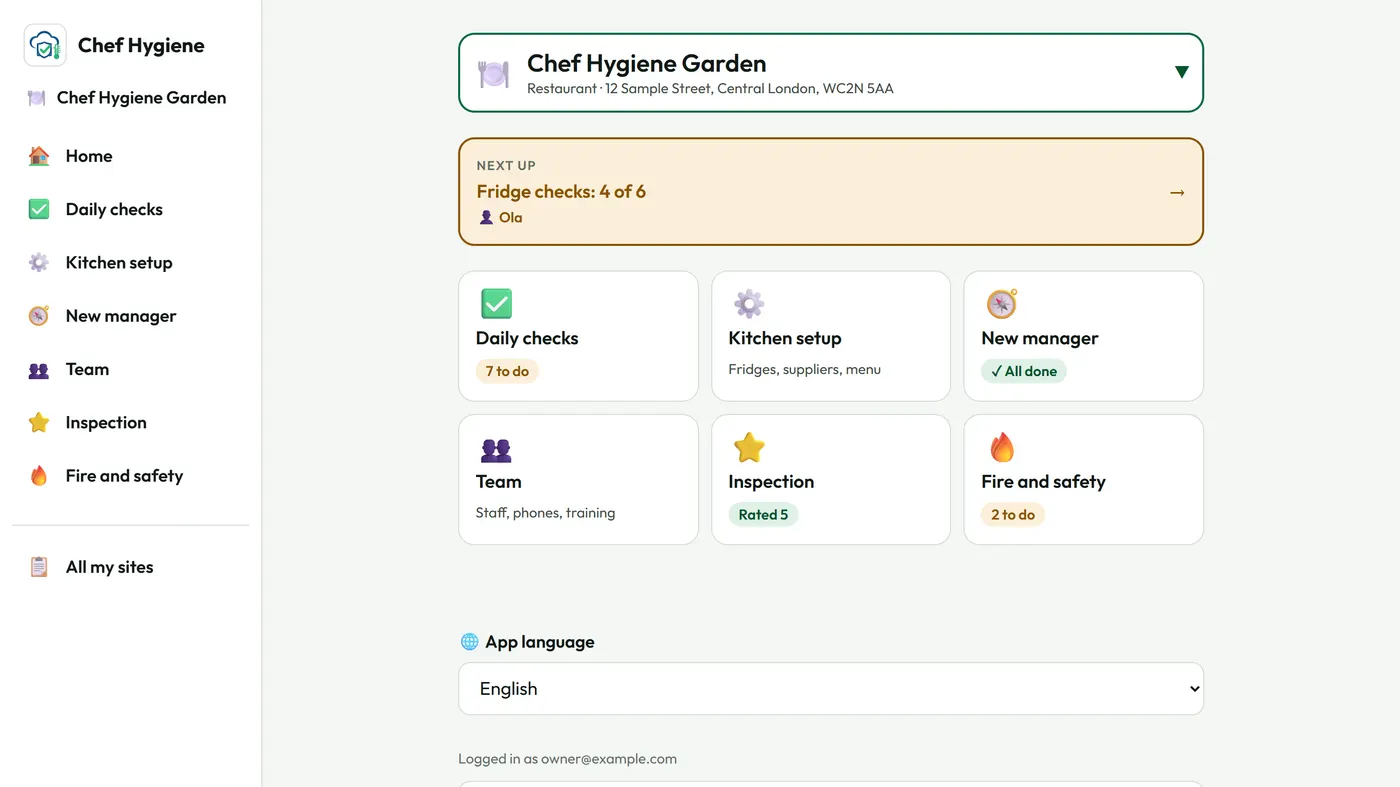
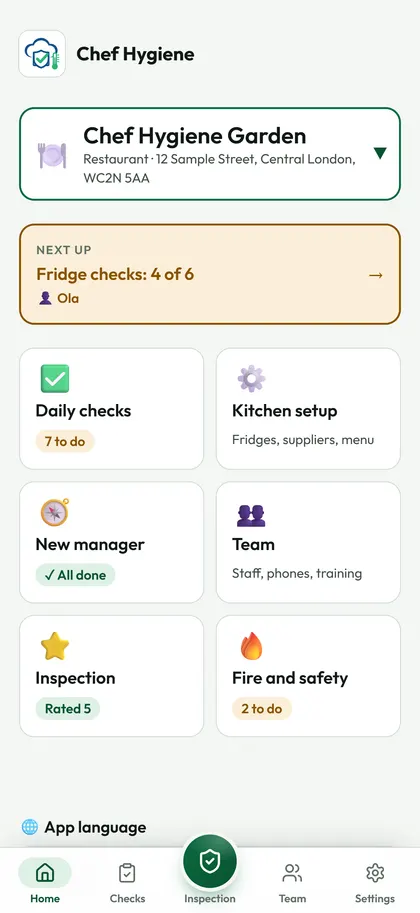
La aplicación carga estas normas para tu cocina, compara tus registros con ellas y guarda pruebas para el inspector.
Otros países
 Reino Unido
 Irlanda
 Islandia
 Estados Unidos
 Canadá
 Francia
 España
 Países Bajos
 Bélgica
 Portugal
 Alemania
 Austria
 Polonia
 Rumanía
 Italia
 Grecia
 Dinamarca
 Suiza
Suiza Luxemburgo
 Chipre
 Malta
Malta Suecia
 Noruega
 Finlandia
 Chequia
 Croacia
 Bulgaria
 Eslovaquia
 Eslovenia
 Estonia
 Letonia
 Lituania
 Liechtenstein
 San Marino
 Gibraltar
 Mónaco
 Moldavia
 Andorra
 Serbia
 Jersey
 Guernesey
 Isla de Man
 Turquía
 Montenegro
 Bosnia y Herzegovina
 Kosovo
 Albania
 Macedonia del Norte
 Ucrania