 Kroatien: für Restaurants und Imbissbuden
Bereit für die Lebensmittelkontrolle. Jeden Tag.
In Croatia the app follows the EU hygiene rules, the HACCP rulebook NN 124/2025 and the national catering guide of the Chamber of Trades and Crafts (HOK); the State Inspectorate inspects.
14 Tage kostenlos · Ein Preis pro Standort · Keine Vertragsbindung
Kroatien: Lebensmittelhygieneregeln
Die Regeln auf dieser Seite sind vorerst auf Englisch. Sie werden in Ihre Sprache übersetzt.
- Inspektionsstelle
- State Inspectorate, sanitary inspection (Državni inspektorat, sanitarna inspekcija)
- Öffentliche Bewertung
- NEIN
- Sprachen in der App
- Hrvatski, English
Ihre Inspektion
The State Inspectorate (Državni inspektorat, DIRH) inspects through its sanitary inspection (sanitarna inspekcija). It checks food hygiene, HACCP and staff health. It works from five regional offices (Zagreb, Osijek, Rijeka, Split, Varaždin). Tourism, market and labour inspectors also visit.
The inspector can ban rooms, equipment, products or a person’s work, and can seal the premises: 1 to 15 days the first time, 30 days if the same fault returns within 3 years. Fines for a company start at EUR 6,630 to 13,270 for having no HACCP system (Act NN 83/22). Appeals do not stop an order.
Hygienebewertung
There is no national rating, sticker or smiley, and no duty to display an inspection result. The State Inspectorate publishes only totals.
„Gesetz“ ist eine verbindliche Regel. „Offizielle Richtlinien“ sind kein Gesetz, werden aber von Prüfern erwartet. „Chef Hygiene Standardwert“ ist ein Wert, den die App überprüft, wenn keine Regel einen Wert vorgibt.
Temperaturen
- Offizielle LeitlinienNo Croatian law sets restaurant fridge, hot-holding, cooling or reheating numbers. The values below come from the national catering guide (HOK, 2nd edition 2025).
- Offizielle LeitlinienFridge: cooked dishes and poultry 4°C, minced meat 2°C, offal 3°C, other meat 7°C, vegetables 8°C. Fresh fish is kept at melting-ice temperature. Any fridge must stay at +8°C or colder.
- Offizielle LeitlinienFreezer: −18°C or colder.
- Offizielle LeitlinienCooking: 73°C for 30 seconds in the thickest part of the food.
- Offizielle LeitlinienHot holding: 65°C or hotter, checked every 2 hours. If it fell below 65°C for under 2 hours, reheat once to 73°C and use it. After 2 to 4 hours, use it at once. After more than 4 hours, throw it away.
- Offizielle LeitlinienCooling: at most 30 minutes at room temperature, then down to 4°C within 6 hours in all. Use the food within 24 hours.
- Offizielle LeitlinienReheating: 73°C for 30 seconds, and only once.
- Offizielle LeitlinienCold display: 8°C at most, aim for 4°C. After 2 hours over the limit, use the food within the next 2 hours. After 4 hours, throw it away.
- Offizielle LeitlinienAt goods-in, chilled food should be 8°C at most and frozen food −18°C or colder. Catering vans carry food at 4°C at most.
Personal, Schulung und Gesundheit
- GesetzEveryone who touches, prepares or serves food needs the food hygiene course certificate before starting work, renewed every 5 years. The course is 15 teaching hours at a county public health institute. The employer pays (Act on protection from infectious diseases, Art. 37 and 39).
- GesetzStaff in direct contact with unpacked food need a medical exam before starting and then every year, including stool tests. The result goes in the sanitary card (sanitarna iskaznica), which the employer keeps (same Act and Rulebook NN 116/2018).
- GesetzPeople with an infectious disease that food can carry, or infected skin disease, must not work with food. After typhoid, dysentery or salmonellosis they need negative tests first.
- GesetzThe business must train the HACCP team and every worker whose job affects food safety, check that the training worked and keep records (Rulebook NN 124/2025, Art. 6).
Allergene
- GesetzYou must give the 14 EU allergens for food that is not prepacked, in writing, easy to see, next to the food (Rulebook on unpackaged food, Art. 8). The information is free and available before the sale.
- GesetzOral information is allowed if a visible notice says where the information is or invites guests to ask staff, and the full information is also in print or electronic form on the premises for guests and inspectors.
- GesetzFor delivery orders, give the information before the sale and at delivery. It must be in Croatian, Latin script; other languages may be added. Keep a list of the allergens in every dish.
Brandschutzprüfungen
- GesetzThe owner checks each extinguisher at least every 3 months and records it. An authorised firm services it at least every year and after any use (Rulebook NN 101/11). Each floor needs at least 2 extinguishers (Rulebook NN 100/99).
- GesetzVentilation ducts from food-preparation rooms are cleaned every 3 months while the premises are open. Other ventilation ducts are cleaned at least yearly, with a written record (Rulebook NN 100/99, Art. 27).
- GesetzEmergency lighting is checked twice a year, once just before the main season, and recorded (Rulebook NN 100/99, Art. 23). Small ground-floor food premises are excepted.
- GesetzThe electrical installation is inspected and measured at least every 4 years. Keep the written report (technical regulation NN 5/2010).
Aufzeichnungen
- GesetzRestaurants keep these on the premises: goods-in rules, a cleaning plan, swab results, the cold-chain record at least once a day, shelf-life instructions for prepared dishes, and the pest plan and certificates (Rulebook NN 124/2025, Art. 14).
- GesetzSurface swab tests by a laboratory are needed at least every 6 months, with at least 10 samples for a restaurant (Rulebook NN 137/2009).
- GesetzKeep corrective-action records for 1 year after the shelf-life date, or 6 months for perishable food with no date (Rulebook NN 124/2025, Art. 22).
Offizielle Quellen
- State Inspectorate (Državni inspektorat)
- Croatian Chamber of Trades and Crafts (HOK), catering HACCP guide
- HACCP rulebook NN 124/2025
- Food hygiene Act NN 83/22
Checked
Diese Seite enthält allgemeine Informationen und stellt keine Rechtsberatung dar. Bitte wenden Sie sich an Ihre örtliche Behörde.
Kroatien: Leitfäden zur Lebensmittelhygiene
Richten Sie Chef Hygiene ein
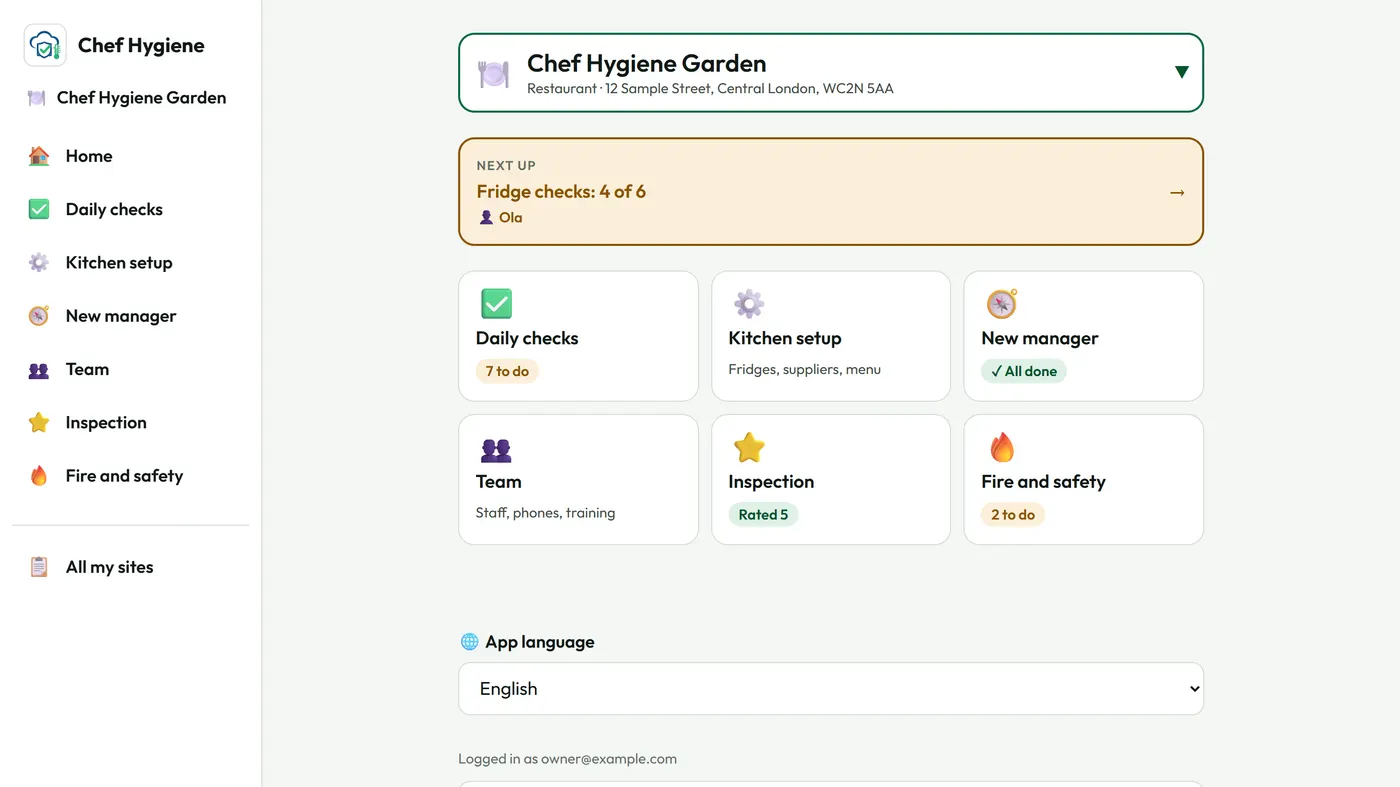
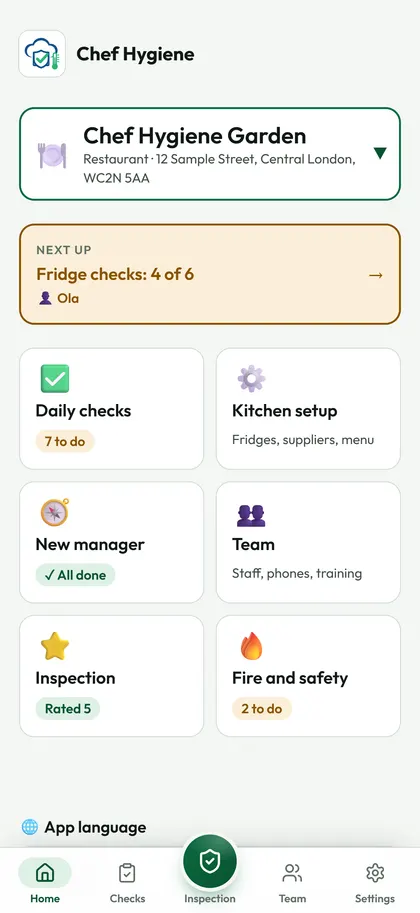
Erstellen Sie Ihr Konto, richten Sie ein Tablet für die gemeinsame Küche ein und installieren Sie die App Schritt für Schritt auf den Telefonen Ihrer Mitarbeiter.
Kroatien: Lebensmittelkontrollen
Wer inspiziert Ihre Küche, wie funktioniert eine Inspektion und ob es eine öffentliche Hygienebewertung gibt.
Kroatien: Regeln für die Lebensmitteltemperatur
Die Lebensmitteltemperaturen, die Ihre Küche einhalten muss, und die dahinter stehenden Regeln.
Kroatien: Allergene
Was Ihre Küche Ihren Kunden über Allergene sagen muss.
Kroatien: Krankheit und Schulung des Personals
Schulungen, Regeln für den Umgang mit Lebensmitteln und wenn krankes Personal sich von Lebensmitteln fernhalten muss.
Kroatien: Brandschutz
Brandschutzkontrollen für Ihre Küche und deren Häufigkeit.
Kroatien: aufzubewahrende Aufzeichnungen
Die Aufzeichnungen und Registrierungen, die Ihre Küche führen muss.
Kroatien: die Chef Hygiene-App
Die App lädt diese Regeln für Ihre Küche, gleicht Ihre Aufzeichnungen damit ab und speichert Nachweise für den Kontrolleur.
Andere Länder
 Vereinigtes Königreich
 Irland
 Island
 Vereinigte Staaten
 Kanada
 Frankreich
 Spanien
 Niederlande
 Belgien
 Portugal
 Deutschland
 Österreich
 Polen
Polen Rumänien
 Italien
 Griechenland
 Dänemark
 Schweiz
 Luxemburg
 Zypern
 Malta
Malta Schweden
 Norwegen
 Finnland
 Tschechien
 Ungarn
 Bulgarien
 Slowakei
 Slowenien
 Estland
 Lettland
 Litauen
 Liechtenstein
 San Marino
 Gibraltar
 Monaco
 Republik Moldau
 Andorra
 Serbien
 Jersey
 Guernsey
 Isle of Man
 Türkei
 Montenegro
 Bosnien und Herzegowina
 Kosovo
 Albanien
 Nordmazedonien
 Ukraine