 Belgien: für Restaurants und Imbissbuden
Bereit für die Lebensmittelkontrolle. Jeden Tag.
In Belgium, Chef Hygiene follows the royal decree of 13 July 2014 on food hygiene, the FAVV guides G-023 and G-044 and EU rules, and the FAVV inspects restaurants and publishes a Food Hygiene Rating.
14 Tage kostenlos · Ein Preis pro Standort · Keine Vertragsbindung
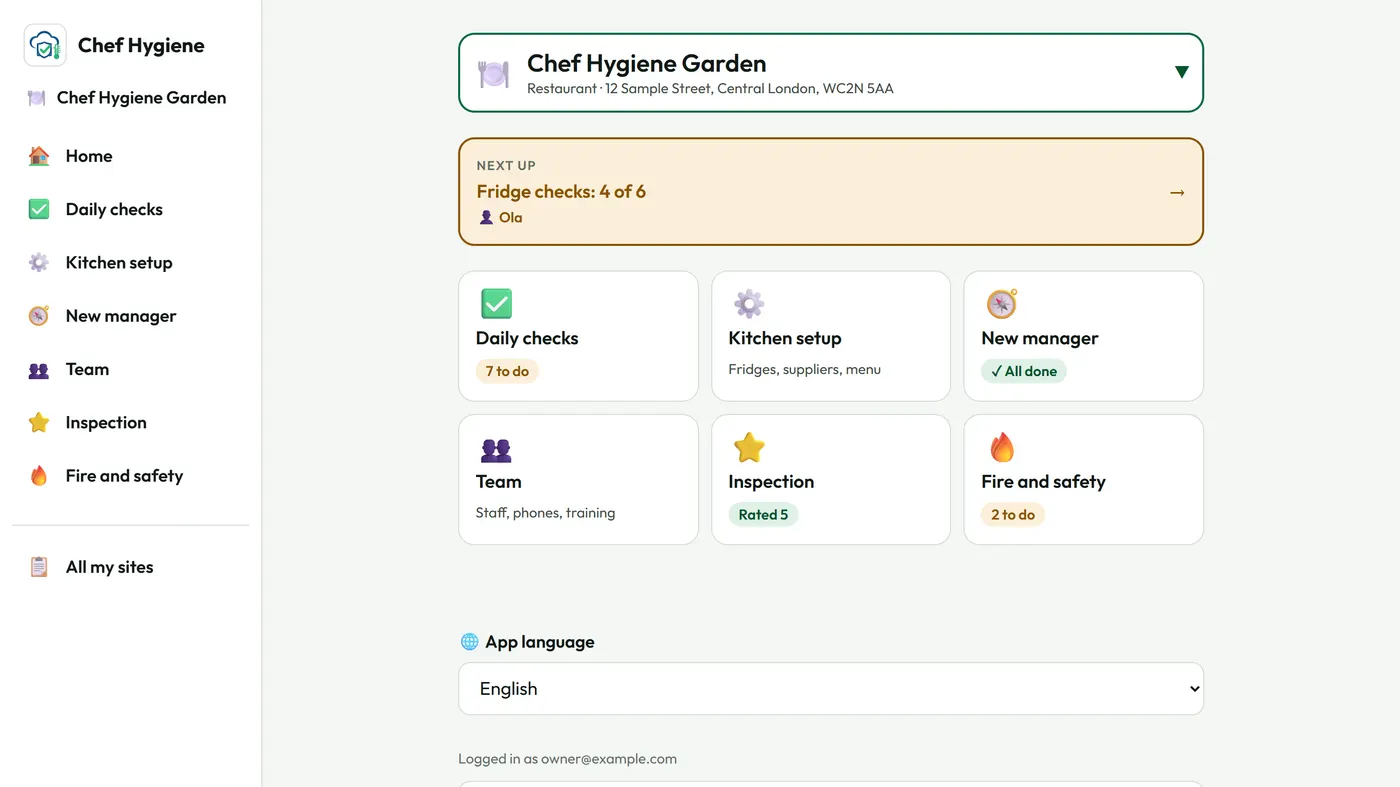
Belgien: Lebensmittelhygieneregeln
Die Regeln auf dieser Seite sind vorerst auf Englisch. Sie werden in Ihre Sprache übersetzt.
- Inspektionsstelle
- Federal Agency for the Safety of the Food Chain (Federaal Agentschap voor de Veiligheid van de Voedselketen, FAVV; Agence fédérale pour la Sécurité de la Chaîne alimentaire, AFSCA)
- Öffentliche Bewertung
- Ja
- Sprachen in der App
- Nederlands, Français, English
Ihre Inspektion
One federal agency, the FAVV (AFSCA in French), inspects food businesses in the whole country through its provincial control units. It works in Dutch, French, German and English.
Inspections follow risk, and the FAVV sets a frequency for each activity. An unfavourable result can bring a warning or an official report (proces-verbaal), then a re-inspection. If public health is at serious risk, the FAVV can order temporary closure. Non-compliant food is seized.
Hygienebewertung
Yes. The Food Hygiene Rating (fhr.favv-afsca.be, website and app, since 4 November 2025) has six classes from Excellent to To be improved, plus No recent inspection. It uses a Smiley and blue forks. You do not have to display your result, but you must display the FAVV authorisation poster, visible from outside.
„Gesetz“ ist eine verbindliche Regel. „Offizielle Richtlinien“ sind kein Gesetz, werden aber von Prüfern erwartet. „Chef Hygiene Standardwert“ ist ein Wert, den die App überprüft, wenn keine Regel einen Wert vorgibt.
Temperaturen
- GesetzChilled red meat, meat products, potato, vegetable, rice and pasta dishes, dairy and cream desserts: 7°C or colder (royal decree of 13 July 2014, Annex IV).
- GesetzChilled raw poultry, offal, minced meat, meat preparations and processed fish: 4°C or colder. A mixed dish follows its strictest ingredient. Chef Hygiene aims for 4°C.
- GesetzFresh fish: near melting ice, at most 4°C. A short rise of up to 3°C while handling is allowed for other food, never for fresh fish.
- GesetzFrozen food: −18°C or colder, with a short rise to −15°C allowed (art. 22/1).
- GesetzHot food kept hot: 60°C or hotter (art. 23 §1). Guide G-044: food at 55 to 60°C must be reheated at once, and food below 55°C is thrown away.
- GesetzCooling: from 60°C to 10°C within 2 hours at most (art. 23 §2).
- GesetzReheating: as quickly as possible to 60°C or hotter (art. 23 §1). Guide G-023: from 10°C to 60°C in under 1 hour, and eat it the same day.
- Offizielle LeitlinienBelgian law sets no core cooking temperature. Guide G-023 says “well heated” means at least 2 minutes at 70°C in the centre.
- Offizielle LeitlinienCooled dishes are kept 3 to 4 days at most, labelled with the dish, the cooling date and the use-by date (G-023).
Personal, Schulung und Gesundheit
- GesetzBelgian law sets no food hygiene certificate, number of hours or renewal. Staff must be supervised and trained to suit their work (EU Regulation 852/2004, Annex II, Chapter XII).
- Offizielle LeitlinienThe FAVV checklist for hospitality asks for at least a short training when someone is hired and a regular reminder, and you must be able to prove it. Keep a training log.
- GesetzThe medical certificate for food handlers was abolished on 11 August 2018.
- Offizielle LeitlinienStaff who are ill or carry germs that can contaminate food, such as gastro-enteritis or diarrhoea, must tell the person in charge. Measures follow a medical examination (G-044). Cuts are dressed at once.
Allergene
- GesetzThe 14 EU allergens must be declared: gluten cereals, crustaceans, eggs, fish, peanuts, soya, milk, tree nuts, celery, mustard, sesame, sulphites, lupin and molluscs (Regulation 1169/2011).
- GesetzFor food that is not prepacked, written information is the rule (royal decree of 17 July 2014, art. 3). Show it on paper or a screen where the food is sold, easy to read before buying.
- GesetzSpoken information is allowed only if it is given at once and free of charge. A written procedure must exist at the point of sale, and staff must be trained on it.
- GesetzYou must always show a clear written notice that says where to find or ask for allergen information and that recipes can change.
Brandschutzprüfungen
- GesetzFire extinguishers and other fire equipment: checked at least once a year (Codex over het welzijn op het werk, art. III.3-22 §1). Keep the dates and findings.
- GesetzEvacuation drill for staff: at least once a year (Codex, art. III.3-26 §2).
- GesetzLow-voltage electrical installations are inspected every 5 years by an accredited inspection body (AREI/RGIE).
- GesetzGas, heating and electrical installations must be checked periodically (Codex, art. III.3-22 §2). There is no national interval for gas. The town or fire zone sets it.
- Offizielle LeitlinienHood and ducts have no national cleaning interval. In Brussels, operators must have them cleaned regularly by a specialist firm and be able to prove it.
Aufzeichnungen
- GesetzEvery food business except primary production needs a self-check system (autocontrole) based on HACCP principles and good hygiene practice (Royal Decree of 14 November 2003).
- Offizielle LeitlinienSmall businesses can use the relaxations in the FAVV guide G-044 (version 2, 25 October 2024) or the hospitality guide G-023.
- Offizielle LeitlinienCheck fridges and freezers every day and write the temperatures down. Every cold unit needs a thermometer accurate to 1°C (art. 21).
- Offizielle LeitlinienKeep self-check records 6 months after the product’s shelf life with the relaxations, or 2 years otherwise. Keep traceability records 2 years (G-044).
Offizielle Quellen
- FAVV (AFSCA), official site
- Food Hygiene Rating
- Royal decree of 13 July 2014 on food hygiene, consolidated (Justel)
- FAVV circular on allergens, 13 December 2014
- FAVV generic self-check guide G-044
Checked
Diese Seite enthält allgemeine Informationen und stellt keine Rechtsberatung dar. Bitte wenden Sie sich an Ihre örtliche Behörde.
Belgien: Leitfäden zur Lebensmittelhygiene
Richten Sie Chef Hygiene ein
Erstellen Sie Ihr Konto, richten Sie ein Tablet für die gemeinsame Küche ein und installieren Sie die App Schritt für Schritt auf den Telefonen Ihrer Mitarbeiter.
Belgien: Lebensmittelkontrollen
Wer inspiziert Ihre Küche, wie funktioniert eine Inspektion und ob es eine öffentliche Hygienebewertung gibt.
Belgien: Regeln für die Lebensmitteltemperatur
Die Lebensmitteltemperaturen, die Ihre Küche einhalten muss, und die dahinter stehenden Regeln.
Belgien: Allergene
Was Ihre Küche Ihren Kunden über Allergene sagen muss.
Belgien: Krankheit und Schulung des Personals
Schulungen, Regeln für den Umgang mit Lebensmitteln und wenn krankes Personal sich von Lebensmitteln fernhalten muss.
Belgien: Brandschutz
Brandschutzkontrollen für Ihre Küche und deren Häufigkeit.
Belgien: aufzubewahrende Aufzeichnungen
Die Aufzeichnungen und Registrierungen, die Ihre Küche führen muss.
Belgien: die Chef Hygiene-App
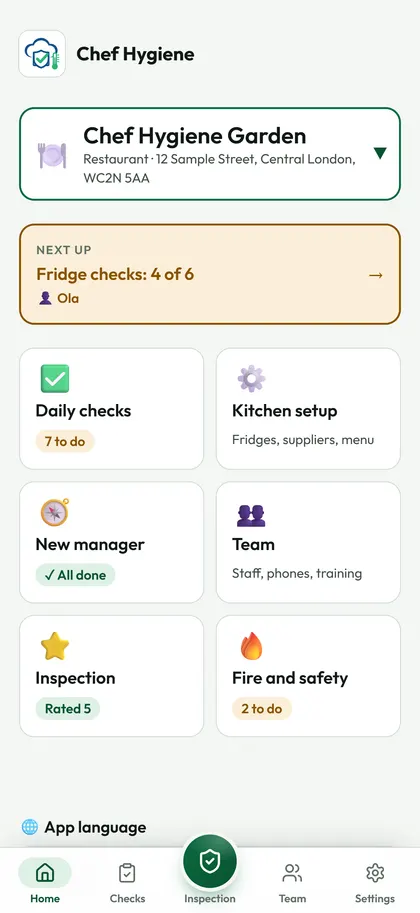
Die App lädt diese Regeln für Ihre Küche, gleicht Ihre Aufzeichnungen damit ab und speichert Nachweise für den Kontrolleur.
Andere Länder
 Vereinigtes Königreich
 Irland
 Island
 Vereinigte Staaten
 Kanada
 Frankreich
 Spanien
 Niederlande
 Portugal
 Deutschland
 Österreich
 Polen
Polen Rumänien
 Italien
 Griechenland
 Dänemark
 Schweiz
 Luxemburg
 Zypern
 Malta
Malta Schweden
 Norwegen
 Finnland
 Tschechien
 Ungarn
 Kroatien
 Bulgarien
 Slowakei
 Slowenien
 Estland
 Lettland
 Litauen
 Liechtenstein
 San Marino
 Gibraltar
 Monaco
 Republik Moldau
 Andorra
 Serbien
 Jersey
 Guernsey
 Isle of Man
 Türkei
 Montenegro
 Bosnien und Herzegowina
 Kosovo
 Albanien
 Nordmazedonien
 Ukraine