 Romênia: para restaurantes e delivery
Pronto para a inspeção sanitária. Todos os dias.
In Romania the app follows the Ministry of Health’s hygiene rules (Order 976/1998), EU Regulation 852/2004 and the sector guides for restaurants; the county offices DSVSA and DSP and the consumer authority ANPC inspect.
14 dias grátis · preço único por site · sem contrato
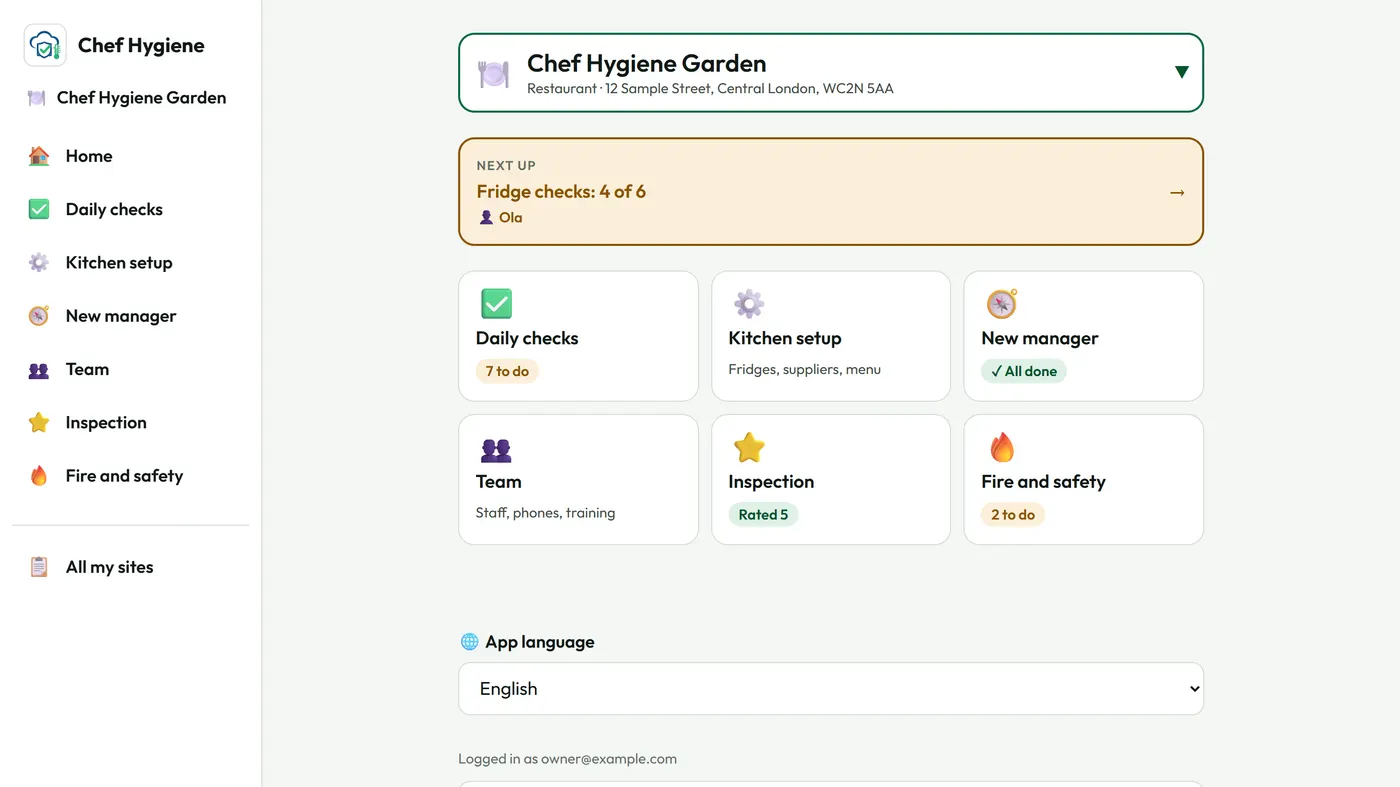
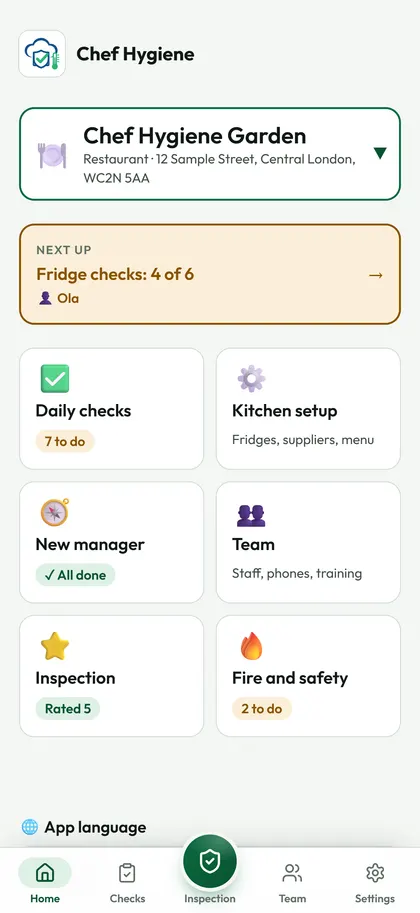
Romênia: regras de higiene alimentar
As regras desta página estão em inglês por enquanto. Elas serão traduzidas para o seu idioma.
- Órgão de inspeção
- National Sanitary Veterinary and Food Safety Authority (ANSVSA, Autoritatea Națională Sanitară Veterinară și pentru Siguranța Alimentelor)
- Classificação pública
- Não
- Idiomas disponíveis no aplicativo
- Română, English
Sua inspeção
Three bodies inspect restaurants. The county office DSVSA (of ANSVSA) checks food safety, and every restaurant must be registered with it. The county public health directorate DSP (Ministry of Health) checks hygiene, staff medical checks and hygiene course certificates. The consumer authority ANPC checks menus, allergen information and prices.
Visits are based on risk. Activity can be suspended or banned. Fines are set under Government Decisions 984/2005 (food safety) and 857/2011 (public health).
Classificação de higiene
Romania has no public hygiene rating, score or sticker. The only published results are the lists, on each DSVSA website, of units whose activity was banned.
“Lei” é uma regra vinculativa. “Orientação oficial” não é lei, mas os inspetores esperam que seja. “Chef Hygiene padrão” é um valor que o aplicativo verifica quando nenhuma regra fornece um número.
Temperaturas
- LeiCold finished dishes are kept at 8°C or colder until served (Order 976/1998, art. 37 c). This 8°C is only for cold prepared dishes.
- LeiWhere one store room is used, the fridge has a separate raw meat compartment at 4°C or colder (Order 976/1998, art. 38 b). ANSVSA advises 0–4°C for food of animal origin, and Chef Hygiene aims for 4°C.
- LeiQuick-frozen food: −18°C or colder, with short rises of up to 3°C in transport and display (Order ANSVSA 134/2010).
- LeiHot dishes are kept at 60°C or hotter until served (Order 976/1998, art. 37 c).
- Chef Hygiene padrãoChef Hygiene checks hot food against 63°C, the figure in the ANBCT chefs’ guide (2023) and the ANPC guide (2024). It is stricter than the law and meets both.
- Orientações oficiaisCooling: the law only says to cool food as quickly as possible. The ANBCT guide says to 10–15°C within 90 minutes, then below 7°C within a further 150 minutes.
- Orientações oficiaisReheating: the centre reaches 72°C with at least 2 minutes of even boiling, and food is reheated only once (ANBCT guide). Cooking: at least 75°C before hot holding.
- Chef Hygiene padrãoDeliveries: Romanian law gives no number, so the temperature on the label applies. Chef Hygiene checks chilled deliveries against 4°C and flags frozen ones above −15°C.
- LeiMeals for organised groups, such as tourists or events: keep a sample of each dish for 48 hours at 4°C in a separate fridge (Order 976/1998, art. 37 e).
Equipe, treinamento e saúde
- LeiFood hygiene course: the county public health directorate (DSP) issues a certificate after an exam of 30 questions with a 60% pass mark. It is valid 3 years, then a new course and exam are needed (Order 2209/4469/2022).
- LeiThe staff course (Level II) lasts at least 10 hours including a test. Managers take Level I, which lasts 12 hours (Order 2209/4469/2022).
- LeiMedical checks for everyone who touches unpackaged food: at hiring a doctor’s exam, a stool culture and a parasite test. After that a doctor’s exam every 6 months and the two tests every year. The fitness sheet says “apt lucru în sector alimentar” (Government Decision 355/2007).
- LeiSick staff: anyone with fever, diarrhoea, vomiting, jaundice, tonsillitis, boils, hand wounds, skin infections or pus goes to a doctor. They return only with the doctor’s written note (Government Decision 355/2007).
Alérgenos
- LeiThe 14 EU allergens: cereals with gluten, crustaceans, eggs, fish, peanuts, soybeans, milk, nuts, celery, mustard, sesame, sulphites, lupin and molluscs.
- LeiInformation must be in writing, not spoken. For food sold unpacked it must be at the point of sale, visible, easy to read and indelible (ANPC Order 163/2021).
- LeiRestaurant menus list each dish’s ingredients with the allergens highlighted, name the additives and give the nutrition declaration (ANPC Order 201/2022, in force from 15 March 2023).
- LeiA QR code to the full menu is allowed if a printed copy is on site. For online orders, show the information before payment and on the delivery label. Public texts need a Romanian version (Law 500/2004).
Verificações de segurança contra incêndio
- LeiFire extinguishers: your fire safety person checks them every month and writes it in a register. CO2 extinguishers are weighed every 6 months, and an authorised firm verifies them every 12 months once the warranty ends (OMAI 135/2023).
- LeiExtinguishers are recharged after use and at least every 3 years, and scrapped after 20 years (OMAI 135/2023).
- LeiGas installations: a technical verification at most every 2 years, and a technical revision at most every 10 years. The revision is also needed after more than 6 months unused or any incident. An ANRE-authorised firm does both (ANRE Order 179/2015).
- LeiElectrical installations are checked at start-up, periodically and after repairs, by ANRE-authorised electricians (Government Decision 1146/2006).
Registros
- LeiYou need food safety procedures based on HACCP principles (EU Regulation 852/2004, art. 5). Fridge temperatures must be recorded (Order 976/1998, art. 11).
- LeiPest control: insects at least every 3 months and rodents at least every 6 months, by a certified firm. Keep the signed report of each visit (Order 119/2014).
- LeiGas check records and the technical file are kept for the life of the installation (ANRE Order 179/2015).
- LeiKeep supplier records so food can be traced one step back and one step forward (EU Regulation 178/2002, art. 18).
Fontes oficiais
- ANSVSA, food safety authority
- ANPC, consumer protection: guides for public catering
- Ministry of Health
- ANRE, energy regulator: gas and electrical installations
- IGSU, emergency situations inspectorate: fire safety
Checked
Esta página contém informações gerais e não constitui aconselhamento jurídico. Consulte a sua autoridade local.
Romênia: guias de higiene alimentar
Configurar Chef Hygiene
Crie sua conta, configure um tablet de cozinha compartilhada e coloque o aplicativo nos telefones de sua equipe, passo a passo.
Romênia: inspeções de alimentos
Quem fiscaliza sua cozinha, como funciona a fiscalização e se existe classificação de higiene pública.
Romênia: regras de temperatura dos alimentos
As temperaturas dos alimentos que sua cozinha deve manter e as regras por trás delas.
Romênia: alérgenos
O que sua cozinha deve informar aos clientes sobre alérgenos.
Romênia: doença e treinamento do pessoal
Treinamento, regras para manipuladores de alimentos e quando a equipe doente deve ficar longe dos alimentos.
Romênia: segurança contra incêndio
Verificações de segurança contra incêndio em sua cozinha e com que frequência.
Romênia: registros a serem mantidos
Os registros e registros que sua cozinha deve manter.
Romênia: o aplicativo Chef Hygiene
O aplicativo carrega essas regras para sua cozinha, compara seus registros com elas e guarda comprovantes para o inspetor.
Outros países
 Reino Unido
 Irlanda
 Islândia
 Estados Unidos
 Canadá
 França
 Espanha
 Países Baixos
 Bélgica
 Portugal
 Alemanha
 Áustria
 Polônia
 Itália
 Grécia
 Dinamarca
 Suíça
Suíça Luxemburgo
 Chipre
 Malta
Malta Suécia
 Noruega
 Finlândia
 Tchéquia
 Hungria
 Croácia
 Bulgária
 Eslováquia
 Eslovênia
 Estônia
 Letônia
 Lituânia
 Liechtenstein
 San Marino
 Gibraltar
 Mônaco
 Moldávia
 Andorra
 Sérvia
 Jersey
 Guernsey
 Ilha de Man
 Turquia
 Montenegro
 Bósnia e Herzegovina
 Kosovo
 Albânia
 Macedônia do Norte
 Ucrânia