 Romania: per ristoranti e takeaway
Pronti per l’ispezione alimentare. Ogni giorno.
In Romania the app follows the Ministry of Health’s hygiene rules (Order 976/1998), EU Regulation 852/2004 and the sector guides for restaurants; the county offices DSVSA and DSP and the consumer authority ANPC inspect.
14 giorni gratuiti · un prezzo unico per sito · nessun contratto
Romania: norme di igiene alimentare
Le regole presenti in questa pagina sono al momento in inglese. Verranno tradotte nella tua lingua.
- organismo di ispezione
- National Sanitary Veterinary and Food Safety Authority (ANSVSA, Autoritatea Națională Sanitară Veterinară și pentru Siguranța Alimentelor)
- Valutazione pubblica
- NO
- Lingue nell’app
- Română, English
La tua ispezione
Three bodies inspect restaurants. The county office DSVSA (of ANSVSA) checks food safety, and every restaurant must be registered with it. The county public health directorate DSP (Ministry of Health) checks hygiene, staff medical checks and hygiene course certificates. The consumer authority ANPC checks menus, allergen information and prices.
Visits are based on risk. Activity can be suspended or banned. Fines are set under Government Decisions 984/2005 (food safety) and 857/2011 (public health).
Valutazione igienica
Romania has no public hygiene rating, score or sticker. The only published results are the lists, on each DSVSA website, of units whose activity was banned.
“Legge” è una norma vincolante. “Linee guida ufficiali” non sono legge, ma gli ispettori se le aspettano. “Chef Hygiene predefinito” è un valore che l’app controlla quando nessuna norma fornisce un numero.
Temperature
- LeggeCold finished dishes are kept at 8°C or colder until served (Order 976/1998, art. 37 c). This 8°C is only for cold prepared dishes.
- LeggeWhere one store room is used, the fridge has a separate raw meat compartment at 4°C or colder (Order 976/1998, art. 38 b). ANSVSA advises 0–4°C for food of animal origin, and Chef Hygiene aims for 4°C.
- LeggeQuick-frozen food: −18°C or colder, with short rises of up to 3°C in transport and display (Order ANSVSA 134/2010).
- LeggeHot dishes are kept at 60°C or hotter until served (Order 976/1998, art. 37 c).
- Chef Hygiene predefinitoChef Hygiene checks hot food against 63°C, the figure in the ANBCT chefs’ guide (2023) and the ANPC guide (2024). It is stricter than the law and meets both.
- Linee guida ufficialiCooling: the law only says to cool food as quickly as possible. The ANBCT guide says to 10–15°C within 90 minutes, then below 7°C within a further 150 minutes.
- Linee guida ufficialiReheating: the centre reaches 72°C with at least 2 minutes of even boiling, and food is reheated only once (ANBCT guide). Cooking: at least 75°C before hot holding.
- Chef Hygiene predefinitoDeliveries: Romanian law gives no number, so the temperature on the label applies. Chef Hygiene checks chilled deliveries against 4°C and flags frozen ones above −15°C.
- LeggeMeals for organised groups, such as tourists or events: keep a sample of each dish for 48 hours at 4°C in a separate fridge (Order 976/1998, art. 37 e).
Personale, formazione e salute
- LeggeFood hygiene course: the county public health directorate (DSP) issues a certificate after an exam of 30 questions with a 60% pass mark. It is valid 3 years, then a new course and exam are needed (Order 2209/4469/2022).
- LeggeThe staff course (Level II) lasts at least 10 hours including a test. Managers take Level I, which lasts 12 hours (Order 2209/4469/2022).
- LeggeMedical checks for everyone who touches unpackaged food: at hiring a doctor’s exam, a stool culture and a parasite test. After that a doctor’s exam every 6 months and the two tests every year. The fitness sheet says “apt lucru în sector alimentar” (Government Decision 355/2007).
- LeggeSick staff: anyone with fever, diarrhoea, vomiting, jaundice, tonsillitis, boils, hand wounds, skin infections or pus goes to a doctor. They return only with the doctor’s written note (Government Decision 355/2007).
Allergeni
- LeggeThe 14 EU allergens: cereals with gluten, crustaceans, eggs, fish, peanuts, soybeans, milk, nuts, celery, mustard, sesame, sulphites, lupin and molluscs.
- LeggeInformation must be in writing, not spoken. For food sold unpacked it must be at the point of sale, visible, easy to read and indelible (ANPC Order 163/2021).
- LeggeRestaurant menus list each dish’s ingredients with the allergens highlighted, name the additives and give the nutrition declaration (ANPC Order 201/2022, in force from 15 March 2023).
- LeggeA QR code to the full menu is allowed if a printed copy is on site. For online orders, show the information before payment and on the delivery label. Public texts need a Romanian version (Law 500/2004).
Controlli di sicurezza antincendio
- LeggeFire extinguishers: your fire safety person checks them every month and writes it in a register. CO2 extinguishers are weighed every 6 months, and an authorised firm verifies them every 12 months once the warranty ends (OMAI 135/2023).
- LeggeExtinguishers are recharged after use and at least every 3 years, and scrapped after 20 years (OMAI 135/2023).
- LeggeGas installations: a technical verification at most every 2 years, and a technical revision at most every 10 years. The revision is also needed after more than 6 months unused or any incident. An ANRE-authorised firm does both (ANRE Order 179/2015).
- LeggeElectrical installations are checked at start-up, periodically and after repairs, by ANRE-authorised electricians (Government Decision 1146/2006).
Registri
- LeggeYou need food safety procedures based on HACCP principles (EU Regulation 852/2004, art. 5). Fridge temperatures must be recorded (Order 976/1998, art. 11).
- LeggePest control: insects at least every 3 months and rodents at least every 6 months, by a certified firm. Keep the signed report of each visit (Order 119/2014).
- LeggeGas check records and the technical file are kept for the life of the installation (ANRE Order 179/2015).
- LeggeKeep supplier records so food can be traced one step back and one step forward (EU Regulation 178/2002, art. 18).
Fonti ufficiali
- ANSVSA, food safety authority
- ANPC, consumer protection: guides for public catering
- Ministry of Health
- ANRE, energy regulator: gas and electrical installations
- IGSU, emergency situations inspectorate: fire safety
Checked
Questa pagina fornisce informazioni di carattere generale e non costituisce consulenza legale. Si prega di contattare le autorità locali competenti.
Romania: guide sull’igiene alimentare
Configura Chef Hygiene
Crea il tuo account, configura un tablet da cucina condiviso e metti l'app sui telefoni del tuo staff, passo dopo passo.
Romania: ispezioni alimentari
Chi ispeziona la tua cucina, come funziona un’ispezione e se esiste una valutazione di igiene pubblica.
Romania: regole sulla temperatura degli alimenti
Le temperature degli alimenti che la tua cucina deve mantenere e le regole che ne sono alla base.
Romania: allergeni
Cosa deve dire la tua cucina ai clienti sugli allergeni.
Romania: malattia e formazione del personale
Formazione, regole per gli operatori alimentari e quando il personale malato deve stare lontano dal cibo.
Romania: sicurezza antincendio
Controlli di sicurezza antincendio per la tua cucina e quanto spesso sono dovuti.
Romania: record da conservare
I registri e le registrazioni che la tua cucina deve conservare.
Romania: l'app Chef Hygiene.
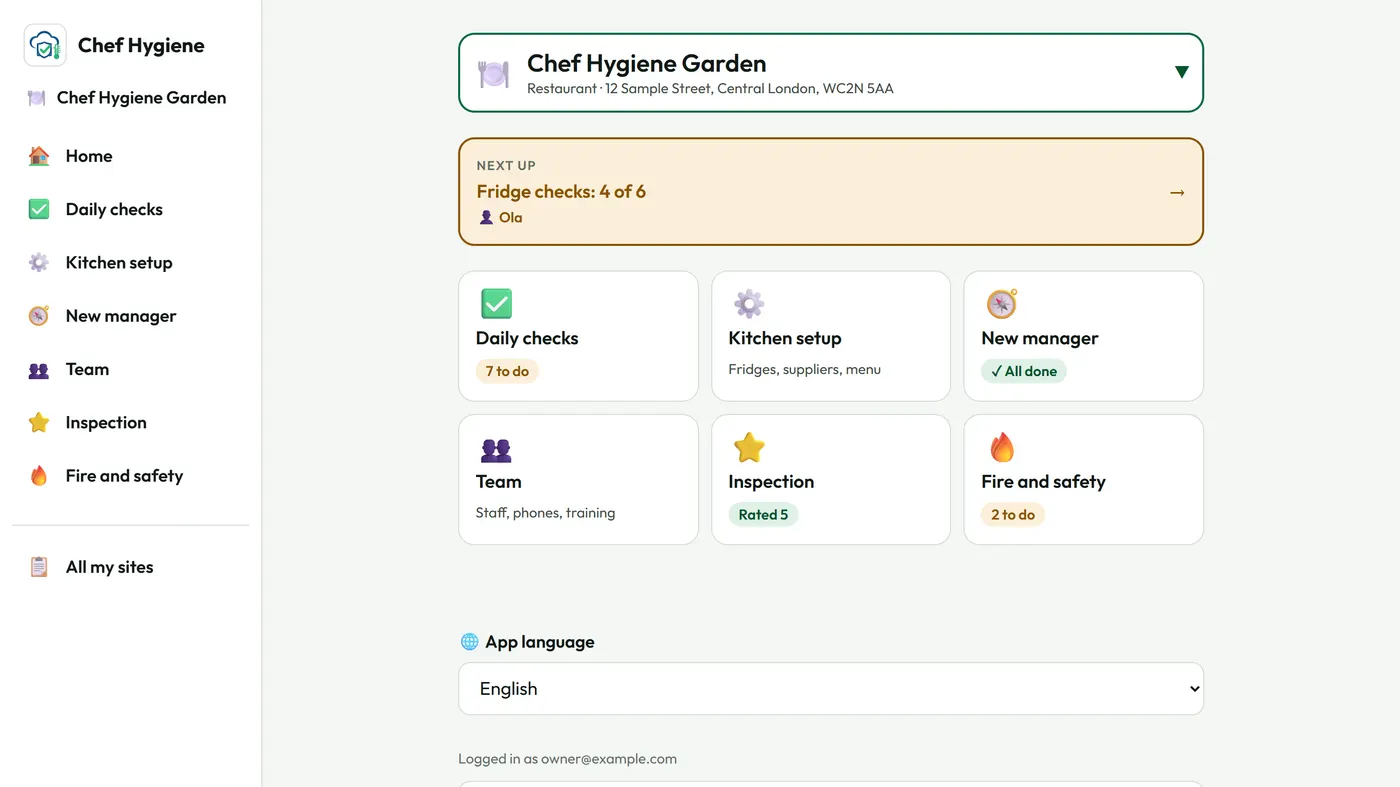
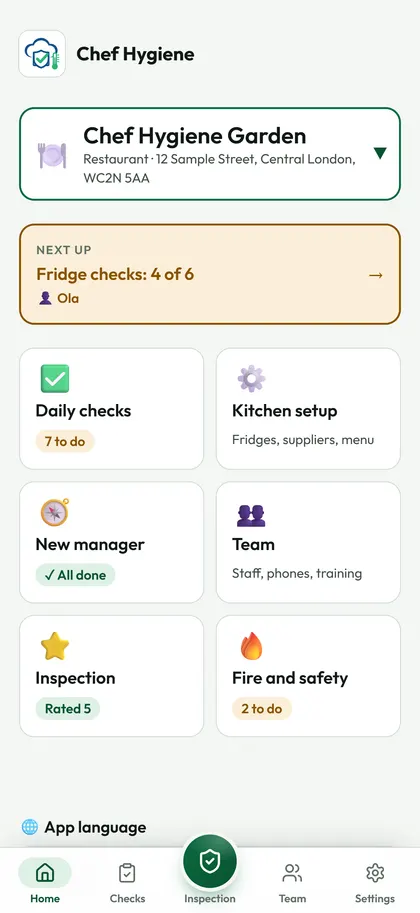
L’app carica queste regole per la tua cucina, verifica la conformità dei tuoi registri e conserva la documentazione per l’ispettore.
Altri paesi
 Regno Unito
 Irlanda
 Islanda
 Stati Uniti
 Canada
 Francia
 Spagna
 Paesi Bassi
 Belgio
 Portogallo
 Germania
 Austria
 Polonia
 Italia
 Grecia
 Danimarca
 Svizzera
 Lussemburgo
 Cipro
Cipro Malta
Malta Svezia
 Norvegia
 Finlandia
 Cechia
 Ungheria
 Croazia
 Bulgaria
 Slovacchia
 Slovenia
 Estonia
 Lettonia
 Lituania
 Liechtenstein
 San Marino
 Gibilterra
 Monaco
 Moldavia
 Andorra
 Serbia
 Jersey
 Guernsey
 Isola di Man
 Turchia
 Montenegro
 Bosnia ed Erzegovina
 Kosovo
 Albania
 Macedonia del Nord
 Ucraina