 Cipro: per ristoranti e takeaway
Pronti per l’ispezione alimentare. Ogni giorno.
In the Republic of Cyprus the app follows EU Regulation 852/2004, the Hygiene Regulations (Κ.Δ.Π. 320/2006) and the Public Health Services hygiene guides; the Public Health Services inspect, and there is no public rating.
14 giorni gratuiti · un prezzo unico per sito · nessun contratto
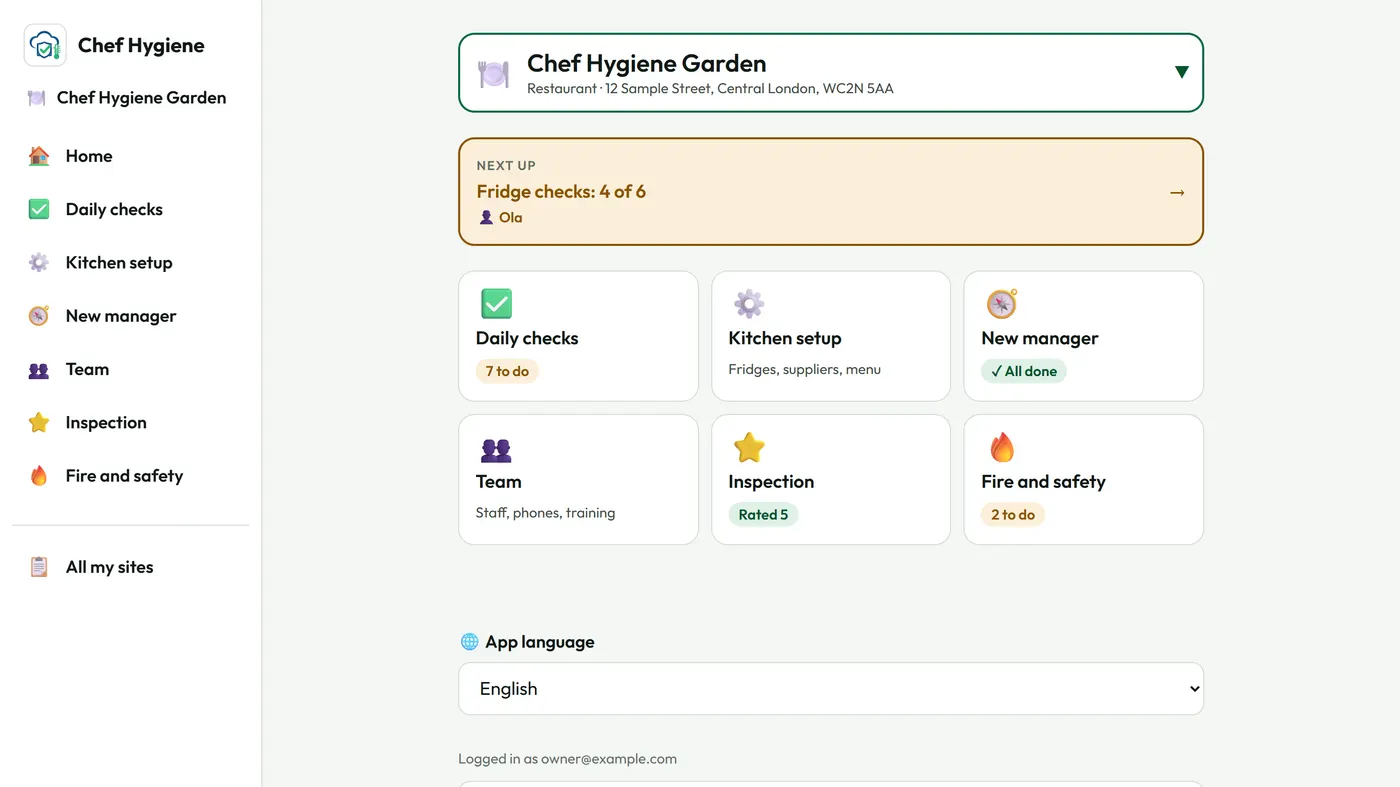
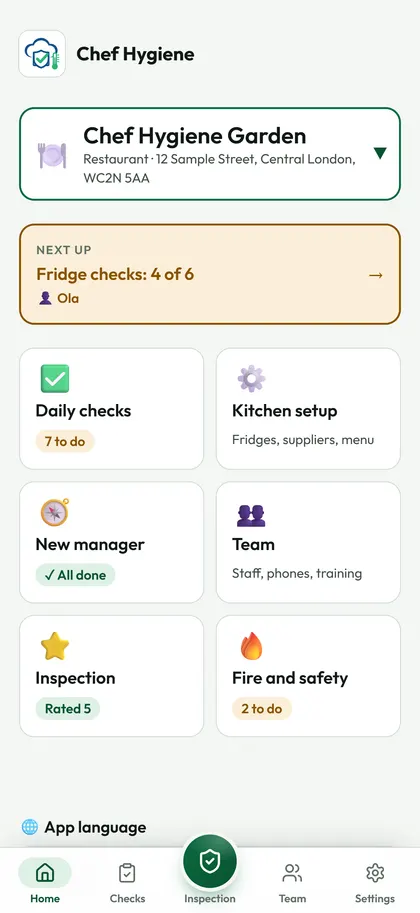
Cipro: norme di igiene alimentare
Le regole presenti in questa pagina sono al momento in inglese. Verranno tradotte nella tua lingua.
- organismo di ispezione
- Public Health Services of the Ministry of Health (Υγειονομικές Υπηρεσίες)
- Valutazione pubblica
- NO
- Lingue nell’app
- Ελληνικά, English
La tua ispezione
The Public Health Services (Υγειονομικές Υπηρεσίες) of the Ministry of Health inspect restaurants through five district offices. Some municipal health services may inspect in their own area under Law 54(I)/1996. The Deputy Ministry of Tourism licenses restaurants under Law 29/1985, and its officers also check cleanliness.
Inspections are risk-based. Eleven risk factors give a category from 1 to 4, and the category is the number of full inspections a year. Seasonal businesses get fewer. The inspector can give written instructions, take samples, seize food, and suspend a business for up to 4 days, renewable. Administrative fines can reach €854 a day, and a court can fine, close the premises and ban trading (Law 54(I)/1996). You can object to a suspension or seizure within 3 working days.
Valutazione igienica
Cyprus has no public hygiene rating, grade or sticker, and nothing has to be displayed. The Tourism classes A, B and C describe the building and service, not hygiene.
“Legge” è una norma vincolante. “Linee guida ufficiali” non sono legge, ma gli ispettori se le aspettano. “Chef Hygiene predefinito” è un valore che l’app controlla quando nessuna norma fornisce un numero.
Temperature
- Linee guida ufficialiNo Cyprus law sets fridge, hot-holding, cooling or reheating numbers for restaurants. The numbers below come from the Public Health Services Hygiene Guide No 1 (2nd edition) and its HACCP plan for small businesses.
- Linee guida ufficialiGuide No 1: chilled food, and raw meat, poultry and fish, at 5°C or below. The small-business plan sets a critical limit of 7°C. Chef Hygiene aims for 5°C and warns above 7°C. Cakes and pastries: 8°C at most.
- LeggeQuick-frozen food must be at −18°C or colder. Brief rises of up to 3°C are allowed in transport and display (Κ.Δ.Π. 80/2002, reg. 6). Guide: never refreeze; ice cream on display at −14°C or colder.
- Linee guida ufficialiGuide No 1: cook to 75°C in the centre, or 70°C for 2 minutes. Pork and burgers: 68,3°C for 15 seconds. Frying oil never above 180°C.
- Linee guida ufficialiGuide No 1: keep hot food at 60°C or more. Below 60°C is allowed once, for serving only. The small-business plan says above 63°C.
- Linee guida ufficialiGuide No 1 for food between 5°C and 60°C: under 2 hours, chill it or eat it. From 2 to 4 hours, eat it at once. Over 4 hours, throw it away.
- Linee guida ufficialiGuide No 1: cool from 60°C to 10°C within 2 hours, never over 3 hours, then keep at 5°C or below.
- Linee guida ufficialiGuide No 1: reheat to above 75°C in the centre. No time limit is given.
- Linee guida ufficialiGuide No 1: thaw in the fridge at 5°C or below, or under running drinking water at 21°C or below for at most 3 hours.
Personale, formazione e salute
- LeggeEveryone who touches open food needs a health certificate from a government Chief Medical Officer, renewed every 12 months. It includes a stool test for Salmonella and parasites (Κ.Δ.Π. 320/2006). Keep it ready for inspectors.
- LeggeStaff who are ill tell the manager, and the manager tells the district Chief Medical Officer at once. They return to work only when that officer decides. There is no fixed number of days off (Κ.Δ.Π. 320/2006).
- LeggeStaff who handle open food keep themselves clean, cover wounds with a waterproof dressing, do not smoke or spit, and wear a white coat and a head covering (Κ.Δ.Π. 320/2006).
- Linee guida ufficialiGuide No 1: all staff do Level 1 at hiring (read the Ministry’s hygiene handbook and sign a statement). Owners, managers and staff who prepare food do Level 2, a 30-hour course. No legal course or renewal is set.
- LeggeStaff must be supervised and trained to suit their job (Regulation 852/2004, Annex II).
Allergeni
- LeggeGive information on the 14 EU allergens for food served or sold loose (Regulation 1169/2011, art. 44).
- Linee guida ufficialiPublic Health Services: loose food gives the information through labelling, and the minimum is the allergenic ingredients. Chef Hygiene asks for a written list per dish and an “ask staff” sign.
- LeggeAll food information must be in Greek. Other languages may be added (Κ.Δ.Π. 262/2002, reg. 5).
- LeggeFor phone and online orders, give the information before ordering and again at delivery, in Greek (Regulation 1169/2011, art. 14).
Controlli di sicurezza antincendio
- Linee guida ufficialiExtinguishers: the owner checks at least every 3 months and writes it down. A qualified firm services them every year (Κ.Δ.Π. 520/2014 code of practice).
- LeggeLPG installations must be inspected by an approved gas installation inspector: every 6 years for 4 or more linked cylinders or up to 500 kg, every 5 years for 500 to 2,000 kg or food trucks, every 4 years above 2,000 kg or for tanks (Κ.Δ.Π. 189/2021). Storage of up to 200 kg and one cylinder joined straight to one appliance are exempt.
- LeggeThe employer must have an emergency plan and name, train and record staff for first aid, fire fighting and evacuation. Fire equipment and alarms are tested by a competent person.
- LeggeElectrical installations over 150 kVA need a registered maintainer and a register (Κ.Δ.Π. 78/2022). No fixed interval was found for smaller sites. No legal hood cleaning interval was found.
Registri
- LeggeHACCP-based procedures with records that fit the size of the business are required (Regulation 852/2004, art. 5).
- Linee guida ufficialiPublic Health Services small-business plan: keep records of suppliers and goods-in, fridge and freezer temperatures (2–3 times a day), cooking and reheating, hot and cold display, water and ice tests, staff health certificates, cleaning, pest control with a bait map, equipment upkeep and staff training. Review the plan 1–2 times a year.
- LeggePest control by a licensed operator is required for professional biocide work (Κ.Δ.Π. 145/2019). Keep records and a bait map.
Fonti ufficiali
- Public Health Services, Ministry of Health
- Hygiene Regulations Κ.Δ.Π. 320/2006, CyLaw
- Food (Control and Sale) Law 54(I)/1996, CyLaw
- PHS Hygiene Guide No 1
- Business in Cyprus, restaurant licence
Checked
Questa pagina fornisce informazioni di carattere generale e non costituisce consulenza legale. Si prega di contattare le autorità locali competenti.
Cipro: guide sull’igiene alimentare
Configura Chef Hygiene
Crea il tuo account, configura un tablet da cucina condiviso e metti l'app sui telefoni del tuo staff, passo dopo passo.
Cipro: ispezioni alimentari
Chi ispeziona la tua cucina, come funziona un’ispezione e se esiste una valutazione di igiene pubblica.
Cipro: regole sulla temperatura degli alimenti
Le temperature degli alimenti che la tua cucina deve mantenere e le regole che ne sono alla base.
Cipro: allergeni
Cosa deve dire la tua cucina ai clienti sugli allergeni.
Cipro: malattia e formazione del personale
Formazione, regole per gli operatori alimentari e quando il personale malato deve stare lontano dal cibo.
Cipro: sicurezza antincendio
Controlli di sicurezza antincendio per la tua cucina e quanto spesso sono dovuti.
Cipro: record da conservare
I registri e le registrazioni che la tua cucina deve conservare.
Cipro: l'app Chef Hygiene.
L’app carica queste regole per la tua cucina, verifica la conformità dei tuoi registri e conserva la documentazione per l’ispettore.
Altri paesi
 Regno Unito
 Irlanda
 Islanda
 Stati Uniti
 Canada
 Francia
 Spagna
 Paesi Bassi
 Belgio
 Portogallo
 Germania
 Austria
 Polonia
 Romania
 Italia
 Grecia
 Danimarca
 Svizzera
 Lussemburgo
 Malta
Malta Svezia
 Norvegia
 Finlandia
 Cechia
 Ungheria
 Croazia
 Bulgaria
 Slovacchia
 Slovenia
 Estonia
 Lettonia
 Lituania
 Liechtenstein
 San Marino
 Gibilterra
 Monaco
 Moldavia
 Andorra
 Serbia
 Jersey
 Guernsey
 Isola di Man
 Turchia
 Montenegro
 Bosnia ed Erzegovina
 Kosovo
 Albania
 Macedonia del Nord
 Ucraina