 Croazia: per ristoranti e takeaway
Pronti per l’ispezione alimentare. Ogni giorno.
In Croatia the app follows the EU hygiene rules, the HACCP rulebook NN 124/2025 and the national catering guide of the Chamber of Trades and Crafts (HOK); the State Inspectorate inspects.
14 giorni gratuiti · un prezzo unico per sito · nessun contratto
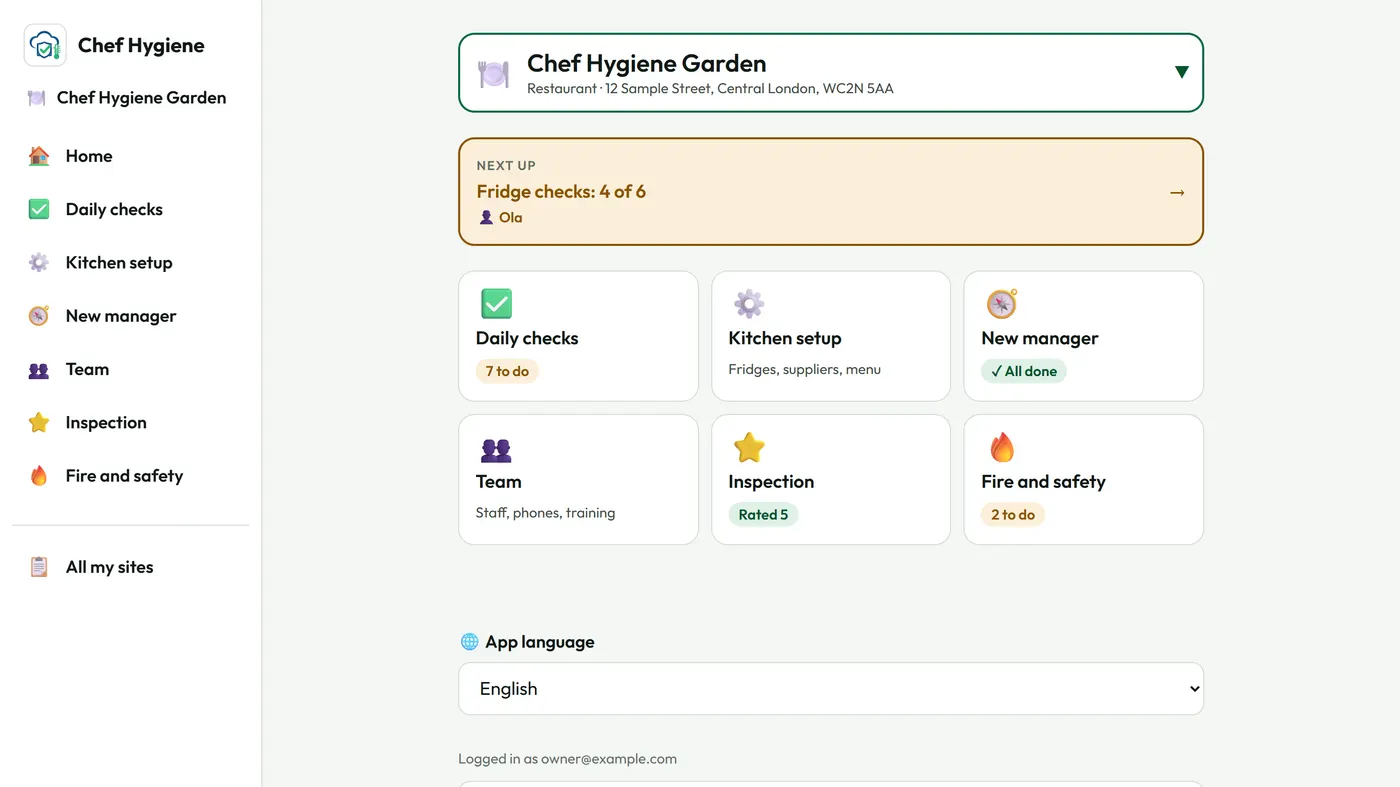
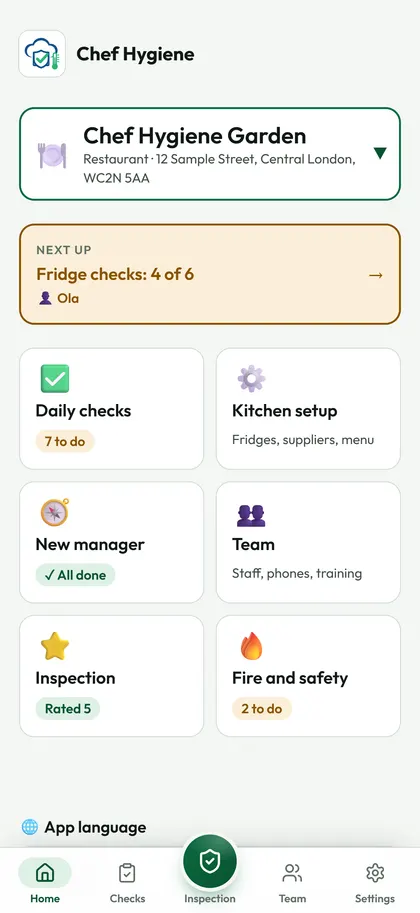
Croazia: norme di igiene alimentare
Le regole presenti in questa pagina sono al momento in inglese. Verranno tradotte nella tua lingua.
- organismo di ispezione
- State Inspectorate, sanitary inspection (Državni inspektorat, sanitarna inspekcija)
- Valutazione pubblica
- NO
- Lingue nell’app
- Hrvatski, English
La tua ispezione
The State Inspectorate (Državni inspektorat, DIRH) inspects through its sanitary inspection (sanitarna inspekcija). It checks food hygiene, HACCP and staff health. It works from five regional offices (Zagreb, Osijek, Rijeka, Split, Varaždin). Tourism, market and labour inspectors also visit.
The inspector can ban rooms, equipment, products or a person’s work, and can seal the premises: 1 to 15 days the first time, 30 days if the same fault returns within 3 years. Fines for a company start at EUR 6,630 to 13,270 for having no HACCP system (Act NN 83/22). Appeals do not stop an order.
Valutazione igienica
There is no national rating, sticker or smiley, and no duty to display an inspection result. The State Inspectorate publishes only totals.
“Legge” è una norma vincolante. “Linee guida ufficiali” non sono legge, ma gli ispettori se le aspettano. “Chef Hygiene predefinito” è un valore che l’app controlla quando nessuna norma fornisce un numero.
Temperature
- Linee guida ufficialiNo Croatian law sets restaurant fridge, hot-holding, cooling or reheating numbers. The values below come from the national catering guide (HOK, 2nd edition 2025).
- Linee guida ufficialiFridge: cooked dishes and poultry 4°C, minced meat 2°C, offal 3°C, other meat 7°C, vegetables 8°C. Fresh fish is kept at melting-ice temperature. Any fridge must stay at +8°C or colder.
- Linee guida ufficialiFreezer: −18°C or colder.
- Linee guida ufficialiCooking: 73°C for 30 seconds in the thickest part of the food.
- Linee guida ufficialiHot holding: 65°C or hotter, checked every 2 hours. If it fell below 65°C for under 2 hours, reheat once to 73°C and use it. After 2 to 4 hours, use it at once. After more than 4 hours, throw it away.
- Linee guida ufficialiCooling: at most 30 minutes at room temperature, then down to 4°C within 6 hours in all. Use the food within 24 hours.
- Linee guida ufficialiReheating: 73°C for 30 seconds, and only once.
- Linee guida ufficialiCold display: 8°C at most, aim for 4°C. After 2 hours over the limit, use the food within the next 2 hours. After 4 hours, throw it away.
- Linee guida ufficialiAt goods-in, chilled food should be 8°C at most and frozen food −18°C or colder. Catering vans carry food at 4°C at most.
Personale, formazione e salute
- LeggeEveryone who touches, prepares or serves food needs the food hygiene course certificate before starting work, renewed every 5 years. The course is 15 teaching hours at a county public health institute. The employer pays (Act on protection from infectious diseases, Art. 37 and 39).
- LeggeStaff in direct contact with unpacked food need a medical exam before starting and then every year, including stool tests. The result goes in the sanitary card (sanitarna iskaznica), which the employer keeps (same Act and Rulebook NN 116/2018).
- LeggePeople with an infectious disease that food can carry, or infected skin disease, must not work with food. After typhoid, dysentery or salmonellosis they need negative tests first.
- LeggeThe business must train the HACCP team and every worker whose job affects food safety, check that the training worked and keep records (Rulebook NN 124/2025, Art. 6).
Allergeni
- LeggeYou must give the 14 EU allergens for food that is not prepacked, in writing, easy to see, next to the food (Rulebook on unpackaged food, Art. 8). The information is free and available before the sale.
- LeggeOral information is allowed if a visible notice says where the information is or invites guests to ask staff, and the full information is also in print or electronic form on the premises for guests and inspectors.
- LeggeFor delivery orders, give the information before the sale and at delivery. It must be in Croatian, Latin script; other languages may be added. Keep a list of the allergens in every dish.
Controlli di sicurezza antincendio
- LeggeThe owner checks each extinguisher at least every 3 months and records it. An authorised firm services it at least every year and after any use (Rulebook NN 101/11). Each floor needs at least 2 extinguishers (Rulebook NN 100/99).
- LeggeVentilation ducts from food-preparation rooms are cleaned every 3 months while the premises are open. Other ventilation ducts are cleaned at least yearly, with a written record (Rulebook NN 100/99, Art. 27).
- LeggeEmergency lighting is checked twice a year, once just before the main season, and recorded (Rulebook NN 100/99, Art. 23). Small ground-floor food premises are excepted.
- LeggeThe electrical installation is inspected and measured at least every 4 years. Keep the written report (technical regulation NN 5/2010).
Registri
- LeggeRestaurants keep these on the premises: goods-in rules, a cleaning plan, swab results, the cold-chain record at least once a day, shelf-life instructions for prepared dishes, and the pest plan and certificates (Rulebook NN 124/2025, Art. 14).
- LeggeSurface swab tests by a laboratory are needed at least every 6 months, with at least 10 samples for a restaurant (Rulebook NN 137/2009).
- LeggeKeep corrective-action records for 1 year after the shelf-life date, or 6 months for perishable food with no date (Rulebook NN 124/2025, Art. 22).
Fonti ufficiali
- State Inspectorate (Državni inspektorat)
- Croatian Chamber of Trades and Crafts (HOK), catering HACCP guide
- HACCP rulebook NN 124/2025
- Food hygiene Act NN 83/22
Checked
Questa pagina fornisce informazioni di carattere generale e non costituisce consulenza legale. Si prega di contattare le autorità locali competenti.
Croazia: guide sull’igiene alimentare
Configura Chef Hygiene
Crea il tuo account, configura un tablet da cucina condiviso e metti l'app sui telefoni del tuo staff, passo dopo passo.
Croazia: ispezioni alimentari
Chi ispeziona la tua cucina, come funziona un’ispezione e se esiste una valutazione di igiene pubblica.
Croazia: regole sulla temperatura degli alimenti
Le temperature degli alimenti che la tua cucina deve mantenere e le regole che ne sono alla base.
Croazia: allergeni
Cosa deve dire la tua cucina ai clienti sugli allergeni.
Croazia: malattia e formazione del personale
Formazione, regole per gli operatori alimentari e quando il personale malato deve stare lontano dal cibo.
Croazia: sicurezza antincendio
Controlli di sicurezza antincendio per la tua cucina e quanto spesso sono dovuti.
Croazia: record da conservare
I registri e le registrazioni che la tua cucina deve conservare.
Croazia: l'app Chef Hygiene.
L’app carica queste regole per la tua cucina, verifica la conformità dei tuoi registri e conserva la documentazione per l’ispettore.
Altri paesi
 Regno Unito
 Irlanda
 Islanda
 Stati Uniti
 Canada
 Francia
 Spagna
 Paesi Bassi
 Belgio
 Portogallo
 Germania
 Austria
 Polonia
 Romania
 Italia
 Grecia
 Danimarca
 Svizzera
 Lussemburgo
 Cipro
Cipro Malta
Malta Svezia
 Norvegia
 Finlandia
 Cechia
 Ungheria
 Bulgaria
 Slovacchia
 Slovenia
 Estonia
 Lettonia
 Lituania
 Liechtenstein
 San Marino
 Gibilterra
 Monaco
 Moldavia
 Andorra
 Serbia
 Jersey
 Guernsey
 Isola di Man
 Turchia
 Montenegro
 Bosnia ed Erzegovina
 Kosovo
 Albania
 Macedonia del Nord
 Ucraina