 Estonia: for restaurants and takeaways
Ready for the food inspection. Every day.
In Estonia the app follows the Food Act and the EU hygiene rules; the law sets no kitchen temperatures, so the numbers come from the PTA’s catering own-check guide, and the PTA inspects.
14 days free · one price per site · no contract
Estonia: food hygiene rules
- Inspection body
- Agriculture and Food Board (Põllumajandus- ja Toiduamet, PTA)
- Public rating
- No
- Languages in the app
- English
Your inspection
The Agriculture and Food Board (PTA) is the one national food authority, with regional offices (Food Act § 47). It inspects restaurants and cafés. Visits are risk-based and unannounced.
After a visit the PTA gives an explanation with time to fix small faults, an order (ettekirjutus) for serious faults, or starts misdemeanour proceedings. Dangerous food can be stopped by an order (Food Act § 49). Fines run from EUR 1,200 to EUR 3,200 for most breaches, for example EUR 1,600 (person) or EUR 2,600 (company) for breaking food rules; running without the required notice can cost up to EUR 2,400 or EUR 3,200 (Food Act §§ 53¹–53⁶). A normal restaurant needs no licence, only a business activity notice (majandustegevusteade) to the PTA.
Hygiene rating
Estonia has no public hygiene rating, sticker or score, and nothing has to be displayed. The aim is a visit with no faults.
“Law” is a binding rule. “Official guidance” is not law, but inspectors expect it. “Chef Hygiene default” is a value the app checks against where no rule gives a number.
Temperatures
- LawEstonian law sets no restaurant fridge, hot-holding, cooling, cooking or reheating numbers. Food Act § 26 sends hygiene to EU Regulations 852/2004 and 853/2004. Your own-check plan is the legal duty.
- Official guidanceChilled storage at 2–6°C (PTA catering guide, model plan). The maker’s label range wins. Chef Hygiene aims for 5°C or colder.
- Official guidanceFrozen food at −18°C or colder (PTA guide). Quick-frozen food must be at −18°C (EU Regulation 37/2005).
- Official guidanceCooking: meat core at 75°C or more, measured for 2 minutes (PTA guide, example limit).
- Official guidanceHot holding: not below 63°C and not longer than 2 hours. Hot food sent out of the kitchen stays at 63°C or more (PTA guide).
- Official guidanceCooling: the food must be 5°C or colder after 2 hours (PTA guide, example limit).
- Official guidanceReheating: core at 75°C or more (PTA guide, example).
- Official guidanceDeep-fry oil below 175°C (PTA guide, example limit). Check the thermometer in iced water (−1 to +1°C) and boiling water (99–101°C).
Staff, training and health
- LawA written training plan is required, with aims, volume, frequency and procedure. Staff get regular training that fits the job, and their knowledge is assessed (Food Act § 29). There is no state certificate, hours or renewal period. Keep a training log.
- LawStaff who handle food or drinking water, or clean food rooms, need a health certificate (tervisetõend) from a family doctor or occupational doctor before the first day. Keep it for the job plus 1 year (NETS § 13). There is no routine renewal.
- Official guidanceStop food work and tell the manager with diarrhoea, vomiting, fever, sore throat with fever, infected skin sores, or discharge from the ear, eye or nose (EU Regulation 852/2004 Annex II). The PTA guide says return after 48 hours without symptoms.
Allergens
- LawFor food that is not prepacked, give the dish name and the 14 EU allergens at the point of sale, in writing or orally. If not in writing, an easy-to-see notice must say where to get the information or to ask the staff (Regulation 24/2015 § 2). Give it in Estonian or a form the guest understands.
- LawFor online and phone orders, give allergen information before the order and at delivery (Regulation 24/2015 § 2).
Fire safety checks
- LawExtinguishers are checked and serviced by the maker’s interval. Without one, check yearly in a kitchen (damp, heat swings) and every 2 years in a dry, steady place. Keep the papers (Fire Safety Act §§ 31–32; extinguisher regulation § 10).
- LawA fire alarm is serviced each quarter plus a yearly service, with a logbook and a daily look at the panel (fire-alarm regulation §§ 25–27).
- LawStaff get fire training before they start or change job. A fire action plan and a yearly drill are required only where a fire report is required, for restaurants with over 150 usual users or over 1,000 m² (Fire Safety Act § 6).
- Official guidanceA periodic electrical audit is required for business premises. Chef Hygiene suggests every 10 years (5 years if built before 2000), based on TTJA guidance.
- Official guidanceGas: a check by a qualified gas worker every 4 years (TTJA guidance, Nov 2024). Chef Hygiene suggests this; the exact rule for restaurants is not confirmed.
Records
- LawA written own-check plan based on HACCP is required (Food Act § 34; EU Regulation 852/2004 art. 5).
- Official guidanceKeep monitoring sheets for 1 year, and test reports and audit sheets for at least 3 years (PTA guide). Chef Hygiene asks for temperature checks twice a day.
- LawSend a business activity notice (majandustegevusteade) to the PTA before you start. You may start after the notice, and the PTA inspects after.
Official sources
- Agriculture and Food Board (PTA)
- PTA catering own-check guide (2021)
- Food Act (Riigi Teataja)
- Allergen information (Ministry of Agriculture)
- Fire Safety Act (Riigi Teataja)
Checked
This page is general information, not legal advice. Check with your local authority.
Estonia: food hygiene guides
Set up Chef Hygiene
Create your account, set up a shared kitchen tablet, and put the app on your staff's phones, step by step.
Estonia: food inspections
Who inspects your kitchen, how an inspection works and whether there is a public hygiene rating.
Estonia: food temperature rules
The food temperatures your kitchen must keep, and the rules behind them.
Estonia: allergens
What your kitchen must tell customers about allergens.
Estonia: staff sickness and training
Training, food handler rules and when sick staff must stay away from food.
Estonia: fire safety
Fire safety checks for your kitchen, and how often they are due.
Estonia: records to keep
The records and registrations your kitchen must keep.
Estonia: the Chef Hygiene app
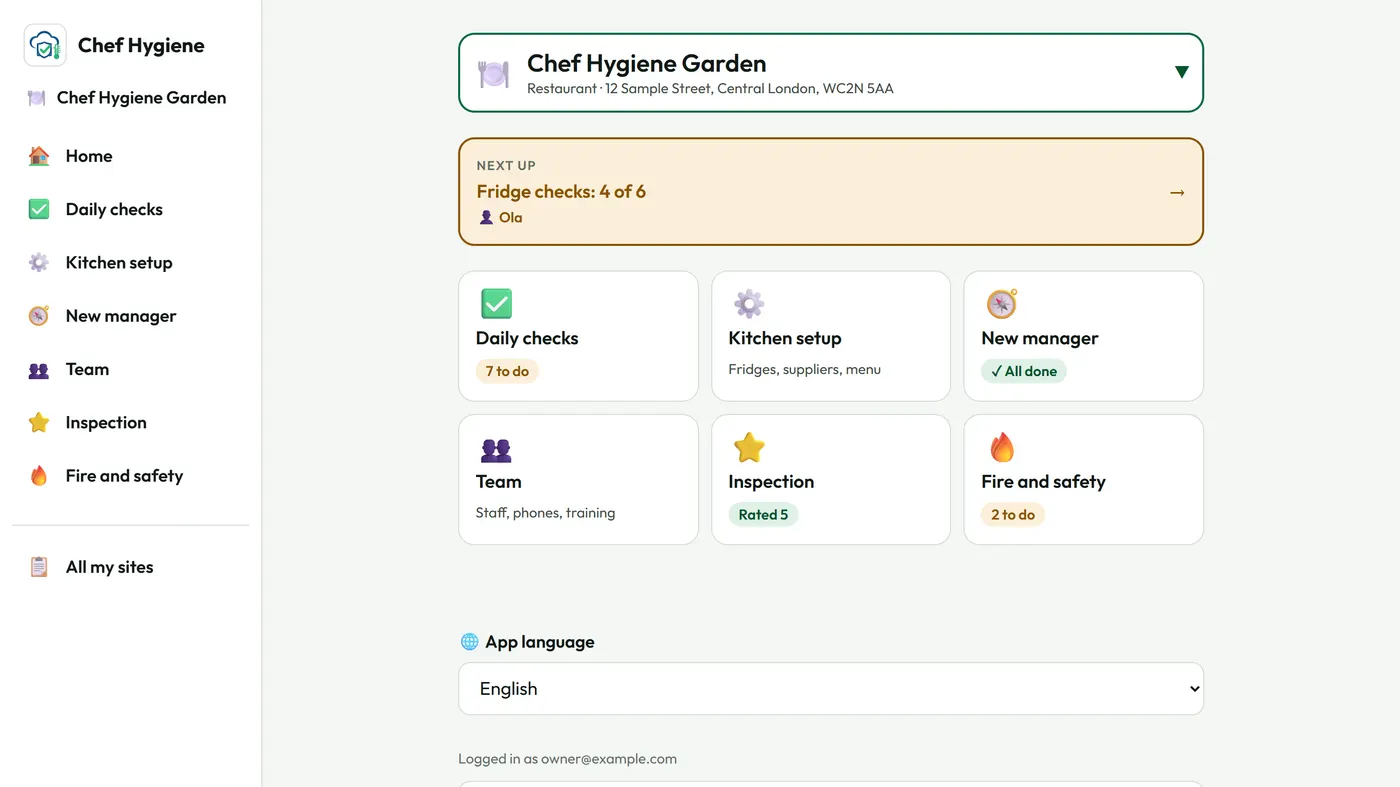
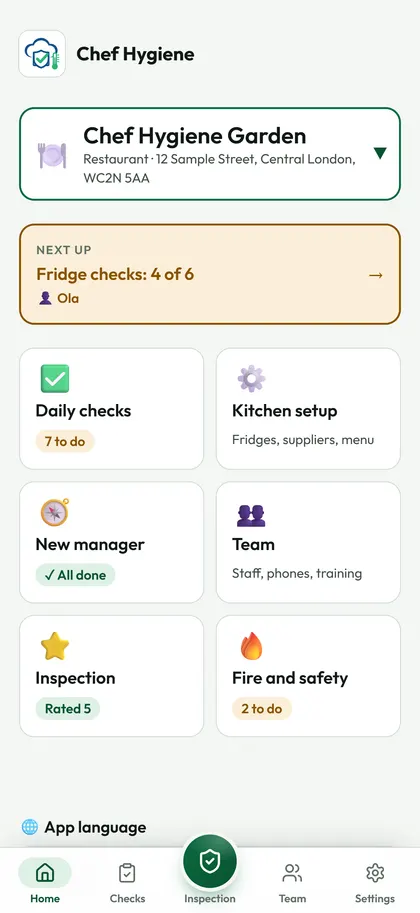
The app loads these rules for your kitchen, checks your records against them and keeps proof for the inspector.
Other countries
 United Kingdom
 Ireland
 Iceland
 United States
 Canada
 France
 Spain
Spain Netherlands
 Belgium
 Portugal
 Germany
 Austria
 Poland
 Romania
 Italy
Italy Greece
 Denmark
 Switzerland
 Luxembourg
 Cyprus
 Malta
Malta Sweden
 Norway
 Finland
 Czechia
 Hungary
 Croatia
 Bulgaria
 Slovakia
 Slovenia
 Latvia
 Lithuania
 Liechtenstein
 San Marino
 Gibraltar
 Monaco
 Moldova
 Andorra
 Serbia
 Jersey
 Guernsey
 Isle of Man
 Türkiye
 Montenegro
 Bosnia & Herzegovina
 Kosovo
 Albania
 North Macedonia
 Ukraine