 Dania: dla restauracji i dań na wynos
Gotowi na kontrolę żywności. Codziennie.
Chef Hygiene follows the Danish hygiene order (BEK 1331/2025) and the hygiene guide VEJ 9700/2025 of the Danish Veterinary and Food Authority (Fødevarestyrelsen), which inspects and publishes the Smiley result.
14 dni za darmo · jedna cena za witrynę · bez umowy
Dania: zasady higieny żywności
Zasady na tej stronie są na razie po angielsku. Zostaną przetłumaczone na Twój język.
- Organ inspekcyjny
- Danish Veterinary and Food Authority (Fødevarestyrelsen)
- Ocena publiczna
- Tak
- Języki w aplikacji
- Dansk, English
Twoja inspekcja
One national authority inspects: Fødevarestyrelsen (the Danish Veterinary and Food Authority), part of the Ministry of Business. It works through three food units: East, South and North. The inspector checks your self-check (egenkontrol), the premises and your papers.
Visits are unannounced. Most restaurants and cafés get sample-based control chosen by a risk model, with no fixed rhythm: firms with problems get more visits. The inspector can take samples and photos and hold back food. Sanctions are a warning, an order, a ban, an administrative fine, a police report or loss of approval. After a warning you pay for 1 follow-up visit, and after an order, ban or fine for 2.
Ocena higieny
Yes: the public Smiley scheme (BEK 1225/2024). A glad smiley means no remarks. A smiley with a straight mouth means a warning, order or ban. A sad smiley means a fine, a police report or loss of approval. The smiley sign must hang at every public entrance, and the last 4 results are on findsmiley.dk.
„Prawo” to wiążąca reguła. „Oficjalne wytyczne” nie są prawem, ale inspektorzy ich oczekują. „Chef Hygiene domyślna” to wartość, którą aplikacja sprawdza, gdy żadna reguła nie podaje liczby.
Temperatury
- PrawoFridge: the air must be 5°C or colder for cooked and cooled dishes, minced meat, meat preparations, fresh poultry, food with cream and milk products (BEK 1331/2025, § 25 and annex 3).
- PrawoOther chilled limits in the order: 10°C for mayonnaise salads with pH above 4,5 and for fish semi-preserves, and 12°C for eggs. If the label says colder, follow the label.
- PrawoFresh fish and cooked shellfish: keep them on ice or at 2°C at most (EU Regulation 853/2004, which the authority applies to restaurants).
- PrawoFreezer: −18°C or colder for deep-frozen food (BEK 1194/2005, § 5). A short rise of up to 3°C is allowed during local delivery.
- PrawoCooking and reheating: 75°C in the whole food needs no extra documentation (BEK 1331/2025, § 26). A lower temperature needs your own proof that it is safe.
- Oficjalne wytyczneFish: the hygiene guide accepts 60°C in the centre for at least 1 minute.
- PrawoHot holding: at least 56°C everywhere in the food, with no time limit (BEK 1331/2025, § 29). This has been the rule since 1 January 2026. The old limit was 65°C.
- Oficjalne wytyczneCooling: from 56°C to 10°C within 4 hours, then into the fridge at 5°C (hygiene guide VEJ 9700/2025). The law only says as fast as possible.
- Oficjalne wytyczneChilled food taken out of the fridge for preparing, plating or a buffet: 3 hours at most in all. Leftovers are normally thrown away (hygiene guide).
Kadra, szkolenia i zdrowie
- Oficjalne wytyczneThere is no food hygiene certificate, no set hours and no renewal. Staff must be instructed or trained in food handling and personal hygiene. Training by a colleague is often enough (hygiene guide VEJ 9700/2025, chapter 23).
- Oficjalne wytyczneWhoever builds the self-check must be trained in HACCP (a food safety system), in proportion to the size of the business. The firm chooses who and which course.
- PrawoStaff with an illness food can carry (vomiting, diarrhoea, skin or throat infection) may not handle food or enter food areas. They must tell the manager.
- Oficjalne wytyczneA person should come back at least 48 hours after the symptoms stop. There is no health check or health certificate.
Alergeny
- PrawoThe 14 EU allergens must be declared. For food that is not prepacked, the information can be written or given by staff in words (BEK 1355/2015, § 13).
- PrawoIf the allergens are not written on the menu or by the food, a visible sign must say that allergen information is available from staff on request. For online orders, the notice also goes on the website.
- PrawoYou need no sign if staff ask every customer about allergies first. You must be able to show what each dish contains, including sauces and spice mixes.
Kontrole bezpieczeństwa pożarowego
- Oficjalne wytyczneFire extinguishers: a check every year by a competent person, with a label showing year, month and signature. A pressure test is needed every 5 years, and every 10 years for CO2 extinguishers (building regulation BR18 guide, chapter 7).
- Oficjalne wytyczneKitchen: at least 1 suitable extinguisher, a fire blanket where you fry (checked every year), and a fat extinguisher of type 75 F or higher no more than 30 m away.
- PrawoFire inspection (brandsyn) by the municipal rescue service is free. It is every year for rooms for more than 150 people, and every 2 years for 51 to 150 people only if the municipality decides (BEK 2341/2021).
- PrawoElectrics: in a restaurant for more than 150 people, an authorised electrician checks the installation every 24 months. The certificate must be shown to guests (BEK 1119/2019).
- PrawoGas: a kitchen is class 6 (large kitchen). You need a written operation and maintenance plan that sets how often it is checked (BEK 247/2018). Gas cooking appliances may only run while the extraction runs.
Dokumentacja
- PrawoYour self-check (egenkontrol) is based on HACCP: a written risk analysis and a written programme for the critical points. Good working practices can be given in words. All must be at the premises, on paper or digital (EU Regulation 852/2004, article 5).
- Oficjalne wytyczneTraceability records (supplier, goods, date, quantity, such as invoices or delivery notes) are always needed. Keep them 5 years as a starting point.
- Oficjalne wytyczneKeep self-check records for a suitable period. The guidance gives no number of months. Review the self-check once a year as a rule.
Oficjalne źródła
- Fødevarestyrelsen (Danish Veterinary and Food Authority)
- findsmiley.dk (Smiley results)
- Hygiene order BEK 1331/2025 (Retsinformation)
- Hygiene guide VEJ 9700/2025 (Retsinformation)
- Smiley order BEK 1225/2024 (Retsinformation)
Checked
Ta strona zawiera ogólne informacje, a nie porady prawne. Sprawdź w lokalnym urzędzie.
Dania: Poradniki higieny żywności
Skonfiguruj Chef Hygiene
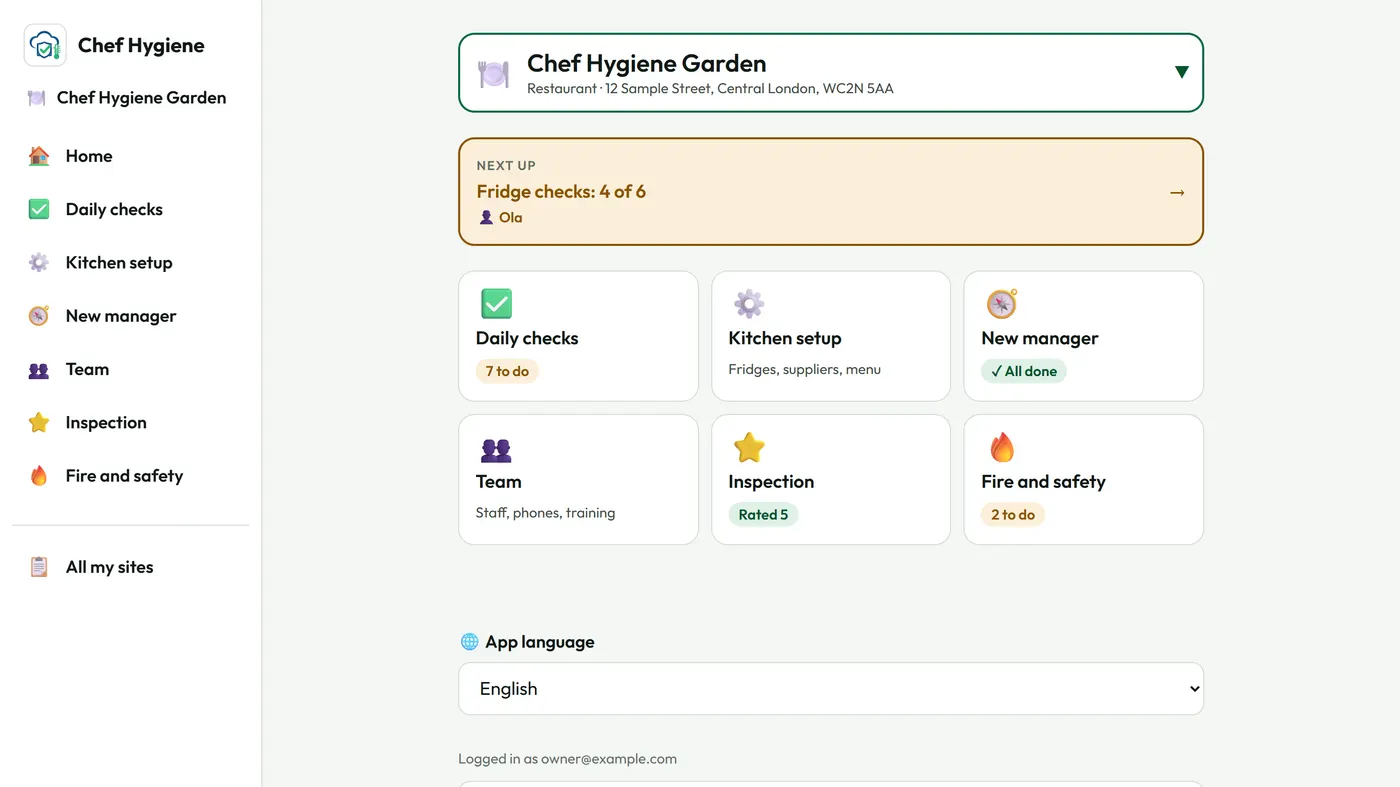
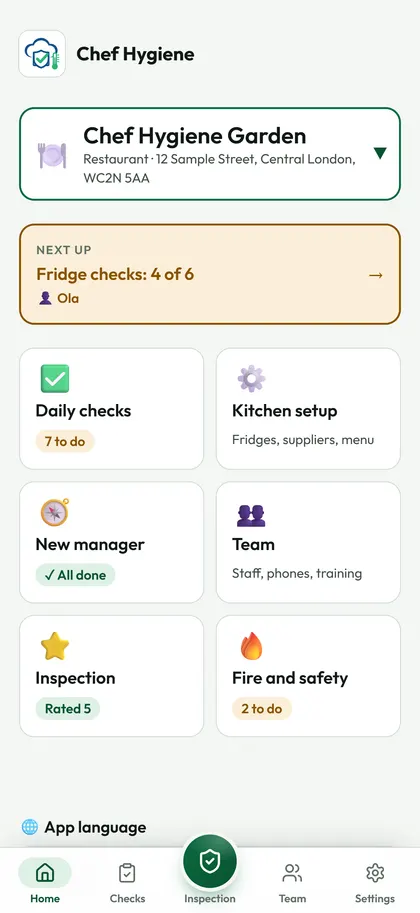
Utwórz konto, skonfiguruj wspólny tablet kuchenny i krok po kroku instaluj aplikację na telefonach swoich pracowników.
Dania: inspekcje żywności
Kto sprawdza Twoją kuchnię, jak przebiega kontrola i czy istnieje ocena higieny publicznej.
Dania: zasady dotyczące temperatury żywności
Temperatury żywności, które musi utrzymywać Twoja kuchnia, i zasady za nimi stojące.
Dania: alergeny
Co Twoja kuchnia musi mówić klientom o alergenach.
Dania: choroba personelu i szkolenie
Szkolenia, zasady postępowania z żywnością oraz sytuacje, w których chory personel musi trzymać się z daleka od żywności.
Dania: bezpieczeństwo przeciwpożarowe
Kontrole bezpieczeństwa przeciwpożarowego Twojej kuchni i częstotliwość ich przeprowadzania.
Dania: zapisy do przechowywania
Rejestry i rejestracje, które musi przechowywać Twoja kuchnia.
Dania: aplikacja Chef Hygiene.
Aplikacja ładuje te zasady do Twojej kuchni, sprawdza je pod kątem zgodności z zapisami i zachowuje dowód dla inspektora.
Inne kraje
 Wielka Brytania
 Irlandia
 Islandia
 Stany Zjednoczone
 Kanada
 Francja
 Hiszpania
 Holandia
 Belgia
 Portugalia
 Niemcy
 Austria
 Polska
 Rumunia
 Włochy
 Grecja
 Szwajcaria
 Luksemburg
 Cypr
Cypr Malta
Malta Szwecja
 Norwegia
 Finlandia
 Czechy
 Węgry
Węgry Chorwacja
 Bułgaria
 Słowacja
 Słowenia
 Estonia
 Łotwa
Łotwa Litwa
Litwa Liechtenstein
 San Marino
 Gibraltar
 Monako
 Mołdawia
 Andora
 Serbia
 Jersey
 Guernsey
 Wyspa Man
 Turcja
 Czarnogóra
 Bośnia i Hercegowina
 Kosowo
 Albania
 Macedonia Północna
 Ukraina