 Croatia: for restaurants and takeaways
Ready for the food inspection. Every day.
In Croatia the app follows the EU hygiene rules, the HACCP rulebook NN 124/2025 and the national catering guide of the Chamber of Trades and Crafts (HOK); the State Inspectorate inspects.
14 days free · one price per site · no contract
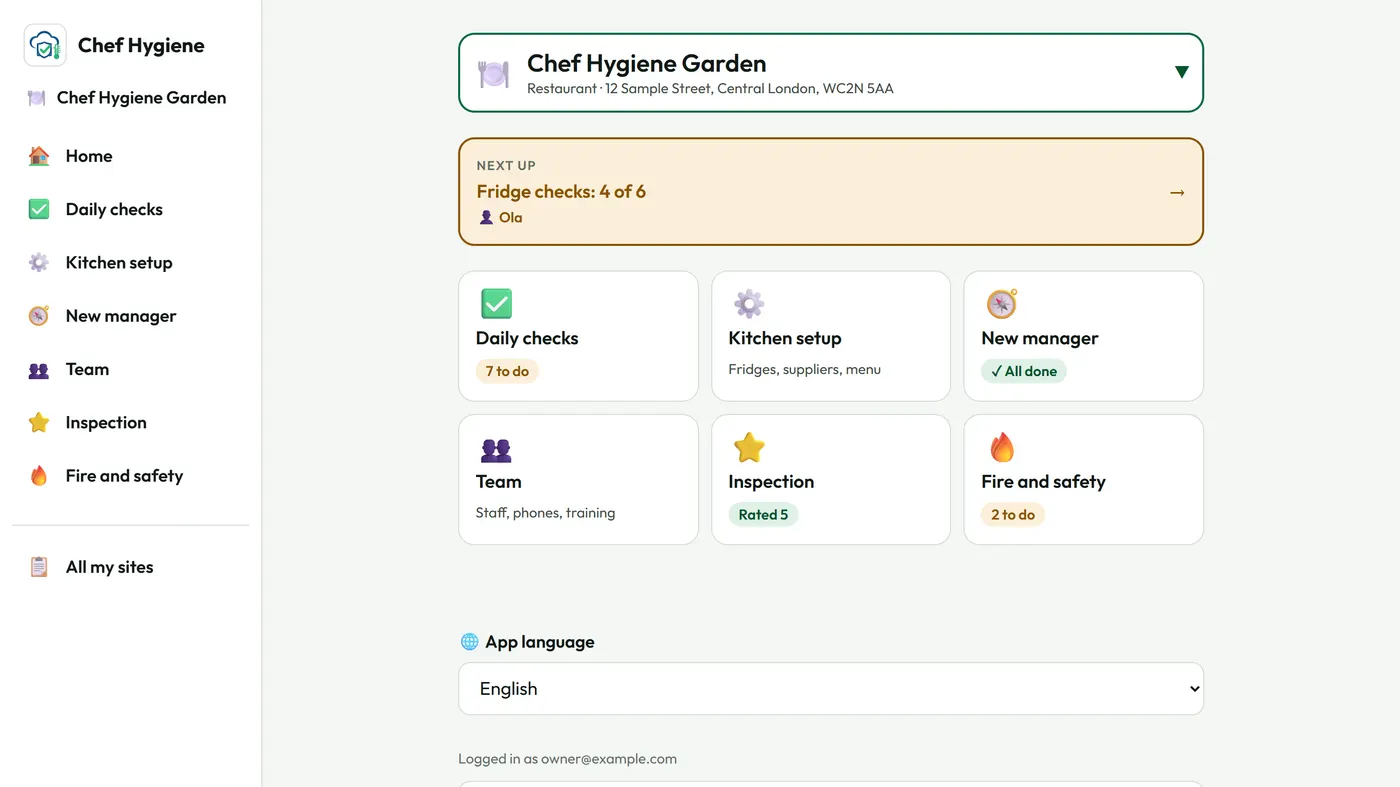
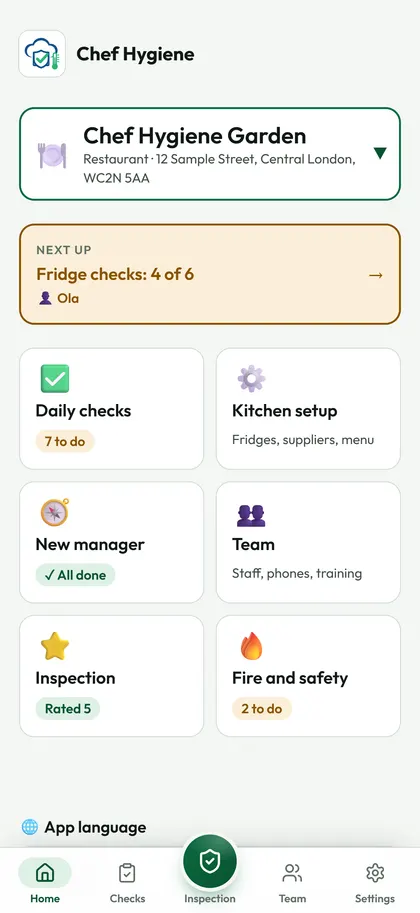
Croatia: food hygiene rules
- Inspection body
- State Inspectorate, sanitary inspection (Državni inspektorat, sanitarna inspekcija)
- Public rating
- No
- Languages in the app
- Hrvatski, English
Your inspection
The State Inspectorate (Državni inspektorat, DIRH) inspects through its sanitary inspection (sanitarna inspekcija). It checks food hygiene, HACCP and staff health. It works from five regional offices (Zagreb, Osijek, Rijeka, Split, Varaždin). Tourism, market and labour inspectors also visit.
The inspector can ban rooms, equipment, products or a person’s work, and can seal the premises: 1 to 15 days the first time, 30 days if the same fault returns within 3 years. Fines for a company start at EUR 6,630 to 13,270 for having no HACCP system (Act NN 83/22). Appeals do not stop an order.
Hygiene rating
There is no national rating, sticker or smiley, and no duty to display an inspection result. The State Inspectorate publishes only totals.
“Law” is a binding rule. “Official guidance” is not law, but inspectors expect it. “Chef Hygiene default” is a value the app checks against where no rule gives a number.
Temperatures
- Official guidanceNo Croatian law sets restaurant fridge, hot-holding, cooling or reheating numbers. The values below come from the national catering guide (HOK, 2nd edition 2025).
- Official guidanceFridge: cooked dishes and poultry 4°C, minced meat 2°C, offal 3°C, other meat 7°C, vegetables 8°C. Fresh fish is kept at melting-ice temperature. Any fridge must stay at +8°C or colder.
- Official guidanceFreezer: −18°C or colder.
- Official guidanceCooking: 73°C for 30 seconds in the thickest part of the food.
- Official guidanceHot holding: 65°C or hotter, checked every 2 hours. If it fell below 65°C for under 2 hours, reheat once to 73°C and use it. After 2 to 4 hours, use it at once. After more than 4 hours, throw it away.
- Official guidanceCooling: at most 30 minutes at room temperature, then down to 4°C within 6 hours in all. Use the food within 24 hours.
- Official guidanceReheating: 73°C for 30 seconds, and only once.
- Official guidanceCold display: 8°C at most, aim for 4°C. After 2 hours over the limit, use the food within the next 2 hours. After 4 hours, throw it away.
- Official guidanceAt goods-in, chilled food should be 8°C at most and frozen food −18°C or colder. Catering vans carry food at 4°C at most.
Staff, training and health
- LawEveryone who touches, prepares or serves food needs the food hygiene course certificate before starting work, renewed every 5 years. The course is 15 teaching hours at a county public health institute. The employer pays (Act on protection from infectious diseases, Art. 37 and 39).
- LawStaff in direct contact with unpacked food need a medical exam before starting and then every year, including stool tests. The result goes in the sanitary card (sanitarna iskaznica), which the employer keeps (same Act and Rulebook NN 116/2018).
- LawPeople with an infectious disease that food can carry, or infected skin disease, must not work with food. After typhoid, dysentery or salmonellosis they need negative tests first.
- LawThe business must train the HACCP team and every worker whose job affects food safety, check that the training worked and keep records (Rulebook NN 124/2025, Art. 6).
Allergens
- LawYou must give the 14 EU allergens for food that is not prepacked, in writing, easy to see, next to the food (Rulebook on unpackaged food, Art. 8). The information is free and available before the sale.
- LawOral information is allowed if a visible notice says where the information is or invites guests to ask staff, and the full information is also in print or electronic form on the premises for guests and inspectors.
- LawFor delivery orders, give the information before the sale and at delivery. It must be in Croatian, Latin script; other languages may be added. Keep a list of the allergens in every dish.
Fire safety checks
- LawThe owner checks each extinguisher at least every 3 months and records it. An authorised firm services it at least every year and after any use (Rulebook NN 101/11). Each floor needs at least 2 extinguishers (Rulebook NN 100/99).
- LawVentilation ducts from food-preparation rooms are cleaned every 3 months while the premises are open. Other ventilation ducts are cleaned at least yearly, with a written record (Rulebook NN 100/99, Art. 27).
- LawEmergency lighting is checked twice a year, once just before the main season, and recorded (Rulebook NN 100/99, Art. 23). Small ground-floor food premises are excepted.
- LawThe electrical installation is inspected and measured at least every 4 years. Keep the written report (technical regulation NN 5/2010).
Records
- LawRestaurants keep these on the premises: goods-in rules, a cleaning plan, swab results, the cold-chain record at least once a day, shelf-life instructions for prepared dishes, and the pest plan and certificates (Rulebook NN 124/2025, Art. 14).
- LawSurface swab tests by a laboratory are needed at least every 6 months, with at least 10 samples for a restaurant (Rulebook NN 137/2009).
- LawKeep corrective-action records for 1 year after the shelf-life date, or 6 months for perishable food with no date (Rulebook NN 124/2025, Art. 22).
Official sources
- State Inspectorate (Državni inspektorat)
- Croatian Chamber of Trades and Crafts (HOK), catering HACCP guide
- HACCP rulebook NN 124/2025
- Food hygiene Act NN 83/22
Checked
This page is general information, not legal advice. Check with your local authority.
Croatia: food hygiene guides
Set up Chef Hygiene
Create your account, set up a shared kitchen tablet, and put the app on your staff's phones, step by step.
Croatia: food inspections
Who inspects your kitchen, how an inspection works and whether there is a public hygiene rating.
Croatia: food temperature rules
The food temperatures your kitchen must keep, and the rules behind them.
Croatia: allergens
What your kitchen must tell customers about allergens.
Croatia: staff sickness and training
Training, food handler rules and when sick staff must stay away from food.
Croatia: fire safety
Fire safety checks for your kitchen, and how often they are due.
Croatia: records to keep
The records and registrations your kitchen must keep.
Croatia: the Chef Hygiene app
The app loads these rules for your kitchen, checks your records against them and keeps proof for the inspector.
Other countries
 United Kingdom
 Ireland
 Iceland
 United States
 Canada
 France
 Spain
Spain Netherlands
 Belgium
 Portugal
 Germany
 Austria
 Poland
 Romania
 Italy
Italy Greece
 Denmark
 Switzerland
 Luxembourg
 Cyprus
 Malta
Malta Sweden
 Norway
 Finland
 Czechia
 Hungary
 Bulgaria
 Slovakia
 Slovenia
 Estonia
 Latvia
 Lithuania
 Liechtenstein
 San Marino
 Gibraltar
 Monaco
 Moldova
 Andorra
 Serbia
 Jersey
 Guernsey
 Isle of Man
 Türkiye
 Montenegro
 Bosnia & Herzegovina
 Kosovo
 Albania
 North Macedonia
 Ukraine