 Croácia: para restaurantes e delivery
Pronto para a inspeção sanitária. Todos os dias.
In Croatia the app follows the EU hygiene rules, the HACCP rulebook NN 124/2025 and the national catering guide of the Chamber of Trades and Crafts (HOK); the State Inspectorate inspects.
14 dias grátis · preço único por site · sem contrato
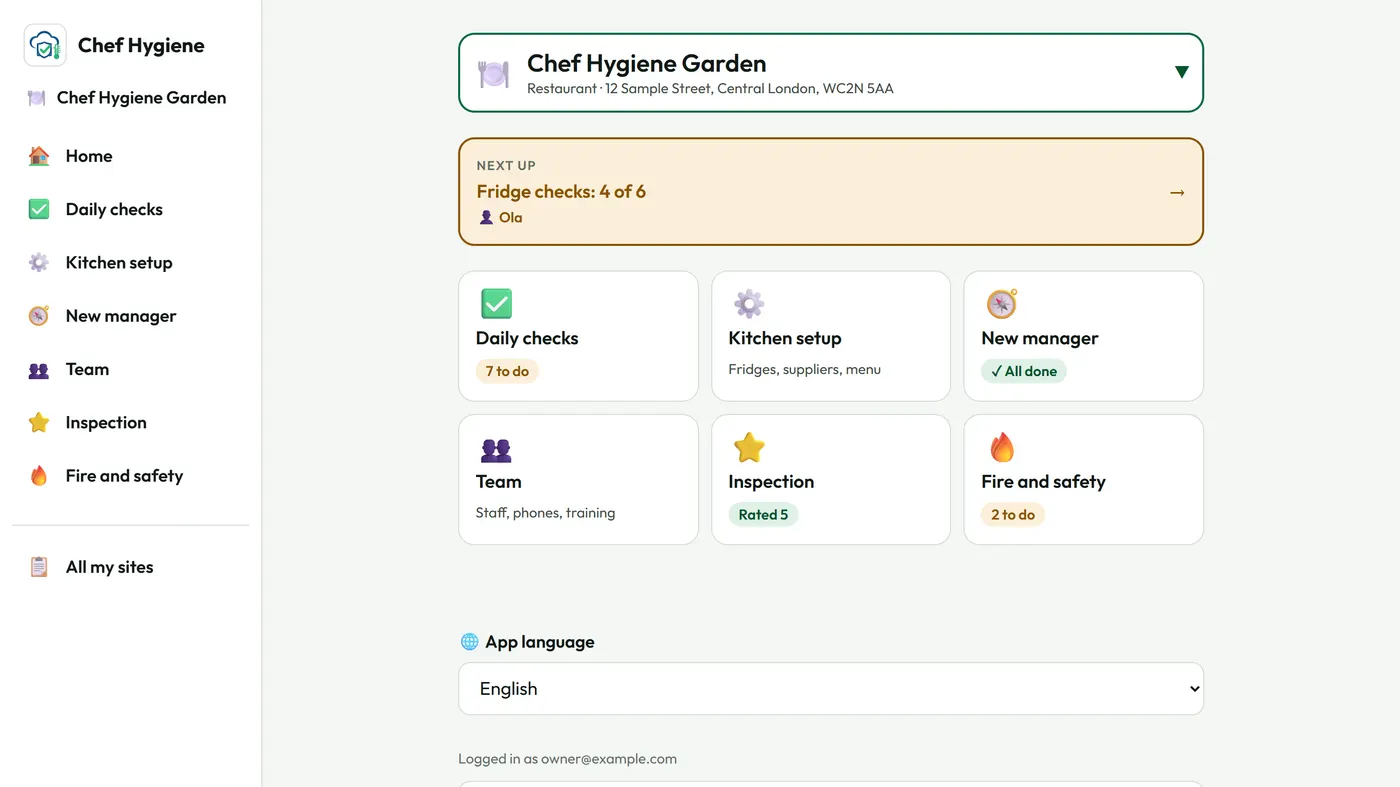
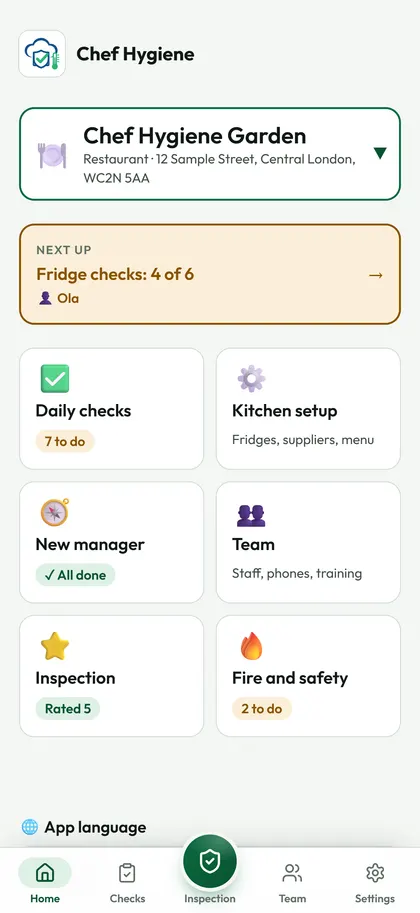
Croácia: regras de higiene alimentar
As regras desta página estão em inglês por enquanto. Elas serão traduzidas para o seu idioma.
- Órgão de inspeção
- State Inspectorate, sanitary inspection (Državni inspektorat, sanitarna inspekcija)
- Classificação pública
- Não
- Idiomas disponíveis no aplicativo
- Hrvatski, English
Sua inspeção
The State Inspectorate (Državni inspektorat, DIRH) inspects through its sanitary inspection (sanitarna inspekcija). It checks food hygiene, HACCP and staff health. It works from five regional offices (Zagreb, Osijek, Rijeka, Split, Varaždin). Tourism, market and labour inspectors also visit.
The inspector can ban rooms, equipment, products or a person’s work, and can seal the premises: 1 to 15 days the first time, 30 days if the same fault returns within 3 years. Fines for a company start at EUR 6,630 to 13,270 for having no HACCP system (Act NN 83/22). Appeals do not stop an order.
Classificação de higiene
There is no national rating, sticker or smiley, and no duty to display an inspection result. The State Inspectorate publishes only totals.
“Lei” é uma regra vinculativa. “Orientação oficial” não é lei, mas os inspetores esperam que seja. “Chef Hygiene padrão” é um valor que o aplicativo verifica quando nenhuma regra fornece um número.
Temperaturas
- Orientações oficiaisNo Croatian law sets restaurant fridge, hot-holding, cooling or reheating numbers. The values below come from the national catering guide (HOK, 2nd edition 2025).
- Orientações oficiaisFridge: cooked dishes and poultry 4°C, minced meat 2°C, offal 3°C, other meat 7°C, vegetables 8°C. Fresh fish is kept at melting-ice temperature. Any fridge must stay at +8°C or colder.
- Orientações oficiaisFreezer: −18°C or colder.
- Orientações oficiaisCooking: 73°C for 30 seconds in the thickest part of the food.
- Orientações oficiaisHot holding: 65°C or hotter, checked every 2 hours. If it fell below 65°C for under 2 hours, reheat once to 73°C and use it. After 2 to 4 hours, use it at once. After more than 4 hours, throw it away.
- Orientações oficiaisCooling: at most 30 minutes at room temperature, then down to 4°C within 6 hours in all. Use the food within 24 hours.
- Orientações oficiaisReheating: 73°C for 30 seconds, and only once.
- Orientações oficiaisCold display: 8°C at most, aim for 4°C. After 2 hours over the limit, use the food within the next 2 hours. After 4 hours, throw it away.
- Orientações oficiaisAt goods-in, chilled food should be 8°C at most and frozen food −18°C or colder. Catering vans carry food at 4°C at most.
Equipe, treinamento e saúde
- LeiEveryone who touches, prepares or serves food needs the food hygiene course certificate before starting work, renewed every 5 years. The course is 15 teaching hours at a county public health institute. The employer pays (Act on protection from infectious diseases, Art. 37 and 39).
- LeiStaff in direct contact with unpacked food need a medical exam before starting and then every year, including stool tests. The result goes in the sanitary card (sanitarna iskaznica), which the employer keeps (same Act and Rulebook NN 116/2018).
- LeiPeople with an infectious disease that food can carry, or infected skin disease, must not work with food. After typhoid, dysentery or salmonellosis they need negative tests first.
- LeiThe business must train the HACCP team and every worker whose job affects food safety, check that the training worked and keep records (Rulebook NN 124/2025, Art. 6).
Alérgenos
- LeiYou must give the 14 EU allergens for food that is not prepacked, in writing, easy to see, next to the food (Rulebook on unpackaged food, Art. 8). The information is free and available before the sale.
- LeiOral information is allowed if a visible notice says where the information is or invites guests to ask staff, and the full information is also in print or electronic form on the premises for guests and inspectors.
- LeiFor delivery orders, give the information before the sale and at delivery. It must be in Croatian, Latin script; other languages may be added. Keep a list of the allergens in every dish.
Verificações de segurança contra incêndio
- LeiThe owner checks each extinguisher at least every 3 months and records it. An authorised firm services it at least every year and after any use (Rulebook NN 101/11). Each floor needs at least 2 extinguishers (Rulebook NN 100/99).
- LeiVentilation ducts from food-preparation rooms are cleaned every 3 months while the premises are open. Other ventilation ducts are cleaned at least yearly, with a written record (Rulebook NN 100/99, Art. 27).
- LeiEmergency lighting is checked twice a year, once just before the main season, and recorded (Rulebook NN 100/99, Art. 23). Small ground-floor food premises are excepted.
- LeiThe electrical installation is inspected and measured at least every 4 years. Keep the written report (technical regulation NN 5/2010).
Registros
- LeiRestaurants keep these on the premises: goods-in rules, a cleaning plan, swab results, the cold-chain record at least once a day, shelf-life instructions for prepared dishes, and the pest plan and certificates (Rulebook NN 124/2025, Art. 14).
- LeiSurface swab tests by a laboratory are needed at least every 6 months, with at least 10 samples for a restaurant (Rulebook NN 137/2009).
- LeiKeep corrective-action records for 1 year after the shelf-life date, or 6 months for perishable food with no date (Rulebook NN 124/2025, Art. 22).
Fontes oficiais
- State Inspectorate (Državni inspektorat)
- Croatian Chamber of Trades and Crafts (HOK), catering HACCP guide
- HACCP rulebook NN 124/2025
- Food hygiene Act NN 83/22
Checked
Esta página contém informações gerais e não constitui aconselhamento jurídico. Consulte a sua autoridade local.
Croácia: guias de higiene alimentar
Configurar Chef Hygiene
Crie sua conta, configure um tablet de cozinha compartilhada e coloque o aplicativo nos telefones de sua equipe, passo a passo.
Croácia: inspeções de alimentos
Quem fiscaliza sua cozinha, como funciona a fiscalização e se existe classificação de higiene pública.
Croácia: regras de temperatura dos alimentos
As temperaturas dos alimentos que sua cozinha deve manter e as regras por trás delas.
Croácia: alérgenos
O que sua cozinha deve informar aos clientes sobre alérgenos.
Croácia: doença e treinamento do pessoal
Treinamento, regras para manipuladores de alimentos e quando a equipe doente deve ficar longe dos alimentos.
Croácia: segurança contra incêndio
Verificações de segurança contra incêndio em sua cozinha e com que frequência.
Croácia: registros a serem mantidos
Os registros e registros que sua cozinha deve manter.
Croácia: o aplicativo Chef Hygiene
O aplicativo carrega essas regras para sua cozinha, compara seus registros com elas e guarda comprovantes para o inspetor.
Outros países
 Reino Unido
 Irlanda
 Islândia
 Estados Unidos
 Canadá
 França
 Espanha
 Países Baixos
 Bélgica
 Portugal
 Alemanha
 Áustria
 Polônia
 Romênia
 Itália
 Grécia
 Dinamarca
 Suíça
Suíça Luxemburgo
 Chipre
 Malta
Malta Suécia
 Noruega
 Finlândia
 Tchéquia
 Hungria
 Bulgária
 Eslováquia
 Eslovênia
 Estônia
 Letônia
 Lituânia
 Liechtenstein
 San Marino
 Gibraltar
 Mônaco
 Moldávia
 Andorra
 Sérvia
 Jersey
 Guernsey
 Ilha de Man
 Turquia
 Montenegro
 Bósnia e Herzegovina
 Kosovo
 Albânia
 Macedônia do Norte
 Ucrânia