 Belgium: for restaurants and takeaways
Ready for the food inspection. Every day.
In Belgium, Chef Hygiene follows the royal decree of 13 July 2014 on food hygiene, the FAVV guides G-023 and G-044 and EU rules, and the FAVV inspects restaurants and publishes a Food Hygiene Rating.
14 days free · one price per site · no contract
Belgium: food hygiene rules
- Inspection body
- Federal Agency for the Safety of the Food Chain (Federaal Agentschap voor de Veiligheid van de Voedselketen, FAVV; Agence fédérale pour la Sécurité de la Chaîne alimentaire, AFSCA)
- Public rating
- Yes
- Languages in the app
- Nederlands, Français, English
Your inspection
One federal agency, the FAVV (AFSCA in French), inspects food businesses in the whole country through its provincial control units. It works in Dutch, French, German and English.
Inspections follow risk, and the FAVV sets a frequency for each activity. An unfavourable result can bring a warning or an official report (proces-verbaal), then a re-inspection. If public health is at serious risk, the FAVV can order temporary closure. Non-compliant food is seized.
Hygiene rating
Yes. The Food Hygiene Rating (fhr.favv-afsca.be, website and app, since 4 November 2025) has six classes from Excellent to To be improved, plus No recent inspection. It uses a Smiley and blue forks. You do not have to display your result, but you must display the FAVV authorisation poster, visible from outside.
“Law” is a binding rule. “Official guidance” is not law, but inspectors expect it. “Chef Hygiene default” is a value the app checks against where no rule gives a number.
Temperatures
- LawChilled red meat, meat products, potato, vegetable, rice and pasta dishes, dairy and cream desserts: 7°C or colder (royal decree of 13 July 2014, Annex IV).
- LawChilled raw poultry, offal, minced meat, meat preparations and processed fish: 4°C or colder. A mixed dish follows its strictest ingredient. Chef Hygiene aims for 4°C.
- LawFresh fish: near melting ice, at most 4°C. A short rise of up to 3°C while handling is allowed for other food, never for fresh fish.
- LawFrozen food: −18°C or colder, with a short rise to −15°C allowed (art. 22/1).
- LawHot food kept hot: 60°C or hotter (art. 23 §1). Guide G-044: food at 55 to 60°C must be reheated at once, and food below 55°C is thrown away.
- LawCooling: from 60°C to 10°C within 2 hours at most (art. 23 §2).
- LawReheating: as quickly as possible to 60°C or hotter (art. 23 §1). Guide G-023: from 10°C to 60°C in under 1 hour, and eat it the same day.
- Official guidanceBelgian law sets no core cooking temperature. Guide G-023 says “well heated” means at least 2 minutes at 70°C in the centre.
- Official guidanceCooled dishes are kept 3 to 4 days at most, labelled with the dish, the cooling date and the use-by date (G-023).
Staff, training and health
- LawBelgian law sets no food hygiene certificate, number of hours or renewal. Staff must be supervised and trained to suit their work (EU Regulation 852/2004, Annex II, Chapter XII).
- Official guidanceThe FAVV checklist for hospitality asks for at least a short training when someone is hired and a regular reminder, and you must be able to prove it. Keep a training log.
- LawThe medical certificate for food handlers was abolished on 11 August 2018.
- Official guidanceStaff who are ill or carry germs that can contaminate food, such as gastro-enteritis or diarrhoea, must tell the person in charge. Measures follow a medical examination (G-044). Cuts are dressed at once.
Allergens
- LawThe 14 EU allergens must be declared: gluten cereals, crustaceans, eggs, fish, peanuts, soya, milk, tree nuts, celery, mustard, sesame, sulphites, lupin and molluscs (Regulation 1169/2011).
- LawFor food that is not prepacked, written information is the rule (royal decree of 17 July 2014, art. 3). Show it on paper or a screen where the food is sold, easy to read before buying.
- LawSpoken information is allowed only if it is given at once and free of charge. A written procedure must exist at the point of sale, and staff must be trained on it.
- LawYou must always show a clear written notice that says where to find or ask for allergen information and that recipes can change.
Fire safety checks
- LawFire extinguishers and other fire equipment: checked at least once a year (Codex over het welzijn op het werk, art. III.3-22 §1). Keep the dates and findings.
- LawEvacuation drill for staff: at least once a year (Codex, art. III.3-26 §2).
- LawLow-voltage electrical installations are inspected every 5 years by an accredited inspection body (AREI/RGIE).
- LawGas, heating and electrical installations must be checked periodically (Codex, art. III.3-22 §2). There is no national interval for gas. The town or fire zone sets it.
- Official guidanceHood and ducts have no national cleaning interval. In Brussels, operators must have them cleaned regularly by a specialist firm and be able to prove it.
Records
- LawEvery food business except primary production needs a self-check system (autocontrole) based on HACCP principles and good hygiene practice (Royal Decree of 14 November 2003).
- Official guidanceSmall businesses can use the relaxations in the FAVV guide G-044 (version 2, 25 October 2024) or the hospitality guide G-023.
- Official guidanceCheck fridges and freezers every day and write the temperatures down. Every cold unit needs a thermometer accurate to 1°C (art. 21).
- Official guidanceKeep self-check records 6 months after the product’s shelf life with the relaxations, or 2 years otherwise. Keep traceability records 2 years (G-044).
Official sources
- FAVV (AFSCA), official site
- Food Hygiene Rating
- Royal decree of 13 July 2014 on food hygiene, consolidated (Justel)
- FAVV circular on allergens, 13 December 2014
- FAVV generic self-check guide G-044
Checked
This page is general information, not legal advice. Check with your local authority.
Belgium: food hygiene guides
Set up Chef Hygiene
Create your account, set up a shared kitchen tablet, and put the app on your staff's phones, step by step.
Belgium: food inspections
Who inspects your kitchen, how an inspection works and whether there is a public hygiene rating.
Belgium: food temperature rules
The food temperatures your kitchen must keep, and the rules behind them.
Belgium: allergens
What your kitchen must tell customers about allergens.
Belgium: staff sickness and training
Training, food handler rules and when sick staff must stay away from food.
Belgium: fire safety
Fire safety checks for your kitchen, and how often they are due.
Belgium: records to keep
The records and registrations your kitchen must keep.
Belgium: the Chef Hygiene app
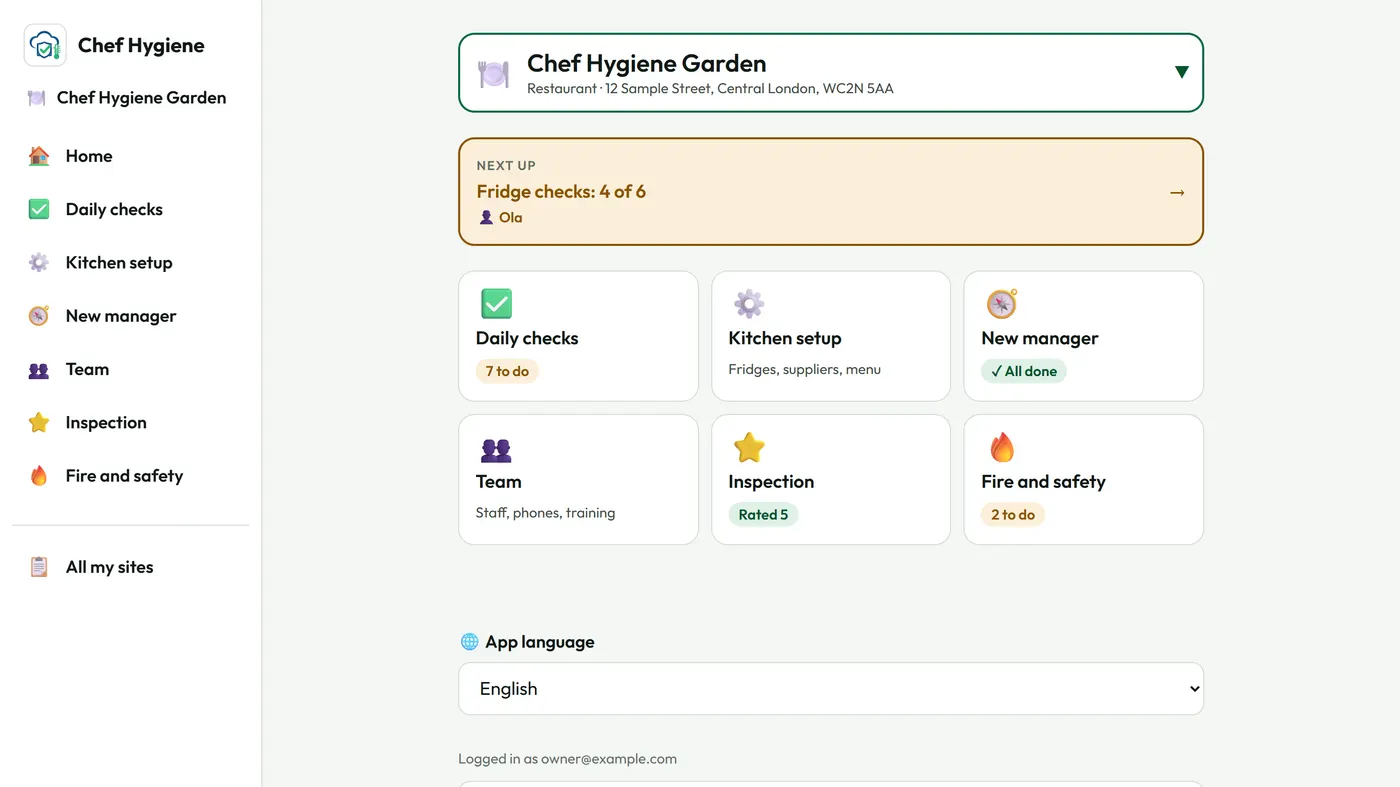
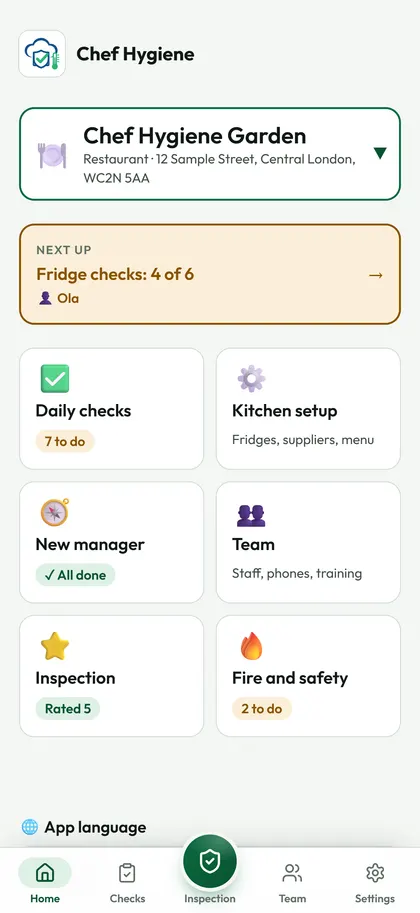
The app loads these rules for your kitchen, checks your records against them and keeps proof for the inspector.
Other countries
 United Kingdom
 Ireland
 Iceland
 United States
 Canada
 France
 Spain
Spain Netherlands
 Portugal
 Germany
 Austria
 Poland
 Romania
 Italy
Italy Greece
 Denmark
 Switzerland
 Luxembourg
 Cyprus
 Malta
Malta Sweden
 Norway
 Finland
 Czechia
 Hungary
 Croatia
 Bulgaria
 Slovakia
 Slovenia
 Estonia
 Latvia
 Lithuania
 Liechtenstein
 San Marino
 Gibraltar
 Monaco
 Moldova
 Andorra
 Serbia
 Jersey
 Guernsey
 Isle of Man
 Türkiye
 Montenegro
 Bosnia & Herzegovina
 Kosovo
 Albania
 North Macedonia
 Ukraine