 Włochy: dla restauracji i dań na wynos
Gotowi na kontrolę żywności. Codziennie.
In Italy the app follows EU Regulation 852/2004, the allergen decree D.Lgs. 231/2017 and the guidance of the regions and local health authorities (ASL); the ASL food hygiene service (SIAN) inspects.
14 dni za darmo · jedna cena za witrynę · bez umowy
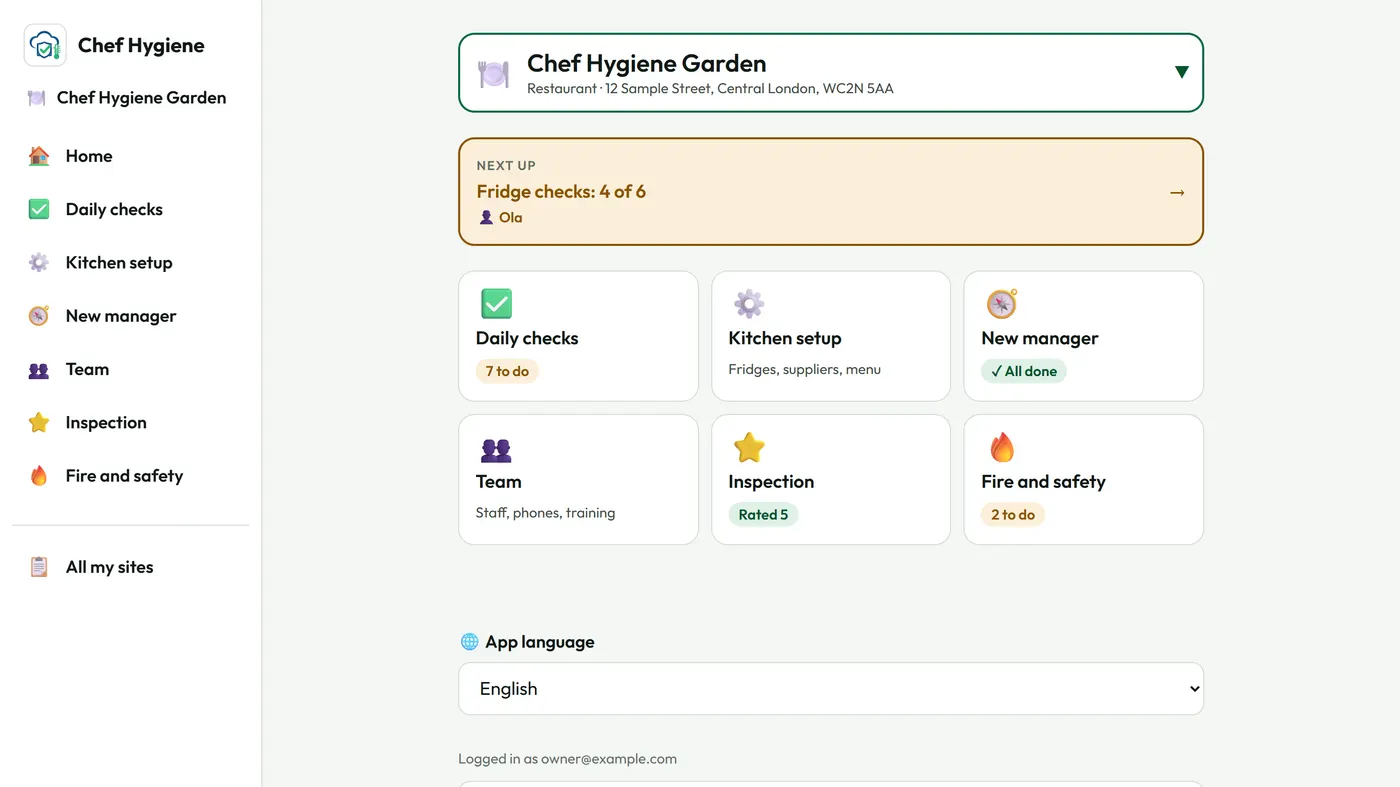
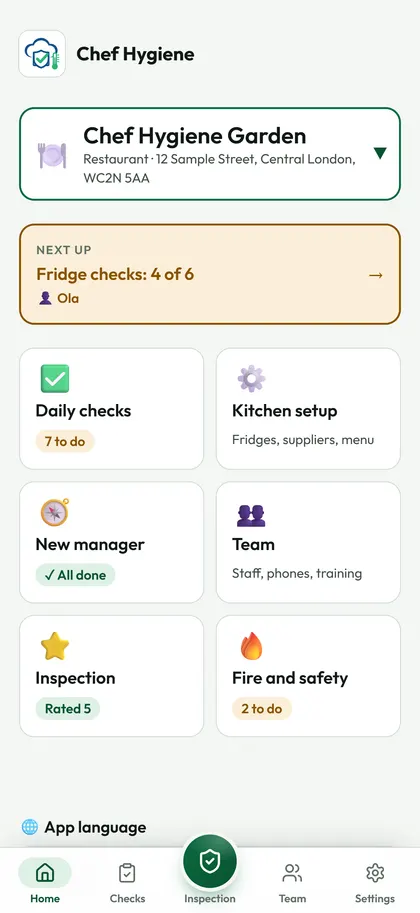
Włochy: zasady higieny żywności
Zasady na tej stronie są na razie po angielsku. Zostaną przetłumaczone na Twój język.
- Organ inspekcyjny
- Local health authority (ASL, Azienda Sanitaria Locale), food hygiene service SIAN
- Ocena publiczna
- NIE
- Języki w aplikacji
- Italiano, English
Twoja inspekcja
The local health authority (ASL) inspects restaurants through its food hygiene service (SIAN). It has other names in some regions: ATS in Lombardy, ULSS in Veneto and ASP in Sicily. The Carabinieri NAS, a health unit of the military police, can also inspect and tells the ASL what it finds.
Visits are based on risk. A new restaurant notifies the ASL through the town’s one-stop desk (SUAP). Fines include €1,500–9,000 for no registration, €500–3,000 for breaking hygiene rules and €1,000–6,000 for no HACCP-based procedures. The ASL can stop all or part of the business, and selling food in a bad state of preservation is a crime.
Ocena higieny
Italy has no public hygiene rating or sticker. Inspection results are not published for each business, and nothing has to be displayed.
„Prawo” to wiążąca reguła. „Oficjalne wytyczne” nie są prawem, ale inspektorzy ich oczekują. „Chef Hygiene domyślna” to wartość, którą aplikacja sprawdza, gdy żadna reguła nie podaje liczby.
Temperatury
- Oficjalne wytyczneChef Hygiene checks fridges against 4°C. Local health authorities use a cold chain of 4°C (AUSL Bologna) and 0–4°C (ATS Brianza). Older national rules, whose status is disputed since 2021, allow cooked food eaten cold and filled fresh pasta up to 10°C.
- PrawoQuick-frozen food: −18°C or colder in every part of the product, with short rises of up to 3°C in transport and display (D.Lgs. 110/1992, art. 4).
- Oficjalne wytyczneHot food: 60–65°C, and below 60°C it may not be served (Regione Veneto, 2021; older decree DPR 327/1980).
- Oficjalne wytyczneCooling: Italian and EU law only say to cool food as quickly as possible. Without a blast chiller (ATS Brianza, 2023) go from 65°C to 21°C within 2 hours, then to 5°C within 6 hours in all.
- Oficjalne wytyczneCooling with a blast chiller (Regione Veneto, 2021): 10°C in the centre within 2 hours of cooking, then 4°C within 2 more hours.
- Oficjalne wytyczneReheating: no law sets a number. The centre reaches 75°C (ATS Brianza); Regione Veneto says at least 70°C. Chef Hygiene warns on a reading below 75°C.
- Oficjalne wytyczneCooking: no law sets a core temperature. Regione Veneto gives 75°C in the centre as an example.
- PrawoDeliveries: suppliers must keep meat at 7°C or colder, offal 3°C, poultry 4°C, mince 2°C, meat preparations 4°C, and fish near melting ice (Regulation 853/2004). Chef Hygiene checks chilled deliveries against 4°C and flags frozen ones above −15°C.
- PrawoFish eaten raw or almost raw: freeze at −20°C or colder for at least 24 hours, or −35°C or colder for at least 15 hours (Regulation 853/2004).
Kadra, szkolenia i zdrowie
- PrawoItalian national law sets no food hygiene certificate, hours or renewal. The business must make sure staff are supervised and trained for their work (EU Regulation 852/2004). The old health booklet (libretto sanitario) ended in March 2021.
- PrawoEach region sets its own training rules. In Lombardy the business trains its own staff with no set hours. In Emilia-Romagna there has been no regional course since 26 July 2025.
- PrawoTuscany: everyone takes a 2-hour Module A; cooks, pizza makers and bartenders add a 4-hour Module B; owners and HACCP managers add an 8-hour Module C. Level 2 staff and managers do a 3-hour refresher every 5 years (regional decision DGR 540/2024).
- PrawoFire wardens trained by the employer: 4 hours (level 1) or 8 hours (level 2), with a refresher at least every 5 years. First aid staff repeat their training at least every 3 years.
- PrawoSick staff: anyone with a disease that can pass through food, infected wounds, skin infections or diarrhoea must not handle food, and must tell the business at once (EU Regulation 852/2004).
Alergeny
- PrawoThe 14 EU allergens: cereals with gluten, crustaceans, eggs, fish, peanuts, soybeans, milk, tree nuts, celery, mustard, sesame, sulphites, lupin and molluscs.
- PrawoFor each dish, show the allergens before it is served: on the menu, a register, a sign or a digital system kept in view. A digital system also needs the information on paper that the inspector and guests can easily find (D.Lgs. 231/2017, art. 19).
- PrawoOr put a notice on the menu, register or sign telling guests to ask staff. Written allergen sheets must then be easy to find for the inspector and guests. The information must be in Italian, clear and readable.
- PrawoFines: no allergen information €3,000–24,000; information given in the wrong way €1,000–8,000; formal faults only €500–4,000 (D.Lgs. 231/2017, art. 23).
Kontrole bezpieczeństwa pożarowego
- PrawoFire extinguisher checks and maintenance follow the technical standards and the maker’s instructions, and every check is recorded (decree DM 1 September 2021). The technician’s periodic check is every 6 months under standard UNI 9994-1; this is usual practice.
- PrawoThe earthing system and any lightning protection are checked every 5 years, or every 2 years in places at higher fire risk. The ASL, ARPA or an authorised body does it (DPR 462/2001, art. 4).
- PrawoGas boilers for heating or hot water get an efficiency check every 4 years (10–100 kW) or every 2 years (100 kW or more) (DPR 74/2013). No national law sets an interval for gas cooking appliances; a qualified installer fits them and maintenance follows the maker’s instructions.
- PrawoBars and restaurants do not need a fire prevention certificate. Attached activities do, for example a heat plant over 116 kW (DPR 151/2011).
- PrawoEvery employer does a fire risk assessment. An emergency plan is needed with 10 or more workers, or with more than 50 people present at once.
Dokumentacja
- PrawoYou must have self-check (autocontrollo) procedures based on HACCP principles (EU Regulation 852/2004, art. 5). Having none costs €1,000–6,000, and so does not applying them correctly (D.Lgs. 193/2007).
- Oficjalne wytyczneKeep temperature logs, cleaning logs, pest control reports, supplier and batch records, equipment maintenance records and staff training records.
- PrawoNo national keeping period exists. EU law says to keep records for an appropriate period. In Tuscany, a business that runs its own staff courses keeps the course papers at least 10 years.
Oficjalne źródła
- Ministry of Health (Ministero della Salute)
- Normattiva: Italian laws in force
- Fire brigade (Vigili del Fuoco)
- One-stop desk for businesses (SUAP)
- Carabinieri (NAS health unit)
Checked
Ta strona zawiera ogólne informacje, a nie porady prawne. Sprawdź w lokalnym urzędzie.
Włochy: Poradniki higieny żywności
Skonfiguruj Chef Hygiene
Utwórz konto, skonfiguruj wspólny tablet kuchenny i krok po kroku instaluj aplikację na telefonach swoich pracowników.
Włochy: inspekcje żywności
Kto sprawdza Twoją kuchnię, jak przebiega kontrola i czy istnieje ocena higieny publicznej.
Włochy: zasady dotyczące temperatury żywności
Temperatury żywności, które musi utrzymywać Twoja kuchnia, i zasady za nimi stojące.
Włochy: alergeny
Co Twoja kuchnia musi mówić klientom o alergenach.
Włochy: choroba personelu i szkolenie
Szkolenia, zasady postępowania z żywnością oraz sytuacje, w których chory personel musi trzymać się z daleka od żywności.
Włochy: bezpieczeństwo przeciwpożarowe
Kontrole bezpieczeństwa przeciwpożarowego Twojej kuchni i częstotliwość ich przeprowadzania.
Włochy: zapisy do przechowywania
Rejestry i rejestracje, które musi przechowywać Twoja kuchnia.
Włochy: aplikacja Chef Hygiene.
Aplikacja ładuje te zasady do Twojej kuchni, sprawdza je pod kątem zgodności z zapisami i zachowuje dowód dla inspektora.
Inne kraje
 Wielka Brytania
 Irlandia
 Islandia
 Stany Zjednoczone
 Kanada
 Francja
 Hiszpania
 Holandia
 Belgia
 Portugalia
 Niemcy
 Austria
 Polska
 Rumunia
 Grecja
 Dania
Dania Szwajcaria
 Luksemburg
 Cypr
Cypr Malta
Malta Szwecja
 Norwegia
 Finlandia
 Czechy
 Węgry
Węgry Chorwacja
 Bułgaria
 Słowacja
 Słowenia
 Estonia
 Łotwa
Łotwa Litwa
Litwa Liechtenstein
 San Marino
 Gibraltar
 Monako
 Mołdawia
 Andora
 Serbia
 Jersey
 Guernsey
 Wyspa Man
 Turcja
 Czarnogóra
 Bośnia i Hercegowina
 Kosowo
 Albania
 Macedonia Północna
 Ukraina