 Cypr: dla restauracji i dań na wynos
Gotowi na kontrolę żywności. Codziennie.
In the Republic of Cyprus the app follows EU Regulation 852/2004, the Hygiene Regulations (Κ.Δ.Π. 320/2006) and the Public Health Services hygiene guides; the Public Health Services inspect, and there is no public rating.
14 dni za darmo · jedna cena za witrynę · bez umowy
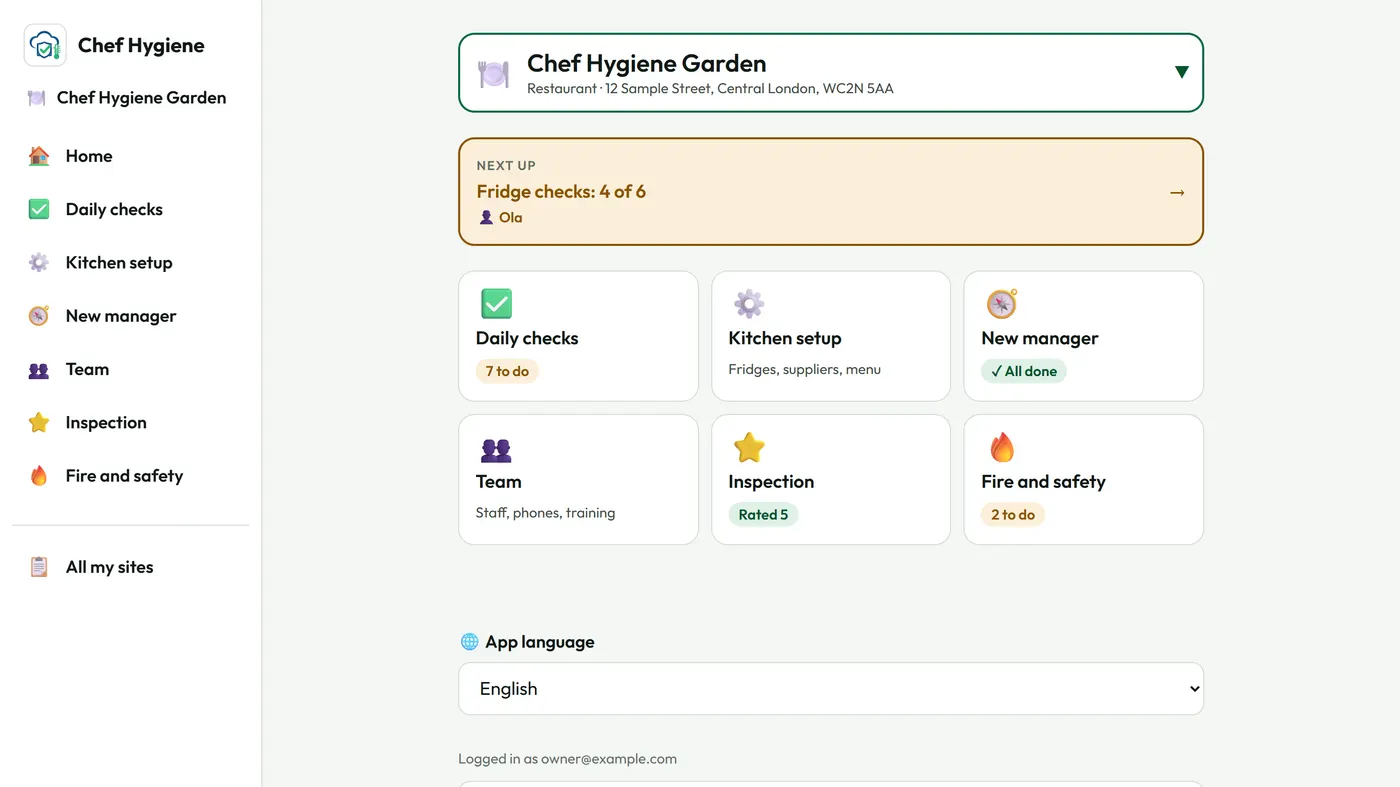
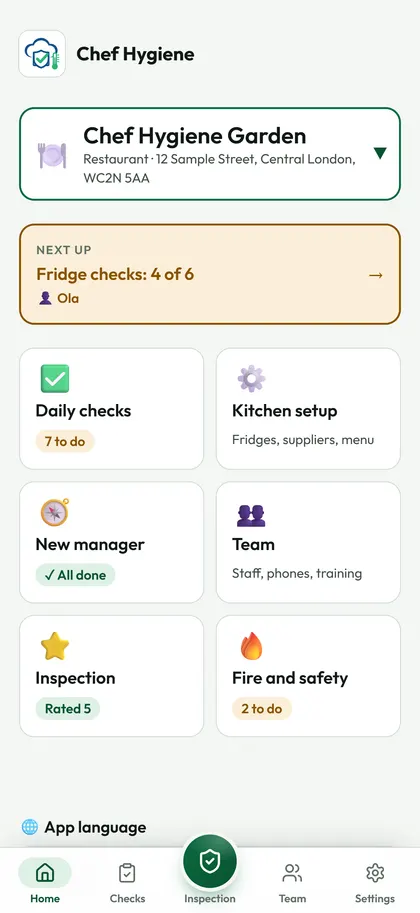
Cypr: zasady higieny żywności
Zasady na tej stronie są na razie po angielsku. Zostaną przetłumaczone na Twój język.
- Organ inspekcyjny
- Public Health Services of the Ministry of Health (Υγειονομικές Υπηρεσίες)
- Ocena publiczna
- NIE
- Języki w aplikacji
- Ελληνικά, English
Twoja inspekcja
The Public Health Services (Υγειονομικές Υπηρεσίες) of the Ministry of Health inspect restaurants through five district offices. Some municipal health services may inspect in their own area under Law 54(I)/1996. The Deputy Ministry of Tourism licenses restaurants under Law 29/1985, and its officers also check cleanliness.
Inspections are risk-based. Eleven risk factors give a category from 1 to 4, and the category is the number of full inspections a year. Seasonal businesses get fewer. The inspector can give written instructions, take samples, seize food, and suspend a business for up to 4 days, renewable. Administrative fines can reach €854 a day, and a court can fine, close the premises and ban trading (Law 54(I)/1996). You can object to a suspension or seizure within 3 working days.
Ocena higieny
Cyprus has no public hygiene rating, grade or sticker, and nothing has to be displayed. The Tourism classes A, B and C describe the building and service, not hygiene.
„Prawo” to wiążąca reguła. „Oficjalne wytyczne” nie są prawem, ale inspektorzy ich oczekują. „Chef Hygiene domyślna” to wartość, którą aplikacja sprawdza, gdy żadna reguła nie podaje liczby.
Temperatury
- Oficjalne wytyczneNo Cyprus law sets fridge, hot-holding, cooling or reheating numbers for restaurants. The numbers below come from the Public Health Services Hygiene Guide No 1 (2nd edition) and its HACCP plan for small businesses.
- Oficjalne wytyczneGuide No 1: chilled food, and raw meat, poultry and fish, at 5°C or below. The small-business plan sets a critical limit of 7°C. Chef Hygiene aims for 5°C and warns above 7°C. Cakes and pastries: 8°C at most.
- PrawoQuick-frozen food must be at −18°C or colder. Brief rises of up to 3°C are allowed in transport and display (Κ.Δ.Π. 80/2002, reg. 6). Guide: never refreeze; ice cream on display at −14°C or colder.
- Oficjalne wytyczneGuide No 1: cook to 75°C in the centre, or 70°C for 2 minutes. Pork and burgers: 68,3°C for 15 seconds. Frying oil never above 180°C.
- Oficjalne wytyczneGuide No 1: keep hot food at 60°C or more. Below 60°C is allowed once, for serving only. The small-business plan says above 63°C.
- Oficjalne wytyczneGuide No 1 for food between 5°C and 60°C: under 2 hours, chill it or eat it. From 2 to 4 hours, eat it at once. Over 4 hours, throw it away.
- Oficjalne wytyczneGuide No 1: cool from 60°C to 10°C within 2 hours, never over 3 hours, then keep at 5°C or below.
- Oficjalne wytyczneGuide No 1: reheat to above 75°C in the centre. No time limit is given.
- Oficjalne wytyczneGuide No 1: thaw in the fridge at 5°C or below, or under running drinking water at 21°C or below for at most 3 hours.
Kadra, szkolenia i zdrowie
- PrawoEveryone who touches open food needs a health certificate from a government Chief Medical Officer, renewed every 12 months. It includes a stool test for Salmonella and parasites (Κ.Δ.Π. 320/2006). Keep it ready for inspectors.
- PrawoStaff who are ill tell the manager, and the manager tells the district Chief Medical Officer at once. They return to work only when that officer decides. There is no fixed number of days off (Κ.Δ.Π. 320/2006).
- PrawoStaff who handle open food keep themselves clean, cover wounds with a waterproof dressing, do not smoke or spit, and wear a white coat and a head covering (Κ.Δ.Π. 320/2006).
- Oficjalne wytyczneGuide No 1: all staff do Level 1 at hiring (read the Ministry’s hygiene handbook and sign a statement). Owners, managers and staff who prepare food do Level 2, a 30-hour course. No legal course or renewal is set.
- PrawoStaff must be supervised and trained to suit their job (Regulation 852/2004, Annex II).
Alergeny
- PrawoGive information on the 14 EU allergens for food served or sold loose (Regulation 1169/2011, art. 44).
- Oficjalne wytycznePublic Health Services: loose food gives the information through labelling, and the minimum is the allergenic ingredients. Chef Hygiene asks for a written list per dish and an “ask staff” sign.
- PrawoAll food information must be in Greek. Other languages may be added (Κ.Δ.Π. 262/2002, reg. 5).
- PrawoFor phone and online orders, give the information before ordering and again at delivery, in Greek (Regulation 1169/2011, art. 14).
Kontrole bezpieczeństwa pożarowego
- Oficjalne wytyczneExtinguishers: the owner checks at least every 3 months and writes it down. A qualified firm services them every year (Κ.Δ.Π. 520/2014 code of practice).
- PrawoLPG installations must be inspected by an approved gas installation inspector: every 6 years for 4 or more linked cylinders or up to 500 kg, every 5 years for 500 to 2,000 kg or food trucks, every 4 years above 2,000 kg or for tanks (Κ.Δ.Π. 189/2021). Storage of up to 200 kg and one cylinder joined straight to one appliance are exempt.
- PrawoThe employer must have an emergency plan and name, train and record staff for first aid, fire fighting and evacuation. Fire equipment and alarms are tested by a competent person.
- PrawoElectrical installations over 150 kVA need a registered maintainer and a register (Κ.Δ.Π. 78/2022). No fixed interval was found for smaller sites. No legal hood cleaning interval was found.
Dokumentacja
- PrawoHACCP-based procedures with records that fit the size of the business are required (Regulation 852/2004, art. 5).
- Oficjalne wytycznePublic Health Services small-business plan: keep records of suppliers and goods-in, fridge and freezer temperatures (2–3 times a day), cooking and reheating, hot and cold display, water and ice tests, staff health certificates, cleaning, pest control with a bait map, equipment upkeep and staff training. Review the plan 1–2 times a year.
- PrawoPest control by a licensed operator is required for professional biocide work (Κ.Δ.Π. 145/2019). Keep records and a bait map.
Oficjalne źródła
- Public Health Services, Ministry of Health
- Hygiene Regulations Κ.Δ.Π. 320/2006, CyLaw
- Food (Control and Sale) Law 54(I)/1996, CyLaw
- PHS Hygiene Guide No 1
- Business in Cyprus, restaurant licence
Checked
Ta strona zawiera ogólne informacje, a nie porady prawne. Sprawdź w lokalnym urzędzie.
Cypr: Poradniki higieny żywności
Skonfiguruj Chef Hygiene
Utwórz konto, skonfiguruj wspólny tablet kuchenny i krok po kroku instaluj aplikację na telefonach swoich pracowników.
Cypr: inspekcje żywności
Kto sprawdza Twoją kuchnię, jak przebiega kontrola i czy istnieje ocena higieny publicznej.
Cypr: zasady dotyczące temperatury żywności
Temperatury żywności, które musi utrzymywać Twoja kuchnia, i zasady za nimi stojące.
Cypr: alergeny
Co Twoja kuchnia musi mówić klientom o alergenach.
Cypr: choroba personelu i szkolenie
Szkolenia, zasady postępowania z żywnością oraz sytuacje, w których chory personel musi trzymać się z daleka od żywności.
Cypr: bezpieczeństwo przeciwpożarowe
Kontrole bezpieczeństwa przeciwpożarowego Twojej kuchni i częstotliwość ich przeprowadzania.
Cypr: zapisy do przechowywania
Rejestry i rejestracje, które musi przechowywać Twoja kuchnia.
Cypr: aplikacja Chef Hygiene.
Aplikacja ładuje te zasady do Twojej kuchni, sprawdza je pod kątem zgodności z zapisami i zachowuje dowód dla inspektora.
Inne kraje
 Wielka Brytania
 Irlandia
 Islandia
 Stany Zjednoczone
 Kanada
 Francja
 Hiszpania
 Holandia
 Belgia
 Portugalia
 Niemcy
 Austria
 Polska
 Rumunia
 Włochy
 Grecja
 Dania
Dania Szwajcaria
 Luksemburg
 Malta
Malta Szwecja
 Norwegia
 Finlandia
 Czechy
 Węgry
Węgry Chorwacja
 Bułgaria
 Słowacja
 Słowenia
 Estonia
 Łotwa
Łotwa Litwa
Litwa Liechtenstein
 San Marino
 Gibraltar
 Monako
 Mołdawia
 Andora
 Serbia
 Jersey
 Guernsey
 Wyspa Man
 Turcja
 Czarnogóra
 Bośnia i Hercegowina
 Kosowo
 Albania
 Macedonia Północna
 Ukraina