 Stany Zjednoczone: dla restauracji i dań na wynos
Gotowi na kontrolę żywności. Codziennie.
In the United States the app follows the FDA Food Code as your state adopted it (editions from 2005 to 2022), with your state’s own changes. Your state, county or city health department inspects.
14 dni za darmo · jedna cena za witrynę · bez umowy
Stany Zjednoczone: zasady higieny żywności
Zasady na tej stronie są na razie po angielsku. Zostaną przetłumaczone na Twój język.
- Organ inspekcyjny
- State, county or city health department (the FDA publishes the model Food Code that states adopt)
- Ocena publiczna
- W niektórych miejscach
- Języki w aplikacji
- English
Twoja inspekcja
The FDA Food Code is a model, not a federal law. States adopt it in full or with changes, and a state, county or city health department inspects restaurants. The USDA covers meat, poultry and some egg products only. The local fire marshal or fire department checks fire safety.
Most inspections are not announced. The inspector can come at any reasonable time when you are open and checks your food against the Food Code edition your state adopted. You get a copy of the report. Rules differ by state, county and city.
Ocena higieny
There is no national grade. Some places post scores, letter grades or placards online or in the window. For example, New York City uses A, B or C, Louisiana uses a 1–5 pelican rating, and Texas has no statewide grades.
„Prawo” to wiążąca reguła. „Oficjalne wytyczne” nie są prawem, ale inspektorzy ich oczekują. „Chef Hygiene domyślna” to wartość, którą aplikacja sprawdza, gdy żadna reguła nie podaje liczby.
Temperatury
- PrawoCold holding: 41°F (5°C) or below. Hot holding: 135°F (57°C) or above. Roasts cooked as the Food Code allows may be held at 130°F (54°C) (Food Code 3-501.16).
- PrawoCooking for 15 seconds: 165°F (74°C) for poultry, stuffed food and wild game; 145°F (63°C) for fish, whole cuts of meat and eggs cooked to order for immediate service (Food Code 3-401.11).
- PrawoGround meat and fish, and non-intact meat: 155°F (68°C) for 17 seconds. Equal options are 150°F (66°C) for 1 minute, 158°F (70°C) for under a second, or 145°F (63°C) for 3 minutes.
- PrawoReheating for hot holding: 165°F (74°C) for 15 seconds, within 2 hours. In a microwave, reach 165°F (74°C), stir, cover and stand for 2 minutes (Food Code 3-403.11).
- PrawoCooling: from 135°F (57°C) to 70°F (21°C) within 2 hours, then to 41°F (5°C) or below within 6 hours in total. Food made from room-temperature ingredients must reach 41°F (5°C) within 4 hours (Food Code 3-501.14).
- PrawoDate marking: ready-to-eat food that needs temperature control and is kept more than 24 hours must carry a consume-or-discard date. The limit is 7 days at 41°F (5°C) or below, and the day it is made counts as day 1 (Food Code 3-501.17).
- PrawoTime as a public health control needs written procedures. Food can stay out for up to 4 hours, then it is thrown away. Cold food starts at 41°F (5°C) or below, and hot food at 135°F (57°C) or above. Cold food only: up to 6 hours if it never goes above 70°F (21°C) (Food Code 3-501.19).
- PrawoThaw in the fridge, under cold running water at 70°F (21°C) or below, in a microwave and then cook at once, or as part of cooking. Food thermometers must be accurate to ±2°F (±1°C).
- PrawoSome places differ. New York State outside the city: cold 45°F (7°C), hot 140°F (60°C). New York City: hot 140°F (60°C). South Dakota: hot 140°F (60°C). Vermont cools in one stage, 135°F (57°C) to 41°F (5°C) within 4 hours.
Kadra, szkolenia i zdrowie
- PrawoFood Code 2022: the person in charge must be a Certified Food Protection Manager (CFPM), unless the regulator treats the place as minimal risk. Older editions ask for at least one CFPM. States differ, and Hawaii did not adopt the 2022 rule.
- PrawoStaff must report these symptoms: vomiting, diarrhea, jaundice, sore throat with fever, and infected cuts or boils.
- PrawoStaff must also report these diagnoses: norovirus, hepatitis A, Shigella, Shiga toxin-producing E. coli, typhoid fever and nontyphoidal Salmonella.
- Chef Hygiene domyślneFood handler cards are needed where your state or city asks for them. Chef Hygiene suggests a renewal date: a manager certificate lasts up to 5 years and a food handler card usually 2 or 3 years.
Alergeny
- PrawoUS law lists 9 major food allergens: milk, eggs, fish, crustacean shellfish, tree nuts, peanuts, wheat, soybeans and sesame. Sesame has been included since 1 January 2023 (FASTER Act).
- PrawoThe menu must tell customers about raw or undercooked animal foods and remind them of the risk (Food Code 3-603.11, consumer advisory).
Kontrole bezpieczeństwa pożarowego
- Oficjalne wytyczneNFPA 96 hood inspections depend on the cooking: monthly for solid fuel (wood or charcoal), quarterly for high volume, every 6 months for moderate volume, and yearly for low volume. Many states and cities adopt NFPA 96 in their fire code.
- Oficjalne wytyczneClean the hood system whenever an inspection finds grease build-up. Keep a certificate on site that shows the date, the company and any areas not cleaned.
- Oficjalne wytyczneExtinguishers that protect cooking appliances using vegetable or animal oils and fats must be listed for Class K fires (NFPA 10).
- Oficjalne wytyczneInternational Fire Code: commercial cooking that makes grease-laden vapors needs an automatic fire-extinguishing system (UL 300). Its manual pull station sits on the way out, 10 to 20 feet from the hood.
- Chef Hygiene domyślneChef Hygiene checks that the hood’s fire suppression system is inspected every 6 months.
Dokumentacja
- PrawoOSHA: report a death within 8 hours, and an in-patient hospital stay, an amputation or the loss of an eye within 24 hours. Call 1-800-321-6742 or use osha.gov/report.
- PrawoFull-service restaurants and limited-service eating places are partly exempt from keeping OSHA injury and illness records, but must still report the severe events above.
- PrawoSome states run their own OSHA State Plan that covers private businesses, for example California and Oregon. A restaurant there deals with the state plan. In other states, restaurants are under federal OSHA.
- PrawoTime as a public health control needs written procedures, and ready-to-eat food kept more than 24 hours needs a consume-or-discard date mark (Food Code 3-501.19 and 3-501.17).
Oficjalne źródła
- FDA Food Code 2022
- FDA: Food Code adoption by states
- OSHA: report a fatality or severe injury
- OSHA State Plans
- NFPA 96 (kitchen hood cleaning)
Checked
Ta strona zawiera ogólne informacje, a nie porady prawne. Sprawdź w lokalnym urzędzie.
Stany Zjednoczone: Poradniki higieny żywności
Skonfiguruj Chef Hygiene
Utwórz konto, skonfiguruj wspólny tablet kuchenny i krok po kroku instaluj aplikację na telefonach swoich pracowników.
Stany Zjednoczone: inspekcje żywności
Kto sprawdza Twoją kuchnię, jak przebiega kontrola i czy istnieje ocena higieny publicznej.
Stany Zjednoczone: zasady dotyczące temperatury żywności
Temperatury żywności, które musi utrzymywać Twoja kuchnia, i zasady za nimi stojące.
Stany Zjednoczone: alergeny
Co Twoja kuchnia musi mówić klientom o alergenach.
Stany Zjednoczone: choroba personelu i szkolenie
Szkolenia, zasady postępowania z żywnością oraz sytuacje, w których chory personel musi trzymać się z daleka od żywności.
Stany Zjednoczone: bezpieczeństwo przeciwpożarowe
Kontrole bezpieczeństwa przeciwpożarowego Twojej kuchni i częstotliwość ich przeprowadzania.
Stany Zjednoczone: zapisy do przechowywania
Rejestry i rejestracje, które musi przechowywać Twoja kuchnia.
Stany Zjednoczone: aplikacja Chef Hygiene.
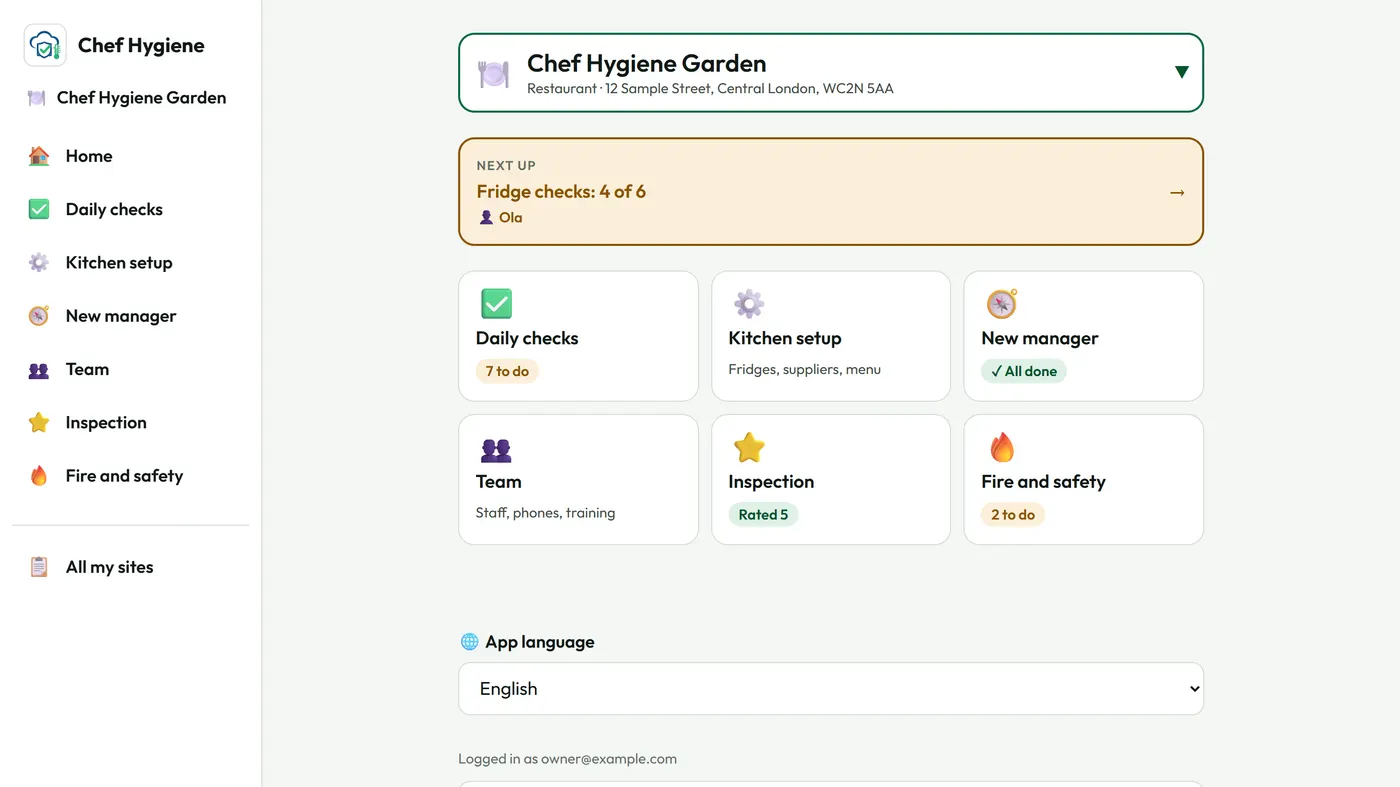
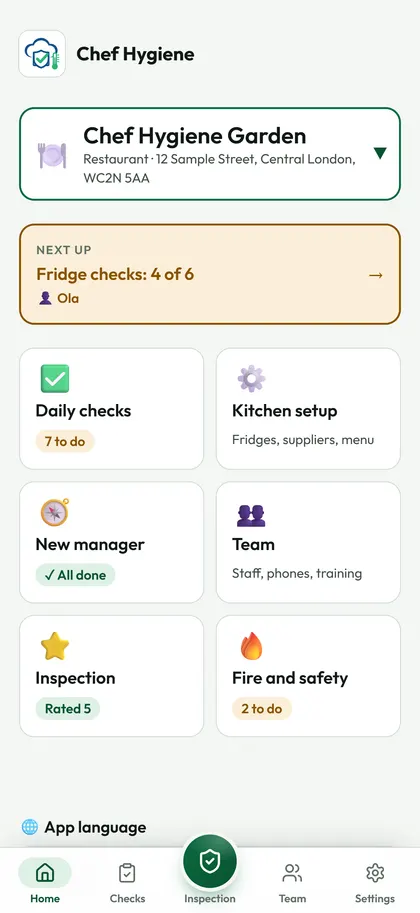
Aplikacja ładuje te zasady do Twojej kuchni, sprawdza je pod kątem zgodności z zapisami i zachowuje dowód dla inspektora.
Inne kraje
 Wielka Brytania
 Irlandia
 Islandia
 Kanada
 Francja
 Hiszpania
 Holandia
 Belgia
 Portugalia
 Niemcy
 Austria
 Polska
 Rumunia
 Włochy
 Grecja
 Dania
Dania Szwajcaria
 Luksemburg
 Cypr
Cypr Malta
Malta Szwecja
 Norwegia
 Finlandia
 Czechy
 Węgry
Węgry Chorwacja
 Bułgaria
 Słowacja
 Słowenia
 Estonia
 Łotwa
Łotwa Litwa
Litwa Liechtenstein
 San Marino
 Gibraltar
 Monako
 Mołdawia
 Andora
 Serbia
 Jersey
 Guernsey
 Wyspa Man
 Turcja
 Czarnogóra
 Bośnia i Hercegowina
 Kosowo
 Albania
 Macedonia Północna
 Ukraina